
As I observed the dusty test range, a four-foot-long drone crept slowly across the terrain, its movements tracked on the targeting screen inside an armored vehicle. With a press of a button, the 30mm autocannon engaged, and the drone erupted into a fireball. This scene, from a recent evaluation of an emerging anti-drone system, underscored the rapid advancements in counter-unmanned aerial vehicle technologies. The integration of such systems onto platforms like the Stryker vehicle marks a significant leap in the “sensor-to-shooter” paradigm, aiming to neutralize the growing threat posed by drone swarms and autonomous systems. In this article, I will delve into the technical intricacies, operational challenges, and future directions of anti-drone warfare, drawing from firsthand insights and broader industry developments.
The proliferation of drones, especially small, commercially available models, has revolutionized modern battlefields. These systems offer low-cost intelligence, surveillance, reconnaissance (ISR), and even attack capabilities, making them a pervasive threat. Militaries worldwide are prioritizing anti-drone solutions to protect troops and infrastructure. The challenge escalates with drone swarms—coordinated groups of UAVs that can overwhelm traditional defenses through sheer numbers and decentralized operations. For instance, if a swarm of ten drones attacks, even if seven are destroyed, the remaining three can complete the mission. This asymmetry drives innovation in anti-drone technologies, focusing on both kinetic and non-kinetic approaches.
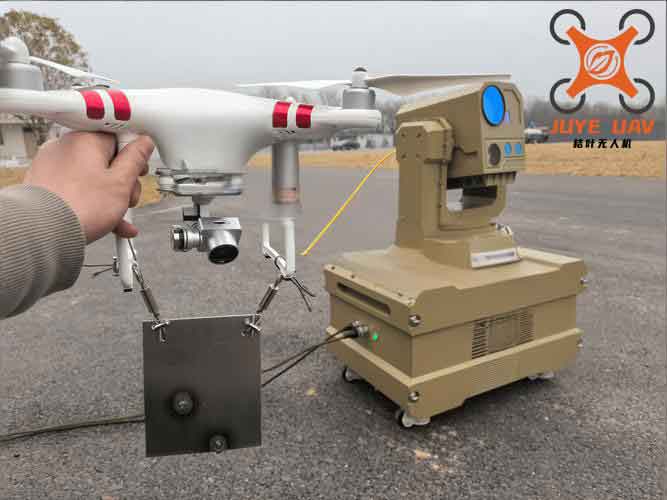
To understand the anti-drone ecosystem, consider the core components of a typical system, such as the one I witnessed during testing. It integrates sensors, effectors, and command-and-control elements onto a mobile platform. Below is a table summarizing key subsystems and their functions:
| Subsystem | Function | Key Technologies |
|---|---|---|
| Detection Radar | Identifies and tracks UAVs via radio waves | Active electronically scanned array (AESA), pulse-Doppler |
| Electro-Optical/Infrared (EO/IR) Sensors | Provides visual confirmation and targeting data | High-resolution cameras, thermal imaging |
| Electronic Warfare (EW) Suite | Jams or spoofs drone communications and navigation | Radio frequency (RF) jammers, GPS disruptors |
| Kinetic Effector | Physically destroys threats with projectiles or energy | Autocannons, missiles, high-energy lasers |
| Command and Control (C2) | Fuses sensor data and coordinates engagement | AI algorithms, software-defined radios |
The synergy of these elements enables a robust anti-drone capability. For example, the detection radar can pinpoint a drone’s location using the radar range equation, which governs the maximum distance at which a target can be detected. This is expressed as:
$$R_{max} = \sqrt[4]{\frac{P_t G_t G_r \lambda^2 \sigma}{(4\pi)^3 P_{min}}}$$
Where \(R_{max}\) is the maximum detection range, \(P_t\) is the transmitter power, \(G_t\) and \(G_r\) are the antenna gains, \(\lambda\) is the wavelength, \(\sigma\) is the target’s radar cross-section (RCS), and \(P_{min}\) is the minimum detectable signal. For small drones with low RCS (often below 0.01 m²), enhancing \(P_t\) and \(G_t\) is crucial, as seen in modern anti-drone radars. In my experience, these systems must adapt to cluttered environments where birds or debris can cause false alarms, necessitating advanced signal processing.
Once detected, the anti-drone system classifies the threat. I have seen algorithms that use machine learning to distinguish between drone types based on kinematic patterns and RF signatures. The probability of correct classification, \(P_{cc}\), can be modeled using Bayesian inference:
$$P_{cc} = \frac{P(x|C) P(C)}{P(x)}$$
Here, \(P(x|C)\) is the likelihood of observed data \(x\) given class \(C\) (e.g., quadcopter vs. fixed-wing), \(P(C)\) is the prior probability, and \(P(x)\) is the evidence. High \(P_{cc}\) values, often above 0.9, are essential for minimizing fratricide in dense airspace. This is particularly vital for anti-drone operations in urban settings, where collateral damage must be avoided.
Engagement involves either kinetic or non-kinetic means. Kinetic options, like autocannons, rely on fire-control systems to compute shooting solutions. The required lead angle, \(\theta\), for hitting a moving drone is derived from:
$$\theta = \arctan\left(\frac{v_d \sin(\phi)}{v_p + v_d \cos(\phi)}\right)$$
Where \(v_d\) is the drone velocity, \(v_p\) is the projectile speed, and \(\phi\) is the angle between the drone’s path and the line of sight. In tests, I noted that anti-drone systems use real-time updates from sensors to adjust \(\theta\), accounting for wind and atmospheric conditions. For swarm engagements, time-fuzed munitions that explode in proximity to multiple targets are effective. The fragmentation density, \(\rho_f\), at a distance \(r\) from burst point is:
$$\rho_f(r) = \frac{N_f}{4\pi r^2} e^{-\alpha r}$$
Here, \(N_f\) is the number of fragments, and \(\alpha\) is an attenuation coefficient. Such munitions create a “shotgun” effect, ideal for neutralizing close-proximity drones in a swarm—a key anti-drone tactic.
Non-kinetic solutions, especially electronic warfare, offer a soft-kill alternative. EW systems can be passive or active. Passive systems listen for drone RF emissions without revealing their presence, which is critical in contested environments. The detected signal strength, \(S\), follows the Friis transmission equation:
$$S = P_{tx} G_{tx} G_{rx} \left(\frac{\lambda}{4\pi d}\right)^2$$
Where \(P_{tx}\) is the transmitter power of the drone, \(G_{tx}\) and \(G_{rx}\) are the gains of the drone and EW antennas, \(\lambda\) is the wavelength, and \(d\) is the distance. By monitoring \(S\), passive anti-drone systems can geolocate threats and initiate jamming. Active systems, conversely, emit signals to disrupt drone controls. The jamming-to-signal ratio (J/S) required for effective disruption is:
$$\frac{J}{S} = \frac{P_j G_j}{P_d G_d} \left(\frac{d_d}{d_j}\right)^2$$
In this equation, \(P_j\) and \(G_j\) are the jammer’s power and gain, \(P_d\) and \(G_d\) are the drone’s equivalent parameters, and \(d_d\) and \(d_j\) are distances from the drone to its controller and jammer, respectively. High J/S ratios, often exceeding 20 dB, can commandeer or disable drones—a common anti-drone measure I have seen deployed against commercial UAVs.
The integration of these technologies onto vehicles like the Stryker enhances mobility and survivability. Below is a table comparing various anti-drone platforms and their capabilities:
| Platform Type | Detection Range | Engagement Options | Advantages for Anti-Drone Missions |
|---|---|---|---|
| Ground Vehicle (e.g., Stryker) | 5-10 km | Kinetic (guns, missiles), EW | Mobile, armored, can operate in forward areas |
| Static Emplacement | 10-20 km | EW, directed energy | Persistent coverage, higher power output |
| Handheld Systems | 1-2 km | EW, net guns | Portable, rapid deployment for infantry |
| Aerial Systems (e.g., UAV interceptors) | 2-5 km | Collision, EW | Ability to engage at altitude, counter-swarm tactics |
In my observations, the Stryker-based anti-drone system exemplifies this integration. Its mast-mounted sensors provide a 360-degree view, while the fire-control computer fuses data to present a unified track. The operator interface, with joysticks and screens, allows for seamless targeting. During a demonstration, I watched as the system tracked multiple drones simultaneously, prioritizing threats based on speed and proximity—a testament to its AI-driven C2. This capability is vital for countering swarms, where decision-making must occur in seconds.
The mathematics behind sensor fusion is intricate. For instance, Kalman filtering combines radar and EO/IR data to estimate a drone’s state vector \(\mathbf{x} = [x, y, z, \dot{x}, \dot{y}, \dot{z}]^T\), representing position and velocity. The update equation is:
$$\mathbf{\hat{x}}_{k|k} = \mathbf{\hat{x}}_{k|k-1} + \mathbf{K}_k (\mathbf{z}_k – \mathbf{H} \mathbf{\hat{x}}_{k|k-1})$$
Here, \(\mathbf{\hat{x}}_{k|k}\) is the updated estimate at time \(k\), \(\mathbf{K}_k\) is the Kalman gain, \(\mathbf{z}_k\) is the measurement, and \(\mathbf{H}\) is the observation matrix. This fusion reduces uncertainty, enabling precise targeting for anti-drone engagements. In practice, I have seen covariance ellipses shrink by over 50% when multiple sensors are used, greatly improving hit probabilities.
Looking ahead, anti-drone technology will evolve with advances in AI and directed energy. Laser systems, for example, offer speed-of-light engagement with low cost per shot. The required power density, \(I\), on target for damage is given by:
$$I = \frac{P_l}{\pi r_b^2} e^{-\beta R}$$
Where \(P_l\) is laser power, \(r_b\) is beam radius at the target, \(\beta\) is atmospheric attenuation coefficient, and \(R\) is range. Current systems require tens of kilowatts to burn through drone skins, but improvements in beam control may lower this. Additionally, microwave weapons can disable drone electronics over wide areas, using the field strength \(E\):
$$E = \frac{\sqrt{30 P_m G_m}}{d}$$
Here, \(P_m\) is microwave power, \(G_m\) is antenna gain, and \(d\) is distance. Such non-kinetic tools are becoming integral to layered anti-drone defenses.
However, challenges remain. Drone swarms can employ adaptive tactics, like frequency hopping or autonomous navigation, to evade jamming. The effectiveness of an anti-drone system against a swarm can be modeled as a Lanchester-type equation for modern combat:
$$\frac{dD}{dt} = -\alpha A D, \quad \frac{dA}{dt} = -\beta D A$$
Where \(D\) is the number of drones, \(A\) is the number of anti-drone units, and \(\alpha, \beta\) are attrition coefficients. Solutions show that to defeat a large swarm, \(A\) must have superior detection and engagement rates—a driver for developing autonomous counter-swarm systems. In my view, combining kinetic and non-kinetic methods in a network-centric architecture will be key. For example, one unit might jam communications while another launches interceptors, all coordinated by a central AI.
The strategic implications are profound. As drones become cheaper and more capable, anti-drone measures must scale accordingly. I recall discussions where experts emphasized the need for standardized protocols to share tracking data across forces, akin to air defense networks. This interoperability can be quantified using information theory metrics, such as mutual information \(I(X;Y)\) between sensors:
$$I(X;Y) = \sum_{x \in X} \sum_{y \in Y} p(x,y) \log \frac{p(x,y)}{p(x)p(y)}$$
High \(I(X;Y)\) values indicate effective data sharing, enhancing situational awareness for anti-drone operations. Moreover, international regulations on drone use will shape anti-drone development, potentially limiting certain EW techniques to avoid collateral interference.
In conclusion, the anti-drone domain is dynamic and critical for future security. From my perspective, the integration of multi-sensor systems, advanced algorithms, and versatile effectors onto mobile platforms represents a paradigm shift. The Stryker-based system I observed is just one example of how militaries are adapting to the drone threat. As technology matures, we will see more compact, powerful, and autonomous anti-drone solutions capable of protecting assets from swarms and sophisticated UAVs. The continuous iteration of these systems, driven by real-world testing and mathematical optimization, ensures that anti-drone capabilities will remain at the forefront of defense innovation for years to come.
To encapsulate key parameters, here is a table of typical performance metrics for modern anti-drone systems:
| Metric | Typical Value | Notes |
|---|---|---|
| Detection Range for Small Drones | 3-8 km | Depends on RCS and radar power |
| Engagement Time (from detection to kill) | 5-15 seconds | Shorter for directed energy, longer for missiles |
| Simultaneous Tracks | 10-50 targets | AI-enhanced for swarm scenarios |
| EW Jamming Range | 1-5 km | Varies with frequency and power |
| System Mobility | Up to 100 km/h on roads | For vehicle-mounted systems |
| Power Consumption | 5-20 kW | Higher for lasers and active radars |
This comprehensive approach to anti-drone defense, blending hardware, software, and doctrine, will define success in countering unmanned threats. As I reflect on the tests and developments, it is clear that the journey toward robust anti-drone capabilities is ongoing, with each advancement bringing us closer to neutralizing the challenges posed by agile and numerous UAVs.