
As an observer and analyst in the field of advanced aerial systems, I have closely followed the progression of vertical take-off and landing (VTOL) technology, particularly in the realm of unmanned aerial vehicles (UAVs). The concept of a modular VTOL drone represents a significant leap forward in military logistics and transport capabilities. Inspired by earlier projects like the “flying jeep,” the development of systems such as the Aerial Reconfigurable Embedded System (ARES) highlights a transformative approach to cargo delivery and battlefield support. In this article, I will delve into the technical intricacies, historical context, and future prospects of modular VTOL drones, emphasizing their design principles, performance metrics, and potential applications. Throughout this discussion, the term ‘VTOL drone’ will be frequently referenced to underscore its centrality in modern aerospace innovation.
The journey toward modular VTOL drones began with ambitious military initiatives aimed at enhancing mobility. One notable precursor was the exploration of a “flying jeep” concept, where ground vehicles were envisioned to integrate lift systems for autonomous ship-to-shore transfers. This idea, though challenging, laid the groundwork for rethinking transport paradigms. It evolved into the ARES project, which focuses on a modular, unmanned, and vertically deployable system. The core idea is to decouple the lift module from the payload capsule, allowing the VTOL drone to return to base after delivery, thereby increasing operational efficiency and reducing costs. This modularity is a key feature that distinguishes modern VTOL drones from traditional helicopters or fixed-wing UAVs.
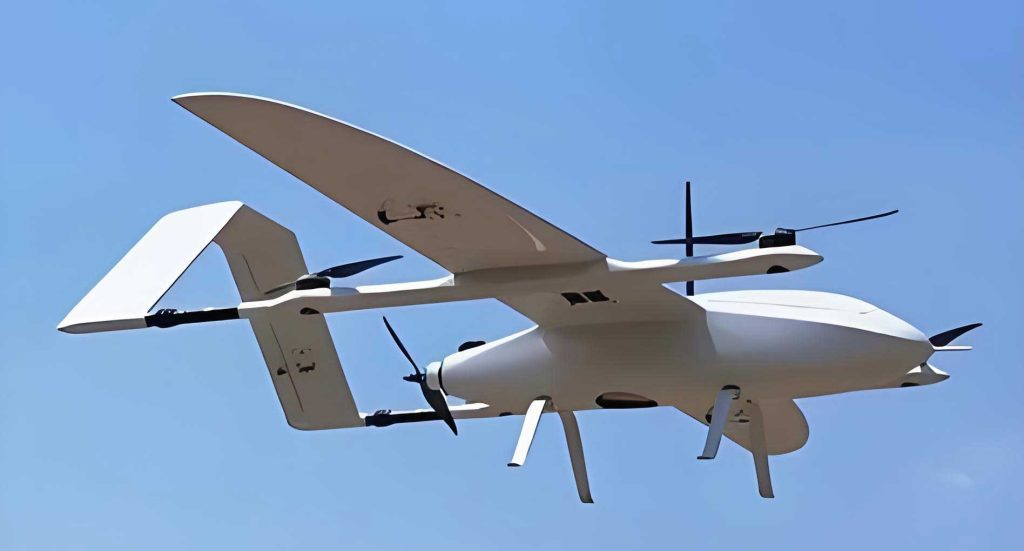
From a design perspective, the modular VTOL drone incorporates several innovative elements. The lift module typically features tiltable ducted fans, which provide thrust for both vertical ascent and forward flight. These fans are mounted on a central wing section, with high skid-type landing gear to accommodate the payload module underneath. The ducted configuration offers advantages in safety and compactness, as the shrouds protect ground personnel and allow for storage in confined spaces. Moreover, the flight control system employs fly-by-wire technology, leveraging control laws similar to those used in short take-off/vertical landing aircraft like the F-35B. This enables seamless transitions between hover, tilt, and cruise modes, a critical capability for a versatile VTOL drone.
To better understand the technical specifications, let’s examine some key parameters through tables and formulas. The following table summarizes the design characteristics of a typical modular VTOL drone, such as the ARES prototype:
| Parameter | Value | Description |
|---|---|---|
| Wingspan (deployed) | 42 feet | Span with wings unfolded for forward flight |
| Duct diameter | 8.5 feet | External diameter of the ducted fan assembly |
| Fan diameter | 7.5 feet | Diameter of the internal fan blades |
| Length (folded) | 30 feet | Storage length with wings folded |
| Width (folded) | 8.5 feet | Storage width for transportability |
| Engine type | Turboshaft | Typically two engines for redundancy and power |
| Control method | Fly-by-wire | Electronic flight control system for stability |
The aerodynamic performance of a VTOL drone can be analyzed using fundamental equations. For instance, the lift generated by the ducted fans during hover can be expressed as:
$$L = \frac{1}{2} \rho v^2 A C_L$$
where \(L\) is the lift force, \(\rho\) is the air density, \(v\) is the induced velocity through the fan, \(A\) is the fan disk area, and \(C_L\) is the lift coefficient specific to the ducted design. In forward flight, the thrust required for propulsion can be modeled as:
$$T = D + W \sin(\gamma)$$
with \(T\) being thrust, \(D\) the drag force, \(W\) the weight of the VTOL drone, and \(\gamma\) the flight path angle. These formulas highlight the interplay between vertical and horizontal modes, a challenge addressed by the modular VTOL drone’s adaptive control systems.
Another critical aspect is the modularity efficiency, which can be quantified through a cost-benefit analysis. Let’s define a metric for operational savings:
$$S = \frac{C_t – C_m}{C_t} \times 100\%$$
Here, \(S\) represents the percentage savings, \(C_t\) is the cost of traditional transport methods (e.g., manned helicopters), and \(C_m\) is the cost using a modular VTOL drone. Studies suggest that \(S\) can exceed 30% due to reduced manpower and fuel consumption. The table below compares a modular VTOL drone with conventional systems:
| System | Payload Capacity | Range | VTOL Capability | Modularity |
|---|---|---|---|---|
| Modular VTOL Drone | Up to 1,000 kg | 200 km | Yes | High (separate lift/payload) |
| Traditional Helicopter | 1,500 kg | 300 km | Yes | Low (integrated design) |
| Fixed-Wing UAV | 500 kg | 500 km | No | Medium (modular payloads) |
The development of a modular VTOL drone involves extensive testing and validation. For the ARES project, wind tunnel experiments using scaled models have been crucial. These tests simulate various flight conditions, measuring control efficiency and lift generation. The data collected often informs iterative design improvements, ensuring that the VTOL drone meets stringent performance standards. For example, the dynamic conversion control laws can be represented as a set of differential equations:
$$\dot{x} = A x + B u$$
where \(x\) is the state vector (e.g., position, velocity), \(u\) is the control input (e.g., fan pitch, duct orientation), and \(A\) and \(B\) are matrices derived from aerodynamic models. Solving these equations allows for stable transitions, a hallmark of an advanced VTOL drone.
Looking at current progress, the modular VTOL drone paradigm has gained traction due to its potential in military logistics. The success of earlier UAVs like the K-Max in cargo missions has paved the way for more sophisticated systems. ARES, as a next-generation VTOL drone, aims to demonstrate autonomous operations, including vertical take-off, delivery, and return of the lift module. This capability could revolutionize supply chains in contested environments, reducing exposure to threats. Moreover, the compact footprint of a ducted-fan VTOL drone minimizes landing zone requirements, a significant advantage in urban or rugged terrains.
From a broader perspective, the modular VTOL drone concept extends beyond military use. Civilian applications include disaster relief, medical supply delivery, and infrastructure inspection. The modular design allows for rapid reconfiguration—for instance, swapping a cargo capsule for a sensor package or medical pod. This versatility underscores the transformative potential of VTOL drones. To quantify this, consider a reliability model for a modular VTOL drone system:
$$R(t) = e^{-\lambda t}$$
where \(R(t)\) is the reliability over time \(t\), and \(\lambda\) is the failure rate. Modularity can reduce \(\lambda\) by enabling easier maintenance and component replacement, thus enhancing the overall robustness of the VTOL drone.
In terms of future directions, the modular VTOL drone ecosystem is poised for growth. Advances in materials science, such as lightweight composites, could further improve payload efficiency. Additionally, integration with artificial intelligence for autonomous navigation will enhance the operational scope of VTOL drones. The table below outlines potential upgrade paths:
| Technology Area | Impact on VTOL Drone | Expected Timeline |
|---|---|---|
| Advanced Batteries | Increased endurance and electric propulsion | 5-10 years |
| AI-Based Control | Fully autonomous missions in complex environments | 3-7 years |
| Swarm Coordination | Multiple VTOL drones operating collaboratively | 5-10 years |
| Noise Reduction | Stealthier operations for military and urban use | 2-5 years |
The economic implications are also substantial. A cost model for deploying a fleet of modular VTOL drones can be expressed as:
$$C_{total} = N \times (C_a + C_o) + C_i$$
with \(N\) being the number of VTOL drones, \(C_a\) the acquisition cost per unit, \(C_o\) the annual operating cost, and \(C_i\) the infrastructure investment. Modularity may lower \(C_a\) through standardized components, making the VTOL drone a cost-effective solution for large-scale logistics.
In conclusion, the evolution of the modular VTOL drone represents a convergence of aerospace engineering, robotics, and strategic thinking. From its origins in projects like the flying jeep to the sophisticated ARES system, this technology has demonstrated remarkable adaptability. The key lies in the modular architecture, which enables separation of lift and payload modules, fostering reusability and flexibility. As testing continues and new innovations emerge, the VTOL drone will likely become a cornerstone of modern transport systems, both in defense and civilian sectors. Its ability to operate in diverse conditions, coupled with ongoing advancements in control and efficiency, ensures that the modular VTOL drone will remain at the forefront of aerial innovation for years to come. Throughout this discourse, I have emphasized the centrality of the VTOL drone concept, and I anticipate that future developments will further solidify its role as a transformative tool in global logistics.