
As a researcher deeply immersed in the field of autonomous aerial systems, I have witnessed firsthand the remarkable transformation of military UAVs from mere support tools to pivotal assets in modern warfare. The term “military UAV” refers to an unmanned aerial vehicle that operates via radio control or pre-programmed autonomous flight, eliminating the need for an onboard pilot. This absence of a human crew allows for significant reductions in size, weight, and complexity, while enhancing mobility and cost-effectiveness. In this article, I will explore the multifaceted world of military UAVs, delving into their history, characteristics, missions, classifications, technological advancements, and future trajectories. Throughout, I will emphasize the growing dominance of the military UAV in contemporary and future combat scenarios.
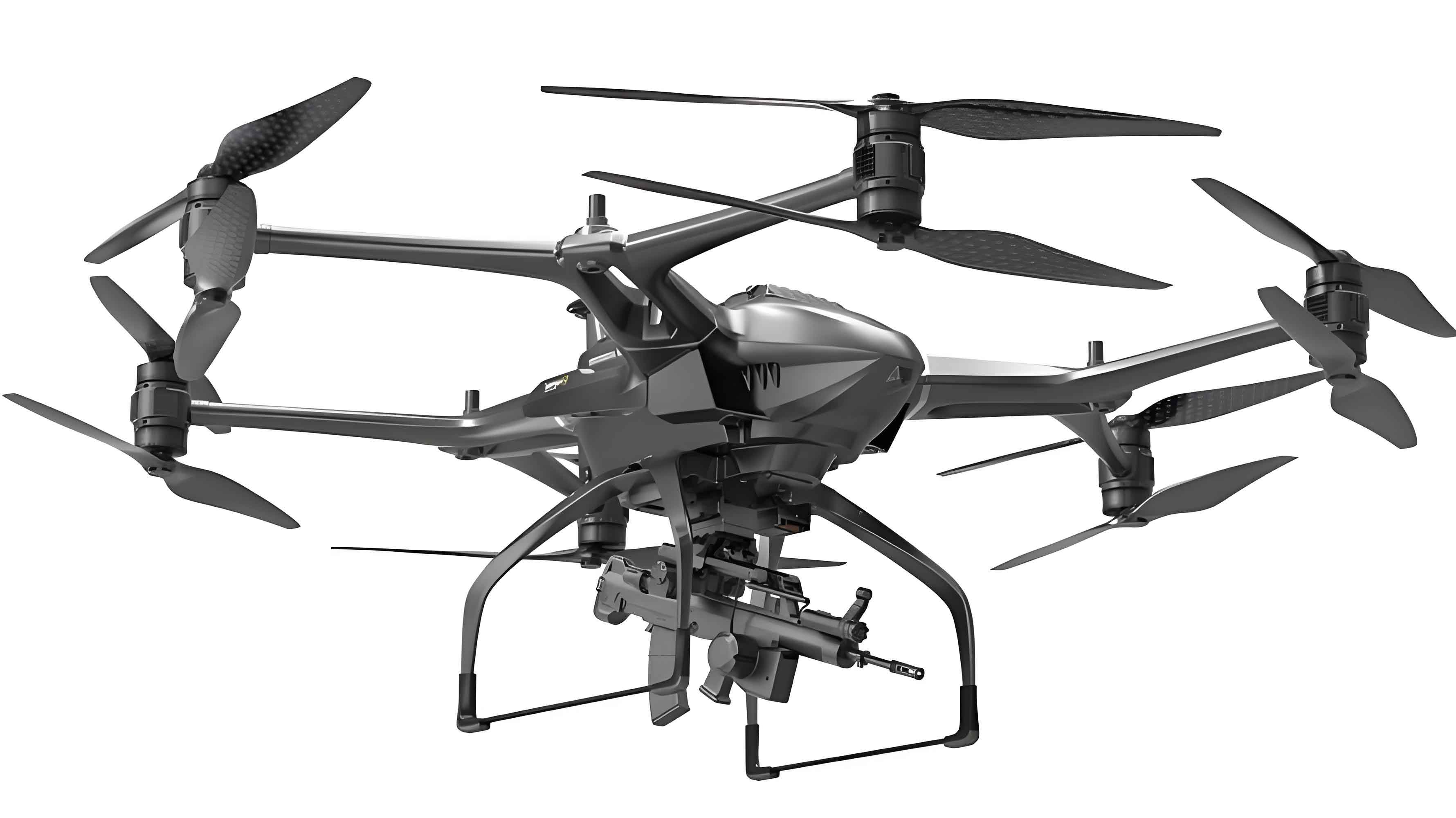
The development of military UAVs began in the early 20th century, shortly after the advent of manned aircraft. Over decades, particularly in recent years, the military UAV has evolved from performing support roles, such as reconnaissance, to undertaking direct combat missions in high-intensity conflicts. This shift has established the military UAV as a distinct and crucial category within military aviation. The impact of unmanned combat aircraft on future aerial battlefields is profound, prompting major military powers to prioritize the military UAV as a key focus in aircraft development.
Fundamentally, a military UAV is characterized by its lack of a pilot, cockpit systems, and the physiological limitations inherent to human operators. This design freedom enables several advantages, which can be summarized by the cost-effectiveness ratio often analyzed in procurement decisions:
$$ \text{Cost-Effectiveness Ratio (CER)} = \frac{\text{Operational Performance}}{\text{Total Lifecycle Cost}} $$
For a military UAV, operational performance encompasses factors like mission success rate, survivability, and payload capacity, while cost includes development, production, and maintenance expenses. Typically, the military UAV demonstrates a higher CER compared to manned equivalents due to lower production and operational costs. Moreover, advancements in avionics and composite materials have allowed for the integration of reconnaissance, navigation, and data processing equipment into compact systems, enhancing functionality and reducing vulnerability to防空 threats. In the context of作战 doctrines like integrated air-ground operations and deep strike, the military UAV proves invaluable for operating in纵深 or hazardous核生化 environments, undertaking perilous missions that minimize both material loss and personnel casualties.
The missions undertaken by modern military UAVs are diverse and expanding. Below is a table categorizing primary mission sets for the military UAV:
| Mission Category | Specific Tasks | Typical Payloads |
|---|---|---|
| Intelligence, Surveillance, Reconnaissance (ISR) | Battlefield reconnaissance, target indication, persistent monitoring | Electro-optical/infrared sensors, synthetic aperture radar, signals intelligence equipment |
| Electronic Warfare (EW) | Electronic attack, jamming,反辐射 strikes | Jammers,反辐射 missiles, decoy emitters |
| Strike and Combat | Air-to-ground attacks,空战, suppression of enemy air defenses | Guided munitions, air-to-air missiles, loitering弹药 |
| Support and Logistics | Communications relay, cargo transport, psychological operations | Radio repeaters, small cargo pods, loudspeakers |
| Training and Testing | Acting as aerial targets for weapon systems testing and crew training | Signature enhancers, scoring systems |
The system architecture of a military UAV typically comprises the aerial vehicle itself, a ground control station (GCS), launch and recovery equipment, and data links. Launch methods vary from conventional runway takeoff and catapult launches from ships to air drops from manned aircraft. Recovery can involve wheeled landings, parachute descents, or net capture systems. The propulsion systems for military UAVs range from piston and turbojet engines to emerging technologies like electric and solar-powered engines. The payload, which often accounts for 10-40% of the total vehicle weight and a significant portion of its cost, is tailored to mission requirements and may include specialized detectors for核生化 agents or distributed sensor networks.
Classification of military UAVs is not standardized globally but can be organized along several dimensions. The following table provides a consolidated view:
| Classification Basis | Categories | Typical Characteristics |
|---|---|---|
| Control Method | Programmed (Autonomous), Remotely Piloted (RPV), Hybrid | Varies from full pre-flight programming to real-time human control. |
| Primary Role | Reconnaissance UAV, Target Drone, EW UAV, Unmanned Combat Aerial Vehicle (UCAV), Communications Relay UAV, Early Warning UAV | Defined by core mission capability. |
| Size/Weight | Large (>600 kg), Medium (150-600 kg), Small (<150 kg),微型/Micro (<2 kg) | Impacts endurance, payload, and deployment method. |
| Range/Endurance | Close-Range ( < 50 km), Short-Range (50-200 km), Medium-Range (200-800 km), Long-Range/Endurance (>800 km and >24h) | Determines operational reach and loiter time. |
Technological progress since the late 20th century, driven by advances in computing, sensors, and materials, has been the bedrock for the enhanced capabilities of the military UAV. Key areas of development include airframe design, propulsion, avionics, and stealth. For instance, the use of modular structures facilitates rapid assembly and maintenance. Propulsion trends favor efficient转子 engines for endurance or small electric motors for微型 UAVs. Composite materials reduce weight and radar cross-section. Avionics are evolving towards miniaturization, digitization, and higher integration, with sensors focusing on all-weather, real-time, high-resolution capabilities. Flight control systems are achieving greater automation in navigation and mission execution.
A notable trend is the miniaturization of the military UAV, particularly in the reconnaissance domain.微型 UAVs, defined by wingspans under 15 cm, represent a significant shift. These systems are often semi-autonomous, equipped with real-time video feeds, GPS, and secure data links. Their performance can be modeled using simple kinematic equations. For example, the operational radius \( R \) can be related to speed \( v \) and endurance \( t \):
$$ R \approx v \cdot t \cdot k $$
where \( k \) is a factor accounting for loiter and reserve power. A typical微型 military UAV might have \( v \approx 50 \text{ km/h} \), \( t \approx 45 \text{ minutes} \), yielding an effective \( R \) of several kilometers. Their low cost, often in the thousands of dollars per unit, and portability allow infantry soldiers to deploy them manually for tactical reconnaissance, providing critical situational awareness beyond line-of-sight. The proliferation of such微型 military UAVs could fundamentally alter small-unit tactics.
Another critical advancement is in长航时 (long-endurance) military UAVs. Endurance \( T \) is fundamentally limited by energy storage \( E \) and power consumption \( P \):
$$ T = \frac{E}{P} $$
Traditional engines limit \( T \) to tens of hours. However, solar-powered military UAVs aim to drastically extend this by harvesting solar energy. The power available from solar panels can be expressed as:
$$ P_{\text{solar}} = \eta \cdot A \cdot I $$
where \( \eta \) is panel efficiency, \( A \) is area, and \( I \) is solar irradiance. High-altitude platforms leveraging this technology seek to achieve endurance measured in months or even years, acting as persistent通信 or surveillance nodes. The technical challenges involve efficient energy collection, storage for night operations (e.g., via regenerative fuel cells or advanced batteries), and robust autonomous control for extended missions with minimal ground intervention. The development of such solar-powered military UAVs promises to revolutionize persistent ISR and communications infrastructure.
The most dynamically evolving segment is the无人作战飞机 (Unmanned Combat Aerial Vehicle – UCAV). Historically, early precursors emerged during World War II. Modern UCAVs include both loitering弹药 (often referred to as “suicide drones”) and reusable systems designed for strike and air combat missions. A prime example is the反辐射 military UAV, which autonomously hunts radar emitters. Its effectiveness can be modeled based on sensor sensitivity and engagement probability. The probability \( P_k \) of killing a radar target might be approximated by:
$$ P_k = P_d \cdot P_{\text{lock}} \cdot P_{\text{hit}} $$
where \( P_d \) is detection probability, \( P_{\text{lock}} \) is probability of successful guidance lock-on, and \( P_{\text{hit}} \) is warhead lethality probability. Reusable UCAVs are being developed with features like low observability (stealth), high maneuverability, and modular payload bays. The economic and tactical rationale is compelling: a UCAV can undertake high-risk missions without endangering pilots, and its lower unit cost allows for more distributed and attrition-tolerant force structures. The future military UAV in combat roles will increasingly incorporate artificial intelligence (AI) for autonomous decision-making.
Looking ahead, the trajectory for military UAVs points towards greater autonomy, swarming capabilities, and multi-role adaptability. Future autonomous military UAVs will employ advanced AI algorithms for real-time target recognition,战术 planning, and dynamic weapon allocation. The concept of a fully autonomous “loyal wingman” or a standalone hunter-killer military UAV is under active research. These systems will process vast amounts of sensor data using machine learning models, making decisions based on rules of engagement encoded in software. The performance of such an AI pilot could be benchmarked using metrics like mission success rate \( S \) against a set of scenarios \( \Sigma \):
$$ S = \frac{1}{|\Sigma|} \sum_{\sigma \in \Sigma} I(\text{mission accomplished in } \sigma) $$
where \( I \) is an indicator function. Furthermore, research into multi-domain robotic systems envisions军事 UAVs that can operate in conjunction with ground and underwater unmanned vehicles, creating integrated robotic battle networks. This represents a paradigm shift towards highly automated, networked warfare where the military UAV is a central node.
To quantify the growth and investment in military UAV technology, consider the following hypothetical table summarizing key performance parameters across generations:
| Generation | Era | Typical Endurance (hours) | Typical Range (km) | Key Technological Leap | Primary Role Evolution |
|---|---|---|---|---|---|
| 1st | 1960s-1970s | 1-3 | 100-500 | Remote control, basic reconnaissance | Target drones, basic reconnaissance |
| 2nd | 1980s-1990s | 5-24 | 500-1000 | Composite materials, improved sensors, data links | Tactical ISR, limited strike |
| 3rd | 2000s-2010s | 24-40+ | 1000+ | Satellite comms, precision weapons integration, MALE/HALE platforms | Persistent ISR, armed reconnaissance, strategic strikes |
| 4th (Current/Future) | 2020s+ | 40+ to months (solar) | Global (via relays) | AI/ML autonomy, swarming, low-cost attritable designs, directed energy weapons | Full-spectrum combat, collaborative operations, electronic warfare dominance |
The formula for a military UAV’s effectiveness in a contested environment might incorporate factors like survivability \( S_v \), sensor accuracy \( A_s \), and weapon effectiveness \( W_e \), combined in a weighted model:
$$ \text{System Effectiveness} = \alpha \cdot S_v + \beta \cdot A_s + \gamma \cdot W_e $$
where \( \alpha, \beta, \gamma \) are weights determined by mission priorities. As stealth, electronic protection, and autonomous threat response improve, \( S_v \) increases, enhancing overall effectiveness.
In conclusion, the military UAV has undergone a metamorphosis from a niche support asset to a cornerstone of modern military strategy. Its advantages in cost, persistence, and risk reduction are undeniable. As technology continues to advance—particularly in AI, energy systems, and miniaturization—the role of the military UAV will only expand, encompassing more sophisticated combat and support functions. The future battlefield will likely feature heterogeneous teams of manned and unmanned systems, with the military UAV acting as a force multiplier, a persistent eye in the sky, and an autonomous combatant. The ongoing innovation in this field ensures that the military UAV will remain at the forefront of aerial warfare evolution for decades to come, continually reshaping tactics, strategies, and the very nature of conflict.