
In my exploration of technological advancements, I have observed that civilian drones have transformed from niche tools into ubiquitous devices, reshaping industries and daily life. The journey of civilian drones, particularly in China, offers a fascinating case study of innovation, market dynamics, and societal impact. Here, I will delve into the historical development, driving forces, market projections, and future trajectories of civilian drones, emphasizing their growing significance. Throughout this analysis, I will frequently reference civilian drones to underscore their central role in this narrative.
The origins of civilian drones can be traced back to the 1980s, a period when drone technology was predominantly military-focused. In March 1980, a scientific committee in China commissioned the development of a multi-purpose unmanned aircraft, marking a pivotal shift toward civilian applications. This early model, designed for aerial surveying and geological exploration, completed its first successful test flight in 1982 and passed technical appraisal in 1983. By 1995, it entered small-scale production, symbolizing the first genuine civilian drone model and pioneering the transition from military to civilian use. This era laid the groundwork for civilian drones, demonstrating their potential beyond defense.
From the 1990s to 2006, I noted that private enterprises began joining the research and development efforts for civilian drones, though output was limited to low-end products primarily used for scientific research. These early civilian drones were immature, lacking the capability for mass production or widespread adoption. A milestone emerged in 1996 with a medium-range multi-purpose unmanned aircraft that enabled dual military-civilian use. In civilian contexts, it served roles such as geological exploration, disaster monitoring, and coastal surveillance. This phase highlighted the gradual diversification of civilian drones, albeit with slow progress due to technical constraints.
The period from 2007 to 2012 witnessed a surge in civilian drone manufacturers, akin to mushrooms after rain, alongside defense groups venturing into the civilian sector. In 2008, a long-endurance medium-altitude drone for civilian purposes made its maiden flight, expanding the horizons for civilian drones. However, it was around 2012 that civilian drones truly captured public imagination, thanks to consumer-grade models that launched a strong offensive into the market. Products like the Phantom3 popularized aerial photography, while numerous companies plunged into the fray, turning the consumer drone market into a red ocean. In just a few years, civilian drones underwent a dramatic transformation, ushering in an unprecedented era of prosperity. This rapid evolution underscores how civilian drones have become integral to modern technology.
Reflecting on this timeline, I categorize the development of civilian drones into four distinct stages, as summarized in the table below. This segmentation helps clarify the progression of civilian drones from experimental tools to mainstream gadgets.
| Stage | Time Period | Key Characteristics | Impact on Civilian Drones |
|---|---|---|---|
| 1. Origins | 1980s | Military-to-civilian transition, initial models for surveying and exploration | Laid foundation for civilian drones, first dedicated civilian models |
| 2. Early Development | 1990s-2006 | Private sector entry, low-end products for research, dual-use applications | Slow growth, limited adoption, focus on niche civilian uses |
| 3. Expansion | 2007-2012 | Manufacturer proliferation, defense involvement, longer-endurance models | Broader civilian applications, increased technological sophistication |
| 4. Consumer Boom | 2012 onwards | Consumer-grade drones, aerial photography popularity, market competition | Mass adoption, civilian drones enter public consciousness, rapid innovation |
Now, let’s examine why civilian drones have risen so prominently. In my analysis, four primary factors have fueled the ascent of civilian drones, each interlinked with technological and economic trends.
First, the open-sourcing of flight control systems acted as a catalyst for the civilian drone industry. Early open-source platforms like Arduino paved the way, but it was APM (ArduPilot Mega) that truly ignited the market, becoming a mature and widely adopted project. Other open-source systems, such as PPZ, PX4, Pixhawk, MWC, and OpenPilot, followed suit. This openness lowered the entry barrier for manufacturing civilian drones, enabling even hobbyists to build DIY drones from purchased components. The democratization of technology through open-source initiatives has been instrumental in proliferating civilian drones.
Second, the gradual完善 of the industrial supply chain served as an accelerator for civilian drones. In recent years, many Chinese companies shifted from traditional OEM models to independent research and development, enhancing the upstream and midstream segments of the产业链. This shift facilitated the transformation from “Made in China” to “Innovated in China.” Additionally, the rise of drone services, such as pilot training and data collection, improved downstream布局, benefiting both前端 and end-users. The synergy within the产业链 has propelled civilian drones forward.
Third, the declining cost of hardware has created a favorable environment for civilian drones. Components like lithium-ion batteries and MEMS inertial sensors have become smaller, more power-efficient, and cheaper. For instance, the price of lithium-ion batteries dropped from nearly $1300 per kWh in 2006 to around $300 per kWh in 2015. Similarly, MEMS sensors, mass-produced for consumer-grade civilian drones, now cost less than $1 per unit. This cost reduction can be modeled using an exponential decay formula: $$ C(t) = C_0 e^{-kt} $$ where \( C(t) \) is the cost at time \( t \), \( C_0 \) is the initial cost, and \( k \) is the decay constant. Such trends have made civilian drones more affordable and accessible.
Fourth, sustained market demand is the fundamental driver behind civilian drones. Technological advancements have expanded the application areas of civilian drones, which are favored for their safety, portability, and ease of deployment. Currently, civilian drones boast over 600 uses, with nearly 400 enterprises in China alone. Key sectors include public security, agriculture, power line inspection, and commercial aerial photography. The demand for civilian drones continues to grow, influenced by their versatility. To quantify this, I estimate the market size using a logistic growth model: $$ D(t) = \frac{L}{1 + e^{-r(t-t_0)}} $$ where \( D(t) \) is the demand at time \( t \), \( L \) is the carrying capacity (maximum potential demand), \( r \) is the growth rate, and \( t_0 \) is the inflection point. This model reflects how civilian drones are penetrating various industries.
The table below summarizes these崛起原因 for civilian drones, highlighting their interconnected roles.
| Factor | Description | Impact on Civilian Drones |
|---|---|---|
| Open-Source Flight Control | Availability of开源飞控 like APM, lowering entry barriers | Democratized manufacturing, spurred innovation in civilian drones |
| Industrial Supply Chain | 完善 of upstream and downstream产业链, shift to R&D | Enhanced production efficiency, supported scalability of civilian drones |
| Hardware Cost Reduction | Declining prices of batteries, sensors, and other components | Increased affordability and adoption of civilian drones |
| Market Demand | Growing applications in agriculture, security, photography, etc. | Drove commercialization and diversification of civilian drones |
Turning to market size and前景, I project that in the coming years, the influx of drone hardware will be accompanied by a maturing service ecosystem, forming a complete产业链. For civilian drone products, various research机构 have offered predictions. For example, EVTank reported that in 2014, global drone sales reached approximately 390,000 units, with civilian drones accounting for 96%. In China, sales were around 20,000 units, with civilian drones making up 98.6%. The sales scale for civilian drones in China hit 4 billion yuan in 2014. Looking ahead,易观智库 forecasts that by 2018, the product sales market for civilian drones in China will reach 110.9 billion yuan. Similarly,海鹰资讯 estimates 17.9 billion dollars for the same year. The Teal Group predicts that global drone procurement spending will double over the next decade (2015-2024), while IDC anticipates that consumer-grade drone shipments in China will hit 3 million units by 2019. My own analysis aligns with these trends, suggesting that by 2020, the product sales market for civilian drones in China could reach 265 billion yuan.
To encapsulate these projections, I present the following table, which consolidates forecasts for civilian drones from different sources.
| Forecasting Agency | Prediction Content | Time Node | Predicted Value |
|---|---|---|---|
| 易观智库 | Product sales market for civilian drones in China | 2018 | 110.9 billion yuan |
| 海鹰资讯 | Product sales market for civilian drones in China | 2018 | 17.9 billion dollars |
| Teal Group | Global drone procurement spending | 2024 | Double from 2015 |
| IDC | Consumer-grade drone shipments in China | 2019 | 3 million units |
| My Analysis | Product sales market for civilian drones in China | 2020 | 265 billion yuan |
Beyond products, the service market for civilian drones is poised for significant growth. Drone services encompass maintenance, insurance, training, promotion, leasing, and operations, generated by the increasing number of civilian drones. Among these, operation services, pilot training, and e-commerce hold the greatest potential. Drawing an analogy to the PC industry, civilian drones today resemble personal computers in the 1980s, transitioning from hobbyist toys to commercial products. The smile curve theory, applied here, suggests that research and marketing at the产业链 ends offer higher value-added than manufacturing. Thus, the future of civilian drones will focus on upstream R&D and downstream services. For instance, in the automotive industry, after-sales services account for about 70% of profits. Similarly, I estimate that over the next five years (2016-2020), the service market for civilian drones in China will exceed 200 billion yuan, with operation services claiming 49%, e-commerce 16%, and leasing 15%. This distribution can be expressed with a simple formula for market share: $$ MS_i = \frac{V_i}{\sum V} \times 100\% $$ where \( MS_i \) is the market share of service type \( i \), and \( V_i \) is its value.
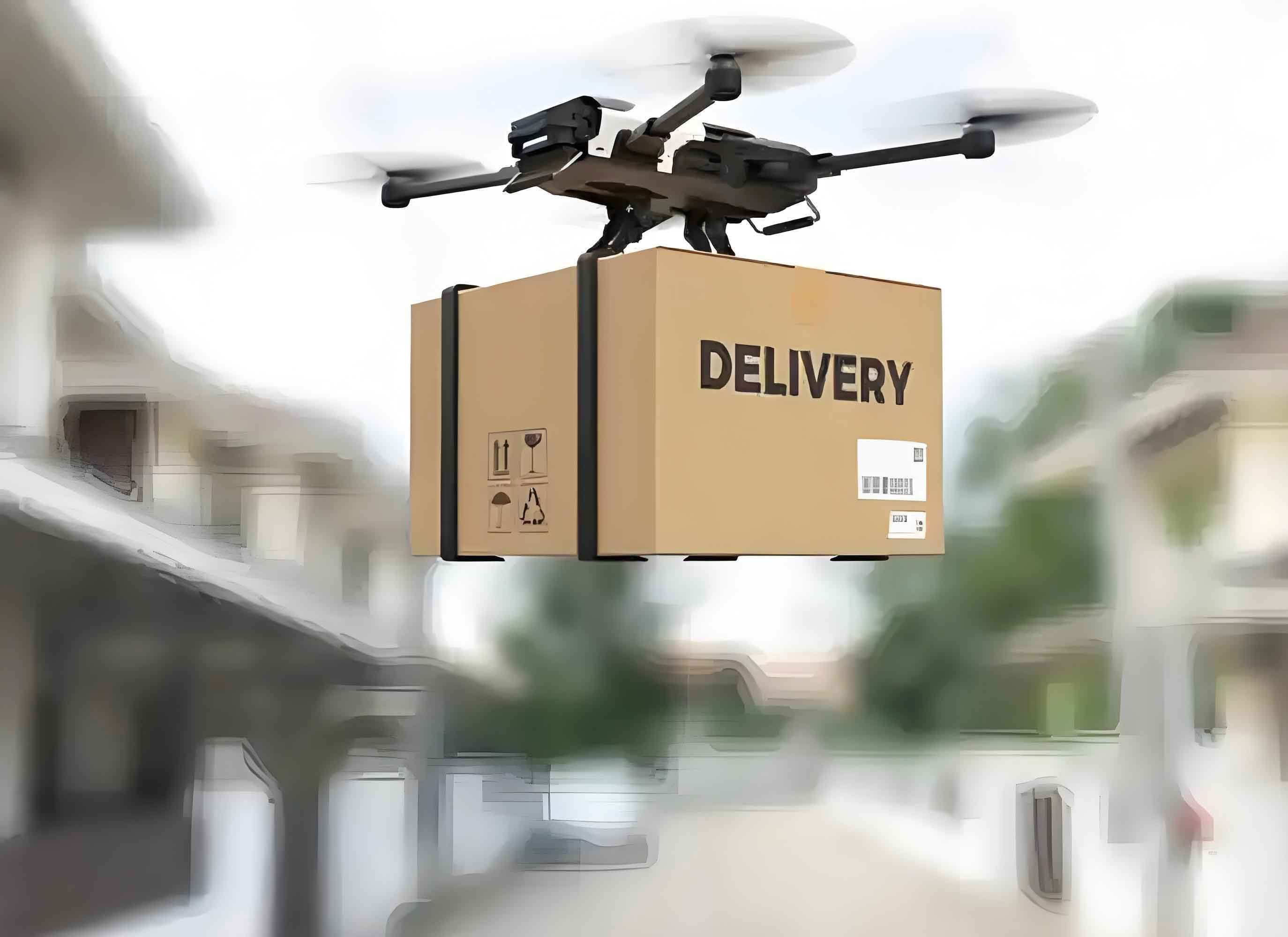
As civilian drones evolve, their role in logistics and delivery is becoming increasingly prominent. For example, drones are being tested for last-mile delivery, offering faster and more efficient solutions in urban and rural areas. This application highlights the expanding utility of civilian drones in everyday commerce.
Looking ahead, I foresee two major trends for civilian drones: technological integration and盈利模式 shifts. Technologically, civilian drones will contribute to “Industry 4.0,” which emphasizes connectivity, data采集, and integration. As aerial relays, civilian drones can enhance communication coverage in complex terrains, ensuring stable data transmission. In data采集, civilian drones act as flying sensors, extending human perception to new heights. For instance, in agriculture, civilian drones collect field data for analysis, optimizing irrigation and crop management. The data from civilian drones can be integrated into big data systems, fostering smart societies. The relationship between drone innovation and Industry 4.0 can be modeled as a feedback loop: $$ I(t+1) = I(t) + \alpha D(t) $$ where \( I(t) \) represents Industry 4.0 advancement at time \( t \), \( D(t) \) is the development level of civilian drones, and \( \alpha \) is a coupling coefficient. This illustrates how civilian drones and industrial progress mutually reinforce each other.
Moreover, various aerial platforms for civilian drones exhibit different性能, as shown in the table below. This comparison aids in selecting appropriate civilian drones for specific tasks.
| Aerial Platform | Altitude | Payload | Endurance | Stability | Mobility |
|---|---|---|---|---|---|
| Micro-Small Drones | Low | Small | Short | Moderate | Excellent |
| Large Conventional Drones | High | Moderate | Longer | Good | Moderate |
| Large Solar Drones | High | Moderate | Very Long | Good | Moderate |
| Helicopters | High | Moderate | Longer | Good | Good |
| Airships | Moderate | Large | Long | Excellent | Poor |
| Tethered Balloons | Lower | Large | Very Long | Moderate | Poor |
Regarding盈利趋势, I observe that most top-ranking civilian drone companies currently rely on hardware sales. However, hardware markets often plateau, prompting a need for service-oriented models. Direct drone services can become new profit centers, benefiting both enterprises and users. In the long term, services are crucial for产业链 cohesion; lagging service development could disconnect manufacturers from users. Therefore, transitioning from制造 to服务 is essential. Over the next five years, operation services, e-commerce, leasing, media, and pilot training for civilian drones will flourish, potentially surpassing hardware in value. The growth of the service market can be described by a compound annual growth rate (CAGR) formula: $$ CAGR = \left( \frac{V_f}{V_i} \right)^{\frac{1}{n}} – 1 $$ where \( V_i \) and \( V_f \) are the initial and final values over \( n \) years. For civilian drone services, I estimate a CAGR of over 20%, reflecting rapid expansion.
In conclusion, civilian drones have journeyed from obscure beginnings to technological stardom, driven by开源, supply chain成熟, cost reductions, and burgeoning demand. The market for civilian drones, both products and services, is set for robust growth, with predictions pointing to百亿-scale economies. Future civilian drones will increasingly interconnect with Industry 4.0, enhancing data采集 and smart integration, while盈利 models will shift toward services. As I reflect on this trajectory, it is clear that civilian drones are not just tools but catalysts for innovation, poised to shape our world in profound ways. The continued evolution of civilian drones will depend on adapting to these trends, ensuring they remain at the forefront of technological progress.