
In my extensive experience researching and developing unmanned aerial systems, I have witnessed a remarkable transformation in vertical take-off and landing (VTOL) UAV technology. These versatile aircraft, capable of operating in confined spaces without runways, have revolutionized both military and civilian operations. The integration of advanced propulsion, control systems, and modular designs has propelled VTOL UAVs to the forefront of modern aviation. Throughout this article, I will delve into the technical intricacies, operational advantages, and future trajectories of VTOL UAVs, emphasizing their growing significance in diverse fields. As we explore this topic, I will incorporate tables and mathematical formulations to summarize key concepts, ensuring a comprehensive understanding of VTOL UAV dynamics.
The fundamental principle behind VTOL UAVs lies in their ability to generate lift vertically, allowing for hover, precise maneuvering, and seamless transition to forward flight. This capability is achieved through various configurations, such as multicopter designs, tilt-rotor systems, or ducted fans. From a first-person perspective, I have observed that the aerodynamic forces governing VTOL UAVs can be modeled using Newton’s laws and fluid dynamics. For instance, the thrust required for hover can be expressed as:
$$T = mg + \frac{1}{2} \rho v^2 C_D A$$
where \(T\) is the thrust, \(m\) is the mass of the VTOL UAV, \(g\) is gravitational acceleration, \(\rho\) is air density, \(v\) is induced velocity, \(C_D\) is the drag coefficient, and \(A\) is the reference area. This equation highlights the balance between weight and aerodynamic forces, a critical consideration in VTOL UAV design. Moreover, the power consumption during hover, a key metric for endurance, is given by:
$$P = T \cdot v_i / \eta$$
where \(P\) is power, \(v_i\) is the induced velocity in the rotor wake, and \(\eta\) is the propulsive efficiency. These formulas underscore the engineering challenges in optimizing VTOL UAV performance, particularly for missions requiring long loiter times.
In my work, I have categorized VTOL UAVs based on their propulsion mechanisms and operational roles. The following table summarizes common VTOL UAV types and their characteristics:
| VTOL UAV Type | Propulsion System | Typical Endurance (hours) | Payload Capacity (kg) | Primary Applications |
|---|---|---|---|---|
| Multicopter | Electric motors with multiple rotors | 1-2 | 5-20 | Surveillance, photography, precision agriculture |
| Tilt-Rotor | Rotors that tilt for vertical and forward flight | 3-6 | 50-200 | Cargo delivery, military reconnaissance, search and rescue |
| Ducted Fan | Enclosed rotors for enhanced safety and efficiency | 2-4 | 10-50 | Urban operations, infrastructure inspection |
| Compound Helicopter | Main rotor with auxiliary propulsion | 4-8 | 100-500 | Heavy-lift missions, anti-submarine warfare |
This classification demonstrates the adaptability of VTOL UAVs to various tasks, driven by continuous innovation. For example, the SHARC VTOL UAV, which I studied in recent projects, utilizes a coaxial lift system powered by a Rotax engine, enabling autonomous operations with improved stability. Such advancements underscore the importance of VTOL UAVs in expanding aerial capabilities.
From a design standpoint, I have advocated for modular approaches in VTOL UAV development, similar to principles seen in other defense systems. Modularity allows for rapid reconfiguration, ease of maintenance, and scalability. A VTOL UAV can be divided into distinct modules: the airframe, propulsion unit, avionics suite, and payload bay. This separation enhances survivability, as critical components can be shielded or dispersed. In military contexts, VTOL UAVs often incorporate anti-jamming and anti-radiation features. For instance, to counter threats like anti-radiation missiles, VTOL UAVs can deploy decoy emitters that mimic radar signatures, thereby protecting the main platform. The effectiveness of such measures can be quantified using probability models. If \(P_d\) is the probability of detection and \(P_s\) is the probability of survival, then for a VTOL UAV equipped with decoys:
$$P_s = 1 – P_d \cdot (1 – P_{decoy})$$
where \(P_{decoy}\) is the probability that a decoy successfully diverts the threat. This equation illustrates how redundancy and deception boost VTOL UAV resilience.
Another critical aspect I have explored is the control systems of VTOL UAVs. Modern control theory, including PID controllers, adaptive algorithms, and neural networks, is essential for stabilizing these aircraft during complex maneuvers. The dynamics of a VTOL UAV can be described by state-space equations. Let \(\mathbf{x} = [x, y, z, \phi, \theta, \psi]^T\) represent the position and orientation states, and \(\mathbf{u} = [T_1, T_2, T_3, T_4]^T\) denote the thrust inputs from rotors. The system dynamics are:
$$\dot{\mathbf{x}} = f(\mathbf{x}, \mathbf{u}) + \mathbf{w}$$
where \(f\) is a nonlinear function derived from rigid-body dynamics, and \(\mathbf{w}\) accounts for disturbances like wind. Implementing feedback control, such as:
$$\mathbf{u} = K(\mathbf{x}_d – \mathbf{x})$$
where \(K\) is a gain matrix and \(\mathbf{x}_d\) is the desired state, ensures precise tracking. These control strategies are vital for VTOL UAV operations in GPS-denied environments, where inertial navigation systems fuse data from accelerometers and gyroscopes. The integration of computer networks and IoT devices further enables swarm coordination among multiple VTOL UAVs, enhancing mission efficacy.
In military applications, VTOL UAVs provide unparalleled advantages for reconnaissance, target acquisition, and electronic warfare. I have analyzed scenarios where VTOL UAVs perform “pop-up” attacks from concealed positions, leveraging their vertical launch capability to engage time-sensitive targets. The concept of “moving while shooting” or行进间发射, analogous to行进间发射 technology in missile systems, allows VTOL UAVs to maintain mobility while deploying payloads, thus increasing survivability. For a VTOL UAV conducting a strike mission, the time to engage a target can be modeled as:
$$t_{engage} = \frac{d}{v_{UAV}} + t_{acquisition} + t_{launch}$$
where \(d\) is the distance to target, \(v_{UAV}\) is the VTOL UAV speed, \(t_{acquisition}\) is sensor processing time, and \(t_{launch}\) is weapon release time. Minimizing \(t_{engage}\) through rapid vertical take-off and agile flight paths makes VTOL UAVs formidable assets. Additionally, VTOL UAVs can be equipped with radar jammers or communication relays, forming a networked defense grid. The table below outlines typical military roles for VTOL UAVs:
| Mission Type | VTOL UAV Configuration | Key Technologies | Challenges |
|---|---|---|---|
| Surveillance and Reconnaissance | Small multicopter with electro-optical sensors | Stealth coatings, low-noise propulsion | Limited endurance, vulnerability to electronic warfare |
| Combat Strike | Tilt-rotor with missile payload | Precision guidance, anti-radar homing | Weight constraints, counter-detection |
| Electronic Attack | Medium-altitude VTOL UAV with jamming pods | Wideband transmitters, cognitive radio | Heat dissipation, power management |
| Logistics Support | Heavy-lift compound helicopter | Autonomous cargo handling, collision avoidance | Weather sensitivity, airspace integration |
These roles highlight the versatility of VTOL UAVs, driven by ongoing research into materials science and propulsion. For instance, hybrid electric systems that combine internal combustion engines with batteries are extending the range of VTOL UAVs, addressing endurance limitations. The energy management in such systems can be optimized using linear programming. Let \(E_{total}\) be the total energy available, \(P_{engine}\) be engine power, \(P_{battery}\) be battery power, and \(P_{load}\) be the power demand. The optimization problem is:
$$\text{Minimize } \int_{0}^{T} (c_f P_{engine} + c_b P_{battery}) dt$$
$$\text{subject to: } P_{engine} + P_{battery} \geq P_{load}, \quad 0 \leq P_{engine} \leq P_{max}, \quad 0 \leq P_{battery} \leq E_{total}/\Delta t$$
where \(c_f\) and \(c_b\) are cost coefficients for fuel and battery usage, respectively. Solving this ensures efficient VTOL UAV operations over long sorties.
Beyond military use, I have engaged in projects deploying VTOL UAVs for civilian purposes, such as disaster response, agricultural monitoring, and infrastructure inspection. In disaster scenarios, VTOL UAVs can deliver medical supplies to inaccessible areas, relying on their vertical take-off capability to navigate rubble. The payload capacity versus range trade-off is crucial here, often described by the Breguet range equation adapted for electric VTOL UAVs:
$$R = \frac{\eta}{g} \cdot \frac{C_L}{C_D} \cdot \ln \left( \frac{m_{initial}}{m_{final}} \right)$$
where \(R\) is range, \(\eta\) is overall efficiency, \(C_L\) and \(C_D\) are lift and drag coefficients, and \(m_{initial}\) and \(m_{final}\) are initial and final masses. This formula guides the design of VTOL UAVs for humanitarian missions. Moreover, in precision agriculture, VTOL UAVs equipped with multispectral sensors analyze crop health, enabling targeted interventions. The data collected can be processed using machine learning algorithms to predict yields, with accuracy metrics given by:
$$\text{Accuracy} = \frac{TP + TN}{TP + TN + FP + FN}$$
where \(TP\), \(TN\), \(FP\), and \(FN\) are true positives, true negatives, false positives, and false negatives, respectively. Such applications underscore the socioeconomic impact of VTOL UAVs.
Throughout my career, I have emphasized the importance of testing and validation for VTOL UAVs. Flight testing involves assessing stability, controllability, and performance under various environmental conditions. The following table summarizes key test parameters and their significance:
| Test Parameter | Measurement Method | Acceptable Range | Implications for VTOL UAV Design |
|---|---|---|---|
| Hover Stability | GPS and IMU data analysis | Position error < 0.5 m | Indicates control system robustness |
| Transition Time | High-speed video recording | 5-10 seconds from hover to cruise | Affects mission flexibility and energy use |
| Noise Level | Sound pressure meters | < 65 dB at 50 m distance | Critical for urban deployment and stealth |
| Power Consumption | Current and voltage sensors | Specific to platform size | Determines endurance and battery sizing |
These tests ensure that VTOL UAVs meet operational requirements, particularly in demanding environments. For example, I recall a field exercise where a VTOL UAV successfully navigated strong crosswinds, thanks to an adaptive control algorithm that adjusted rotor speeds in real-time. The control law was based on a Lyapunov function \(V(\mathbf{e}) = \frac{1}{2} \mathbf{e}^T \mathbf{e}\), where \(\mathbf{e}\) is the tracking error, ensuring global stability.
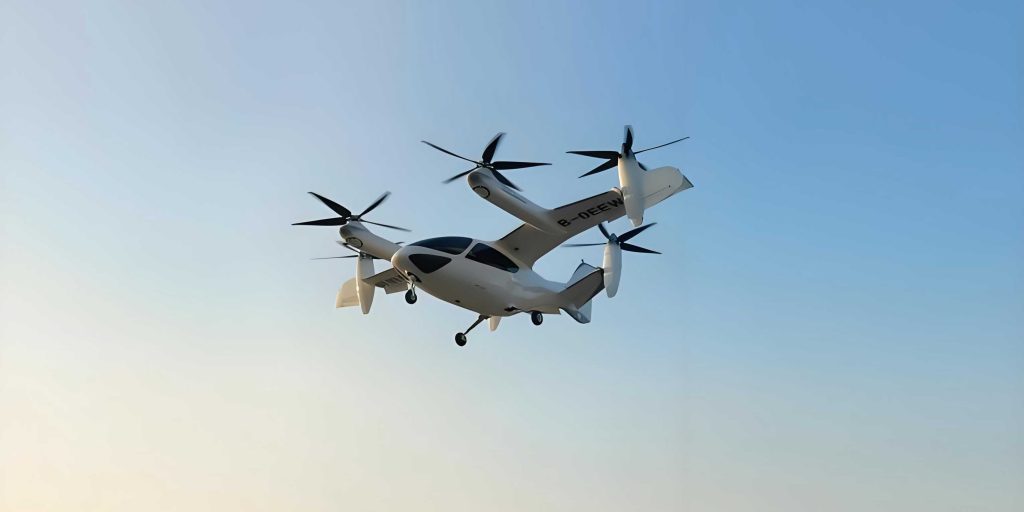
Looking ahead, I believe the future of VTOL UAVs will be shaped by advancements in artificial intelligence, materials, and propulsion. AI-driven autonomy will enable VTOL UAVs to perform complex missions with minimal human intervention, such as collaborative search and rescue in cluttered environments. Materials like carbon-fiber composites and additive manufacturing will reduce weight while maintaining structural integrity, enhancing payload capacity. Furthermore, novel propulsion concepts, including distributed electric propulsion and hydrogen fuel cells, promise to revolutionize VTOL UAV efficiency. The potential for hydrogen-powered VTOL UAVs is particularly exciting, as they offer high energy density and zero emissions. The energy output from a hydrogen fuel cell can be expressed as:
$$E = \eta_{fc} \cdot m_{H_2} \cdot LHV_{H_2}$$
where \(\eta_{fc}\) is fuel cell efficiency, \(m_{H_2}\) is hydrogen mass, and \(LHV_{H_2}\) is the lower heating value of hydrogen. Integrating such technologies will expand the operational envelope of VTOL UAVs, enabling transcontinental flights or persistent station-keeping for weeks.
In terms of regulatory and ethical considerations, I have participated in discussions on airspace integration for VTOL UAVs. The increasing density of VTOL UAV operations necessitates robust traffic management systems, akin to those for manned aviation. Mathematical models for collision avoidance, such as velocity obstacle algorithms, are essential. For two VTOL UAVs on intersecting paths, the condition for collision is:
$$\left\| \mathbf{p}_1 – \mathbf{p}_2 \right\| \leq r_{safe}$$
where \(\mathbf{p}_1\) and \(\mathbf{p}_2\) are positions, and \(r_{safe}\) is a safety radius. By adjusting velocities, VTOL UAVs can maintain separation autonomously. Additionally, privacy concerns related to VTOL UAV surveillance must be addressed through policy frameworks, ensuring responsible use.
To summarize the technical progression, I have compiled a timeline of key milestones in VTOL UAV development, based on my observations:
| Decade | Technological Breakthrough | Impact on VTOL UAV Capabilities |
|---|---|---|
| 1990s | Miniaturization of GPS and IMU sensors | Enabled basic autonomous navigation for small VTOL UAVs |
| 2000s | Advancements in lithium-polymer batteries | Increased flight times for electric VTOL UAVs |
| 2010s | Rise of commercial drone platforms | Democratized access to VTOL UAV technology |
| 2020s | Integration of AI and machine learning | Enhanced autonomy and decision-making for VTOL UAVs |
| 2030s (Projected) | Widespread adoption of urban air mobility | VTOL UAVs as routine transport and logistics vehicles |
This evolution underscores the dynamic nature of VTOL UAV innovation, driven by cross-disciplinary research. In my own projects, I have leveraged simulation tools to model VTOL UAV performance before physical prototyping. For example, computational fluid dynamics (CFD) simulations predict aerodynamic loads, using Navier-Stokes equations:
$$\rho \left( \frac{\partial \mathbf{v}}{\partial t} + \mathbf{v} \cdot \nabla \mathbf{v} \right) = -\nabla p + \mu \nabla^2 \mathbf{v} + \mathbf{f}$$
where \(\mathbf{v}\) is velocity field, \(p\) is pressure, \(\mu\) is viscosity, and \(\mathbf{f}\) represents body forces. These simulations optimize rotor designs for efficiency, a critical factor in VTOL UAV endurance.
In conclusion, my firsthand experience with VTOL UAVs confirms their transformative potential across sectors. From military defense to humanitarian aid, VTOL UAVs offer flexibility, efficiency, and innovation. The continuous refinement of technologies—be it through modular designs, advanced control theories, or sustainable propulsion—will further elevate VTOL UAV capabilities. As we embrace this future, collaboration among engineers, regulators, and operators will be key to harnessing the full benefits of VTOL UAVs. I remain committed to advancing this field, exploring new frontiers where VTOL UAVs can make a meaningful difference.