
In my years of observing modern warfare, I have witnessed a profound transformation driven by the advent of military drones. These unmanned aerial vehicles, often referred to as military drones, have redefined battlefield dynamics, offering unprecedented capabilities that challenge traditional military doctrines. The term “military drone” encompasses a wide range of systems, from small surveillance units to large, armed platforms capable of sustained operations. As I analyze recent conflicts, such as the 2020 Nagorno-Karabakh war where Azerbaijani TB-2 military drones decimated Armenian armor, and the targeted assassination of Iranian General Qasem Soleimani by a U.S. MQ-9 military drone, it becomes clear that these assets are not mere gadgets but pivotal tools in contemporary combat. The proliferation of military drones signals a shift toward more asymmetric, cost-effective, and high-precision warfare, where human risk is minimized while tactical advantages are maximized. This article delves into the intricacies of military drones, exploring their characteristics, applications, technologies, and future trajectories, all from my perspective as an analyst immersed in defense technology.
The fundamental appeal of military drones lies in their versatility and efficiency. From my research, I categorize their key advantages into several domains, which can be summarized in the following table to highlight how military drones outperform conventional systems:
| Advantage | Description | Impact on Military Operations |
|---|---|---|
| Reduced Casualties | Military drones eliminate the need for pilots in hazardous zones, preserving human life. | Lowers political and social costs of warfare, enabling prolonged engagements. |
| High Cost-Effectiveness | Compared to manned aircraft or missiles, military drones offer lower procurement and operational expenses. | Allows for mass deployment, enhancing force multiplication in conflicts. |
| Terrain Flexibility | Military drones can operate in diverse environments, from mountains to urban areas, without infrastructure. | Expands reconnaissance and strike capabilities to previously inaccessible regions. |
| Stealth and Surprise | With low acoustic and radar signatures, military drones can conduct covert missions undetected. | Facilitates sudden attacks, as seen in targeted killings, disrupting enemy plans. |
| Endurance | Many military drones have long flight times, often exceeding 24 hours, due to efficient designs. | Provides persistent surveillance and constant threat presence over battlefields. |
These advantages underscore why military drones have become integral to modern arsenals. In my assessment, the性价比 of military drones can be modeled mathematically. For instance, the cost-benefit ratio for a military drone versus a manned fighter jet can be expressed as: $$ C_{\text{drone}} = \frac{O_{\text{drone}} + M_{\text{drone}}}{E_{\text{drone}}}, $$ where \( C_{\text{drone}} \) is the cost per effective mission hour, \( O_{\text{drone}} \) represents operational costs, \( M_{\text{drone}} \) denotes maintenance expenses, and \( E_{\text{drone}} \) is the mission endurance. Typically, for military drones, this value is significantly lower than for manned alternatives, driving their adoption across nations.
Turning to applications, military drones serve multiple roles based on their design and payload. From my analysis, I classify military drones into distinct categories, each tailored for specific tasks. The table below organizes these types, illustrating the diversity within the military drone ecosystem:
| Type of Military Drone | Primary Function | Examples from Global Forces |
|---|---|---|
| Reconnaissance and Surveillance | Gathers intelligence through sensors like cameras and radar. | U.S. RQ-4 Global Hawk, Israeli Hermes 450. |
| Communications Relay | Acts as a node for data transmission between units. | American Gray Eagle variants with comms packages. |
| Electronic Warfare | Jams enemy signals or conducts cyber operations. | Specialized military drones used in Russian conflicts. |
| Attack and Strike | Carries munitions to engage ground or air targets. | MQ-9 Reaper, Chinese CH-7, TB001. |
| Reconnaissance-Strike Integration | Combines surveillance and attack in one platform. | Most modern military drones, like the TB-2 and CH-7. |
This categorization highlights how military drones are not monolithic but specialized tools. In my view, the evolution toward multifunctional military drones, such as the MQ-9, reflects a trend where a single military drone can perform multiple roles, reducing logistical burdens. The effectiveness of a military drone in these roles can be quantified using metrics like the probability of target detection: $$ P_{\text{detect}} = 1 – e^{-\lambda t}, $$ where \( \lambda \) is the sensor coverage rate and \( t \) is the time on station. For military drones with advanced sensors, this probability approaches unity, making them superior to traditional scouts.
Control mechanisms for military drones vary significantly, influencing their operational scope. Based on my observations, there are three primary control modes for military drones, each with distinct implications. First, handheld remote control is used for small, short-range military drones, often in tactical scenarios. Second, ground control stations (GCS) allow for more complex commands via radio links, typical for medium-altitude military drones like the MQ-9. Third, satellite-based control enables global operations for high-altitude military drones, such as the RQ-4. The choice depends on factors like range and mission criticality. From a technical standpoint, the control loop for a military drone can be represented as a feedback system: $$ \dot{x} = Ax + Bu, \quad y = Cx, $$ where \( x \) is the state vector (e.g., position, velocity), \( u \) is the control input from the operator, and \( y \) is the sensor output. This equation underscores how military drones rely on continuous data exchange to maintain stability and accuracy.
The inner workings of a military drone are akin to those of a flying robot, as I often describe them. A military drone’s core is its flight control system (FCS), which integrates sensors, actuators, and communication modules. In my analysis, the FCS processes inputs from ultrasonic, infrared, and visual sensors to navigate autonomously while adhering to human commands. The ground control station functions as a command center, with operators monitoring feeds and issuing directives. This synergy can be modeled using control theory: $$ G(s) = \frac{Y(s)}{U(s)} = \frac{K}{s^2 + 2\zeta\omega_n s + \omega_n^2}, $$ where \( G(s) \) is the transfer function of the military drone’s altitude control, \( K \) is the gain, \( \zeta \) is the damping ratio, and \( \omega_n \) is the natural frequency. Such formulations ensure that military drones respond smoothly to dynamic battlefield conditions.
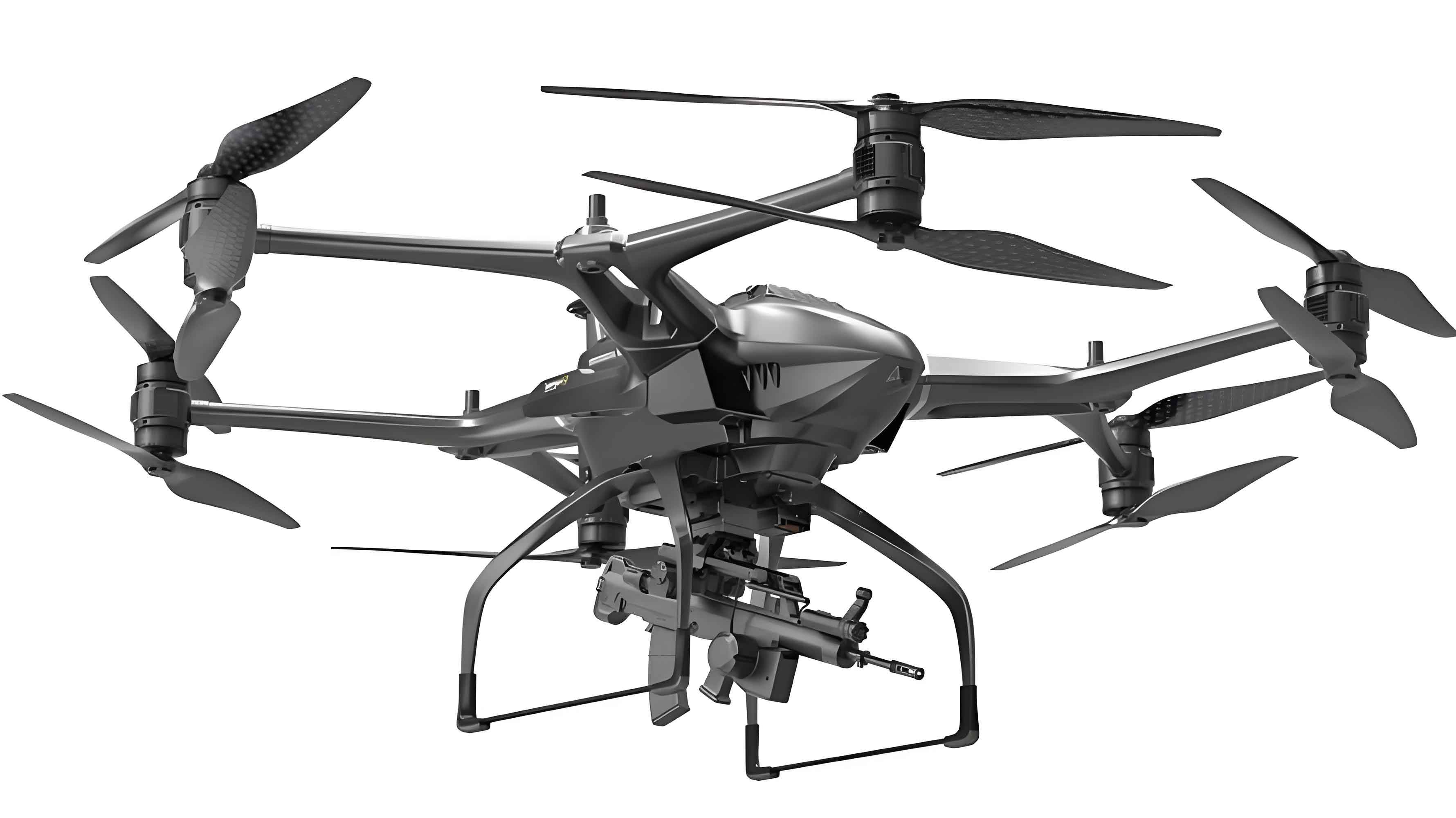
Examining specific models reveals the technological prowess of modern military drones. I have compiled data on prominent military drones to illustrate their capabilities. The table below provides a comparative overview, emphasizing key parameters that define their effectiveness:
| Military Drone Model | Country | Max Speed (km/h) | Max Altitude (m) | Endurance (hours) | Payload Capacity (kg) | Primary Role |
|---|---|---|---|---|---|---|
| MQ-9 Reaper | USA | 482 | 15,000 | 36 | 1,300 | Reconnaissance-Strike |
| Gray Eagle | USA | 250 | 8,800 | 25 | 480 | Multirole (ISR, Attack) |
| Hermes 450 | Israel | 176 | 9,000 | 24 | 150 | Reconnaissance |
| CH-7 Rainbow | China | 920 | 13,000 | 15 | Not specified | Stealth Reconnaissance-Strike |
| TB001 “Twin-Tailed Scorpion” | China | 220 | 8,000 | 35 | 1,000 | Heavy Attack and Reconnaissance |
| DJI Mavic (Military Use) | China (Civilian adapted) | 65 | 5,000 | 0.5 | Light payloads | Tactical Surveillance |
These specifications demonstrate how military drones are engineered for specific niches. For instance, the MQ-9 military drone stands out with its loiter time and payload, enabling extended missions over vast areas. The CH-7 military drone incorporates stealth features, reducing its radar cross-section, which can be expressed as: $$ \text{RCS} = \frac{4\pi A^2}{\lambda^2}, $$ where \( A \) is the effective area and \( \lambda \) is the radar wavelength. By minimizing RCS, such military drones evade detection, enhancing survivability. In my evaluation, the TB001 military drone’s twin-boom design offers structural advantages, allowing heavier loads without compromising agility—a testament to innovation in military drone architecture.
Beyond individual units, military drone swarms represent a paradigm shift. I have closely followed developments in swarm technology, where multiple military drones operate cohesively as a single entity. The Chinese Electronics Technology Group’s recent demonstration of a 48-drone swarm launched from a vehicle showcases this advancement. In a swarm, military drones coordinate using algorithms inspired by natural phenomena, such as bird flocking. The behavior can be modeled with boid rules: $$ \vec{v}_i(t+1) = \vec{v}_i(t) + \alpha \sum_{j \neq i} (\vec{p}_j – \vec{p}_i) + \beta \sum_{j \neq i} (\vec{v}_j – \vec{v}_i), $$ where \( \vec{v}_i \) and \( \vec{p}_i \) are the velocity and position of the i-th military drone, and \( \alpha, \beta \) are cohesion and alignment coefficients. This enables military drone swarms to execute complex maneuvers, saturating defenses and overwhelming targets like aircraft carriers. The tactical advantage of a military drone swarm is quantifiable through swarm density: $$ \rho_{\text{swarm}} = \frac{N}{A}, $$ where \( N \) is the number of military drones and \( A \) is the operational area. High \( \rho_{\text{swarm}} \) values increase the probability of mission success, making military drone swarms a formidable asset in future conflicts.
However, the rise of military drones has spurred countermeasures. From my perspective, defending against military drones involves a multi-layered approach. Traditional anti-aircraft guns are often ineffective due to the high altitude of many military drones. Missiles, while precise, are costly for small military drones, leading to asymmetric economics. I believe electronic warfare (EW) is a potent solution, as it disrupts the command links of military drones. The jamming effectiveness can be calculated as: $$ J_{\text{eff}} = \frac{P_{\text{jam}}}{P_{\text{signal}}} \cdot \frac{1}{d^2}, $$ where \( P_{\text{jam}} \) is the jamming power, \( P_{\text{signal}} \) is the signal power, and \( d \) is the distance. By increasing \( J_{\text{eff}} \), military drones can be neutralized without physical destruction. Additionally, laser weapons emerge as promising counters, with energy delivery described by: $$ E_{\text{damage}} = \frac{P_{\text{laser}} \cdot t_{\text{exposure}}}{\pi r^2}, $$ where \( P_{\text{laser}} \) is the laser power, \( t_{\text{exposure}} \) is the exposure time, and \( r \) is the beam radius. Such systems can disable military drones rapidly, offering a cost-effective defense. This ongoing duel between military drones and anti-drone technologies epitomizes the timeless struggle between offense and defense in warfare.
Looking ahead, I anticipate that military drones will continue to evolve, integrating artificial intelligence for greater autonomy. Future military drones may operate in networked clusters, sharing data in real-time to form a cohesive battlefield picture. The concept of a “loyal wingman,” where military drones accompany manned aircraft, is already taking shape. In my projection, the role of military drones will expand into domains like logistics and cyber warfare, further blurring the lines between traditional combat arms. The exponential growth in military drone capabilities can be modeled with Moore’s Law-like trends: $$ C_{\text{drone}}(t) = C_0 \cdot e^{kt}, $$ where \( C_{\text{drone}}(t) \) is the capability metric (e.g., processing power) at time \( t \), \( C_0 \) is the initial capability, and \( k \) is the growth rate. This suggests that military drones will become smarter, faster, and more lethal, reshaping global security landscapes.
In conclusion, from my vantage point, military drones have irrevocably altered the nature of warfare. They offer a blend of precision, economy, and flexibility that is unmatched by conventional systems. As nations invest in military drone technologies, we are witnessing a new era where aerial dominance is increasingly unmanned. The keyword “military drone” encapsulates this revolution—a term that now signifies both a tool of strategy and a symbol of technological prowess. Whether through solo operations or swarm tactics, military drones are here to stay, driving innovation and challenging adversaries. As I reflect on their impact, I am convinced that the future of conflict will be written in the skies, with military drones as the authors of a new chapter in military history.