
As I stand here, remote control in hand, feeling the subtle vibrations of the drone’s motors through the transmitter, I am acutely aware that I am part of a profound transformation. The sky is no longer just a domain for birds and airplanes; it is becoming a canvas for innovation, a highway for delivery, and a field for precision agriculture. This is the dawn of low-altitude economy, and at its heart lies a critical, thrilling new profession: that of the drone pilot, or “flyer.” My journey into this world began with a simple fascination but quickly evolved into a deep commitment to mastering the art and science of unmanned aerial vehicles through comprehensive drone training. The demand for skilled operators is staggering, with a national talent gap reportedly reaching one million positions. This gap is not just a number; it is an ocean of opportunity, and I have dived in headfirst, riding the wave of a burgeoning drone training热潮 that is sweeping across the nation.
The propulsion behind this surge is multifaceted. On January 1, 2024, a pivotal regulation, the “Interim Regulations on the Flight Management of Unmanned Aircraft,” came into effect. It mandates that pilots operating small, medium, and large civil drones must hold corresponding licenses. This legal framework has elevated the profession, transforming it from a hobbyist’s pastime into a certified, respected career path. For someone like me, seeking a dynamic and future-proof vocation, this was a clarion call. The structured drone training ecosystem, now supported by law, provides a clear pathway from novice to professional. The core of this training is not merely about learning to steer a device; it is about understanding a complex system. The curriculum encompasses aerodynamics, electronics, meteorology, airspace regulations, data analysis, and mission planning. It is a rigorous blend of theoretical knowledge and hands-on practice.
To quantify the scope and structure of modern drone training programs, consider the following table which breaks down common certification paths and their core modules. This framework is what I immersed myself in.
| License/Certificate Category | Typical Drone Weight/Specification | Primary Training Focus Areas | Estimated Minimum Training Duration | Key Operational Applications Post-Training |
|---|---|---|---|---|
| Visual Line of Sight (VLOS) Pilot License | Small to Medium (e.g., 250g – 25kg) | Basic Flight Controls, Battery Management, Pre-flight Checklists, Emergency Procedures, Air Law & Regulations. | 2 – 3 Weeks | Aerial Photography, Basic Surveying, Event Coverage. |
| Beyond Visual Line of Sight (BVLOS) Pilot License | Medium to Large (e.g., 7kg – 150kg) | Advanced Navigation (GPS/RTK), Long-range Communication Systems, Risk Assessment for Extended Operations, Automated Flight Planning. | 4 – 6 Weeks | Linear Infrastructure Inspection (Power Lines, Pipelines), Large-scale Agricultural Mapping, Long-distance Logistics. |
| Specialized Operations Certificate (e.g., Agricultural, Surveying) | Varies, often modified medium drones | Application-specific Sensor Operation (Multispectral, LiDAR), Data Processing Software, Sector-specific Regulations (e.g., Pesticide Application Guidelines). | 1 – 2 Weeks (post core license) | Precision Agriculture (Spraying, Crop Health Analysis), Topographic Surveying, 3D Modeling. |
| Instructor Rating | All categories | Pedagogical Techniques, Assessment and Evaluation Methods, Advanced Flight Instruction Methodology, Training Program Design. | Several Months (with experience) | Conducting drone training courses at certified institutions. |
The theoretical foundation of drone training is deeply rooted in physics and engineering. A fundamental understanding of flight dynamics is crucial. For instance, the basic forces acting on a multirotor drone can be described by a simplified equation set. The thrust (T) generated by the motors must balance the weight (W) and counteract drag (D) for stable hover. In a simplified vertical axis model:
$$ \sum T_i = W + D_v $$
where $$ T_i = k \cdot \omega_i^2 $$, with \( k \) being a motor constant and \( \omega_i \) the angular velocity of motor \( i \). During my drone training, moving from this equation to actually controlling those motor speeds via the remote controller was a revelatory experience. Furthermore, the drone’s attitude (orientation) is controlled by differential thrust. The roll moment (\( M_{\phi} \)) can be approximated as:
$$ M_{\phi} = l \cdot (T_2 + T_3 – T_1 – T_4) $$
for a quadcopter with arms of length \( l \). Mastering the coordination of these inputs to achieve smooth, precise movement is the essence of practical drone training.
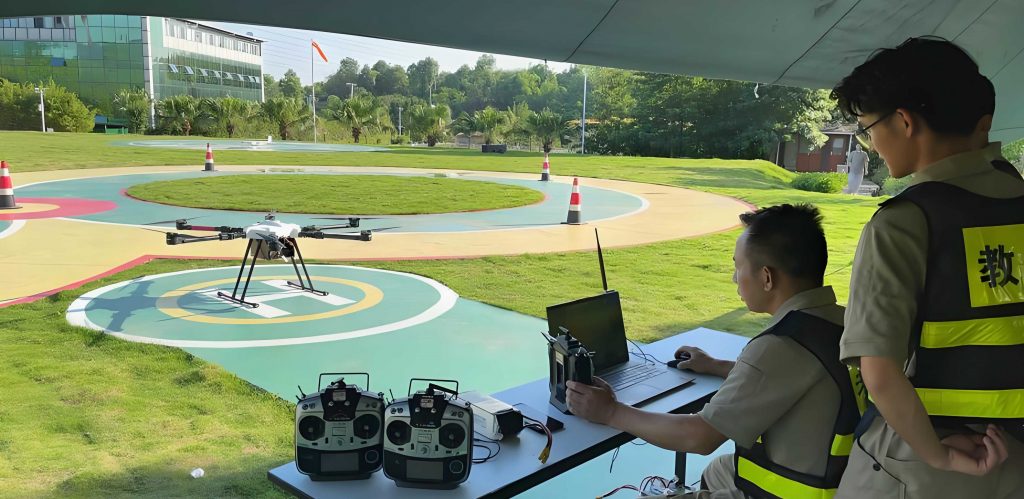
The image above captures a moment very familiar to me: a focused training session where the hum of propellers is the soundtrack of learning. It symbolizes the hands-on, immersive nature of quality drone training. My own days were filled with such scenes—starting with simulators to internalize control responses without risk, then progressing to open fields for basic maneuvers: take-off, hover, yaw turns, square patterns, and finally, more complex exercises like orbit flying and precision landing. Each failed maneuver was a lesson in physics; each successful one, a boost in confidence. The drone training regimen was methodical. We began with pre-flight procedures, which are as critical as the flight itself. A standard checklist includes verifying battery charge levels (which degrade over cycles, a factor we modeled simply as \( C_{effective} = C_{initial} \cdot (1 – \gamma)^n \), where \( \gamma \) is the degradation rate per cycle and \( n \) is the number of charge cycles), inspecting propellers for damage, checking GPS signal strength, and ensuring the home point is accurately recorded.
The market for drone training has exploded in response to the demand. It’s a vibrant, competitive landscape. Beyond dedicated aviation academies and the over 500 vocational colleges that have integrated drone programs, an interesting trend is the entry of traditional driver training schools into this airspace. They leverage their existing infrastructure, management experience, and understanding of regulated training systems to offer drone training courses. This cross-industry migration underscores the perceived longevity and economic viability of this profession. The proliferation of providers has made drone training more accessible but also necessitates careful selection by aspiring pilots. Key differentiators include the quality of instructors (who should be seasoned pilots themselves), the variety and maintenance level of training drone fleets, the availability of advanced simulators, and the success rate of students in licensing exams.
To understand the economic driver behind this drone training boom, one must look at the career prospects. The following table synthesizes indicative salary ranges and requirements for various drone pilot roles, based on aggregated job market data. This data was a constant motivator during my intensive drone training periods.
| Job Role/Industry Sector | Minimum Certification & Experience Required | Key Responsibilities | Typical Annual Salary Range (Entry to Senior) | Growth Potential & Notes |
|---|---|---|---|---|
| Aerial Surveying & Mapping Pilot | VLOS/BVLOS License + Specialized training in photogrammetry/GIS software. 1-2 years experience preferred. | Plan and execute mapping missions, process raw data into 2D/3D models, ensure data accuracy and coverage. | $45,000 – $85,000 | High growth tied to construction, mining, and urban planning. Skill in data processing is a major value adder. |
| Precision Agriculture Specialist | VLOS License + Agricultural application certification. Understanding of agronomy. | Conduct crop health scans using multispectral sensors, execute precise spraying missions, analyze data for yield prediction. | $40,000 – $75,000 | Critical for modern farming. Income often seasonal but can be high during peak periods. Business ownership potential. |
| Infrastructure Inspection Pilot (Energy, Utilities) | BVLOS License often required. Certifications in thermography, LiDAR operation. 3+ years experience typical for complex sites. | Inspect power lines, wind turbines, cell towers, pipelines. Identify defects (e.g., hot spots, corrosion) from aerial data. | $60,000 – $110,000+ | High demand due to safety and efficiency gains over manual inspection. Requires ability to work in challenging environments. |
| Drone Logistics & Delivery Pilot | BVLOS License + specific operational approval from aviation authority. Experience in logistics software. | Monitor and manage automated delivery drone fleets, handle exceptions/emergencies, maintain flight logs and compliance. | $50,000 – $90,000 | Rapidly emerging field. Role may evolve more towards fleet management and oversight as autonomy increases. |
| Drone Training Instructor | Instructor Rating + several years of professional piloting experience. Excellent communication skills. | Design and deliver drone training curricula, assess student performance, stay updated on evolving regulations and technology. | $55,000 – $95,000 | Directly benefits from the expansion of the drone training industry itself. Requires deep knowledge and patience. |
The path from a freshly certified pilot to a seasoned professional with a top-tier salary is not automatic. My drone training instructors emphasized that the license is a “learner’s permit for the sky.” Real expertise is built through accumulated flight hours, continuous learning, and specialization. We can model the competency growth of a drone pilot, \( C(t) \), as a function of training intensity \( I \), practical flight hours \( H \), and specialization effort \( S \), perhaps using a logistic growth-like function to represent diminishing returns after a plateau:
$$ C(t) = \frac{C_{max}}{1 + e^{-k \cdot (I \cdot T_{train} + \beta \cdot H(t) + \delta \cdot S(t))}} $$
Here, \( C_{max} \) is the maximum potential competency, \( k, \beta, \delta \) are coefficients, \( T_{train} \) is the formal drone training period, and \( H(t) \) and \( S(t) \) are functions of time representing experience and specialized upskilling. This model resonated with me; it framed my career development as a sustained investment beyond the initial drone training course.
The infrastructure supporting our profession is expanding rapidly. The development of low-altitude infrastructure—such as dedicated flight corridors, vertiports for electric vertical take-off and landing (eVTOL) vehicles, and robust UTM (Unmanned Traffic Management) systems—is creating entirely new application scenarios. These scenarios, in turn, generate more specialized drone training needs. For example, future drone training for urban air mobility will require modules on integrating with UTM, negotiating dynamic airspace reservations, and handling high-density operational environments. The innovation cycle is virtuous: new applications create demand for pilots, which fuels more advanced drone training, which enables even more sophisticated applications.
From an industrial policy perspective, clustering is key to maximizing the impact of the low-altitude economy. Concentrating manufacturing, software development, service providers, and drone training institutions in specific regions creates ecosystems of innovation. These clusters become magnets for talent and investment, offering pilots like myself a richer landscape of employers, collaborators, and continuous learning opportunities. The role of drone training in these clusters is foundational: it supplies the human capital that turns technological potential into economic reality.
Reflecting on my personal odyssey through drone training, the journey has been transformative. It moved me from a ground-based perspective to thinking in three dimensions. The initial challenges—the anxiety of the first solo flight, the frustration of a poorly executed maneuver, the intense study of radio frequency protocols—were all integral parts of the process. Every module of the drone training, from learning about battery chemistry to practicing emergency autoland procedures, added a layer of competence and confidence. The field is evolving so quickly that drone training is not a one-time event but a career-long commitment. New sensors, flight control algorithms, and regulatory updates mean that even experienced pilots must regularly engage in recurrent drone training.
In conclusion, the skies of tomorrow will be busy, intelligent, and integral to our daily lives. They will be patrolled, mapped, seeded, and connected by drones. The bridge to that future is being built today on training grounds and in classrooms by a new generation of pilots. Through rigorous, comprehensive drone training, we are not just learning to operate machines; we are learning to manage data, mitigate risks, and unlock economic value from the air itself. My own story is but one among hundreds of thousands, yet it reaffirms a central truth: the demand for skilled, certified, and innovative drone pilots is vast and growing. The drone training industry is the essential crucible where raw interest is forged into professional capability. As I look ahead, I see a horizon filled with opportunity, and I am grateful that my drone training has given me the wings to reach for it. The ascent continues, one controlled, calculated flight at a time.