
As I enter the space, I am immediately enveloped by a narrative that transcends mere exhibition; it is an immersive odyssey where the boundaries between technology, art, and human aspiration blur. This environment, dedicated to UAV drones, orchestrates a symphony of precision and poetry, inviting me to explore the very essence of aerial innovation. The design philosophy hinges on integrating cutting-edge technology with meticulous craftsmanship, using a palette dominated by deep blues and metallic silvers to evoke the infinite cosmos and the sleek mechanics of flight. Every element here is a deliberate gesture towards framing UAV drones not just as tools, but as embodiments of a grander quest for exploration.
The moment I cross the threshold, the spatial dynamics assert their pull. A lofty hall rises before me, its structure defined by a skeletal framework of metal that stretches upward, creating a volume that feels both immense and intimate. Overhead, a semi-transparent optical membrane cloaks the ceiling, serving as a delicate interface between the interior and the imagined sky beyond. Light passing through this dual-layer system undergoes a transformation, governed by principles of refraction. The interaction can be summarized by Snell’s Law, which describes how light bends at the interface between two media:
$$ n_1 \sin\theta_1 = n_2 \sin\theta_2 $$
Here, \( n_1 \) and \( n_2 \) represent the refractive indices of air and the membrane material, while \( \theta_1 \) and \( \theta_2 \) are the angles of incidence and refraction. This calculated bending yields a diffuse, silvery luminance that cascades down like morning mist, animating a matrix of suspended metal fragments. These elements flicker subtly, mimicking the rhythmic pulse of star clusters—a direct metaphorical link to the navigation systems inherent in advanced UAV drones. The floor, covered in a deep blue carpet with渐变 textures, resembles a night sky strewn with nebular folds; each step I take feels like traversing galactic dust, grounding the experience of UAV drones in a cosmic context.
| Element | Material/Feature | Symbolic Meaning | Technical Association with UAV Drones |
|---|---|---|---|
| Main Hall Ceiling | Semi-transparent optical membrane, metal matrix | Infinite sky, data flow visualization | Emulates avionics sensor arrays and light-based navigation |
| Flooring | Blue gradient carpet | Celestial expanse, starry night | Represents the operational domain of UAV drones |
| Structural Framework | Metal骨架, 6m height | Technological骨架, grandeur | Mirrors the airframe and load-bearing structures of UAV drones |
| Staircase | Deep blue and matte white materials | Vertical ascent, journey narrative | Analogous to flight paths and altitude gain in UAV drones operations |
Moving deeper, I encounter the staircase—a central circulatory element that doubles as a curated pathway. The treads alternate between dark blue and muted white, their surfaces engineered to soften ambient sound, creating an acoustically subdued ascent. This attention to sensory detail mirrors the noise-reduction technologies sought in modern UAV drones. Flanked by handrails that play with虚实 contrasts, the staircase’s geometry achieves a state of balanced asymmetry through polygonal transitions. As I ascend, exposed components are displayed linearly along one side, akin to a theatrical reveal of internal mechanics. This sequential unveiling underscores the narrative that UAV drones are marvels of layered engineering, where every part plays a critical role.
The core exhibition zone, which I now approach, is conceived as a tribute to “wing deployment”—the very act that defines UAV drones. Here, silver anodized aluminum panels form a three-dimensional honeycomb deck, upon which conceptual UAV drones models are poised. The wall behind curves in a sweeping, surreal arc, reminiscent of the perfect aerodynamic line traced by a vehicle breaking the sound barrier. This curve is not arbitrary; it follows principles of fluid dynamics, capturing the essence of wind resistance and lift. The force of drag, for instance, can be expressed as:
$$ F_d = \frac{1}{2} \rho v^2 C_d A $$
where \( \rho \) is air density, \( v \) is velocity, \( C_d \) is the drag coefficient, and \( A \) is the cross-sectional area. The wall’s form visualizes the optimization of such forces, crucial for UAV drones efficiency. The aluminum surfaces themselves are treated with multi-layer nano-etching, resulting in textures that resemble magnified circuit pathways or sensor arrays. Under light, these etched patterns create flowing silver veins, evoking the silent data streams that govern UAV drones navigation. This interplay of light and texture can be modeled using reflectance equations, where the intensity \( I \) of reflected light depends on the angle of incidence and surface roughness:
$$ I = I_0 \cdot R(\theta) \cdot f(\sigma) $$
Here, \( I_0 \) is incident intensity, \( R(\theta) \) is the Fresnel reflectance factor, and \( f(\sigma) \) is a function accounting for surface roughness \( \sigma \). Such details transform the wall into a topographical map of UAV drones’ electronic神经 systems, each groove and ridge acting like a mechanical neuron awaiting activation.
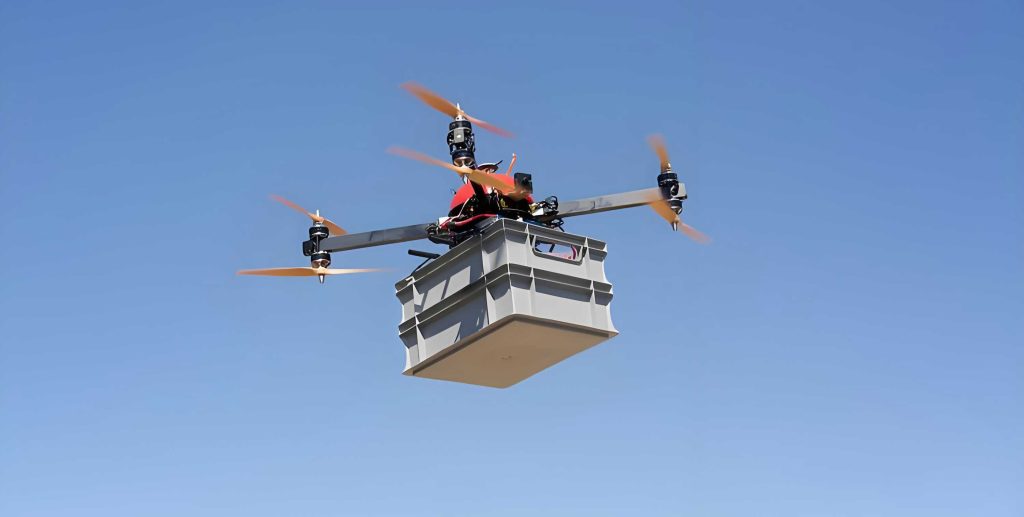
Adjacent to this, near the curtain wall, a landing platform extends into the space with a bold, sweeping arc. Its base is constructed from ultrathin titanium sheets laminated together—a feat of material science that ensures featherlight weight coupled with immense load-bearing capacity, much like the airframes of high-end UAV drones. The edge detailing involves弧形收口压型, where metal is press-molded under high pressure to form a continuous smooth曲面 with minimal倒角. When light grazes this edge, the entire platform seems sheathed in liquid silver. Suspended titanium拉杆, arranged in a biomimetic骨骼 structure, support aluminum照明悬臂. These serve dual purposes: as light sources and as structural nodes in a precise力学 network. The load distribution across such a system can be analyzed using statics formulas. For a cantilevered beam, the bending moment \( M \) at a distance \( x \) from the support is given by:
$$ M(x) = F \cdot (L – x) $$
where \( F \) is the applied force and \( L \) is the length of the beam. This integration of form and function mirrors the engineering rigor behind UAV drones, where every component must balance aesthetic elegance with物理 integrity.
| Material/Technique | Exhibition Application | Property/Process | Parallel in UAV Drones Design |
|---|---|---|---|
| Anodized Aluminum with Nano-etching | Wall cladding, honeycomb decks | Multi-layer蚀刻, light-diffusive纹理 | Sensor housing, heat dissipation surfaces, structural lightweighting |
| Titanium Sheet Lamination | Landing platform base | High strength-to-weight ratio,弧变收口 | Fuselage construction, rotor blades, payload frames |
| Optical Soft Membrane | Ceiling system | Double-layer refraction, diffuse transmission | Canopy materials for cameras, protective lens covers |
| Metal Matrix Suspension | Overhead installation | Dynamic光影 interaction, modular arrangement | Swarm coordination algorithms, communication relay networks |
As I navigate further, the experience transitions into a realm of perceptual unboundedness. The design achieves what I term “horizon effacement”—where visual boundaries dissolve, and one’s senses engage directly with the materiality of technology. The textures here are not passive; they are active conduits for understanding UAV drones. Through tactile encounters with cool metal, reflections of shifting light, and the subtle hum of hidden systems, I perceive the core of UAV drones innovation: the浪漫 within精密计算, the飞行理想 encased in what might seem like cold machinery. This alignment between human perception and technological artifact is crucial. It can be framed using信息 theory, where the amount of information \( I \) transmitted through a design element is a function of its novelty and integration:
$$ I = \log_2 \left( \frac{1}{P(x)} \right) $$
with \( P(x) \) being the probability of encountering such a stimulus in ordinary contexts. Here, every material, curve, and light beam is calibrated to maximize this informational yield about UAV drones.
The integration of UAV drones technology with spatial narrative reaches its zenith in areas dedicated to interaction and contemplation. For instance, a secluded会谈区 employs monochromatic schemes and refined acoustics to foster discussions about UAV drones’ future applications. Similarly, an office space for technical staff is designed with minimal distractions, emphasizing focus and precision—values paramount to UAV drones development. These zones are not mere backdrops; they are active participants in the ecosystem that creates and deploys UAV drones. The flow between spaces can be modeled as a network, where each node (zone) has a specific function, and the edges (pathways) facilitate transitions. The efficiency of such a layout can be evaluated using graph theory metrics, such as connectivity \( C \):
$$ C = \frac{2E}{N(N-1)} $$
where \( E \) is the number of connections and \( N \) is the number of nodes. An optimal layout for an exhibition on UAV drones would maximize \( C \) to ensure seamless visitor movement and engagement.
In reflecting on the journey, I realize that this space is more than a showcase; it is a manifesto for the future of UAV drones. It argues that the evolution of UAV drones is not solely a technical trajectory but also a cultural and aesthetic one. The materials—white stone slabs, metal panels, glossy white boards, wood-grain stainless steel, cement paint, white gradient glass, sapphire blue carpet—are not arbitrarily selected. Each is chosen for its ability to convey specific qualities: durability, reflectivity, warmth, or futurity. These choices mirror the material selections in UAV drones manufacturing, where composites, alloys, and polymers are tailored for performance under extreme conditions. The interplay of these materials creates a dialectic between the organic and the engineered, much like how UAV drones bridge natural environments and human ingenuity.
| Sensory Modality | Design Stimulus | Emotional/Cognitive Response | Link to UAV Drones Technology |
|---|---|---|---|
| Visual | Gradient lighting, reflective surfaces, curved forms | Awe, clarity, perception of infinity | Enhanced visibility for UAV drones cameras, LiDAR mapping aesthetics |
| Tactile | Smooth metal, textured carpets, cool finishes | Connection to material reality, appreciation of craftsmanship | Ergonomics of UAV drones controllers, durability of components |
| Auditory | Sound-absorbing materials, subtle ambient tones | Focus, immersion, reduced cognitive load | Noise reduction in UAV drones propellers, acoustic stealth技术 |
| Spatial | High ceilings, open plans, guided pathways | Freedom, exploration, structured discovery | Flight airspace management, autonomous navigation algorithms |
The culmination of this experience is a profound understanding that UAV drones represent a pinnacle of interdisciplinary achievement. From the aerodynamic curves frozen in architecture to the data streams hinted at by etched metal, every detail conspires to tell a story of ascent—both literal and metaphorical. The design employs mathematical elegance to underscore this narrative. For example, the curvature of walls and platforms often follows golden ratio proportions or parametric equations, symbolizing the optimized forms found in nature and engineered into UAV drones. A parametric curve in three dimensions might be described as:
$$ \vec{r}(t) = \langle f(t), g(t), h(t) \rangle $$
where \( t \) is a parameter, and \( f, g, h \) are functions defining the shape. Such curves embody the seamless integration of aesthetics and functionality that defines both the space and UAV drones themselves.
In conclusion, as I prepare to leave, the space lingers in my mind as a testament to the epic of flight. UAV drones are not merely objects within this hall; they are the protagonists of a narrative woven into the very fabric of the design. The careful orchestration of light, material, form, and flow has created an environment where technology transcends its utilitarian roots to become a source of inspiration. This approach not only educates about UAV drones but also elevates them to cultural icons. The future of UAV drones, as hinted here, lies in continuing this synthesis—where every advancement in precision, autonomy, or capability is matched by a deepening of its expressive potential. Ultimately, this exhibition hall stands as a beacon, illuminating the path for UAV drones to soar not just through skies, but through human imagination.