
The evolution of Unmanned Aerial Vehicles (UAVs) has fundamentally altered the landscape of modern operations, transcending their initial roles as mere surveillance tools. Today, they represent a cornerstone of distributed, networked systems capable of executing complex, coordinated tasks. My research focus lies in understanding the underlying mechanisms that enable multiple UAVs, or a drone formation, to act as a cohesive unit. This coordination, whether for strategic defense or breathtaking artistic display, relies on shared principles of autonomy, communication, and collective decision-making. This article explores the modeling and evaluation of such collaborative systems, drawing insights from tactical scenarios and extending them to the rapidly evolving domain of large-scale automated entertainment, epitomized by the modern formation drone light show.
The tactical problem is clear: countering agile, potentially stealthy aerial threats requires a response that is faster, more adaptable, and more resilient than traditional, centrally piloted platforms can provide. A single UAV, no matter how advanced, possesses limited sensor reach and tactical options. However, a networked group, or a formation drone team, can distribute sensors, share data instantaneously, and execute synchronized maneuvers, creating a synergistic combat effect far greater than the sum of its parts. The core challenge is to model and evaluate the effectiveness of such a system. How does the addition of specialized nodes, like early-warning drones, change the outcome? What is the optimal size for a drone formation given a specific threat and area of responsibility? The answers to these questions are critical for effective operational deployment.
To investigate these dynamics, I employ Agent-Based Modeling and Simulation (ABMS). ABMS is a powerful paradigm for simulating the actions and interactions of autonomous entities (agents) to assess their effects on the system as a whole. Each UAV is modeled as an intelligent agent with its own sensors, rules, and objectives. This bottom-up approach is ideal for capturing emergent behaviors—the complex group tactics that arise not from a single command but from the localized interactions between agents following relatively simple rules. This mirrors the decentralized control often envisioned for future formation drone light show fleets, where hundreds of drones autonomously maintain position and execute pre-programmed flight paths based on local neighbor information.
The conceptual framework for agent behavior is the classic OODA (Observe-Orient-Decide-Act) loop. This cycle provides a robust structure for modeling the decision-making process of each agent within the drone formation:
- Observe: The agent gathers data from its environment using onboard sensors (e.g., radar, electro-optical). In a formation drone light show, this equates to each drone using GPS, inertial measurement units (IMUs), and potentially ultra-wideband radio to ascertain its precise location relative to its neighbors and the global reference frame.
- Orient: The agent fuses its own sensor data with information received from teammates to build a coherent situational picture. In combat, this means identifying and tracking threats. In a show, it means understanding its target position in the evolving 3D image.
- Decide: Based on the oriented picture and predefined rules or mission objectives, the agent selects a course of action. For a fighter UAV, this could be “intercept target Bravo.” For a show drone, it is “move to coordinate set [X,Y,Z] at velocity V.”
- Act: The agent executes the decision, adjusting its flight path, preparing a weapon, or simply moving to the next waypoint. The loop then repeats continuously.
The agent’s internal logic, often implemented as a finite state machine, governs the transitions between these OODA states. For example, an attack UAV agent’s states might include: Patrol, Track, Engage, Weapon_Guidance, and Assess. The conditions for transition—such as detecting a target, entering weapon range, or losing a track—are mathematically defined thresholds. The core kinematic and sensor models for each agent type are summarized below:
| Agent Type | Key Parameters (Combat Context) | Key Parameters (Show Context) |
|---|---|---|
| Attack UAV | Detection Range (R_d), Cruise Speed (V_c), Weapon Count (N_w), Weapon Range (R_w) | Positional Accuracy (σ_p), Max Acceleration (a_max), LED Color/Intensity Commands |
| Early-Warning UAV | Extended Detection Range (R_ew > R_d), No Weapons | Reference Beacon, Master Timing Node |
| Munition (e.g., Missile) | Average Speed (V_m), Maximum Range (R_m), Single-Shot Probability of Kill (P_k) | Not Applicable |
| Show Drone | Not Applicable | Battery Life (t_b), Communication Latency (t_l), Inter-Drone Safe Distance (d_s) |
In a tactical simulation, the engagement begins with a “Blue” force of intruding aircraft and a “Red” force of defending UAVs. The Red formation drone team is tasked with area denial. Performance is measured using key metrics. The primary metric is the Intercept Rate (IR), defined as the proportion of Blue aircraft successfully neutralized before they can complete their attack run.
$$ IR = \frac{N_{blue, intercepted}}{N_{blue, total}} $$
A secondary, and tactically crucial, metric is the Mean Intercept Distance (D̄) from the defended asset. A longer average intercept distance signifies a more effective outer layer of defense.
$$ \bar{D} = \frac{1}{N_{blue, intercepted}} \sum_{i=1}^{N_{blue, intercepted}} D_i $$
where $D_i$ is the distance from the defended asset at the moment the i-th Blue aircraft is intercepted.
Running Monte Carlo simulations (e.g., 2000 runs per scenario) accounts for the stochastic nature of detection, engagement, and weapon effects. The results reveal non-linear relationships between team composition and effectiveness. For instance, consider a scenario with 2 attacking UAVs versus 2 intruders. As the UAVs’ detection range ($R_d$) increases, performance improves but exhibits saturation. The reason is bounded by weapon capability: even if a target is detected at 200 km, the UAV must still close to within its missile’s effective “no-escape” envelope (e.g., 80 km) to launch. Thus, the benefit of improved sensors is capped by the kinetic reach of the formation drone team’s weapons.
| UAV Detection Range ($R_d$) [km] | Intercept Rate (IR) | Mean Intercept Distance ($\bar{D}$) [km] |
|---|---|---|
| 80 | 0.33 | 305 |
| 100 | 0.42 | 327 |
| 120 | 0.44 | 337 |
| 140 | 0.43 | 340 |
Similarly, scaling the size of a homogeneous attack drone formation yields diminishing returns. While adding more drones from 2 to 4 significantly boosts the IR from 0.44 to 0.70, further increasing to 6 or 8 provides smaller marginal gains (IR ~0.79-0.80). This suggests an optimal fleet size exists for a given threat density and patrol area, beyond which resource efficiency drops. The most significant leap in effectiveness comes from introducing heterogeneity. Replacing one attack UAV in a 4-drone team with a dedicated early-warning UAV, which has a much larger $R_{ew}$ but carries no weapons, boosts performance markedly.
| Formation Composition | Intercept Rate (IR) | Mean Intercept Distance ($\bar{D}$) [km] |
|---|---|---|
| 4 × Attack UAV | 0.70 | 413 |
| 1 × Early-Warning + 3 × Attack UAV | 0.84 | 452 |
This underscores a critical principle: in a networked formation drone system, information superiority can be more valuable than incremental firepower. The early-warning node accelerates the team’s collective OODA loop, allowing shooters to be positioned more effectively long before the threat enters their own sensor range. This concept of layered sensing and decision-making is directly analogous to the architecture of a complex formation drone light show. A master control node (like the early-warning UAV) broadcasts a global timeline and reference frame, while individual drones (like the attack UAVs) use local coordination algorithms to maintain precise relative positions, creating a resilient and scalable system.
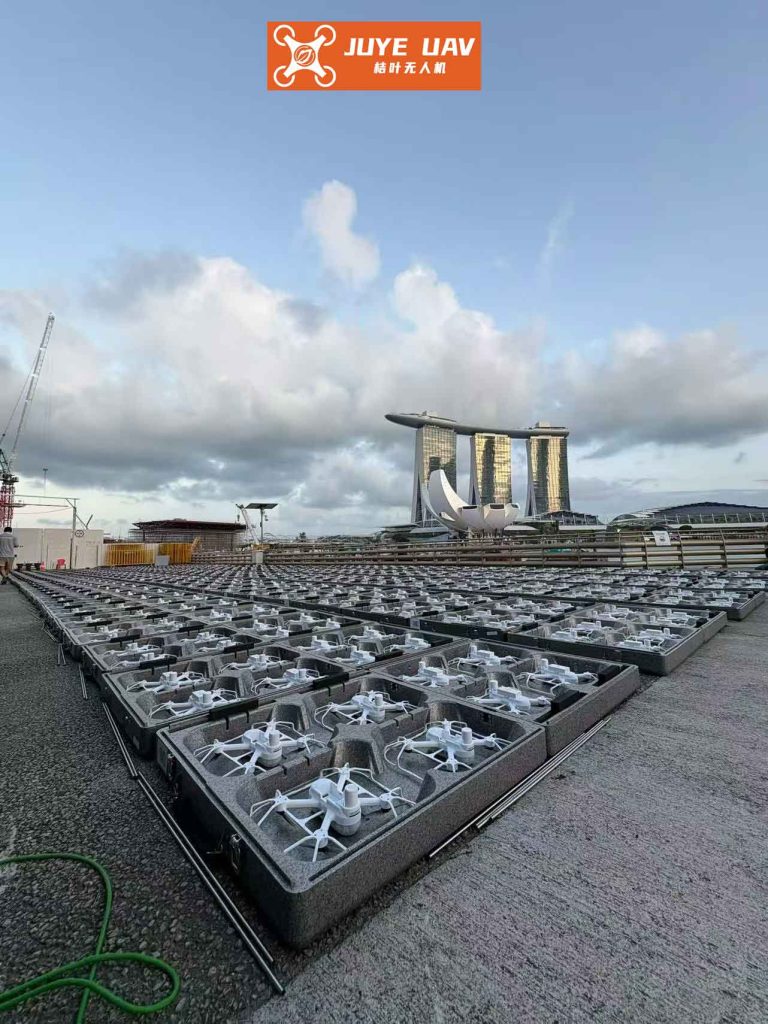
The transition from military simulation to entertainment application is fascinating. The core technologies—precise GNSS navigation, robust mesh networking, and distributed flocking algorithms—are identical. The objective simply shifts from maximizing intercept distance to maximizing visual impact and reliability. A formation drone light show is, in essence, a peacetime demonstration of extreme multi-agent coordination. Each drone is an agent following a meticulously choreographed path defined by a time-series of 3D coordinates: $ \vec{P}_i(t) = [x_i(t), y_i(t), z_i(t)] $ for drone $i$.
The “Observe” phase involves each drone constantly determining its own state $ \vec{S}_i = [\vec{P}_i, \vec{V}_i, \vec{\Theta}_i] $ (position, velocity, attitude). The “Orient” phase involves receiving state information from immediate neighbors to ensure formation integrity. A common algorithm for maintaining shape is the consensus-based controller, where the desired acceleration for drone $i$ is based on its deviation from its target trajectory and the deviations of its neighbors:
$$ \vec{a}_i^{des} = k_p (\vec{P}_i^{target} – \vec{P}_i) + k_v (\vec{V}_i^{target} – \vec{V}_i) + \sum_{j \in \mathcal{N}_i} k_f (\vec{P}_j – \vec{P}_i – \vec{d}_{ij}^{des}) $$
Here, $k_p$, $k_v$, and $k_f$ are gain constants, $\mathcal{N}_i$ is the set of neighbors for drone $i$, and $\vec{d}_{ij}^{des}$ is the desired offset between drone $i$ and $j$. This creates a virtual elastic structure—the formation—that is resilient to minor perturbations. The “Decide” and “Act” phases involve solving for the motor commands needed to achieve $\vec{a}_i^{des}$ and synchronizing the RGB LED output to the global show clock, $T_{show}$. The performance metrics change entirely: Key Performance Indicators (KPIs) for a formation drone light show include:
- Formation Accuracy ($\sigma_{form}$): The standard deviation of the actual drone positions from their intended points in the 3D shape.
- Synchronization Error ($\Delta T_{sync}$): The maximum timing error in color/brightness changes across the entire fleet.
- Show Reliability ($R_{show}$): The probability that all drones complete the entire performance without critical failure (e.g., mid-air collision, early battery depletion).
$$ R_{show} = \exp\left(-\lambda_{fail} \cdot N_{drones} \cdot t_{show}\right) $$
Where $\lambda_{fail}$ is the failure rate per drone per hour, $N_{drones}$ is the fleet size, and $t_{show}$ is the show duration. This equation highlights the exponential reliability challenge of scaling a formation drone light show to thousands of units, demanding exceptional hardware robustness and fault-tolerant algorithms.
The simulation methodologies are mutually informative. ABMS used for combat analysis can be adapted to stress-test show logistics and fault recovery. Conversely, the real-world data from millions of flight hours logged by commercial formation drone light show companies provides invaluable data on swarm reliability and communication latency in dense, urban RF environments—data that is highly relevant for modeling military swarm tactics in contested electromagnetic spectra.
In conclusion, the coordinated operation of UAV formations, whether for tactical advantage or artistic spectacle, is governed by universal principles of multi-agent systems. Through Agent-Based Modeling grounded in the OODA framework, we can quantitatively evaluate design trades: the value of specialized agents, the optimal scale of a team, and the criticality of information-sharing latency. The analysis demonstrates that effectiveness scales non-linearly, with information often trumping sheer numbers. The spectacular formation drone light show is not merely an entertainment product; it is the most visible and publicly accessible validation of the advanced coordination algorithms that will define the next generation of autonomous systems. It proves that controlling a vast formation drone fleet to create delicate, luminous shapes in the night sky is a solved engineering problem—a foundation upon which more critical applications in security, logistics, and disaster response are actively being built. The symphony of lights is a prelude to a future where synchronized drone formations are an integral part of our technological ecosystem.