
The relentless pursuit of advanced aerial platforms has driven engineers beyond the conventional paradigms of fixed-wing and rotary-wing flight. In the quest for superior agility, low-speed maneuverability, and energy-efficient hovering, the natural world offers a masterclass in bio-fluid dynamics. Among nature’s fliers, the butterfly stands out as a creature of particular intrigue and complexity. Its flight appears almost whimsical—a series of seemingly erratic flaps and body undulations. Yet, this apparent chaos masks a highly sophisticated and efficient aerodynamic system. This article delves into the intricate biomechanics of butterfly flight and articulates the comprehensive design philosophy, mechanical implementation, and control architecture for a next-generation **bionic butterfly drone**. By translating nature’s secrets into engineering principles, we present a novel electromechanical model that serves as both a research platform for fundamental fluid dynamics and a prototype for a new class of micro-aerial vehicles (MAVs).
Traditional MAVs often struggle with the competing demands of stable hover, efficient forward flight, and rapid maneuverability. The **bionic butterfly drone** concept challenges these trade-offs by embracing a morphologically inspired design. Butterflies possess distinct features: wings with exceptionally low aspect ratio, complex planform geometry, and a flight kinematic that involves not just wing flapping but pronounced body pitching and heaving motions. This unique combination, observed in species like *Morpho peleides*, suggests unexplored aerodynamic mechanisms capable of generating high lift at low Reynolds numbers (typically 1,000 to 5,000). Our mission is to decode these mechanisms through a high-fidelity experimental model, thereby paving the way for drones that can hover and dart with the grace and efficiency of their biological counterparts.
1. Deconstructing Butterfly Flight: The Biological Blueprint
The design of an effective **bionic butterfly drone** must be rooted in accurate biological data. Extensive studies on neotropical butterflies have quantified their key morphological and kinematic parameters. The butterfly’s wing is not merely a low-aspect-ratio plate; it is a carefully shaped membrane with a complex venation structure that provides both structural integrity and controlled flexibility. The body, while seemingly passive, is an active participant in the flight dynamic.
The kinematics are fundamentally different from well-studied insects like bees or dragonflies. A butterfly’s stroke plane is nearly perpendicular to its body axis during hover. Crucially, the wings do not undergo a pronounced rotational flip at the stroke reversals as seen in many other insects. Instead, the body itself executes significant synchronized motions: a pitching oscillation about its center of mass and a substantial heaving (vertical) translation. Computational studies suggest these body motions are not merely a byproduct but are essential for force balance and lift enhancement in hover. The primary design parameters extracted from biological observation are summarized below.
| Parameter Category | Symbol | Typical Biological Value | Description & Implication for Design |
|---|---|---|---|
| Wing Geometry | R, c, λ | R ≈ Wing Span c ≈ 0.0955 m (Mean Chord) λ ≈ 1.57 |
Low aspect ratio (λ) wing is central to the model. It dictates unique vortex formation and requires a rigid yet lightweight construction. |
| Flapping Kinematics | Φ(t), Φm, A | Φm ≈ 87° A ≈ 130° f ≈ 9 Hz (Biological) |
Wing angle relative to stroke plane. Large amplitude (A) and high mean stroke angle (Φm) are defining features. The model replicates this with a simple harmonic motion. |
| Body Kinematics (Hover) | ZE(t), θb(t) | ZE amplitude ≈ ±0.55c θb amplitude ≈ ±15° Body pitch: 30° mean |
The body heaves vertically and pitches. These degrees of freedom are coupled and essential for replicating true butterfly aerodynamics in a bionic butterfly drone. |
| Dynamic Similarity | Re | 1,000 – 5,000 | Reynolds number range for butterflies. The experimental model operates in water to achieve dynamically similar Re with larger scale and slower, observable motions. |
The governing equation for the wing flapping motion is derived as a simple harmonic function:
$$
\Phi(t) = \Phi_m – \frac{A}{2} \cos\left(\frac{2\pi t}{T}\right)
$$
where \( \Phi(t) \) is the instantaneous stroke angle, \( \Phi_m \) is the mean stroke angle, \( A \) is the total stroke amplitude, and \( T \) is the period of flapping. For a hovering simulation, the body motions are approximated as:
$$
Z_E(t) = 0.55c \cdot \sin\left(\frac{2\pi (t+0.05T)}{T}\right) – 0.17c
$$
$$
\theta_b(t) = \frac{\pi}{12} \cos\left(\frac{2\pi t}{T}\right) + \frac{\pi}{12}
$$
where \( Z_E \) is the vertical body position and \( \theta_b \) is the body pitch angle. These equations form the kinematic core for controlling the **bionic butterfly drone** model.
2. The Electromechanical Muse: Design and Implementation of the Model
Translating the biological blueprint into a functional physical model presents significant engineering challenges. The primary goal was to create a system that could independently and accurately control wing flapping, body pitching, and body heaving in a coupled manner, while minimizing interference with the surrounding flow field—a critical requirement for precise fluid dynamics experiments like Particle Image Velocimetry (PIV).
The core philosophy was to separate the actuation mechanism from the fluid observation volume. The model itself, comprising a body and two wings, is submerged in a water tank. All motors and primary drives are located above the water surface, connected to the model via slender, streamlined shafts. This architecture is fundamental to the integrity of the experimental data collected for the **bionic butterfly drone** concept.
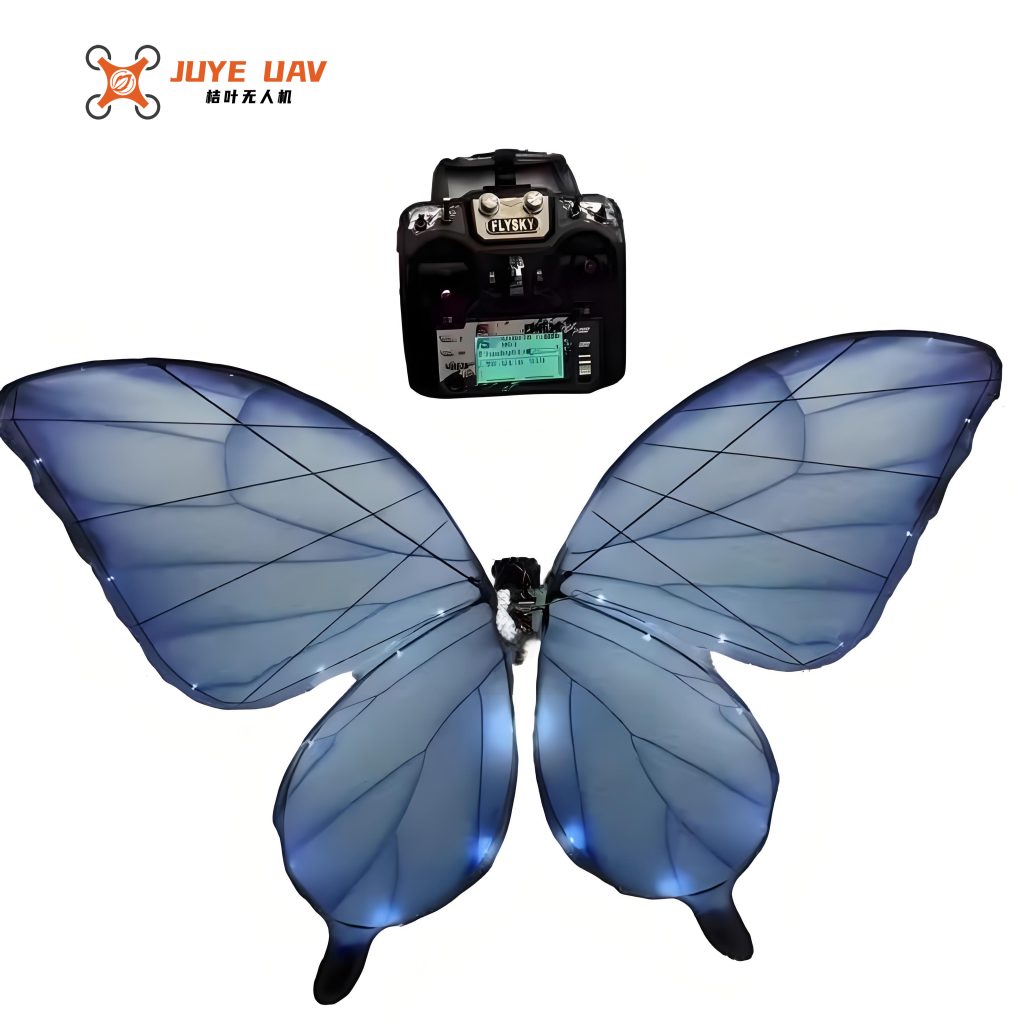
2.1 Morphological Replication: The Physical Model
The model’s geometry was scaled from biological measurements to a workable laboratory size while preserving the essential ratios. The wing planform was laser-cut from thin stainless steel sheet (0.5 mm) to ensure rigidity and precise shape. The body was machined from aluminum alloy as a cylindrical form, split longitudinally to allow internal routing for dye injection tubes used in flow visualization. The wings are attached to the body via flexible membrane hinges, simulating the compliant connection found in nature. Key model dimensions are: Wing Span (R) = 0.15 m, Mean Chord (c) = 0.0955 m, yielding an Aspect Ratio (λ) = 1.57. Operating in water with a flapping period T between 10-20 seconds achieves a Reynolds number range of 1,632 to 3,264, perfectly matching the biological Re regime.
2.2 Kinematic Realization: The Drive Train Architecture
The drive system is a masterpiece of coordinated motion control, designed to deliver three key degrees of freedom (DOF) with high precision.
- Wing Flapping (1 DOF): A single servo motor (Motor 1) drives a central gearbox via a shaft and universal joint. The gearbox is designed with mirrored output shafts that rotate in opposite directions, each connected to a wing root. This mechanism ensures perfectly symmetric flapping of both wings according to the harmonic law \( \Phi(t) \).
- Body Pitching (1 DOF): A second servo motor (Motor 2) drives a four-bar linkage connected to the main model housing. This causes the entire submerged model—wings and body—to rotate about a designated pitch axis, executing the \( \theta_b(t) \) motion.
- Body Heaving (1 DOF): Two electric linear translation stages (Stages 1 & 2) are mounted orthogonally. They move the entire assembly of Motors 1, 2, and the connecting shafts in the horizontal (X) and vertical (Z) directions. Their coordinated movement is programmed not only to produce the desired body heave \( Z_E(t) \) but also to compensate for any unwanted translation of the body’s center of mass caused by the fact that the physical pitch axis is not perfectly aligned with the model’s computed center of mass.
This compensation is vital for simulating a true hover, where the body oscillates but its average position remains fixed in space. If the pitch axis is offset from the CoM by a distance \( L \), the pitch motion alone would induce parasitic CoM translation. The translation stages must therefore execute an additional corrective motion. The required correction displacement \( (S_X, S_Z) \) and velocity \( (V_X, V_Z) \) for the stages are calculated as:
$$
S_X = -L (\cos\theta_b(t) – \cos\theta_{b0})
$$
$$
V_X = L \sin\theta_b(t) \cdot \dot{\theta}_b(t)
$$
The net commanded motion for the vertical stage then becomes the sum of the hover heave and the pitch compensation: \( S_Z = Z_E(t) + [-L(\sin\theta_b(t) – \sin\theta_{b0})] \). This complex, coordinated control is what allows our **bionic butterfly drone** model to faithfully replicate the subtle, coupled kinematics of real butterfly flight.
2.3 Precision Alignment: The Adjustment Platform
For detailed PIV measurements, the model must be positioned with micron-level accuracy relative to the laser light sheet and camera. A separate adjustment platform provides three additional, manually controlled degrees of freedom: two rotational stages to orient the wing vertically and perpendicular to the laser sheet, and a transverse translation stage to scan different spanwise sections of the wing through the measurement plane. This ensures that every region of the **bionic butterfly drone** wing’s flow field can be systematically investigated.
3. The Brain of the Butterfly: Motion Control and System Integration
The kinematic equations are translated into precise actuator commands. High-precision DC servo motors with optical encoders (500 counts per revolution) and planetary gear reducers are used for both flapping and pitching motions. The linear stages employ similar servo motors driving precision lead screws. All four actuators are controlled synchronously via a digital motion controller programmed in PVT (Position-Velocity-Time) mode.
The control functions for a hover cycle (T=20s) are as follows:
- Motor 1 (Flapping): Follows \( \Phi(t) = 87^\circ – 65^\circ \cdot \cos(2\pi t / T) \).
- Motor 2 (Pitching): Follows \( \theta_b(t) = 15^\circ \cdot \cos(2\pi t / T) + 15^\circ \).
- Linear Stage 1 (X-compensation): Follows \( S_X(t) \) and \( V_X(t) \) as defined above.
- Linear Stage 2 (Z-heave & compensation): Follows the combined \( S_Z(t) \) and \( V_Z(t) \) function.
A critical validation test involved running the model with all four actuators engaged in hover simulation, but with the intended body heave command \( Z_E(t) \) set to zero. In a perfectly compensated system, the model’s CoM should remain stationary despite the pitching and flapping. Video tracking analysis confirmed the CoM drift was limited to approximately 0.005 m, which is only about 5% of the mean chord length. This high level of kinematic fidelity confirms that the **bionic butterfly drone** model is capable of producing a clean, reproducible flow field suitable for quantitative analysis.
| Actuator | Function | Core Components | Control Function (for Hover) | Performance Metric |
|---|---|---|---|---|
| Servo Motor 1 | Wing Flapping | RE35 motor, 120:1 gearbox | $$ \Phi(t) = 87^\circ – 65^\circ \cos(2\pi t / T) $$ | Precise harmonic motion, amplitude 130° |
| Servo Motor 2 | Body Pitching | RE35 motor, 120:1 gearbox, linkage | $$ \theta_b(t) = 15^\circ \cos(2\pi t / T) + 15^\circ $$ | Accurate ±15° oscillation |
| Linear Stage 1 (X) | CoM Compensation | RE40 motor, 4.3:1 gearbox, 4mm lead screw | $$ S_X(t) = -L (\cos\theta_b(t) – \cos\theta_{b0}) $$ | Eliminates horizontal CoM drift |
| Linear Stage 2 (Z) | Body Heave + Compensation | RE40 motor, 4.3:1 gearbox, 5mm lead screw | $$ S_Z(t) = Z_E(t) – L (\sin\theta_b(t) – \sin\theta_{b0}) $$ | Produces ~1.1c heave amplitude; minimizes vertical drift |
4. Experimental Framework and Envisaged Insights
The primary purpose of this sophisticated **bionic butterfly drone** model is to serve as a scientific instrument for uncovering fluid dynamic secrets. It is installed over a large water tank (1.2m x 1.0m x 0.95m depth). The water medium allows for slower motion scaling while maintaining dynamic similarity (matching Reynolds number), making complex vortex structures visible and measurable.
Flow Visualization: The model is equipped with a network of tiny tubes leading to critical points on the wings (leading edge, trailing edge, root) and body. By injecting colored dyes (e.g., red and blue) during flapping, we can visually track the formation, evolution, and interaction of vortices. This provides immediate qualitative insight into the leading-edge vortices (LEVs), tip vortices, and wake capture processes that are hypothesized to be central to the high-lift mechanism in butterfly flight.
Particle Image Velocimetry (PIV): This is the core quantitative technique. The water is seeded with fine, neutrally buoyant particles. A high-power laser sheet illuminates a plane of interest (e.g., a cross-section at 50% wing span). A high-speed digital camera captures the motion of particles in this plane at successive instants during the flapping cycle. Sophisticated cross-correlation software then calculates the full-field, instantaneous velocity vectors. From this velocity field, crucial derived quantities like vorticity \( (\omega = \nabla \times \vec{v}) \), circulation, and instantaneous pressure fields can be computed. The PIV data allows us to directly measure the strength and stability of the LEV, quantify the momentum imparted to the fluid, and ultimately calculate the lift and thrust forces generated by the **bionic butterfly drone** wing throughout its stroke.
5. Beyond the Lab: Implications for Autonomous Bionic Butterfly Drones
While the current model is a tethered experimental platform, the principles it embodies have direct and profound implications for the development of free-flying **bionic butterfly drone** vehicles. The key lessons translate as follows:
1. Embrace Coupled Body-Wing Dynamics: The proof that body pitching and heaving are integral to force generation suggests that future flapping-wing MAVs should not treat the body as a passive payload. Active or passively resonant body motions could significantly enhance aerodynamic efficiency and maneuverability.
2. Low-Aspect-Ratio Wings for Agility: The butterfly’s wing planform, while less efficient for steady glide, facilitates rapid roll and yaw maneuvers by allowing for highly differential control of the left and right wings. A **bionic butterfly drone** could achieve unparalleled agility in cluttered environments.
3. Energy-Efficient Hovering Strategies: The specific kinematic patterns—large stroke amplitude, near-vertical stroke plane, and synchronized body motion—may point to methods for generating sufficient lift with lower peak power requirements than in hummingbird-style flapping, potentially leading to longer endurance hover.
4. Scalability and Morphing Structures: Understanding the fluid-structure interaction in the flexible membrane wings of a butterfly could inform the design of adaptive, morphing wings for a **bionic butterfly drone** that change shape or camber dynamically for optimal performance across different flight regimes.
6. Conclusion and Future Trajectory
The development of this electromechanical model represents a significant leap forward in the biomimetic engineering of insect flight. It is not merely a mimic but a high-precision analytical tool that captures the essential morphological and kinematic complexity of butterfly hover. By successfully integrating wing flapping with active body pitching and heaving in a dynamically scaled, flow-transparent apparatus, we have created the definitive platform for interrogating the unresolved questions in butterfly aerodynamics.
The experimental data generated—from qualitative dye visualizations to quantitative, time-resolved PIV velocity fields—will provide the first complete, physics-based explanation for how butterflies generate lift. This knowledge is the foundational bedrock upon which practical **bionic butterfly drone** technology can be built. The next steps involve conducting the comprehensive PIV campaign, using the data to validate and refine computational fluid dynamics (CFD) models, and ultimately feeding these insights into the design of lightweight, untethered, autonomously controlled prototypes. The journey from biological curiosity to engineering reality is well underway, promising a future where drones flutter with the silent, efficient, and mesmerizing agility of the butterfly.