
I have always been fascinated by humanity’s quest to conquer the skies. In recent years, this fascination has crystallized around a particular technology: the unmanned aerial vehicle, or drone. My observation of its evolution, particularly within China, tells a story not just of technological prowess, but of profound societal transformation. The moment that truly cemented this view for me was during the catastrophic floods in Henan in July 2021. When traditional communication networks failed, cutting off entire towns, a unique solution took to the skies. Messages of hope were broadcast, and emergency signals were located, not from a cell tower, but from a drone hovering overhead. This wasn’t science fiction; it was a powerful, real-world demonstration of how China drone technology had become a lifeline.
That drone, part of the Wing Loong series, represents just one branch of a vast and growing family. Today, the applications of drones are limited only by our imagination. In scientific research, they collect atmospheric samples; in agriculture, they precision-spray crops; in logistics, they promise rapid deliveries; and in entertainment, they offer breathtaking aerial vistas. The core technologies—avionics, sensors, autonomous navigation, and data links—have converged to create tools of immense versatility. The potential is encapsulated in a fundamental operational metric, the endurance-range product, which drone designers constantly strive to maximize:
$$ \text{Operational Coverage} = E \times V \times \eta_{\text{payload}} $$
Where \(E\) is endurance (hours), \(V\) is cruising velocity (km/h), and \(\eta_{\text{payload}}\) is the efficiency factor of the specific payload (e.g., camera, sensor package). The relentless improvement in this product for China drone platforms is what enables missions from long-endurance reconnaissance to complex aerial surveys.
The journey to this point, however, is a relatively recent chapter in aviation history. Globally, drone development followed a path deeply intertwined with conflict and later, commercial innovation.
The Global Context: A Timeline of UAV Evolution
The genesis of drones is often traced back to military necessity. The high cost of losing trained pilots in World War I accelerated the development of remotely controlled aircraft. The following table outlines the key phases in global drone development:
| Era | Period | Key Developments & Characteristics | Primary Use |
|---|---|---|---|
| Germination | 1910s – 1930s | First radio-controlled aircraft (USA, 1917). British “Queen Bee” (1935) as a reusable target drone. Basic stability and control systems. | Target practice, proof-of-concept. |
| Military Expansion | 1940s – 1990s | Rapid advancement during Cold War. Reconnaissance (e.g., U.S. AQM-34 Firebee). 1982 Bekaa Valley conflict: Israeli drones used for SEAD (Suppression of Enemy Air Defenses). 1991 Gulf War: widespread tactical reconnaissance. | Reconnaissance, electronic warfare, target designation. |
| Commercial & Diversification | 2000s – Present | Proliferation of GPS, miniaturized sensors, and advanced composites. Rise of consumer quadcopters. Expansion into agriculture, inspection, filmmaking, and logistics. Integration of AI for autonomy. | Myriad civilian and commercial applications alongside advanced military roles (strike, MALE/HALE surveillance). |
This global trajectory set the stage. While the initial chapters were written elsewhere, the story of the China drone industry is one of remarkable acceleration and scale, catching up and then carving out its own leading path.
The Rise of the China Drone Ecosystem
Compared to the century-long global history, China’s systematic engagement with drone technology began much later. The first successful flight of a domestic unmanned aircraft occurred in the late 1960s. For decades, development was primarily focused on military target drones and basic reconnaissance models. The real turning point came in the early 21st century, fueled by a combination of strategic necessity, entrepreneurial spirit, and a booming electronics manufacturing base.
The market is broadly split into two segments with distinct characteristics, a duality that defines the China drone landscape:
| Parameter | Industrial/Enterprise Drone | Consumer Drone |
|---|---|---|
| Core Objective | Task completion and data acquisition for business processes. | Aerial imaging, videography, and personal recreation. |
| Key Metrics | Endurance, payload capacity, reliability, data accuracy, regulatory compliance. | Ease of use, camera quality, portability, flight stability, price. |
| Economic Model | High unit cost, ROI-driven, often part of a service package (Drone-as-a-Service). | High volume, lower unit cost, direct-to-consumer sales. |
| Typical Payloads | Multispectral sensors, LiDAR, thermal cameras, gas detectors, delivery mechanisms. | High-resolution RGB cameras with gimbals. |
| Design Philosophy | Robustness, modularity, mission-specific optimization. | Integration, aesthetics, user-friendly interface. |
The success in both segments can be partially modeled by a simplified growth equation, where the advancement of the China drone sector (\(G_{CD}\)) is a function of several key factors:
$$ G_{CD}(t) = \alpha \cdot I_{R\&D}(t) + \beta \cdot M_{Supply}(t) + \gamma \cdot P_{Talent}(t) + \delta \cdot D_{Market}(t) $$
Here, \(I_{R\&D}\) represents R&D investment intensity, \(M_{Supply}\) is the strength of the local manufacturing supply chain (exceptionally high in regions like the Pearl River Delta), \(P_{Talent}\) is the pool of engineering talent, and \(D_{Market}\) is both domestic and international demand. The coefficients \(\alpha, \beta, \gamma, \delta\) have proven highly favorable in China’s context over the past two decades.
Soaring Dragons: The Military-Technical Prowess
The story of high-altitude, long-endurance (MALE) drones like the Wing Loong series is a testament to focused innovation. In the early 2000s, observing the operational success of foreign platforms like the Predator, Chinese aerospace engineers identified a critical capability gap. The development journey was initially constrained, starting with limited dedicated resources. The breakthrough came from leveraging existing knowledge from manned aircraft programs and adopting an iterative, pragmatic development cycle.
The Wing Loong’s evolution showcases a rapid maturation curve. Its progression is not merely linear but exponential in terms of capability integration, following a composite improvement function:
$$ C_{\text{Wing Loong}} \propto \int (P_{\text{Propulsion}} \cdot S_{\text{Avionics}} \cdot W_{\text{Payload}})\, dt $$
Where the capability \(C\) is proportional to the integral over time of the product of advances in Propulsion efficiency, Sensor/avionics sophistication, and Weapons/Payload integration. Key milestones are summarized below:
| Timeline | Model / Milestone | Key Specification Leap | Strategic Significance |
|---|---|---|---|
| 2007 | Wing Loong I First Flight | Max Takeoff Weight (MTOW): ~1,100 kg. Endurance: ~20 hours. | Proof of domestic MALE UAV concept. Established basic reconnaissance-strike architecture. |
| 2016/2017 | Wing Loong II Unveiling & First Flight | MTOW: ~4,200 kg. Endurance: ~32 hours. Enhanced payload capacity and variety. | Placed Chinese UAV in same class as leading international counterparts. Major export success. |
| 2019 Onwards | Continued Iterations & Variants | Integration of satellite comms, AI-aided targeting, swarming capabilities, and specialized payloads (e.g., electronic warfare). | Transition from a single-platform tool to a core node in network-centric warfare. Demonstrated high reliability in real-world operational conditions. |
A critical technological hallmark developed was the robust autonomous return and recovery system, a fail-safe that operates independently of continuous data link. This reliability, coupled with a competitive cost structure defined by the equation \( \text{Value} = \frac{\text{Capability}}{\text{Cost}} \), positioned Wing Loong series as a dominant force in the global export market. Today, the China drone presence in the military export sector is formidable, consistently ranking among the world’s top suppliers and altering the strategic dynamics in several regions.
The Consumer Revolution: Defining a Global Category
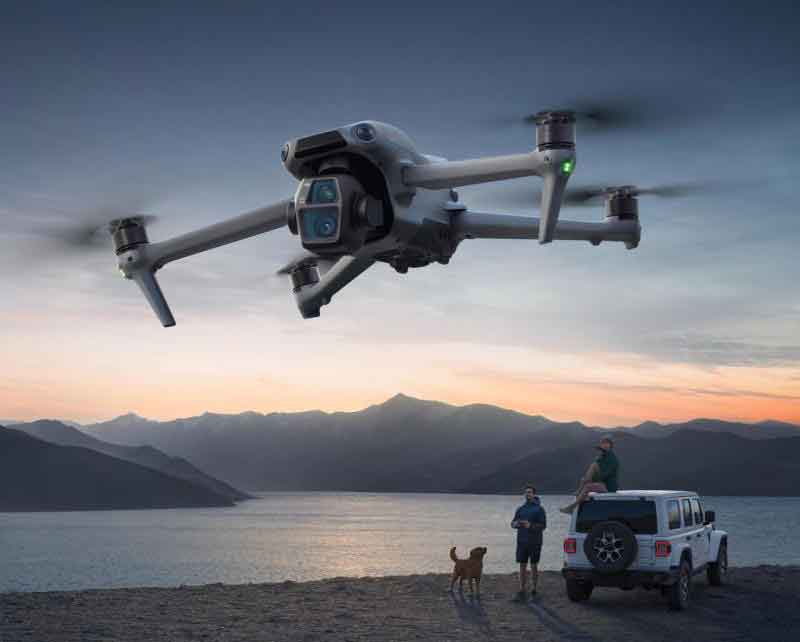
If the military sector demonstrates technical depth, the consumer sector reveals scale and market-defining innovation. Here, the narrative is inseparable from one company: DJI. From its origins in a Shenzhen apartment, DJI did not just enter the market; it created and dominated the global consumer drone category. The formula was elegant: integrate stabilizing gimbals with high-quality cameras, wrap them in intuitive flight control software, and manufacture at scale.
The consumer drone’s value is heavily driven by the quality of its aerial imaging output. A key performance metric is the effective image resolution at a given altitude, which depends on the sensor and lens:
$$ GSD = \frac{H \times p}{f} $$
Where \(GSD\) is the Ground Sampling Distance (a measure of resolution, lower is better), \(H\) is flight altitude, \(p\) is the camera sensor pixel pitch, and \(f\) is the lens focal length. DJI’s relentless optimization of this chain—better sensors, sharper lenses, and rock-solid stabilization—kept it ahead. Their market dominance can be expressed as a massive share of the global consumer drone revenue function:
$$ R_{\text{global}}(t) \approx \sum_{i} (P_i(t) \cdot Q_i(t)) $$
and
$$ \frac{R_{DJI}(t)}{R_{\text{global}}(t)} > 0.70 \quad \text{for much of the past decade} $$
Where \(P_i\) and \(Q_i\) are price and quantity for various consumer drone models. This dominance cemented Shenzhen’s status as the “Drone Capital of the World,” supported by an unparalleled ecosystem of suppliers for motors, flight controllers, batteries, and carbon fiber parts. This ecosystem lowers the barrier for entry and fosters innovation, fueling the entire China drone industry.
Future Trajectories: Autonomy, Integration, and Challenges
Looking forward, the path for China drone technology points toward greater autonomy, deeper integration into urban and industrial airspace, and more sophisticated applications. Concepts like drone swarms for light shows or coordinated operations are becoming reality, governed by distributed control algorithms. A simple model for a cohesive swarm’s movement can be inspired by flocking rules:
$$ \vec{v}_i(t+1) = w_1 \vec{v}_i(t) + w_2 \vec{v}_{\text{align}} + w_3 \vec{v}_{\text{cohere}} + w_4 \vec{v}_{\text{separate}} + \vec{v}_{\text{goal}} $$
Where an individual drone’s velocity is updated based on its previous velocity, alignment with neighbors, cohesion toward the group center, separation to avoid collisions, and a goal-oriented component.
Beyond entertainment, the future lies in Urban Air Mobility (UAM) and automated logistics. The economic viability of such networks will depend on solving complex optimization problems for routing and fleet management, minimizing a cost function \(J\):
$$ J = \sum_{k} (C_{\text{energy},k} + C_{\text{time},k} + C_{\text{risk},k}) $$
subject to constraints: battery life, airspace regulations, weather, and payload delivery windows.
Challenges remain, notably in regulation, public acceptance, and cybersecurity. However, the foundational strengths are clear. From the life-saving missions over disaster zones to the stunning visuals in global media, and from strategic defense exports to the democratization of aerial photography, China drone technology has ascended to a position of global leadership. It is a powerful narrative of how targeted investment, manufacturing prowess, and entrepreneurial vision can converge to not just follow a trend, but to define the future of an entire technological domain. The sky is no longer the limit; it is the domain where this chapter of innovation is being written.