
As a technology analyst and enthusiast observing the rapid evolution of emergency response systems, I have witnessed the transformative integration of unmanned aerial systems into public safety. Specifically, the application of fire drone technology within the firefighting sector represents a paradigm shift, moving from a niche concept to an indispensable operational asset. A fire drone, or unmanned aerial vehicle (UAV) purpose-built or adapted for fire service missions, fundamentally operates through a synergy of remote control, automated flight systems, and sophisticated sensor payloads. This technological amalgamation enables the execution of critical tasks in environments deemed too hazardous, time-sensitive, or complex for human first responders to initially enter. The core demand from the fire service for such technology is clear: to gain a decisive informational and operational advantage during fire suppression, search and rescue, and post-incident analysis, thereby enhancing personnel safety and mission efficacy.
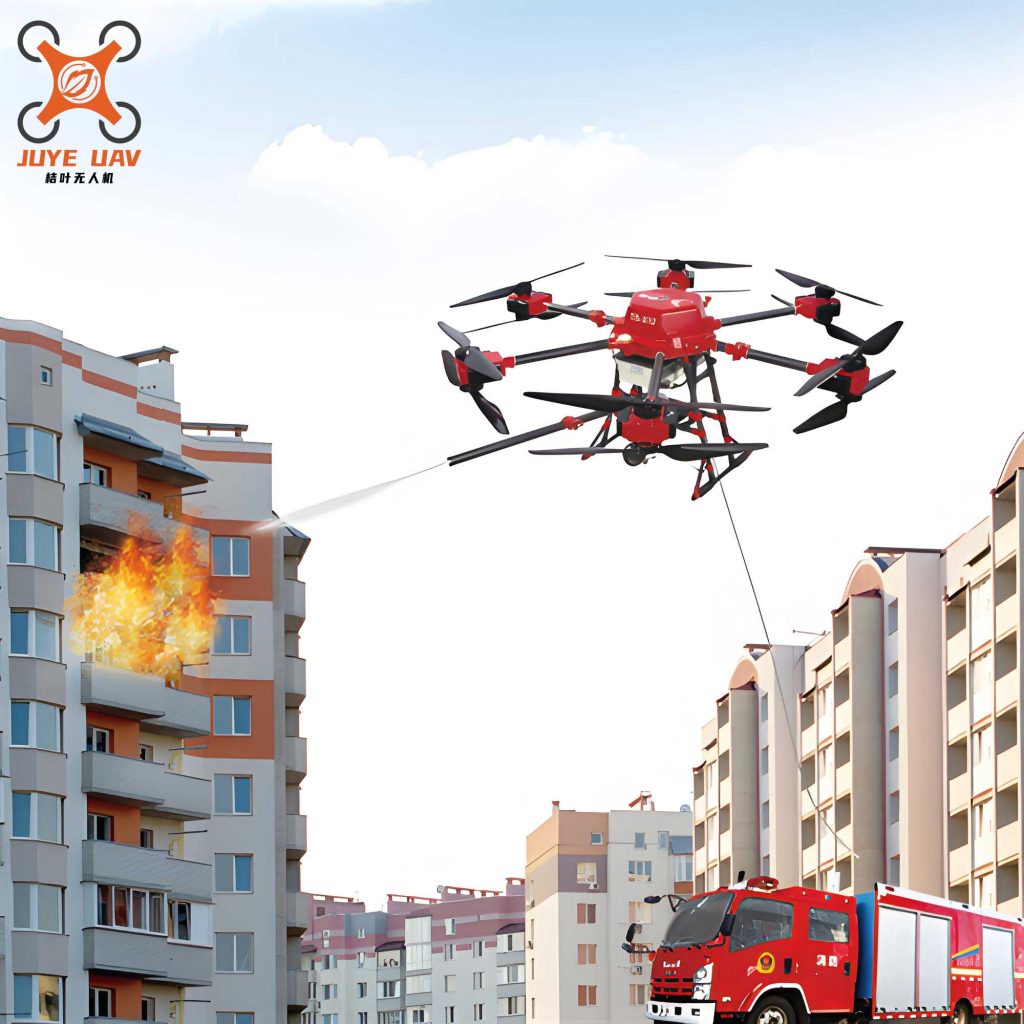
The operational canvas for the modern fire drone is vast, spanning the three critical phases of any fire-related incident: pre-suppression intelligence, active response, and post-event assessment. In the chaotic initial moments of a fire, the primary advantage of a fire drone is its ability to project a sensing platform ahead of ground crews. Deploying a fire drone equipped with high-definition visual and thermal imaging cameras provides command staff with an instantaneous “eye in the sky.” This capability allows for the rapid mapping of fire perimeter, identification of seat(s) of the fire, detection of trapped individuals via thermal signatures, and assessment of structural integrity. The real-time data link transforms situational awareness, moving from informed guesswork to data-driven decision-making. For instance, the thermal data can pinpoint hidden fire pockets behind walls or under roofs, a task fraught with danger for firefighters conducting traditional reconnaissance. The speed of deployment and the breadth of perspective offered by a fire drone are simply unattainable by conventional means in the same timeframe.
| Operational Phase | Primary Tasks of Fire Drone | Key Technological Advantage | Impact on Fireground Operations |
|---|---|---|---|
| Fire Reconnaissance & Intelligence | Rapid aerial assessment, thermal imaging for hot spots & victims, gas detection, live video feed. | Beyond Visual Line of Sight (BVLOS) sensing, real-time telemetry. | Faster size-up, accurate resource deployment, enhanced firefighter safety, improved tactical planning. |
| Active Fire Suppression & Rescue | Direct attack with suppressants (water, foam, dry chem), delivery of emergency equipment, illumination, communication relay. | Precision payload delivery, stability in turbulent environments. | Access to difficult-to-reach areas, initial attack to contain spread, support for interior teams, extended operational window at night. |
| Post-Incident Assessment & Investigation | High-resolution mapping, 3D modeling of structural damage, forensic documentation of fire origin and spread patterns. | Photogrammetry, LiDAR scanning, persistent aerial observation. | Accurate damage assessment, safer investigation process, creation of permanent visual records for analysis and reporting. |
During active firefighting and rescue operations, the role of the fire drone evolves from a scout to an active participant. Specialized fire drone platforms are now capable of carrying integrated payloads for direct intervention. These can range from lightweight drop systems for deploying fire retardant balls or emergency supplies to victims, to more robust systems featuring pressurized liquid or foam delivery mechanisms. The tactical advantage is significant: a fire drone can approach a hazardous materials fire from a safe stand-off distance, apply suppressant to a roof fire without requiring a ground ladder deployment, or cool down an exposed propane tank threatening to explode. Furthermore, by acting as an airborne communications node, a fire drone can bolster failing radio signals in complex urban or wildland environments, ensuring seamless coordination among dispersed teams. This dual role of tool and infrastructure highlights the versatile nature of the modern fire drone.
The final, yet crucial, phase where the fire drone proves its worth is in the aftermath. Conducting a thorough and safe damage assessment or fire origin investigation is a painstaking process. A fire drone equipped with high-resolution mapping cameras can systematically survey the entire incident scene, generating orthomosaic maps and detailed 3D models. These models allow investigators to virtually navigate the site, take precise measurements, and analyze burn patterns without entering potentially unstable structures. The data permanence and analytical depth provided by fire drone-collected data far surpass traditional photographic methods. The efficiency gain is quantifiable, compressing what used to take days of manual work into a few hours of automated flight and data processing.
| Drone Platform Type | Typical Endurance | Payload Capacity | Optimal Mission Profile | Key Limiting Factors |
|---|---|---|---|---|
| Multi-rotor (Quadcopter, Hexacopter) | 20-45 minutes | 1-20 kg | Close-range reconnaissance, tactical delivery, structure inspection, short-duration monitoring. | Endurance, vulnerability to high winds, limited speed. |
| Fixed-Wing | 60-120+ minutes | 0.5-5 kg | Large-area reconnaissance (wildfires), long-duration patrol, mapping/ surveying. | Requires launch/landing area, limited hover capability, lower payload for size. |
| Hybrid VTOL (Vertical Take-Off and Landing) | 45-90 minutes | 3-10 kg | Medium-range missions requiring both hover and efficient transit, extended-area search. | Mechanical complexity, higher cost, currently less common. |
| Heavy-Lift Multi-rotor | 15-30 minutes | 20-100+ kg | Direct firefighting (water/foam payloads), transport of heavy equipment. | Very high power consumption, significant logistical footprint, regulatory hurdles. |
The advantages of integrating fire drone technology are profound and multi-faceted. The most critical is the enhancement of firefighter safety. By delegating high-risk initial reconnaissance and certain suppression tasks to a fire drone, personnel are kept out of immediately dangerous environments. The operational efficiency is also dramatically improved. The time saved in initial assessment directly translates to faster, more targeted attacks, often contained within the crucial early stages of fire development. This can be expressed as a simple conceptual formula where overall response effectiveness (E) is a function of situational awareness (SA) and time (T):
$$ E_{response} = k \int_{t_0}^{t_1} SA(t) \, dt $$
Here, $E_{response}$ represents the cumulative effectiveness of the response, $SA(t)$ is the situational awareness as a function of time, integrated from the incident start time $t_0$ to a later time $t_1$, and $k$ is a proportionality constant representing resource efficiency. A fire drone dramatically increases the $SA(t)$ function from the earliest moments ($t_0$), leading to a steeper rise in cumulative effectiveness. Furthermore, the cost-benefit analysis is compelling. While the initial investment in a capable fire drone system and training is significant, it pales in comparison to the cost of specialized aerial apparatus like helicopters, not to mention the potential human and property costs averted through more effective operations.
However, the path to ubiquitous and flawless fire drone integration is not without substantial challenges. The most persistent technical hurdle remains endurance. The high energy demand from lift, stabilization, and payload operation severely limits flight time, especially for larger fire drone platforms carrying heavy suppressants. Battery technology is improving, but the power-to-weight ratio remains a key constraint. Mathematically, the available flight time $T_{flight}$ can be modeled as:
$$ T_{flight} = \frac{E_{battery}}{P_{hover} + P_{payload} + P_{avionics}} $$
where $E_{battery}$ is the total energy capacity of the power source, $P_{hover}$ is the power required to maintain flight, $P_{payload}$ is the power for operating the mission-specific payload (e.g., pump, camera gimbal), and $P_{avionics}$ is the power for flight control and communications. Innovations in hydrogen fuel cells or hybrid generators are being explored to increase $E_{battery}$ without a proportional weight penalty.
Another critical challenge is communication reliability and cybersecurity. A fire drone depends on a continuous, secure data link for control and video transmission. In dense urban canyons, inside large structures, or in remote wildlands, maintaining this link is problematic. Signal interference, multipath propagation, or intentional jamming poses serious operational risks. The development of robust, encrypted, and frequency-agile communication systems, potentially using mesh networks between multiple drones, is essential. Furthermore, as fire drone systems become more intelligent, they become targets for cyber-attacks, necessitating hardened software architectures.
The evolution towards true autonomy and intelligent swarming represents both the next frontier and a significant challenge. While current fire drone operations rely heavily on skilled pilots, future systems will need advanced AI for autonomous navigation in GPS-denied, smoky, and dynamic environments. Object avoidance, real-time path re-planning around collapsing structures, and intelligent interpretation of sensor data (e.g., distinguishing between a heat signature from a fire and from a sun-baked roof) require immense computational power and sophisticated algorithms. The concept of a swarm of cooperative fire drones—where one acts as a communication relay, several map the fire from different angles, and others perform targeted suppression—introduces complex challenges in decentralized control and collective decision-making.
The operational environment for a fire drone is not solely defined by technology but is heavily shaped by the legal and regulatory framework. Globally, aviation authorities are grappling with integrating UAVs into national airspace, with firefighting often receiving special, but not unregulated, consideration. In many jurisdictions, operations beyond the visual line of sight (BVLOS) of the pilot, which is crucial for large-scale firefighting, require specific and often difficult-to-obtain waivers. Regulations concerning flying over people, at night, or near other aircraft create a complex web of permissions that must be navigated during emergencies. The payload capacity of a fire drone, especially for liquid discharge, also intersects with regulations, as heavier drones fall into different certification categories.
| Regulatory Domain | Typical Challenges for Fire Departments | Potential Mitigation Strategies |
|---|---|---|
| Airspace Integration & BVLOS Flight | Obtaining timely waivers for emergency BVLOS ops, coordinating with manned aircraft (helicopters). | Pre-approved contingency corridors, integrated UTM (Unmanned Traffic Management) systems, dedicated emergency service frequency protocols. |
| Operations Over People & in Populated Areas | Legal restrictions on flying over crowds or non-participants, even during emergencies. | Development of risk-mitigation frameworks for public safety ops, use of tethered fire drone systems for persistent stare in sensitive areas. |
| Pilot Certification & Training Standards | Ensuring pilots have both aviation knowledge and fireground tactical understanding. | Development of nationally recognized Public Safety UAS certification programs, regular scenario-based training. |
| Data Management & Privacy | Handling and storing video/imagery that may capture private property or individuals. | Clear departmental policies on data retention, use of software that automatically blurs non-essential private details. |
Looking ahead, the future trajectory of fire drone technology is incredibly promising. We are moving towards a new generation of more resilient, intelligent, and specialized systems. Advances in materials science will yield lighter and more heat-resistant airframes. Propulsion systems will become more efficient, directly addressing the endurance challenge. Sensor fusion—combining thermal, visual, LiDAR, and multispectral data—will be processed in real-time by onboard AI to provide commanders with not just raw data, but actionable intelligence and predictive analytics. For example, a fire drone could analyze fire spread patterns and building materials to predict a potential collapse or flashover event minutes before it occurs.
The concept of the “mothership” or large carrier UAV deploying smaller tactical fire drones is also gaining traction. This would allow for rapid forward deployment of multiple specialized drones deep into a wildfire or across a large industrial complex. Furthermore, the standardization of payload interfaces will allow a single fire drone platform to be rapidly reconfigured from a mapping tool to a communications hub to a suppression unit in minutes, vastly increasing operational flexibility. The ultimate goal is a seamless human-machine teaming where the fire drone acts as a force multiplier, handling the perilous, the tedious, and the data-intensive tasks, freeing and informing human firefighters to make the highest-level decisions and perform the uniquely human acts of rescue. The fire drone is not a replacement for the firefighter; it is their ever-vigilant, indefatigable, and fearless partner in the ongoing mission to protect life and property.