
The advent of low-altitude, small unmanned aerial vehicles (UAV drones) has profoundly transformed the field of remote sensing. These platforms, characterized by their lightweight airframes, operational flexibility, and relatively low cost, have democratized access to high-resolution geospatial data. The integrated UAV drone remote sensing system, which synergizes the aerial platform, navigation, communication, and imaging payloads, is now indispensable for applications ranging from precision agriculture and infrastructure inspection to emergency response and environmental monitoring. However, as mission requirements grow more complex and diverse, inherent limitations in current systems become apparent. Challenges such as short endurance, sensitivity to atmospheric disturbances, poor interoperability between payloads and platforms, and a reliance on extensive manual operation hinder efficiency and scalability. This analysis delves into the operational characteristics and current technological landscape, proposing a cohesive framework for evolution centered on the synergistic optimization of lightweight design and artificial intelligence (AI). We contend that the future of low-altitude UAV drone remote sensing lies in the convergence of four critical pathways: AI-enabled autonomy, platform/payload standardization, integrated structural design, and strategic miniaturization.
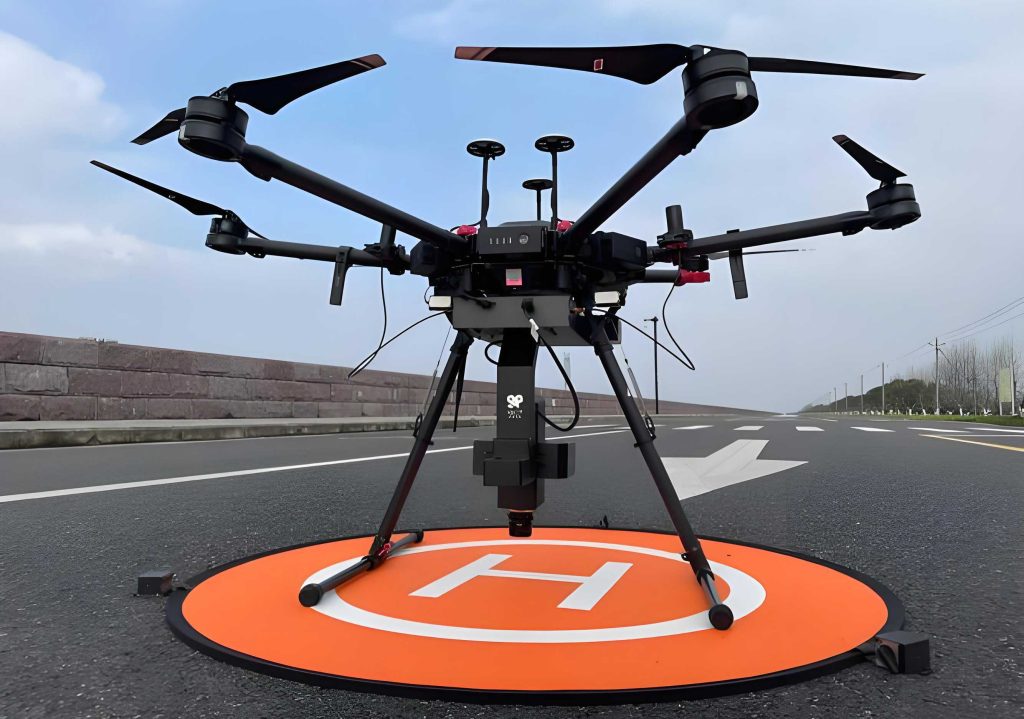
The core mission of a UAV drone in remote sensing is image acquisition. The typical flight profile is markedly distinct from that of military or high-altitude platforms. It involves low-altitude (often below 500m AGL), low-speed flight with a simple profile: takeoff, climb to cruise altitude, transit to the area of interest, execution of a pre-planned raster-scan or polygonal flight path for coverage, return, and landing. This profile, while operationally simple, presents unique control and design challenges. The primary performance indicators for such a UAV drone system include endurance, cruising speed, payload capacity, wind resistance, and ease of deployment. Analysis of prevalent commercial and research systems reveals a landscape where these metrics are often traded off against one another. For instance, multi-rotor UAV drones offer vertical take-off and landing (VTOL) capability and superb hover stability but suffer from limited endurance. Fixed-wing UAV drones provide superior endurance and speed but require launch and recovery infrastructure. The payload capacity for most small UAV drones is under 5 kg, suitable for common electro-optical (EO) and infrared (IR) sensors, but creates a “one-to-many” compatibility challenge where a single airframe must interface with diverse payloads lacking standardized mounts and interfaces.
Operational Imperatives and Technical Challenges
The operational environment for low-altitude UAV drone remote sensing is deceptively demanding. Two primary challenges stand out: atmospheric disturbances and complex take-off/landing scenarios. Unlike controlled laboratory conditions, field operations must contend with low-altitude turbulence, wind shear, and gust fronts, especially in scenarios like post-disaster assessment or maritime surveys. These disturbances degrade flight stability and, consequently, image quality. While operating in ideal weather is preferred, mission-critical applications (e.g., wildfire monitoring, flood assessment) often necessitate operation in sub-optimal conditions. Therefore, enhancing the UAV drone’s inherent stability and its control system’s ability to reject disturbances is paramount.
Furthermore, the expectation for rapid deployment in diverse terrains—urban canyons, mountainous regions, or dense forests—makes VTOL capability highly desirable. The absence of widespread, prepared airstrips pushes the design paradigm towards hybrid or multi-rotor configurations, albeit with the aforementioned endurance penalty. The interplay between these requirements frames the optimization problem: how to maximize endurance, stability, and payload flexibility while minimizing weight, complexity, and operational footprint.
Pathway I: AI-Enabled Intelligence for Autonomous Resilience
Artificial intelligence is the cornerstone for evolving the UAV drone from a remotely piloted data collector to an intelligent, adaptive sensing node. The infusion of AI spans perception, decision-making, and control layers, directly addressing key limitations.
1. Enhanced Perception through Computer Vision: Deep learning models, particularly Convolutional Neural Networks (CNNs) and Vision Transformers, revolutionize onboard image analysis. Beyond post-processing, real-time semantic segmentation and object detection enable immediate in-situ decision-making. For example, a UAV drone mapping agricultural fields can instantly identify zones of pest infestation or nutrient deficiency, dynamically adjusting its flight path to capture higher-resolution imagery of affected areas. This closed-loop sensing-and-adaptation significantly improves mission efficiency. The onboard processing can be modeled as an optimization of a utility function $U$:
$$ U = \sum_{t=0}^{T} [\alpha \cdot I(\text{Data}_{t}) – \beta \cdot E(\text{Maneuver}_{t})] $$
where $I(\text{Data}_{t})$ quantifies the information value of data captured at time $t$, $E(\text{Maneuver}_{t})$ is the energy cost of the associated flight maneuver, and $\alpha, \beta$ are weighting coefficients learned or tuned for the mission.
2. Intelligent Navigation and Dynamic Path Planning: Traditional pre-programmed waypoint navigation falters in dynamic environments. Reinforcement Learning (RL) algorithms, such as Proximal Policy Optimization (PPO) or Deep Q-Networks (DQN), can train a UAV drone’s navigation system to handle unforeseen obstacles, no-fly zones, or changing weather patterns. By simulating millions of flight scenarios, the UAV drone learns an optimal policy $\pi^*$ that maps states $s_t$ (position, sensor data, battery level) to actions $a_t$ (heading, speed changes) to maximize a cumulative reward $R$:
$$ \pi^* = \arg\max_{\pi} \mathbb{E}_{\pi} \left[ \sum_{t} \gamma^t R(s_t, a_t) \right] $$
where $\gamma$ is a discount factor. This enables true autonomous obstacle avoidance and efficient exploration.
3. Multi-Sensor Fusion for Robust State Estimation: Precise navigation and stabilization rely on accurate state estimation. AI-driven sensor fusion algorithms, such as those based on Kalman Filters or Recurrent Neural Networks (RNNs), can optimally combine data from GNSS (GPS, BDS), inertial measurement units (IMUs), visual odometry, and barometric sensors. This is crucial for maintaining position hold and stable flight during GNSS signal denial, common in urban or forested areas. A simplified fusion model for altitude estimation can be represented as a weighted fusion:
$$ \hat{h}_{t} = \mathbf{w}_t^T \cdot [h_{\text{GNSS}, t}, h_{\text{Baro}, t}, h_{\text{VO}, t}] $$
where $\mathbf{w}_t$ is a dynamically adjusted weight vector learned by an AI model to minimize estimation error variance.
4. Adaptive Flight Control for Disturbance Rejection: Traditional PID controllers can be augmented or replaced by AI-based adaptive controllers. Neural networks can model and predict the effects of wind gusts on the UAV drone’s dynamics, enabling preemptive control actions. An adaptive controller can adjust its parameters in real-time to maintain stability, effectively increasing the operational wind envelope of the platform. The control law can be enhanced as:
$$ u(t) = K_P e(t) + K_I \int e(t)dt + K_D \frac{de(t)}{dt} + f_{\text{NN}}(\mathbf{x}_{t}, \mathbf{d}_{t}) $$
where $f_{\text{NN}}$ is a neural network output providing a compensating control signal based on the system state $\mathbf{x}_{t}$ and estimated disturbance $\mathbf{d}_{t}$.
Pathway II: Platform/Payload Standardization for Modular Flexibility
The proliferation of specialized sensors (multispectral, LiDAR, thermal, gas sensors) creates logistical complexity. Standardization of mechanical, electrical, and data interfaces between the UAV drone platform and its payloads is essential for operational agility. A universal “plug-and-play” interface would allow field crews to rapidly reconfigure a single UAV drone for multiple missions within minutes.
Core Standardization Elements:
| Interface Layer | Standard Specification | Benefit |
|---|---|---|
| Mechanical | Standardized rail/mount geometry (e.g., MIS, proprietary quick-release), weight & balance tolerances. | Secure, vibration-damped attachment without custom brackets. |
| Electrical & Power | Defined voltage rails (e.g., 12V, 24V), max current, connector type (e.g., ruggedized multipin). | Safe power delivery, eliminates custom wiring harnesses. |
| Data & Communication | Adoption of open protocols (e.g., MAVLink, ROS topics) over physical links (CAN, Ethernet, Serial). | Seamless bi-directional data flow for telemetry, control, and sensor data. |
| Software | Standardized API/SDK for payload discovery, configuration, and health monitoring. | Ground control software can auto-detect and integrate new payloads. |
The impact of such standardization can be summarized by a simple metric, Reconfiguration Time (T_reconf):
$$ T_{\text{reconf}} = T_{\text{mech}} + T_{\text{elec}} + T_{\text{calib}} $$
Standardization aims to drive $T_{\text{elec}}$ and $T_{\text{calib}}$ to near zero, leaving only the minimal physical swap time $T_{\text{mech}}$. This modularity also facilitates easier maintenance and upgrades, extending the service life of the core UAV drone platform.
Pathway III: Platform/Payload Integrated Design for Ultimate Lightweighting
Beyond attaching payloads, the next frontier is their physical and functional integration into the UAV drone’s airframe. This co-design philosophy treats the sensor not as an add-on but as a fundamental structural and aerodynamic component.
Principles and Benefits: In a traditional setup, the UAV drone’s structure and the payload’s housing are separate, leading to duplicated material, connectors, and volume. Integration seeks to eliminate this redundancy. For instance, an antenna for a synthetic aperture radar (SAR) or a communication system can be embedded directly into the wing skin or fuselage. The protective radome becomes part of the aerodynamic surface. This approach yields multiple benefits:
- Weight Reduction: By removing redundant casings and mounts, system weight can be reduced by 20% or more. This directly translates to increased endurance, as shown in the fundamental endurance equation for a fixed-wing UAV drone (Breguet’s equation simplified):
$$ E \approx \frac{\eta}{g} \cdot \frac{C_L}{C_D} \cdot \frac{1}{\text{SFC}} \cdot \ln \left( \frac{W_{\text{initial}}}{W_{\text{final}}} \right) $$
where $E$ is endurance, $\eta$ is propeller efficiency, $C_L/C_D$ is lift-to-drag ratio, SFC is specific fuel consumption, and $W$ are weights. A lower initial weight $W_{\text{initial}}$ directly increases $E$. - Improved Aerodynamics: A smoother, more streamlined profile reduces drag ($C_D$), further improving the lift-to-drag ratio and efficiency.
- Enhanced System Rigidity: The integrated structure can be stiffer, reducing vibrations that degrade sensor (especially imaging sensor) performance.
- Increased Functional Density: Freed-up space and weight budget can be used for additional batteries, larger sensors, or other subsystems.
The design challenge lies in multi-disciplinary optimization (MDO), balancing structural integrity, aerodynamic efficiency, electromagnetic transparency (for sensors), and thermal management. Advanced composite materials and additive manufacturing are key enablers for creating these complex, multifunctional structures.
Pathway IV: Strategic Miniaturization and Micro-UAV Drone Technology
The drive for ultimate portability and deployment speed pushes the boundaries of miniaturization. Micro- and nano-UAV drones (often defined as having a wingspan/motor-to-motor dimension below 50cm and weight under 200g) represent this frontier. Their development is not merely about scaling down but involves overcoming distinct physics.
Key Technological Hurdles and Innovations:
| Challenge | Description | Research Direction |
|---|---|---|
| Low-Reynolds Number Aerodynamics | At tiny scales, air behaves like a more viscous fluid. Laminar flow separation is common, reducing lift and increasing drag. $$ Re = \frac{\rho v L}{\mu} $$ where $Re$ is Reynolds number, $\rho$ is density, $v$ is velocity, $L$ is characteristic length, and $\mu$ is dynamic viscosity. For micro-UAV drones, $Re$ can be $10^4$-$10^5$, requiring specialized airfoils. | Bio-inspired designs (e.g., mimicking insect or bird wings), flapping-wing propulsion, adaptive wing morphing. |
| Micro Power Systems | Energy density is the limiting factor for endurance. Tiny electric motors are inefficient, and battery technology scales poorly at very small sizes. | Development of high-density micro-batteries, thin-film solar cells for energy harvesting, and efficient micro-power-management circuits. |
| Autonomy in SWaP Constraints | Fitting computational hardware for AI processing (e.g., for visual SLAM) within severe Size, Weight, and Power (SWaP) limits. | Algorithm lightweighting, neuromorphic computing chips, and edge-optimized AI models that trade minimal accuracy for vast efficiency gains. |
While not suitable for all remote sensing tasks due to limited payload and endurance, micro-UAV drones are ideal for confined indoor inspections, ultra-localized data collection, or swarm-based distributed sensing. Their development drives innovations in materials, propulsion, and nano-manufacturing that often trickle up to benefit larger small UAV drones.
Synergistic Integration and Performance Modeling
The true potential is unlocked when these pathways converge. An AI-powered, modular, and partially integrated micro-UAV drone represents the pinnacle of this evolution. We can model the overall system effectiveness $S$ as a multiplicative function of contributions from each pathway:
$$ S = f_{\text{AI}}(A) \cdot f_{\text{Std}}(M) \cdot f_{\text{Int}}(L) \cdot f_{\text{Mini}}(P) $$
- $f_{\text{AI}}(A)$: Effectiveness gain from autonomy level $A$ (e.g., reduced need for human intervention, better data quality).
- $f_{\text{Std}}(M)$: Flexibility gain from modularity index $M$ (e.g., number of payloads seamlessly compatible).
- $f_{\text{Int}}(L)$: Performance gain from lightweighting/integration factor $L$ (e.g., % weight saved).
- $f_{\text{Mini}}(P)$: Deployment gain from portability factor $P$ (e.g., inverse of system pack-up time).
A comparative analysis of current versus optimized future systems can be illustrated:
| Performance Metric | Current Typical System | Future Optimized UAV Drone System | Primary Enabling Pathway(s) |
|---|---|---|---|
| Mission Reconfiguration Time | > 10 minutes | < 2 minutes | Standardization, AI (auto-calibration) |
| Effective Endurance (with 500g payload) | 25-40 minutes (electric multirotor) | 60+ minutes | Integrated Design (lightweighting), AI (efficient path planning) |
| Operational Wind Tolerance | 10-12 m/s | 15-18 m/s | AI (adaptive control), Integrated Design (aerodynamics) |
| Autonomy Level | Automated waypoint navigation | Fully adaptive mission execution with obstacle avoidance | AI (Perception, RL) |
| System Pack Volume | Large case(s) | Backpack-integrated | Miniaturization, Integrated Design |
Conclusion
The evolution of low-altitude UAV drone remote sensing is at an inflection point, moving from a tool for data collection to an intelligent, adaptive, and ubiquitous sensing fabric. The challenges of endurance, robustness, and flexibility cannot be solved by incremental improvements in isolation. Instead, a holistic, synergistic strategy is required. The concurrent pursuit of AI-enabled intelligence for autonomous decision-making, platform/payload standardization for operational agility, integrated co-design for radical lightweighting, and strategic miniaturization for ultimate portability forms a powerful framework for the next generation of systems. This convergence will yield UAV drones that are not only lighter and longer-flying but also smarter and more seamlessly integrated into workflows. They will be capable of self-deploying from a backpack, navigating complex and dynamic environments, and capturing fused, actionable geospatial intelligence with minimal human oversight. The future of environmental monitoring, precision agriculture, disaster management, and infrastructure resilience will be fundamentally shaped by these lightweight, intelligent UAV drone systems, turning them into indispensable partners in understanding and managing our world.