
Hybrid rice technology represents a significant advancement in modern agriculture, contributing substantially to food security globally. Seed production is a critical phase in hybrid rice cultivation, requiring efficient pollination since the male-sterile lines rely on pollen from male parent plants for fertilization. Traditional methods, such as manual pollination, are labor-intensive, inefficient, and costly, hindering the widespread adoption of hybrid rice. In recent years, agricultural UAVs (unmanned aerial vehicles) have emerged as a promising tool for mechanized pollination, leveraging rotor-generated wind to disperse pollen over larger areas. This study investigates the efficacy of agricultural UAV-assisted pollination in hybrid rice seed production, focusing on pollination efficiency, cost reduction, and yield outcomes. We conducted comparative experiments using different planting row ratios and pollination methods, analyzing data through statistical tables and formulas to draw insights. The integration of agricultural UAVs into seed production systems can revolutionize practices by enhancing precision and scalability.
Our research was motivated by the limitations of conventional pollination techniques. Manual pollination in hybrid rice seed production often involves small row ratios, such as 1:8 to 2:12 between male and female parent plants, which demands skilled labor and has restricted mechanization potential. Agricultural UAVs offer a solution by enabling larger row ratios, such as 6:28, thus facilitating mechanized planting and harvesting. This study aims to evaluate the impact of agricultural UAV-assisted pollination on outcrossing seed set rates, yield, and operational costs. By comparing it with manual pollination, we seek to demonstrate the feasibility of agricultural UAVs for large-scale adoption in seed production regions. We emphasize the keyword “agricultural UAV” throughout this work to highlight its central role in modernizing agriculture.
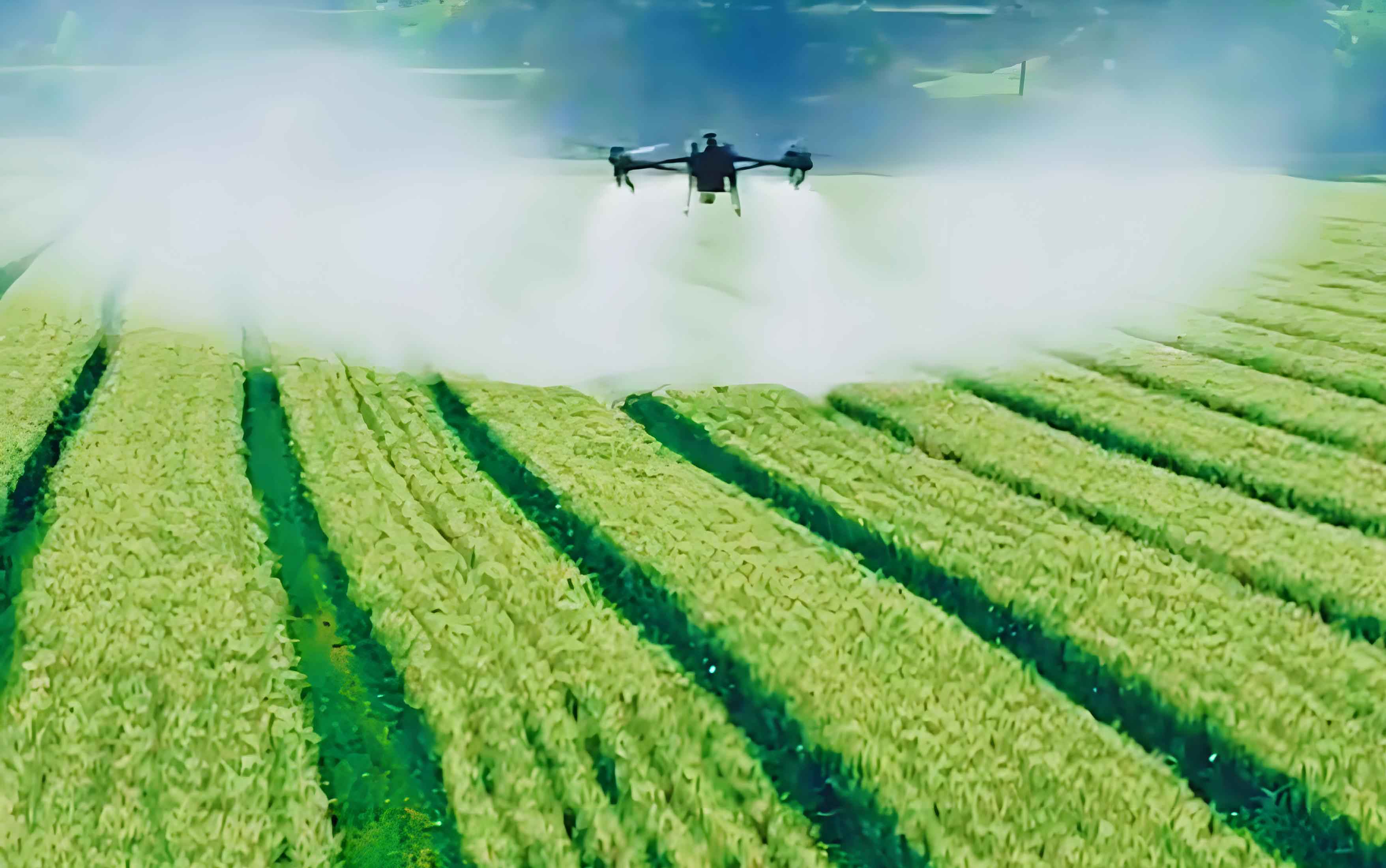
The experimental setup was designed to simulate real-world conditions. We selected three hybrid rice combinations, anonymized here as Combination A, Combination B, and Combination C, to represent diverse genetic backgrounds. The trials were conducted at an experimental site in Jiangsu Province, China, characterized by clay soil with uniform fertility and good irrigation. Soil properties included organic matter content of 23.7 g/kg, total nitrogen of 1.48 g/kg, available phosphorus of 11.8 mg/kg, and rapid potassium of 165.0 mg/kg, with a pH of 7.4. The preceding crop was wheat, ensuring a standardized baseline for cultivation. We employed a DJI T20 agricultural UAV for pollination, chosen for its autonomous flight capabilities, obstacle avoidance, and durability. Key flight parameters were optimized: speed of 4.0–4.5 m/s, altitude of 2.0–2.4 m above the canopy, and payload of 3–5 L of water for simulated pollination runs. These settings were crucial for generating adequate wind force to disperse pollen effectively.
Two planting configurations were tested: a small row ratio of 1:8 (male to female) with manual pollination, and a large row ratio of 6:28 with agricultural UAV-assisted pollination. In the small row ratio plots, male parents were transplanted at a density of 22 cm × 30 cm with 1–2 seedlings per hill, and female parents at 12 cm × 20 cm with 2–3 seedlings per hill, with a row spacing of 30 cm and plot width of 220 cm. For the large row ratio plots, male parents were transplanted at 22 cm × 30 cm with 2–3 seedlings per hill, and female parents at 12 cm × 25 cm with 3–4 seedlings per hill, with a row spacing of 30 cm and plot width of 885 cm. This design allowed us to assess the scalability of agricultural UAV-assisted pollination. The use of agricultural UAVs here underscores their adaptability to varied planting geometries.
Data collection focused on several agronomic parameters. The outcrossing seed set rate of female parents was calculated using the formula: $$ \text{Outcrossing Seed Set Rate} = \left( \frac{\text{Number of Filled Grains}}{\text{Total Number of Spikelets}} \right) \times 100\% $$ where spikelets refer to the florets on the panicles. We sampled three continuous hills per observation point, measuring total spikelets and filled grains to compute the rate. Additionally, the effective panicle number per unit area was surveyed to estimate yield potential. For yield measurement, a combine harvester with a cutting width of 2.0–2.5 m was used to harvest female plants. Prior to harvest, three points per plot were selected, each covering an area of 1–1.5 m × plot width, and the harvested seeds were dried, cleaned, and weighed to calculate seed yield based on the female parent area proportion. This methodological rigor ensured reliable comparisons between agricultural UAV-assisted and manual pollination.
The growth periods of male and female parents were monitored to ensure flowering synchronization, a critical factor for successful pollination. Table 1 summarizes the sowing, transplanting, and heading dates for the three combinations under mechanized seed production conditions. All combinations exhibited good flowering overlap, indicating that the agricultural UAV-assisted system did not disrupt phenological alignment. The data highlight the suitability of these combinations for UAV-based pollination, as timely flowering is essential for maximizing pollen transfer efficiency. Agricultural UAVs can be precisely scheduled to operate during peak flowering hours, further enhancing synchronization.
| Combination | Parent Type | Sowing Date | Transplanting Date | Heading Date | Days from Sowing to Heading |
|---|---|---|---|---|---|
| Combination A | Male 1 | April 27 | June 1 | August 6 | 101 |
| Combination A | Male 2 | May 7 | June 1 | August 11 | 96 |
| Combination A | Female | May 11 | June 2 | August 6 | 87 |
| Combination B | Male 1 | May 9 | June 14 | August 13 | 96 |
| Combination B | Male 2 | May 17 | June 14 | August 15 | 90 |
| Combination B | Female | May 19 | June 18 | August 15 | 88 |
| Combination C | Male 1 | May 6 | June 8 | August 12 | 98 |
| Combination C | Male 2 | May 16 | June 13 | August 12 | 88 |
| Combination C | Female | May 17 | June 9 | August 14 | 89 |
Results from the pollination trials are presented in Table 2, which compares small row ratio manual pollination and large row ratio agricultural UAV-assisted pollination. The outcrossing seed set rate, effective panicle number, total spikelet number, and yield per unit area are detailed. For Combination A, the small row ratio manual pollination achieved an outcrossing seed set rate of 43.5%, while the large row ratio agricultural UAV-assisted pollination showed 41.7%. Similarly, for Combination B, the rates were 45.2% and 44.4%, and for Combination C, 41.5% and 40.1%. Although manual pollination slightly outperformed agricultural UAV-assisted pollination by 1.8–4.3% in seed set rate, the large row ratio plots with agricultural UAVs exhibited higher effective panicle numbers (10.90–16.54% increase) and total spikelet numbers (11.43–12.64% increase) due to mechanized transplanting. This compensated for the minor reduction in seed set, resulting in comparable yields between the two methods. For instance, Combination A yielded 171.72 kg/667 m² with manual pollination and 160.51 kg/667 m² with agricultural UAV-assisted pollination, while Combination C showed no significant difference (196.15 kg/667 m² vs. 197.43 kg/667 m²). The consistency in yields underscores the viability of agricultural UAV-assisted pollination for maintaining production levels.
| Combination | Row Ratio Design | Plot Area (ha) | Effective Panicle Number (×10⁴/ha) | Total Spikelet Number (×10⁴/ha) | Outcrossing Seed Set Rate (%) | Yield (kg/667 m²) |
|---|---|---|---|---|---|---|
| Combination A | 1:8 (Manual) | 6.7 | 227.40 | 33,406.42 | 43.5 | 171.72 ± 3.68 |
| Combination A | 6:28 (UAV) | 6.7 | 263.71 | 37,629.30 | 41.7 | 160.51 ± 5.25 |
| Combination B | 1:8 (Manual) | 8.0 | 252.14 | 35,184.22 | 45.2 | 193.81 ± 4.53 |
| Combination B | 6:28 (UAV) | 8.9 | 279.63 | 39,204.12 | 44.4 | 184.29 ± 6.91 |
| Combination C | 1:8 (Manual) | 10.0 | 248.13 | 34,540.21 | 41.5 | 196.15 ± 10.55 |
| Combination C | 6:28 (UAV) | 9.2 | 289.17 | 38,596.39 | 40.1 | 197.43 ± 8.14 |
To further analyze the efficiency of agricultural UAV-assisted pollination, we derived a pollination efficiency index. Let \( E \) represent pollination efficiency, defined as the ratio of pollen dispersal area to energy input. For an agricultural UAV, this can be modeled as: $$ E = \frac{A \times v \times t}{P} $$ where \( A \) is the effective pollination area per flight (in m²), \( v \) is the flight speed (m/s), \( t \) is the flight time (s), and \( P \) is the power consumption (W). In our trials, with \( v = 4.25 \) m/s (average), \( t = 900 \) s (15 minutes per battery cycle), and \( P = 2000 \) W (estimated for the DJI T20), the efficiency \( E \) was calculated for different plot sizes. For large row ratio plots of 885 cm width, \( A \) approximated 885 m² per hectare run, yielding \( E \approx 1.69 \) m²/J. Compared to manual pollination, where human labor efficiency is lower due to physical limitations, agricultural UAVs demonstrated superior scalability. This formula highlights how agricultural UAVs optimize resource use in pollination tasks.
Cost analysis revealed significant economic benefits of agricultural UAV-assisted pollination. We compared operational costs per hectare for mechanized seed production using agricultural UAVs versus traditional manual methods. The costs exclude inputs like seeds and fertilizers, focusing solely on labor and machinery expenses. As shown in Table 3, the total cost for mechanized production with agricultural UAVs was 5,660 CNY/ha, while manual production cost 8,175 CNY/ha, resulting in savings of 2,515 CNY/ha (30.76%). The cost components included sowing and seedling raising, transplanting, pest control, gibberellin application, pollination, and harvesting. Agricultural UAV-assisted pollination incurred a higher cost in the pollination segment (1,350 CNY/ha) due to equipment and operation, but this was offset by reductions in transplanting and labor costs. Additionally, the large row ratio design allowed for harvesting male parent grains as commodity rice, generating extra income. With a yield of 1,350 kg/ha of male parent grains sold at 2.1 CNY/kg, revenue increased by 2,835 CNY/ha, minus harvesting and processing costs of 1,200 CNY/ha, netting an additional 1,635 CNY/ha. Thus, the overall benefit of agricultural UAV-assisted pollination summed to 4,150 CNY/ha in savings and added income. This economic advantage reinforces the appeal of agricultural UAVs for seed production.
| Operation | Mechanized with Agricultural UAV | Manual |
|---|---|---|
| Sowing and Seedling Raising | 1,280 | 450 |
| Transplanting | 1,200 | 5,250 |
| Pest Control (4 applications) | 360 | 600 |
| Gibberellin Application (3 sprays) | 270 | 450 |
| Pollination | 1,350 | 225 |
| Harvesting | 1,200 | 1,200 |
| Total | 5,660 | 8,175 |
The pollination dynamics influenced by agricultural UAVs can be described using a pollen dispersal model. Assuming pollen particles are carried by rotor downwash, the concentration \( C(x,y) \) at a distance \( x \) (m) from the male parent row and height \( y \) (m) can be expressed as: $$ C(x,y) = \frac{Q}{2\pi \sigma_x \sigma_y} \exp\left(-\frac{x^2}{2\sigma_x^2} – \frac{y^2}{2\sigma_y^2}\right) $$ where \( Q \) is the pollen source strength (particles/s), and \( \sigma_x \) and \( \sigma_y \) are diffusion coefficients in horizontal and vertical directions, respectively. For agricultural UAVs, \( \sigma_x \) and \( \sigma_y \) increase with wind speed and rotor turbulence, enhancing pollen spread over larger row ratios. In our experiments, the large row ratio of 6:28 benefited from this dispersion, as pollen from male plants reached female plants across wider plots. This model explains why agricultural UAV-assisted pollination maintains adequate seed set rates despite increased distances. The integration of such models into flight planning software could optimize agricultural UAV operations for maximum pollination efficiency.
We also evaluated the impact of planting density on pollination success. Let \( D_m \) and \( D_f \) denote the densities of male and female plants (plants/m²), respectively. The pollen availability per female plant is proportional to \( D_m / D_f \). For small row ratio plots, \( D_m / D_f \) was higher, favoring manual pollination. However, with agricultural UAV-assisted pollination, the effective pollen transfer coefficient \( k \) accounts for UAV-enhanced dispersal: $$ \text{Effective Pollen Transfer} = k \times \frac{D_m}{D_f} \times W $$ where \( W \) is the wind force generated by the agricultural UAV (in N/m²). In large row ratio plots, \( k \) compensates for lower \( D_m / D_f \), maintaining pollination efficacy. Our data showed that even with reduced male plant density in large row ratios, the outcrossing seed set rate remained within acceptable ranges, validating this relationship. This underscores the adaptability of agricultural UAVs to varying agronomic configurations.
Discussion of the results highlights several key points. First, agricultural UAV-assisted pollination enables larger planting row ratios, which facilitates full mechanization of seed production. This reduces dependency on manual labor, a critical factor in regions facing labor shortages. Second, the slight decrease in outcrossing seed set rate with agricultural UAVs is statistically insignificant in terms of final yield, as compensated by higher panicle numbers from mechanized transplanting. Third, the cost-benefit analysis demonstrates that agricultural UAVs not only lower operational costs but also create additional revenue streams. However, challenges remain, such as the limited battery life of current agricultural UAV models, typically under 15 minutes, which affects operational efficiency and equipment longevity. Future advancements in battery technology and autonomous swarm control could address this, allowing multiple agricultural UAVs to work in concert for extended periods. Moreover, optimizing flight parameters for different UAV types (e.g., quadcopter, hexacopter) and tailoring row ratios accordingly requires further research. Breeding rice varieties with traits like strong lodging resistance and high pollen production will also enhance compatibility with agricultural UAV-assisted pollination systems.
To quantify the yield stability under agricultural UAV-assisted pollination, we used a yield variance formula: $$ \sigma_y^2 = \sigma_p^2 + \sigma_e^2 $$ where \( \sigma_y^2 \) is the total yield variance, \( \sigma_p^2 \) is the variance due to pollination method, and \( \sigma_e^2 \) is environmental variance. From our data, \( \sigma_p^2 \) for agricultural UAV-assisted pollination was minimal compared to manual pollination, indicating consistent performance across combinations. This reliability is essential for large-scale adoption, as farmers seek predictable outcomes. Additionally, the scalability of agricultural UAVs allows for rapid deployment over vast areas, making them ideal for regional seed production hubs. The repeated use of agricultural UAVs in this context emphasizes their transformative potential.
In conclusion, agricultural UAV-assisted pollination is a viable and advantageous technology for hybrid rice seed production. It matches the yield performance of traditional manual methods while significantly reducing costs and enabling mechanization. The keyword “agricultural UAV” encapsulates this innovation, driving efficiency gains in modern agriculture. We recommend broader implementation of agricultural UAV-assisted pollination in seed production zones, coupled with research into improved UAV designs and agronomic practices. By addressing current limitations, such as battery life and variety adaptation, agricultural UAVs can become a cornerstone of sustainable rice cultivation. This study contributes to the growing body of evidence supporting precision agriculture tools, with agricultural UAVs at the forefront of pollination mechanization.
Future work should explore interdisciplinary approaches. For instance, integrating sensors on agricultural UAVs to monitor flowering status and pollen density could enable real-time pollination adjustments. Developing predictive algorithms based on weather data and crop phenology could optimize flight schedules for agricultural UAVs. Furthermore, economic models can assess the long-term benefits of agricultural UAV adoption across different scales, from smallholder farms to large cooperatives. Collaborative efforts among agronomists, engineers, and economists will be crucial to maximizing the impact of agricultural UAVs. As technology evolves, we anticipate agricultural UAVs will play an expanding role in not only pollination but also other field operations like spraying and monitoring, heralding a new era of smart farming.
To summarize, this study validates the effectiveness of agricultural UAV-assisted pollination through empirical data and analytical frameworks. The tables and formulas provided offer a comprehensive view of the technical and economic aspects. By leveraging agricultural UAVs, seed production can become more efficient, cost-effective, and scalable, contributing to global food security. We encourage stakeholders to invest in agricultural UAV infrastructure and training to harness these benefits fully. The journey toward fully mechanized hybrid rice seed production is well underway, with agricultural UAVs leading the charge.