
As a researcher and practitioner in the field of law enforcement technology, I have observed the rapid integration of police drones into public safety operations worldwide. These unmanned aerial vehicles (UAVs), often referred to as police drones, offer unprecedented capabilities in surveillance, reconnaissance, and emergency response. However, the lack of standardized protocols for police drone operations poses significant challenges to their effective and lawful deployment. In this article, I will explore the current landscape, foundational frameworks, and propose a comprehensive standardization system for police drone usage, emphasizing the need for rigorous operational guidelines to ensure safety, efficiency, and legal compliance.
The adoption of police drones has transformed modern policing, enabling agencies to perform tasks that were previously difficult or dangerous. From traffic management and crowd monitoring to search-and-rescue missions and anti-terror operations, police drones provide a versatile toolset. For instance, in high-altitude patrols, police drones can cover vast areas quickly, reducing the need for manned aircraft and ground personnel. During major events, they enhance security by offering real-time aerial views, while in criminal investigations, they facilitate evidence gathering from inaccessible locations. Despite these advantages, the proliferation of police drones has exposed critical gaps in regulation. Issues such as inconsistent operational procedures, inadequate training standards, and unclear accountability mechanisms have led to public concerns over privacy and safety. In many jurisdictions, the use of police drones remains ad hoc, with varying practices that hinder interoperability and trust.
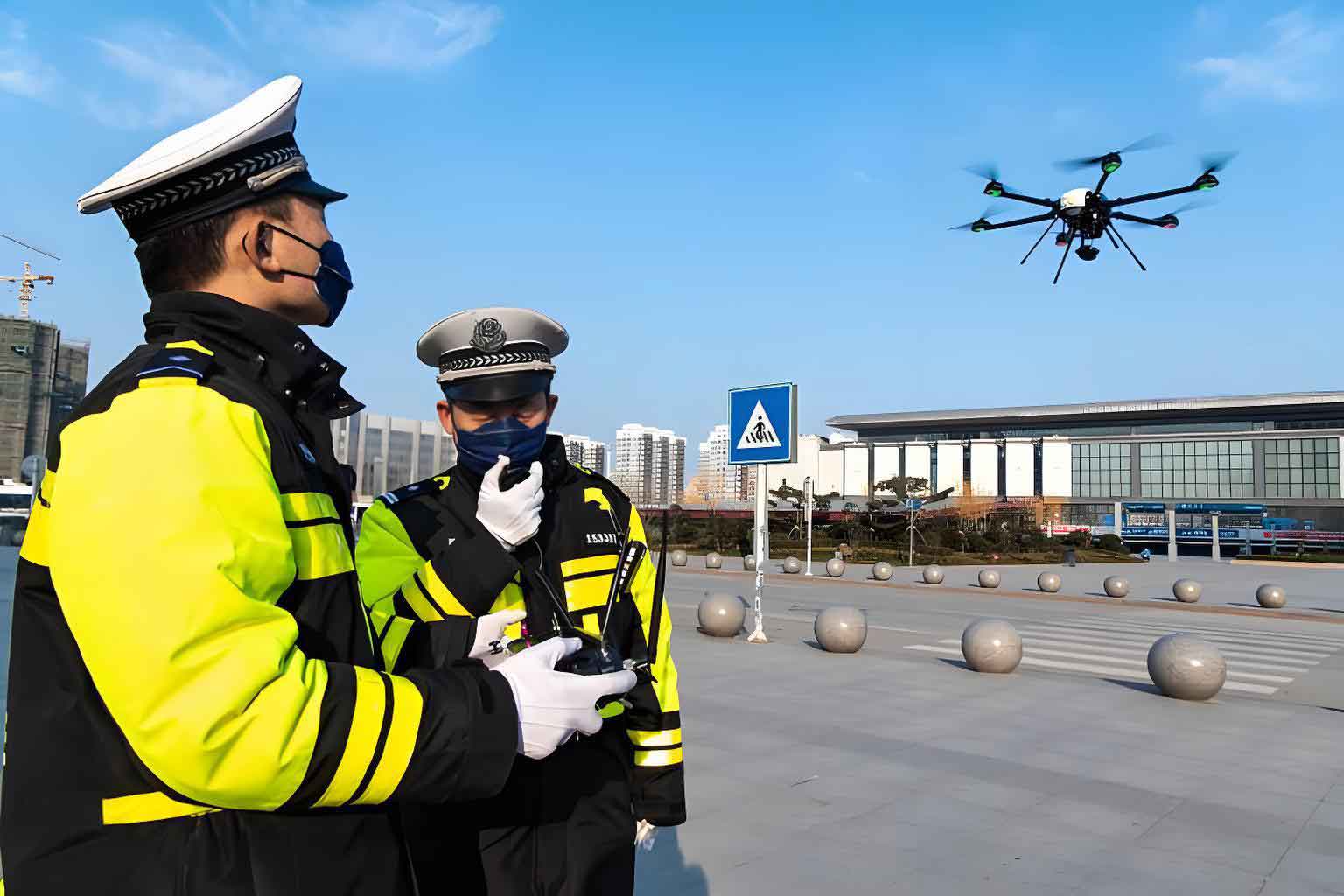
To address these challenges, it is essential to establish a robust standardization framework for police drone operations. Drawing from international guidelines like the Unmanned Aircraft Systems Standard System Construction Guide (2017-2018 Edition), I propose that a police drone standard system should encompass multiple layers: foundational norms, management protocols, technical specifications, and application-specific rules. This layered approach ensures that every aspect of police drone deployment, from hardware selection to flight execution, is governed by clear standards. The core of this system lies in harmonizing existing aviation regulations with law enforcement needs, thereby creating a seamless operational environment for police drones.
The current application of police drones in law enforcement can be summarized through various domains, as shown in Table 1. This table highlights the diverse uses of police drones, along with associated challenges that standardization must mitigate.
| Application Domain | Key Functions | Common Challenges |
|---|---|---|
| Traffic Management | Monitoring congestion, accident investigation, license plate recognition | Limited flight endurance, interference with other air traffic |
| Public Safety Patrols | Aerial surveillance, crowd control, event security | Privacy concerns, noise pollution, public resistance |
| Emergency Response | Search-and-rescue, disaster assessment, hazardous material detection | Weather sensitivity, payload limitations, coordination with ground teams |
| Criminal Investigation | Crime scene documentation, suspect tracking, evidence collection | Legal admissibility of drone-captured data, chain-of-custody issues |
| Counter-Terrorism | Reconnaissance, threat neutralization, perimeter security | High-risk environments, need for specialized equipment, regulatory restrictions |
From this overview, it is evident that police drone operations require a standardized framework to address technical, managerial, and ethical dimensions. In my experience, the absence of such standards often leads to inefficiencies, such as duplicated efforts or incompatible systems between agencies. For example, without unified training, operators may develop varying skill levels, affecting mission success rates. Similarly, inconsistent data handling practices can compromise evidentiary integrity. Therefore, building a police drone standard system is not merely an administrative task but a critical step toward enhancing public safety and operational transparency.
The foundation for police drone standardization can be derived from existing aviation and technology standards. The standard system structure for unmanned aircraft, as outlined in relevant guidelines, includes four main components: basic standards, management standards, technical standards, and industry application standards. For police drones, this structure must be adapted to law enforcement contexts, with emphasis on security, legality, and interoperability. Table 2 breaks down this adapted framework, illustrating how each component applies to police drone operations.
| Component | Description | Examples for Police Drones |
|---|---|---|
| Basic Standards | Fundamental norms for terminology, classification, and reference models | Definitions of police drone categories (e.g., micro, mini, tactical), safety benchmarks |
| Management Standards | Protocols for operations, maintenance, and personnel management | Flight approval processes, maintenance schedules, operator certification |
| Technical Standards | Specifications for hardware, software, and performance metrics | Camera resolution requirements, communication security, battery life standards |
| Application Standards | Rules for specific use cases in law enforcement | Procedures for evidence collection, privacy safeguards during surveillance |
This framework serves as a blueprint for developing detailed police drone standards. However, in practice, many aspects remain underdeveloped. For instance, technical standards for police drones often lag behind civilian counterparts, leading to compatibility issues. To bridge this gap, I recommend a proactive approach that integrates feedback from field operations and technological advancements. Mathematical models can aid in standardizing performance metrics. For example, the effectiveness of a police drone in surveillance can be quantified using a coverage efficiency formula:
$$E_c = \frac{A_{covered}}{A_{total}} \times 100\%$$
where \(E_c\) is the coverage efficiency, \(A_{covered}\) is the area monitored by the police drone, and \(A_{total}\) is the target area. This formula helps set benchmarks for police drone deployments in patrol missions, ensuring optimal resource utilization.
Building on this foundation, I propose specific measures for standardizing police drone operations. These measures span management principles, registration processes, professional training, and standardized operating procedures. First, management principles should emphasize centralized oversight with decentralized execution. A hierarchical management model, where national or regional authorities set policies while local agencies adapt them, can ensure consistency without stifling innovation. For police drones, this involves establishing dedicated units within law enforcement agencies to handle acquisition, registration, and compliance. Registration management is crucial for accountability; each police drone should be uniquely identified through visible markings, digital tags, and embedded chips. The registration process can be modeled as a function:
$$R(d) = \{id, type, owner, status\}$$
where \(R(d)\) represents the registration record for a police drone \(d\), with attributes like identification number, drone type, owning agency, and operational status. This enables tracking and auditing of police drone fleets.
Second, enhancing the professionalism of police drone operators is vital. Training programs should be standardized to include theoretical knowledge, practical skills, and legal education. Operators must obtain certifications from recognized authorities, with periodic recertification to keep pace with technological changes. A competency score \(C_o\) for an operator can be defined as:
$$C_o = w_1 \cdot K + w_2 \cdot S + w_3 \cdot L$$
where \(K\) is knowledge test score, \(S\) is practical skill assessment, \(L\) is legal compliance evaluation, and \(w_1, w_2, w_3\) are weighting factors reflecting the importance of each component. This formula ensures that police drone operators meet a balanced standard of proficiency.
Third, standardizing the entire operational workflow for police drones is essential for consistency. This workflow includes pre-flight planning, in-flight execution, and post-flight procedures. In pre-flight planning, tasks must be categorized, flight paths optimized, and airspace permissions secured. A risk assessment model can be applied:
$$R_{flight} = P_{event} \times I_{impact}$$
where \(R_{flight}\) is the flight risk, \(P_{event}\) is the probability of adverse events (e.g., weather disruptions, technical failures), and \(I_{impact}\) is the potential impact (e.g., safety hazards, legal consequences). For police drones, this model helps in decision-making, ensuring that flights are conducted only when risks are manageable.
During flight operations, police drones should adhere to strict recording protocols. From takeoff to landing, all audio-visual data must be captured and timestamped to maintain a chain of custody. This is particularly important for evidentiary purposes in law enforcement. The data integrity can be ensured through cryptographic hashing:
$$H_{data} = hash(V_{video} + A_{audio} + T_{timestamp})$$
where \(H_{data}\) is the hash value for verification, \(V_{video}\) and \(A_{audio}\) are recorded streams, and \(T_{timestamp}\) is the time data. This safeguards against tampering in police drone operations.
Post-flight procedures involve data archiving, equipment maintenance, and mission debriefing. A standardized checklist, as shown in Table 3, can streamline these activities for police drone units.
| Step | Action | Responsible Party |
|---|---|---|
| 1 | Download and secure recorded data | Operator |
| 2 | Inspect police drone for damage | Technician |
| 3 | Recharge batteries and update logs | Support Staff |
| 4 | Analyze mission outcomes and report | Supervisor |
| 5 | Schedule maintenance if needed | Management |
Implementing such standardized workflows ensures that police drone operations are repeatable, auditable, and aligned with legal requirements. Moreover, it fosters public trust by demonstrating transparency and accountability. In my view, the integration of police drones into law enforcement must be accompanied by continuous evaluation and adaptation of standards. As technology evolves, so too should the protocols governing police drones. For example, advancements in artificial intelligence could enable autonomous police drones for routine patrols, but this necessitates new standards for ethical AI use and human oversight.
In conclusion, the standardization of police drone operations is a multifaceted endeavor that requires collaboration between policymakers, law enforcement agencies, and technology experts. By establishing clear standards for management, training, and procedures, we can harness the full potential of police drones while mitigating risks. The proposed framework, incorporating tables and mathematical models, provides a foundation for developing detailed guidelines. As police drones become more prevalent in law enforcement, a robust standard system will be crucial for ensuring safety, efficiency, and public confidence. Moving forward, I advocate for ongoing research into best practices and international harmonization of police drone standards to address global security challenges effectively.