
In recent years, the rapid development of police UAV (Unmanned Aerial Vehicle) technology has significantly transformed law enforcement practices. As a novel type of police equipment, police UAVs are poised to enhance the efficiency and effectiveness of public security operations. However, the absence of standardized operational guidelines, unified management protocols, and robust safety mechanisms has led to widespread controversies and inconsistencies in the deployment of police UAVs across different regions. From my perspective, having engaged in research and practical observations, it is imperative to establish a comprehensive and规范化执法标准体系 for police UAV operations. This article delves into the current state, foundational requirements, and proposed measures for building such a standardized system, incorporating tables and mathematical models to summarize key concepts.
The integration of police UAVs into law enforcement has yielded remarkable实战效果, yet it has also exposed critical issues such as management chaos, talent shortages, and non-standardized operations. Looking forward, the deeper application of police UAVs across various policing domains necessitates a unified and规范化执法标准. Under the backdrop of ongoing efforts to promote执法规范化建设 within public security departments, and drawing from the “Unmanned Aircraft System Standard System Construction Guide (2017-2018 Edition)” along with practical needs, I will explore the construction of a standardized执法标准体系 for police UAVs.
Currently, police UAVs are extensively used in diverse law enforcement scenarios, including traffic management, aerial patrols, handling mass incidents, security for major events, counter-terrorism operations, and criminal investigations. Their mobility, comprehensive视野, and adaptability to environments make police UAVs invaluable assets. However, the专业性和特殊性 of police UAVs mean that their proliferation is accompanied by challenges: lack of规范准则 for执法操作, absence of统一制式管理标准, and inadequate使用管理机制与安全措施. These gaps have sparked debates on the legitimacy and efficiency of police UAV applications. Therefore, establishing a规范化操作流程 is not just beneficial but essential.
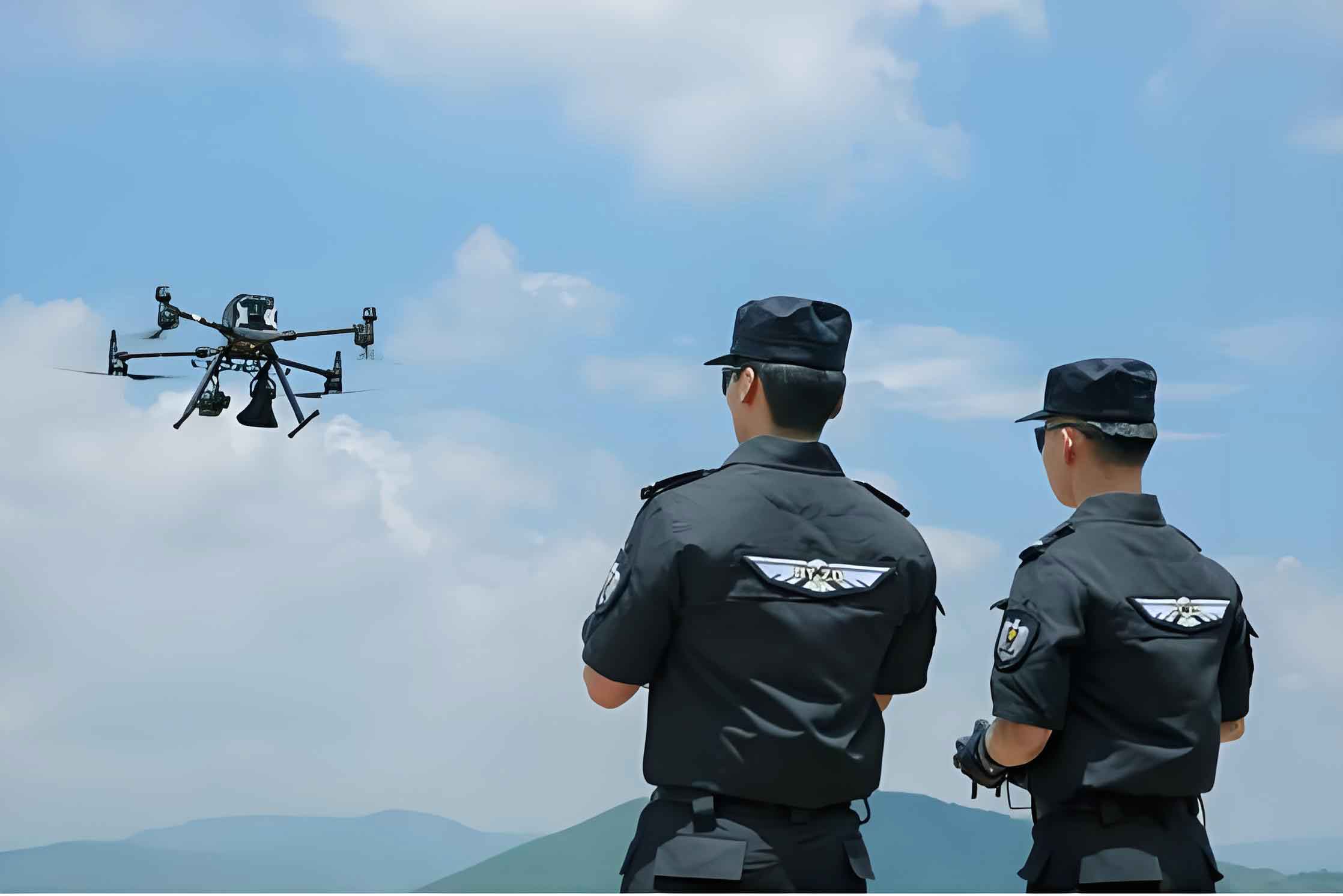
The foundation for building a standardized执法标准体系 for police UAVs lies in existing frameworks and guidelines. The “Unmanned Aircraft System Standard System Construction Guide (2017-2018 Edition)” outlines a standard system structure comprising four parts: A.基础标准, B.管理标准, C.技术标准, and D.行业应用标准. This structure maps into a comprehensive framework for无人驾驶航空器系统标准体系. While民用领域 standards under A, B, and C are relatively well-developed, and some行业应用标准 for agriculture, surveying, and aerial photography have been established, the police UAV domain remains滞后. Notably, the public security industry standard “Police Unmanned Aerial Vehicle System” was released in August 2017, providing a foundational framework. However, from my analysis, this standard lacks specificity in management and operational details, limiting its practical applicability. Thus, there is a pressing need to develop detailed regulations covering management, operation, and safety to规范空中警务执法活动.
To illustrate the standard system structure, I summarize it in the following table, which adapts the指南 framework to emphasize police UAV applications:
| Standard Category | Description | Status for Police UAVs |
|---|---|---|
| A. Foundation Standards | Basic terminology, classification, and general requirements for UAV systems. | Partially covered by existing standards, but需要细化 for police contexts. |
| B. Management Standards | Regulations for registration, personnel资质, maintenance, and safety management. | Largely待制定; critical for police UAV规范化执法. |
| C. Technical Standards | Specifications for design, performance, communication, and data security. | Some民用 standards exist, but警察专用 needs enhancement. |
| D. Industry Application Standards | Guidelines for specific uses like agriculture,测绘, and law enforcement. | Police UAV standards are underdeveloped; urgent need for执法应用标准. |
From this perspective, the construction of a police UAV规范化执法标准体系 must address gaps in management and operational protocols. I propose that the effectiveness of police UAV operations can be modeled using a performance metric that incorporates standardization factors. For instance, let $E$ represent the执法效能 of police UAV operations, which can be expressed as:
$$ E = \alpha S_m + \beta S_o + \gamma S_s $$
where $S_m$ denotes management standardization score, $S_o$ denotes operational standardization score, and $S_s$ denotes safety standardization score. The coefficients $\alpha$, $\beta$, and $\gamma$ are weighting factors that reflect the relative importance of each aspect, typically determined through empirical studies on police UAV deployments. This formula underscores that enhancing standardization directly boosts执法效能.
Building on this, I offer specific measures for constructing the police UAV规范化执法标准体系. First,加强管理原则和登记管理 is crucial. A hierarchical management structure should be established, with police aviation departments at various levels overseeing police UAV operations. For regions without dedicated police aviation units,警务保障部门 can assume these responsibilities. Key elements include:
- 规范化队伍组建、机型选购与审核备案: Police UAV teams should adopt a star-shaped structure centered on municipal public security bureaus. This ensures coordinated deployment across specialized units and基层. Equipment selection must cater to diverse tasks, combining different sizes and models of police UAVs. A registration process involves initial review by municipal police aviation offices, approval by provincial authorities, and备案 at the national level.
- 规范化外观涂装与信息识别要求: Police UAVs should have standardized涂装 and编号 for visual identification. Additionally,识别标识 such as QR codes and身份识别编码 embedded in flight control systems can enhance traceability. For confidential missions, special protocols must apply.
To quantify management efficiency, consider a登记管理 model where the time $T_r$ for registering a police UAV is a function of bureaucratic steps $n$ and standardization level $L_s$:
$$ T_r = k \cdot \frac{n}{L_s} $$
Here, $k$ is a constant, and higher $L_s$ reduces registration time, promoting faster deployment of police UAVs.
Second,提升从业人员专业化程度 is vital. Operators of police UAVs must obtain驾驶执照 issued by national police aviation authorities. For specialized tasks, such as using穿越机 for countering “黑飞” activities, advanced training and certification are necessary. The competency $C_o$ of an operator can be modeled as:
$$ C_o = f(T_t, E_x) $$
where $T_t$ is training hours and $E_x$ is hands-on experience. Standardized curricula for police UAV training should be developed to ensure high $C_o$ across all personnel.
Third, establishing全要素、全流程的标准化操作流程 for police UAV执法活动 is essential. This encompasses pre-flight, in-flight, and post-flight phases. I summarize the key steps in a table to enhance clarity:
| Phase | Standardized Steps | Key Considerations for Police UAVs |
|---|---|---|
| Pre-flight |
|
Emphasis on legal compliance and risk assessment to prevent incidents involving police UAVs. |
| In-flight |
|
Recording is critical for执法规范化 and accountability; treat rotor start as执法活动开始. |
| Post-flight |
|
Proper maintenance ensures longevity and readiness of police UAVs for future missions. |
In the in-flight phase, the recording requirement can be formalized using a binary indicator $R(t)$, where $R(t) = 1$ if recording is active at time $t$, and $0$ otherwise. For a police UAV flight duration from $t_0$ (rotor start) to $t_f$ (rotor stop), the recording完整性 score $S_r$ is:
$$ S_r = \frac{\int_{t_0}^{t_f} R(t) dt}{t_f – t_0} $$
Aim for $S_r = 1$ to ensure full compliance with执法规范化 standards for police UAV operations.
Furthermore, the integration of police UAVs into broader law enforcement strategies requires attention to data management and interoperability. I propose a framework where police UAV data feeds into a centralized command system, enhancing situational awareness. The effectiveness of this integration can be measured using an interoperability index $I$, defined as:
$$ I = \sum_{i=1}^{N} w_i \cdot C_i $$
where $N$ is the number of systems integrated (e.g., dispatch, video analytics), $C_i$ is the compatibility score for each, and $w_i$ are weights. Standardizing data formats for police UAVs will boost $I$, leading to more cohesive operations.
Another critical aspect is safety management for police UAVs. Given the risks of mid-air collisions or technical failures, a risk assessment model should be adopted. Let $P_r$ represent the probability of an incident during a police UAV mission, which can be expressed as:
$$ P_r = 1 – \prod_{j=1}^{M} (1 – p_j) $$
where $p_j$ are probabilities of independent risk factors (e.g., weather, human error, equipment malfunction). Standardized safety protocols, such as pre-flight checks and no-fly zones, aim to minimize each $p_j$, thereby reducing $P_r$ for police UAV deployments.
Moreover, the economic and logistical dimensions of police UAV standardization cannot be overlooked. A cost-benefit analysis can justify investments in standardized systems. The net benefit $B$ of implementing police UAV规范化执法标准体系 is:
$$ B = \sum (E_i – C_i) $$
where $E_i$ are benefits like improved arrest rates or reduced response times, and $C_i$ are costs for training, equipment, and compliance. Empirical data from pilot programs involving police UAVs can help quantify $B$, supporting policy decisions.
In terms of legal and ethical considerations, the use of police UAVs must align with privacy laws and public trust. Standardized guidelines should include provisions for data retention, transparency, and oversight. For instance, a privacy impact assessment (PIA) score $S_p$ can be calculated for each police UAV operation:
$$ S_p = \frac{\sum \text{compliance metrics}}{\text{total metrics}} $$
High $S_p$ indicates adherence to ethical standards, fostering public acceptance of police UAVs.
To facilitate the adoption of these standards, I recommend a phased approach. Phase 1 could focus on developing core management standards for police UAVs, Phase 2 on technical and operational protocols, and Phase 3 on integration and evaluation. Each phase should involve stakeholder consultations, including law enforcement agencies, regulators, and civil society, to ensure practicality and legitimacy.
In conclusion, standardization is pivotal for ensuring the quality of police equipment and enhancing执法效力 in the context of modern governance and rule of law. As police UAVs become integral to law enforcement, establishing comprehensive management, operational, and safety规章制度 is imperative. Through this exploration, I have highlighted the need for a robust police UAV规范化执法标准体系, incorporating mathematical models and structured tables to summarize key points. By addressing gaps in management, professionalism, and流程, we can harness the full potential of police UAVs while mitigating risks. I hope these insights accelerate the建设 of a standardized framework, ultimately contributing to national security and public safety.
Looking ahead, future research could delve into advanced technologies like AI integration for autonomous police UAV operations, requiring updates to standardization frameworks. Continuous evaluation and adaptation will ensure that police UAV standards remain relevant in an evolving landscape. The journey toward fully规范化执法 for police UAVs is complex but necessary, and I am committed to advancing this critical field through ongoing study and collaboration.