
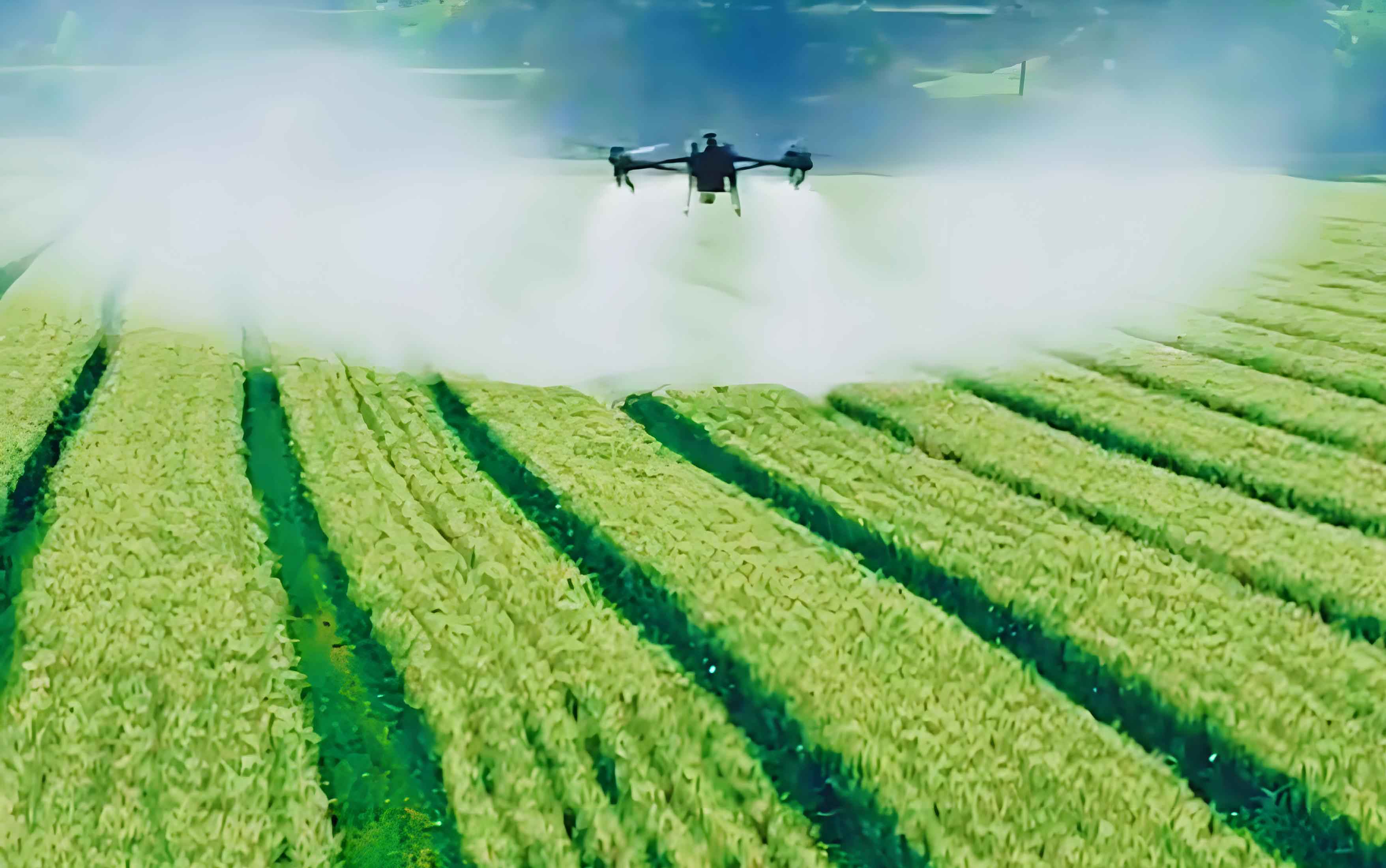
In recent years, the advancement of agricultural technology has propelled the use of crop spraying drones to the forefront of modern farming practices. These spraying UAVs offer significant advantages, including high operational efficiency, improved pesticide utilization, and adaptability to diverse terrains. However, challenges such as substantial droplet drift and uneven distribution persist, largely influenced by the downwash flow generated by the drone’s rotors. Understanding the spatial distribution of this downwash flow is crucial for optimizing spraying performance and minimizing environmental impact. This study focuses on a linear multi-rotor plant protection UAV, employing computational fluid dynamics (CFD) to analyze the downwash flow characteristics under various operational conditions. The investigation covers hover and forward flight scenarios, examining factors like flight height, flight speed, and lateral wind speed. Through single-factor and multi-factor orthogonal experiments, we aim to elucidate the patterns and interactions affecting downwash flow distribution, providing a theoretical foundation for enhancing spraying UAV applications in agriculture.
The physical model of the linear crop spraying drone consists of a symmetric arrangement of four rotors mounted on a 3-meter carbon fiber main rod. Two rotors are fixed for primary lift, while two are tiltable to adjust the drone’s attitude via servo mechanisms. Centrifugal nozzles are installed directly below the main lift rotors. The rotors, models G32-11 for main lift and V22-7.4 for tilt rotors, were reverse-engineered using 3D scanning to create accurate computational models. This linear configuration is distinct from circular layouts, potentially leading to unique downwash flow behaviors. The symmetry ensures balanced operation, with adjacent rotors rotating in opposite directions to counteract torque and maintain stability. This structural design is pivotal in shaping the downwash flow field, which directly impacts droplet movement during spraying operations.
For numerical simulation, the CFD approach utilizes the Reynolds-Averaged Navier-Stokes (RANS) equations, which transform unsteady turbulent flow into a steady problem, reducing computational complexity. The RNG k-ε turbulence model is selected due to its accuracy in handling rotational flows, such as those generated by rotors. The governing equations for this model are as follows:
The turbulence kinetic energy, k, and its dissipation rate, ε, are described by:
$$
\frac{\partial}{\partial t} (\rho k) + \frac{\partial}{\partial x_i} (\rho k u_i) = \frac{\partial}{\partial x_j} \left( \alpha_k \mu_{\text{eff}} \frac{\partial k}{\partial x_j} \right) + G_k + G_b – \rho \epsilon – Y_M + S_K
$$
$$
\frac{\partial (\rho \epsilon)}{\partial t} + \frac{\partial (\rho \epsilon u_i)}{\partial x_i} = \frac{\partial}{\partial x_j} \left( \alpha_\epsilon \mu_{\text{eff}} \frac{\partial \epsilon}{\partial x_j} \right) + C_{1\epsilon} \frac{\epsilon}{k} (G_k + C_{3\epsilon} G_b) – C_{2\epsilon} \rho \frac{\epsilon^2}{k} – R_\epsilon + S_\epsilon
$$
where
$$
R_\epsilon = \frac{C_\mu \rho \eta^3 (1 – \eta / \eta_0)}{1 + \beta \eta^3} \frac{\epsilon^2}{k}, \quad \eta = \frac{s k}{\epsilon}
$$
Constants include $C_{1\epsilon} = 1.42$, $C_{2\epsilon} = 1.68$, $\eta_0 = 4.38$, and $\beta = 0.012$. Here, $\mu_{\text{eff}}$ is the effective viscosity, $u_i$ and $u_j$ are time-averaged velocity components, $G_k$ represents turbulence kinetic energy generation from mean velocity gradients, $G_b$ is buoyancy-induced turbulence, $Y_M$ accounts for compressibility effects, and $S_K$, $S_\epsilon$ are user-defined terms. The computational domain is divided into rotating zones for the rotors and a stationary zone encompassing a 14 m × 12 m × 5 m rectangular volume. Rotor zones are cylindrical: 900 mm diameter and 50 mm height for main rotors, and 600 mm diameter and 35 mm height for tilt rotors. A moving reference frame model applies to rotating zones, with a fixed pitch angle of 3° during forward flight to simplify simulation, derived from force balance equations. The air resistance force is given by:
$$
F = \frac{1}{2} C \rho S v^2
$$
where $F$ is the drag force, $C$ is the drag coefficient, $\rho$ is air density, $S$ is the frontal area, and $v$ is velocity. The pitch angle $\theta_\tau$ is calculated as:
$$
f_Z = \sqrt{F_y^2 + (m g)^2}, \quad \theta_\tau = \arcsin\left( \frac{-F_y}{f_Z} \right)
$$
where $f_Z$ is the force along the Z-axis, $F_y$ is the wind resistance in the Y-direction, $m$ is the drone mass, and $g$ is gravity. Unstructured tetrahedral meshes are used, with skewness below 0.9 and average skewness under 0.3, ensuring accuracy. Boundary conditions set the bottom surface as a stationary wall, top as pressure inlet, and other surfaces as pressure outlets or velocity inlets based on scenarios. For hover, main rotor speed is 3055 rpm and tilt rotor speed is 5174 rpm; for forward flight, main rotor speed is 3163 rpm.
Under ideal hover conditions at 3.0 m height, the downwash flow from the linear spraying UAV exhibits symmetric distribution due to the rotor layout. The flow field can be divided into front, middle, and rear regions at 1.0 m intervals. Streamlines show that the main rotors’ downwash converges inward in the middle and lower regions, forming a trumpet-shaped pattern when viewed laterally. Velocity contours at heights from 0.5 m to 2.5 m reveal that high-speed flows initiate near the rotors and merge with increasing distance, expanding the influenced area. Near the ground, ground effect causes the flow to spread, resulting in a cross-shaped velocity distribution that enhances droplet penetration and widens the spray swath. However, this may also lead to droplet entrainment and reduced deposition. When external winds are introduced, the downwash flow is significantly affected. With a lateral wind speed of 1 m/s, minimal disturbance occurs, but at 3 m/s, the rear flow region deviates noticeably, increasing the deflection angle with wind speed. The front and middle regions remain relatively stable due to high rotor-induced velocities, maintaining vertical flow and lift balance. Comparative analysis indicates that the linear layout is more susceptible to lateral winds than forward winds, highlighting the importance of wind direction in operational planning for crop spraying drones.
During forward flight, the downwash flow distribution is influenced by flight speed, height, and lateral wind speed. At a fixed height of 3.0 m and no lateral wind, varying flight speeds from 3 to 6 m/s show that lower speeds like 3 m/s result in smaller deflection angles, favoring droplet deposition. As speed increases to 4 and 5 m/s, deflection angles change slightly, with downwash extending downward. At 6 m/s, the flow direction shifts parallel to the Y-axis with an upward trend, detrimental to vertical droplet movement. The deflection angle correlates positively with flight speed. In plan view, at 3 m/s, the downwash is primarily from the main rotors, while tilt rotors maintain vertical flow. At higher speeds, tilt rotor downwash exhibits lateral shifts, causing coupling effects and creating velocity differentials in the rear field. The spread angle $\theta$ between main rotors decreases with speed, directly affecting swath width. Thus, selecting an appropriate flight speed is critical for balancing deflection and swath in spraying UAV operations.
Flight height variations alter the downwash flow’s spatial movement and impact velocity at crop level. Simulations at heights of 2.5, 3.0, 3.5, and 4.0 m with a constant speed of 4 m/s and no lateral wind demonstrate that lower heights (2.5 and 3.0 m) promote downwash sinking, aiding droplet deposition. At higher heights (3.5 and 4.0 m), rotor downwashes interlace, causing flow uplift and increased droplet drift. The overall deflection angle increases with height, emphasizing the need for optimal height selection based on crop type. Lateral wind speed further modulates downwash distribution. With a fixed flight speed of 4 m/s and height of 3.0 m, lateral winds of 0, 1, 2, and 3 m/s disrupt flow symmetry. Without wind, the flow is symmetric and extends rearward optimally. As wind speed increases, the flow tilts laterally, leading to significant droplet drift. This underscores the necessity of operating spraying UAVs in low-wind conditions to maintain downwash efficacy.
To analyze the interactive effects of flight height ($h$), flight speed ($v$), and lateral wind speed ($u$) on downwash flow, a three-factor three-level orthogonal experiment was conducted. The factors and levels are summarized in the table below:
| Level | Factor $h$ (m) | $v$ (m/s) | $u$ (m/s) |
|---|---|---|---|
| 1 | 3.0 | 3 | 0 |
| 2 | 3.5 | 4 | 1 |
| 3 | 4.0 | 5 | 2 |
The orthogonal array and range analysis for the maximum vertical velocity component $v_m$ at a 0.5 m height monitoring plane are as follows:
| Test Group | $h$ (m) | $v$ (m/s) | $u$ (m/s) | $v_m$ (m/s) |
|---|---|---|---|---|
| 1 | 3.0 | 3 | 0 | 4.2 |
| 2 | 3.0 | 4 | 2 | 0.6 |
| 3 | 3.0 | 5 | 1 | 1.9 |
| 4 | 3.5 | 3 | 2 | 4.3 |
| 5 | 3.5 | 4 | 1 | 0.9 |
| 6 | 3.5 | 5 | 0 | 2.5 |
| 7 | 4.0 | 3 | 1 | 2.4 |
| 8 | 4.0 | 4 | 0 | 2.8 |
| 9 | 4.0 | 5 | 2 | 0.8 |
Range analysis yields:
| Parameter | $K_1$ | $K_2$ | $K_3$ | $\bar{K}_1$ | $\bar{K}_2$ | $\bar{K}_3$ | Range $R$ |
|---|---|---|---|---|---|---|---|
| $h$ | 6.68 | 7.70 | 6.00 | 2.23 | 2.57 | 2.00 | 0.57 |
| $v$ | 10.90 | 4.28 | 5.20 | 3.63 | 1.43 | 1.73 | 1.90 |
| $u$ | 9.50 | 5.20 | 5.68 | 3.17 | 1.73 | 1.89 | 1.44 |
The results indicate significant interaction among the factors, with flight speed ($v$) having the most substantial impact on the vertical velocity component (range $R = 1.90$), followed by lateral wind speed ($u$, $R = 1.44$), and flight height ($h$, $R = 0.57$). This suggests that for optimal droplet penetration, spraying UAV operations should prioritize lower flight speeds, minimize lateral wind exposure, and adjust height based on crop requirements. The linear correlations observed underscore the importance of integrated parameter settings for enhancing the performance of crop spraying drones.
In conclusion, this study demonstrates that the linear multi-rotor crop spraying drone exhibits unique downwash flow characteristics due to its symmetric layout. Under hover, the flow forms a cross-shaped distribution near the ground, which is highly sensitive to lateral winds. During forward flight, flight speed, height, and lateral wind speed linearly influence the spatial distribution, with speed being the dominant factor. The orthogonal experiment confirms the interactive effects, guiding optimal operational parameters. These findings provide a theoretical basis for improving spraying UAV efficiency and reducing environmental impact, paving the way for future research on droplet dynamics in downwash flows. Further investigations could explore real-time adaptive control systems for spraying UAVs based on downwash monitoring, enhancing precision agriculture applications.