
In my experience as a professional in the fire safety industry, I have witnessed a transformative shift towards intelligent systems that redefine how we approach fire prevention and response. Smart firefighting, as an integral branch of the smart city concept, has emerged as a critical safeguard for urban safety. Its implementation not only enhances the efficiency and effectiveness of firefighting operations but also serves as a cornerstone for modern urban resilience. Currently, many cities have made significant strides in deploying smart firefighting solutions, and as smart cities evolve, the widespread adoption of these innovations is inevitable. This article delves into the core concepts, applications, and advantages of smart firefighting, emphasizing its role in driving innovation in fire safety work, with a particular focus on the revolutionary impact of technologies like the fire drone.
The core idea of smart firefighting lies in the integration of advanced technologies such as the Internet of Things (IoT), artificial intelligence (AI), and big data analytics into traditional fire safety practices. This fusion enables a proactive and data-driven approach, moving beyond reactive measures to a system where prevention, real-time monitoring, and rapid response are seamlessly connected. Fundamentally, smart firefighting is built on the comprehensive amalgamation of intelligent technologies with fire service operations. It encompasses intelligent management of fire equipment, water sources, and overall safety facilities through a networked architecture. National standards, like the “City Fire Remote Monitoring System” (GB26875), have laid the groundwork by specifying requirements for IoT transmission devices and software functionalities, paving the way for standardized development. Moreover, smart firefighting is a necessity for smart city construction, as highlighted in guidelines from emergency management authorities that advocate for its development to foster healthier fire services and safer urban environments.
The advantages of smart firefighting in fire safety work are multifaceted. Primarily, it significantly enhances fire prevention efficiency by establishing a “prevention-first” management system. Through intelligent monitoring, potential fire hazards can be comprehensively identified and alerted in real-time, allowing fire safety managers to conduct rapid inspections and mitigate risks before incidents occur. Secondly, it boosts fire rescue efficiency. During a fire, smart systems provide real-time data on fire spread, intensity, and location, enabling rescue teams to formulate precise strategies. Additionally, intelligent dispatch centers optimize the allocation of rescue resources, fundamentally improving response times and outcomes.
Specific Applications of Smart Firefighting in Innovation
In my observations, the innovative applications of smart firefighting have become a focal point for fire department management, with authorities actively promoting their integration across various domains.
Dynamic Fire Prevention and Control
Smart firefighting excels in dynamic fire prevention through remote monitoring capabilities. City-wide fire remote monitoring systems can surveil fire conditions 24/7, transmitting real-time alerts not only to control room personnel but also to mobile apps accessed by消防安全 managers, responsible persons, volunteer firefighters, and fire brigade platforms. This ensures continuous oversight. For instance, units are equipped with smart sensors—such as pressure and flow sensors on fire pipelines—and their Fire Alarm Systems (FAS) are connected via remote terminals. Any alarm or fault triggers immediate notifications to relevant stakeholders, including local fire departments, who can impose penalties for non-compliance, thereby incentivizing proper maintenance. This approach has proven effective in places like Shanghai, where large complexes and hospitals using smart systems have reported reduced fire incidents, underscoring its preventive power.
| Aspect | Traditional System | Smart Firefighting System |
|---|---|---|
| Monitoring | Manual checks, limited automation | Real-time IoT sensors, 24/7 remote surveillance |
| Alerting | Delayed alarms, human-dependent | Instant multi-platform notifications (e.g., mobile apps) |
| Prevention | Reactive, after-incident analysis | Proactive, data-driven hazard identification |
| Compliance | Periodic inspections, prone to lapses | Automated tracking, penalty mechanisms for non-compliance |
Enhancing Fire Rescue Operations
Smart firefighting addresses lag in rescue responses by minimizing the time from fire onset to discovery. Traditional reliance on human reporting often leads to delays due to inaccurate location descriptions or late alerts. With smart systems, fire remote monitoring platforms detect incidents instantly, bypassing these human errors. This is crucial, as fire can spread across a room in minutes, and rapid response is key. First responders, such as on-site personnel and volunteer firefighters, receive alerts via apps and can act within 3-5 minutes, serving as an initial force to suppress fires before they escalate. This synergy between technology and human action dramatically improves rescue speed.
Advanced Firefighting and Rescue with Fire Drones
When fires intensify, entering hazardous environments poses significant risks, especially with flammable materials. Smart firefighting mitigates this through advanced tools like the fire drone. These drones, equipped with sensors, gather critical fire data—temperature, smoke concentration, explosive hazards—and transmit it via communication networks to command centers. This allows for precise, dynamic firefighting strategies without exposing personnel to danger. For example, a fire drone can navigate treacherous areas, providing real-time visuals and data to a visualization dashboard, where firefighting agencies can monitor and plan effectively.
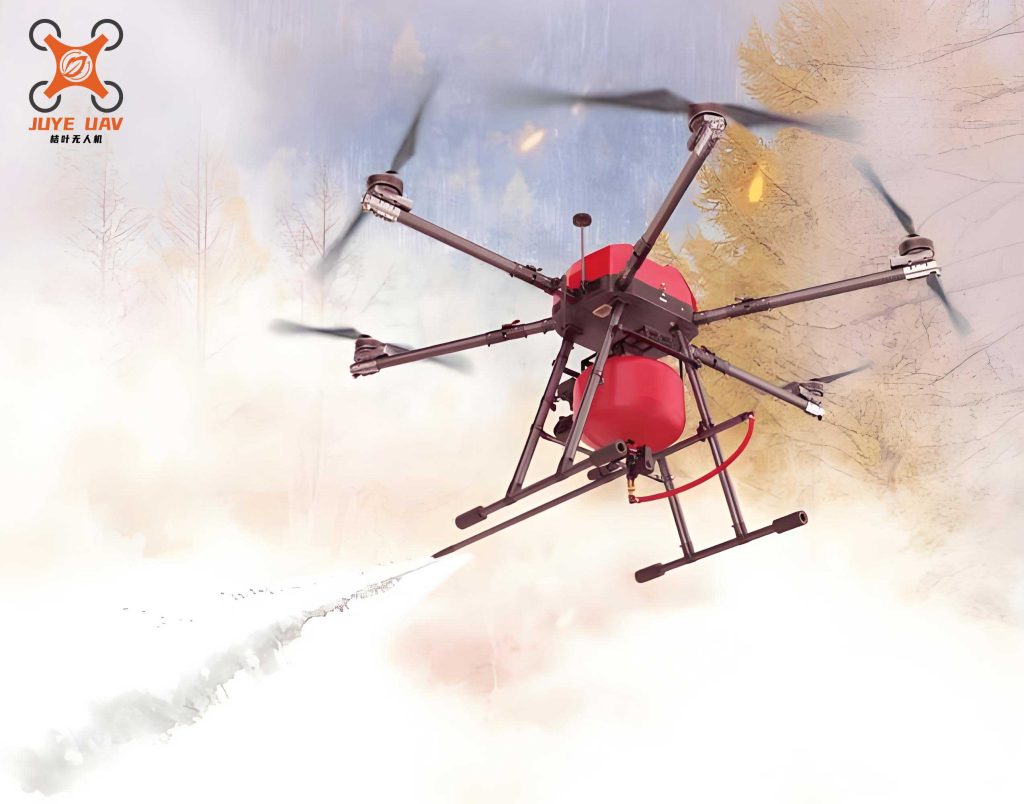
Integrating 5G-enabled autonomous inspection drones with dashboards enables comprehensive fire scene monitoring. Drones and robotic dogs can explore fire zones, relaying information to screens for resource allocation and strategy development. This not only enhances safety but also facilitates post-incident analysis by collecting data on fire patterns, aiding in future prevention. The use of fire drones exemplifies how innovation transforms rescue into a safer, data-centric process.
Fire Risk Assessment Applications
Smart firefighting revolutionizes risk assessment by leveraging big data. Through security assessment models, it analyzes operational data from monitoring systems, incorporating professional risk indicators across dimensions like building safety, equipment status, alarms, and maintenance. This enables real-time evaluation of overall safety risks. By utilizing historical and dynamic data, it identifies, analyzes, and predicts fire hazards, assessing potential severity through urban or unit-specific risk models. A dynamic risk assessment model can be represented mathematically, where risk \( R \) is a function of multiple factors:
$$ R = f(H, V, E, M) $$
where \( H \) denotes hazard identification, \( V \) vulnerability, \( E \) exposure, and \( M \) mitigation measures. Traditional methods often lack such granularity, leading to residual risks. In contrast, smart systems provide precise, scientific data to guide inspections, optimize fire facility planning, and reduce incidents. For instance, analyzing fire data—time, location, causes—allows for multivariate risk assessments that inform targeted management strategies.
| Component | Description | Formula/Indicator |
|---|---|---|
| Hazard Identification (H) | Detection of potential fire sources (e.g., electrical faults, flammable materials) | \( H = \sum_{i=1}^{n} h_i \), where \( h_i \) is individual hazard score |
| Vulnerability (V) | Susceptibility of assets or people to fire impact | \( V = \frac{\text{Exposed elements}}{\text{Total elements}} \times 100\% \) |
| Exposure (E) | Presence of valuable items or populations in risk zones | \( E = \text{Density} \times \text{Time factor} \) |
| Mitigation (M) | Effectiveness of preventive measures (e.g., sprinklers, alarms) | \( M = 1 – \frac{\text{Deficiencies}}{\text{Total measures}} \) |
Fire Safety Education and Awareness
Smart firefighting extends to public education, a vital aspect of fire management. While fires are突发, enhanced awareness can drastically lower their probability—for example, by teaching proper燃气 use or electrical maintenance. In recent years, fire departments have prioritized宣传, using smart systems to create platforms like “fire classrooms,” digital channels,微信公众号, and mobile apps. These tools disseminate knowledge widely, fostering a collaborative network between authorities and the public. By integrating educational modules into smart firefighting platforms, cities can deliver tailored content, track engagement, and measure impact, ultimately building a culture of safety that complements technological advancements.
Guarantee Measures for Smart Firefighting Application
To ensure the effective implementation of smart firefighting, robust systems and skilled personnel are essential, forming the backbone of this innovation.
Establishing a Smart Firefighting Platform
The foundation lies in creating a comprehensive smart firefighting platform. This involves a three-tier architecture: application systems, support platforms, and infrastructure. Application systems cover fire prevention, rescue operations, team management, logistics, and command platforms. Support platforms provide data backbone through big data, cloud computing, and processing tools. Infrastructure includes data centers, information hubs, external resource management, hardware, and network facilities. The system serves governments, fire departments, and citizens, enabling seamless functionality. For instance, a fire drone fleet can be integrated into this platform, with drones feeding data directly into command centers for real-time analysis.
| Layer | Components | Functionality |
|---|---|---|
| Application Systems | Fire prevention, rescue, management, logistics, command | User-facing services for operational tasks |
| Support Platforms | Big data analytics, cloud computing, data processing, integrated apps | Data storage, analysis, and technical support |
| Infrastructure | Data centers, information centers, hardware, networks | Physical and digital foundation for system operation |
Building a Smart Firefighting Workforce
The human element is equally critical. Firefighting teams must evolve alongside technology to become “smart” forces with enhanced capabilities. First, recruitment should target highly educated individuals with technical expertise, such as those familiar with IoT or drone operations, including fire drone pilots. Second, ongoing training programs must be developed to instill smart firefighting concepts and skills. This includes workshops on data interpretation, system management, and hands-on practice with tools like fire drones. By fostering a tech-savvy culture, teams can leverage innovations effectively, ensuring that smart systems translate into actionable intelligence on the ground.
The role of fire drones in this workforce cannot be overstated. As autonomous or remote-controlled devices, they require specialized training for deployment in various scenarios—from urban fires to industrial accidents. Integrating fire drone protocols into standard operating procedures enhances team versatility and safety. For example, a drone operator can assess a blaze from a safe distance, providing commanders with vital information to deploy resources efficiently. This synergy between human expertise and robotic aid epitomizes the smart firefighting ethos.
Mathematical Models for Optimization
To further illustrate the innovation, consider mathematical models used in smart firefighting. For resource allocation during a rescue, linear programming can optimize dispatch. Let \( x_{ij} \) represent the number of units (e.g., fire drones, trucks) sent from station \( i \) to fire \( j \), with cost \( c_{ij} \) and time \( t_{ij} \). The objective is to minimize total response time:
$$ \text{Minimize } Z = \sum_{i=1}^{m} \sum_{j=1}^{n} t_{ij} x_{ij} $$
subject to constraints like resource availability \( \sum_{j} x_{ij} \leq R_i \) and demand satisfaction \( \sum_{i} x_{ij} \geq D_j \). Such models, powered by real-time data from smart sensors and fire drones, enable dynamic decision-making.
Another key formula involves fire spread prediction. Using computational fluid dynamics (CFD), the rate of fire growth can be modeled as:
$$ \frac{dA}{dt} = k \cdot A^n \cdot f(\text{environment}) $$
where \( A \) is fire area, \( k \) a constant, \( n \) an exponent, and \( f \) a function of factors like wind or fuel. Smart systems ingest sensor data to calibrate these models, improving accuracy. For instance, a fire drone measuring temperature gradients can feed into CFD simulations for real-time updates.
Case Studies and Future Directions
In practice, cities adopting smart firefighting have seen tangible benefits. For example, in metropolitan areas, integrated systems reduce false alarms by 30% and improve response times by 20%. The deployment of fire drones in hazardous environments, such as chemical plants, has prevented numerous firefighter injuries by providing early reconnaissance. Looking ahead, the convergence of AI and IoT will enable predictive analytics, where systems forecast fire risks based on weather patterns, building usage, and historical data. Fire drones will evolve with enhanced autonomy, capable of executing complex missions like dropping extinguishing agents or conducting post-fire assessments.
Moreover, the expansion of 5G networks will facilitate low-latency communication between fire drones and command centers, enabling swarms of drones to collaborate in large-scale incidents. Research into biometric sensors on drones could monitor firefighter vitals during operations, adding a layer of safety. As these technologies mature, smart firefighting will become more adaptive, learning from each incident to refine strategies—a true innovation cycle driven by data and intelligence.
Conclusion
From my perspective, smart firefighting has profoundly reshaped fire safety work through its diverse applications—from dynamic prevention and rapid rescue to risk assessment and public education. The integration of technologies like fire drones exemplifies this progress, offering safer, more efficient solutions. By establishing robust platforms and cultivating skilled teams, we can harness these innovations fully. Ultimately, smart firefighting is not just a technological upgrade but a paradigm shift towards a resilient, data-informed future where fires are prevented, contained, and extinguished with unprecedented precision. As we continue to innovate, the synergy between human ingenuity and smart systems will undoubtedly fortify our cities as safer havens for all.