
In modern naval warfare, the threat posed by unmanned aerial vehicles (UAVs) has escalated significantly, evolving from isolated incidents to coordinated swarm attacks alongside anti-ship missiles. As a researcher focused on defense systems, I have observed that these anti-UAV challenges require innovative approaches to weapon coordination. Traditional kinetic weapons alone are often insufficient against low-cost, high-volume drone swarms, prompting the integration of directed energy weapons like high-energy laser (HEL) and high-power microwave (HPM) systems. In this article, I will explore a comprehensive framework for ship-based anti-UAV firepower assignment, emphasizing mathematical modeling, efficiency estimation, and optimization algorithms. My goal is to minimize the cumulative failure rate of threat elimination through synergistic use of multiple weapon systems, thereby enhancing naval defense capabilities against evolving aerial threats.
The proliferation of UAV technology has transformed battlefields, as seen in conflicts where drone swarms have overwhelmed conventional defenses. For instance, coordinated attacks involving dozens of UAVs and missiles have demonstrated the vulnerability of ships to such asymmetric threats. In response, anti-UAV strategies must leverage a mix of hard-kill and soft-kill mechanisms, with HEL and HPM emerging as key assets due to their speed, precision, and cost-effectiveness. However, effectively integrating these energy-based weapons with existing naval armaments—such as missiles and guns—poses a complex decision-making problem. This article addresses this by developing a firepower assignment model that accounts for the unique characteristics of HEL and HPM, using an energy damage relaxation coefficient to estimate destruction probabilities under uncertainty. Through simulation and analysis, I will evaluate the performance of intelligent algorithms in optimizing anti-UAV task allocation, providing insights for future naval combat systems.
To set the stage, let me describe typical ship-based anti-UAV engagement scenarios. UAVs can be launched from airborne platforms within or beyond a ship’s defense zone, often in coordination with anti-ship missiles. In the first scenario, a carrier aircraft releases micro-UAVs close to the ship, aiming to saturate sensors and pave the way for missile strikes. The ship must prioritize intercepting the carrier with missiles, then employ HPM for area defense against the drone swarm, followed by HEL and naval guns for point defense. In the second scenario, UAVs are launched from a stand-off distance, flying low to avoid detection and coordinating with missiles for multi-axis attacks. Here, the ship uses electronic countermeasures initially, then allocates missiles, HEL, guns, and HPM sequentially based on threat proximity and priority. Both scenarios highlight the need for dynamic firepower assignment to manage limited resources against multiple incoming targets, a core aspect of anti-UAV operations.
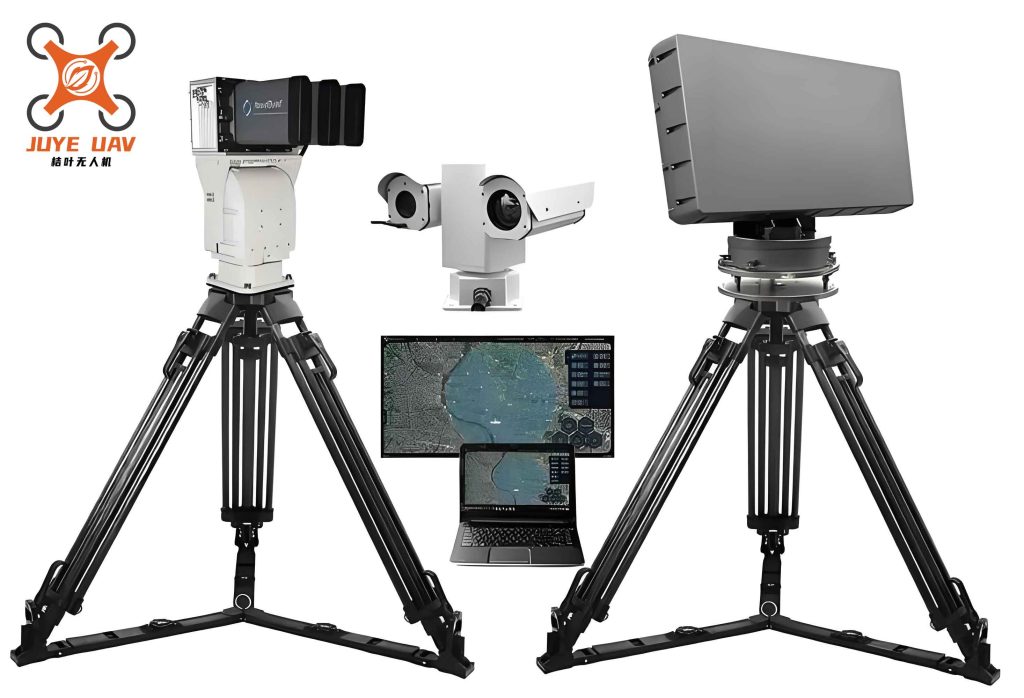
Understanding the operational traits of HEL and HPM is crucial for effective anti-UAV firepower assignment. HEL systems destroy targets by focusing a high-power laser beam on specific components, such as fuel tanks or sensors, requiring precise tracking and sustained irradiation. The energy density on target, \( S_r \), is given by:
$$ S_r = \frac{P_0 \times D^2}{\pi \times 1.222 \times \beta^2 \times \lambda^2 \times R^2} $$
where \( P_0 \) is laser power, \( D \) is telescope diameter, \( \beta \) is beam quality factor, \( \lambda \) is wavelength, and \( R \) is range. Damage occurs when the accumulated energy exceeds material thresholds, which vary for different UAV components. For example, optical sensor interference may require 700 J/cm², while fuel ignition might need 1,800 J/cm². HPM, in contrast, emits high-power microwave pulses to disrupt or destroy electronic systems via front-door or back-door coupling. The power density on target, \( S \), is calculated as:
$$ S = \frac{P_t \times G_t}{4\pi \times R^2} $$
where \( P_t \) is peak power and \( G_t \) is transmit antenna gain. The coupled power into a UAV’s antenna, \( S_r \), depends on receive antenna gain \( G_r \):
$$ S_r = S \times G_r = \frac{P_t \times G_t \times G_r}{4\pi \times R^2} = \frac{P_t \times G_t \times A_{\text{eff}}}{(\lambda \times R)^2} $$
with \( A_{\text{eff}} \) as effective antenna area. HPM damage thresholds range from \(10^{-5}\) W/cm² for minor interference to \( \geq 10^3 \) W/cm² for total destruction. These formulas underscore the range-dependent and energy-cumulative nature of directed energy weapons, influencing their role in anti-UAV missions.
To quantify weapon effectiveness in anti-UAV scenarios, I propose an energy damage relaxation coefficient, \( K \), which accounts for uncertainties in target material properties and nonlinear coupling effects. A higher \( K \) implies greater uncertainty, requiring more energy for reliable damage. The effective damage probability, \( P_{\text{eff}} \), for HEL and HPM is modeled using a parabolic function to simulate nonlinear energy accumulation:
$$ P_{\text{eff}} = \left( \frac{\text{eng}^2}{(K \times \theta)^2} \right) $$
where \( \text{eng} = S_r \) for HPM and \( \text{eng} = S_r \times t \) for HEL (with \( t \) as irradiation time), and \( \theta \) is material damage threshold. This reflects that damage probability increases with energy but is modulated by \( K \). For HEL, the actual kill probability, \( P_k(\text{HEL}) \), incorporates fine-tracking quality \( P_{\text{track}} \):
$$ P_k(\text{HEL}) = P_{\text{track}} \times P_{\text{eff}} $$
\( P_{\text{track}} \) depends on prior engagements; if a previous attack damages the UAV, tracking may be harder. I model this with a piecewise function:
$$ P_{\text{track}}(p_{\text{dm}}, t_{\text{Inv}}, t_{\text{ftr}}) =
\begin{cases}
1, & p_{\text{dm}} = 0 \\
\min\left( \frac{t_{\text{Inv}}}{t_{\text{ftr}}}, 1 \right), & 0 < p_{\text{dm}} \leq p_1 \\
0.1, & p_{\text{dm}} \geq p_2, \, p_2 > p_1 \\
\min\left( \frac{t_{\text{Inv}}}{2t_{\text{ftr}}}, 1 \right), & \text{otherwise}
\end{cases} $$
where \( p_{\text{dm}} \) is prior damage probability, \( t_{\text{Inv}} \) is time interval, \( t_{\text{ftr}} \) is fine-tracking time, and \( p_1, p_2 \) are thresholds. For HPM, kill probability \( P_k(\text{HPM}) \) includes coupling entry probability \( P_{\text{enter}} \):
$$ P_k(\text{HPM}) = P_{\text{enter}} \times P_{\text{eff}} $$
\( P_{\text{enter}} \) is defined as:
$$ P_{\text{enter}}(df_{\text{tar}}, p_{\text{en}}, p_{\text{dm}}) =
\begin{cases}
df_{\text{tar}} p_{\text{en}} + (1 – df_{\text{tar}})(1 – p_{\text{en}}), & p_{\text{dm}} = 0 \\
\max\left( df_{\text{tar}} p_{\text{en}} + (1 – df_{\text{tar}})(1 – p_{\text{en}}) + p_{\text{dm}}, 1 \right), & \text{otherwise}
\end{cases} $$
with \( df_{\text{tar}} \) indicating electromagnetic protection (1 if present, 0 otherwise) and \( p_{\text{en}} \) as base entry probability. These equations capture synergies in sequential engagements, vital for anti-UAV coordination.
Building on this, I formulate a single-ship anti-UAV coordinated firepower assignment model. Let \( N_J \) be the number of incoming targets (UAVs and missiles), each with threat value \( V_j \), and \( N_W \) available weapons. Decision variables include weapon-target assignments and timing windows. The objective is to minimize the cumulative threat elimination failure rate:
$$ \min \frac{\sum_{j=1}^{N_J} V_j \times (1 – P_{kj})}{\sum_{j=1}^{N_J} V_j} $$
where \( P_{kj} \) is the kill probability for target \( j \), computed recursively for a weapon sequence \( X_1, X_2, \dots, X_n \):
$$ P_k(X_1, X_2, \dots, X_n) = 1 – \prod_{i=1}^{n} \left( X_i \cdot \left[ 1 – P_k\left( P_k(X_1, \dots, X_{i-1}) \mid i \right) \right]^{\text{num}(i)} \right) $$
Here, \( X_i = 1 \) if weapon \( i \) is used, else 0; \( \text{num}(i) \) is generalized ammunition (1 for HEL/HPM); and \( P_k(\cdot \mid i) \) incorporates prior effects. Constraints ensure resource limits and non-overlapping engagements:
$$ \sum_{j=1}^{N_J} \text{num}_j \leq \text{NBu}_w, \quad \forall w \in N_W $$
$$ \text{Ywd}_{wj} \cap \text{Ywd}_{mj} = \emptyset, \quad \forall j \in N_J, \, \forall m \neq w \in N_W $$
$$ \text{Ywt}_{wj} \cap \text{Ywt}_{wh} = \emptyset, \quad \forall w \mid \text{typ}_w \notin \text{HPM}, \, \forall j \neq h \in N_J $$
where Ywd and Ywt denote distance and time windows, respectively. This model optimizes the sequence and timing of weapon deployments, essential for effective anti-UAV defense.
To solve this NP-hard problem, I tested three intelligent algorithms: Artificial Fish Swarm Algorithm (AFSA), Particle Swarm Optimization (PSO), and Differential Evolution Whale Optimization (DEWO). Each represents a different mechanism—parallel local search, group reference learning, and differential evolution—suitable for anti-UAV firepower assignment. In simulations, I considered a scenario where UAVs掩护 anti-ship missiles, with targets approaching at varying ranges and speeds. Parameters included weapon characteristics and \( K \) values from 1.2 to 6.0. The algorithms were run 200 times each, evaluating convergence speed and solution quality. Results are summarized in the table below:
| Algorithm | Average Convergence Time (s) | Cumulative Failure Rate (Avg, K=1.7) | Stability (Variance) |
|---|---|---|---|
| AFSA | 28.6 | 0.45 | High |
| PSO | 10.5 | 0.38 | Low |
| DEWO | 19.5 | 0.35 | Medium |
DEWO achieved the lowest failure rate, indicating better optimization for anti-UAV assignments, while PSO was fastest but less stable. Convergence curves showed that DEWO consistently found near-optimal solutions across iterations. To analyze sensitivity, I varied \( K \) and observed its impact on the cumulative failure rate, as shown in another table:
| K Value Range | Effect on Failure Rate | Algorithm Performance Note |
|---|---|---|
| 1.2 – 2.2 | Significant increase (span ~1.6) | DEWO and PSO show large solution spreads |
| 2.2 – 6.0 | Moderate increase (span ~1.0) | DEWO solutions become denser, less sensitive |
These findings suggest that \( K \) significantly influences anti-UAV firepower assignment only within a certain range (1.2–2.2), beyond which its effect diminishes. For higher \( K \), weapon coordination must account for greater uncertainty, potentially requiring more conservative strategies. The simulation also highlighted that sequential use of HEL and HPM, as modeled by \( P_{\text{track}} \) and \( P_{\text{enter}} \), can enhance overall kill probabilities—for instance, HPM after HEL penetration raises coupling chances, a key insight for anti-UAV tactics.
In conclusion, this research presents a robust framework for ship-based anti-UAV firepower assignment, integrating HEL and HPM with conventional weapons through a mathematical model centered on energy damage relaxation. The use of coefficient \( K \) and piecewise functions allows realistic estimation of damage probabilities under uncertainty, addressing gaps in existing literature. Among algorithms, DEWO demonstrated superior performance in optimizing assignment schemes, balancing efficiency and stability for complex anti-UAV scenarios. Future work could expand this to multi-ship coordination or dynamic threat environments, further refining naval defenses against drone swarms. Ultimately, effective anti-UAV operations hinge on synergistic weapon allocation, and this study provides a step toward that goal through modeling and optimization.
To support practical implementation, I recommend further experimentation to determine typical \( K \) values for various UAV and missile types, enabling more accurate planning. Additionally, real-time adaptation algorithms could be developed to adjust assignments based on incoming target behavior, enhancing the responsiveness of anti-UAV systems. As UAV threats continue to evolve, such advanced firepower assignment models will be indispensable for safeguarding naval assets in contested waters.