
As a professional deeply involved in the unmanned aerial vehicle industry, I have observed the meteoric rise of drone light shows as a captivating and eco-friendly alternative to traditional pyrotechnics. With growing environmental regulations, drone light shows have swiftly become a centerpiece at festivals, corporate events, and national celebrations, offering a mesmerizing “high-tech feast” for the eyes. However, the explosive demand for drone light shows has outpaced the development of robust safety frameworks, leading to frequent incidents such as失控, crashes, and collisions with buildings, which undermine public trust and pose significant risks. Therefore, in my view, enhancing the safety management of drone light shows is an urgent priority for regulators, operators, and technologists alike. This article delves into the inherent hazards and proposes a comprehensive safety strategy, drawing from firsthand experience and analysis.
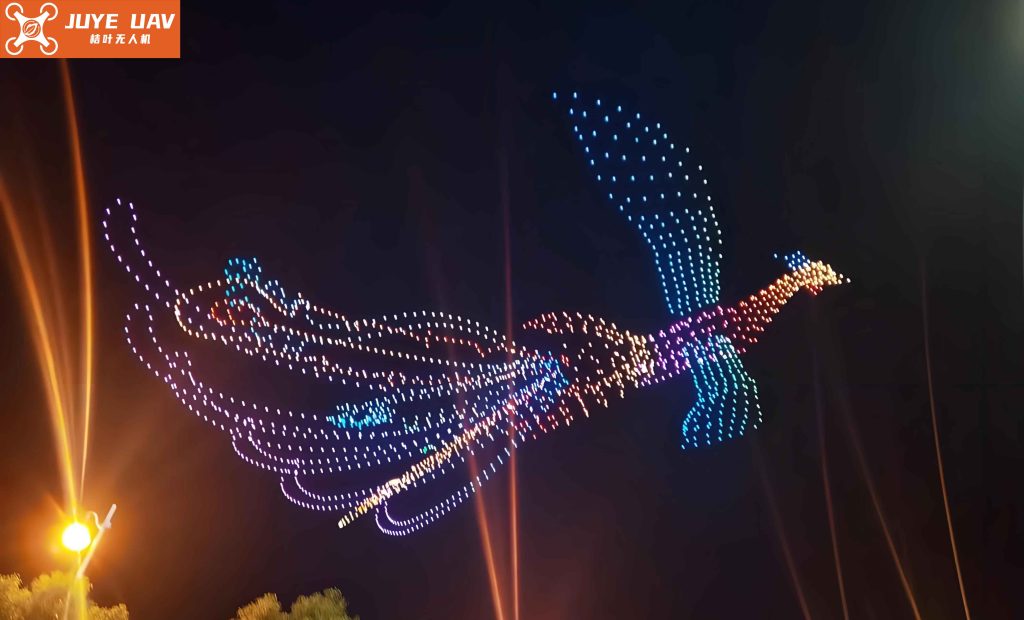
From my perspective, the safety of a drone light show hinges on a delicate interplay of technology, human factors, and environmental conditions. The very nature of a drone light show—where hundreds or thousands of drones operate in tight formation—amplifies risks. I believe that a systematic hazard analysis is the cornerstone of effective management. Below, I categorize the primary safety concerns associated with drone light shows, supported by analytical frameworks.
First, let’s consider the equipment used in drone light shows. To maximize profits, some commercial entities deploy drones with minimal functionality, often lacking advanced sensors. This deficiency significantly elevates the risk of mid-air collisions during a drone light show. A quantitative model can illustrate this: the collision probability \( P_c \) in a swarm of \( n \) drones can be approximated by:
$$ P_c = 1 – \prod_{i=1}^{n} (1 – p_i) $$
where \( p_i \) represents the individual failure probability of the \( i \)-th drone due to inadequate避障 capabilities. As \( n \) increases for a grand drone light show, \( P_c \) rises exponentially, underscoring the need for reliable hardware.
| Hazard Type | Description | Typical Impact |
|---|---|---|
| Lack of避障 Sensors | Drones rely only on basic GPS and lighting, with no real-time obstacle detection. | High collision risk, especially in dynamic environments. |
| Battery Failures | Insufficient battery life or management systems lead to sudden power loss. | Unplanned descent or crash, endangering crowds. |
| Communication Dropouts | Weak or interrupted links between ground control and drones. | Loss of swarm coordination, causing erratic movements. |
Second, management loopholes pose a substantial threat. When organizing a drone light show, authorities are often inundated with flight plan applications but lack tools for accurate risk assessment. Key parameters—such as drone specifications, weather patterns, and operator competence—are not systematically evaluated. I propose a risk scoring formula to address this:
$$ R = w_1 \cdot T + w_2 \cdot E + w_3 \cdot O $$
Here, \( R \) is the overall risk score for a drone light show event, \( T \) denotes technical reliability (e.g., drone quality), \( E \) represents environmental factors (e.g., wind speed), and \( O \) stands for operator experience. The weights \( w_1, w_2, w_3 \) can be adjusted based on historical data. Without such metrics, post-incident溯源 becomes nearly impossible, hampering accountability.
Third, swarm control technology, while innovative, remains immature. The algorithms governing a drone light show—often based on emergent behaviors—can be susceptible to glitches. For instance, the stability of a formation can be modeled using a Laplacian matrix \( L \) in graph theory:
$$ \dot{x} = -L x $$
where \( x \) is the position vector of drones. Any eigenvalue perturbation in \( L \) due to software bugs may lead to divergence, risking a chaotic drone light show. Furthermore, frequency interference is a critical vulnerability. A typical drone light show employs multiple frequency bands, as summarized below:
| Frequency Band | Purpose | Vulnerability |
|---|---|---|
| GPS L1/L2,北斗 B1 | Satellite navigation for positioning | Susceptible to jamming, causing定位 drift. |
| WiFi (2.4-2.4835 GHz, 5.725-5.85 GHz) | Data transmission for swarm communication | Prone to congestion from urban WiFi networks. |
| 433 MHz | Backup control link | Interference from industrial devices can disrupt signals. |
| RTK载波相位差分 | High-precision定位 for tight formations | Requires clear line-of-sight; multipath effects degrade accuracy. |
The signal-to-interference ratio (SIR) dictates performance: $$ SIR = \frac{P_{signal}}{P_{noise} + \sum P_{interference}} $$ If SIR drops below a threshold \( \theta \) (e.g., 10 dB for reliable control), the drone light show may suffer partial or total failure. This underscores the need for proactive spectrum management.
Based on these insights, I advocate for a three-phased safety management approach for drone light shows: pre-event, during event, and post-event. Each phase must integrate technology, regulation, and human factors to mitigate risks.
In the pre-event phase, regulatory frameworks must be solidified. While China has issued departmental rules on drones, a national law specifically governing drone light shows is lacking. I recommend enacting a dedicated statute that mandates stringent生产 standards, operator certification, and flight plan approvals. For training, a curriculum should include risk assessment using formulas like \( R = P \times C \), where \( P \) is probability and \( C \) is consequence. Additionally, all drones for a drone light show should be registered in a centralized database, enhancing traceability.
During the drone light show, real-time monitoring is paramount. I suggest a layered防御 system comprising预警,拒止, and保护区 zones. Technologically, this can be achieved through radar, radio monitoring, and光电 sensors. A control theory model can optimize this: let \( D(t) \) be the drone state vector, and \( M(t) \) the monitoring input. The system dynamics can be expressed as:
$$ \frac{dD}{dt} = f(D, M) + \epsilon $$
where \( \epsilon \) represents external disturbances (e.g., wind). By implementing a feedback loop with a PID controller, deviations can be corrected swiftly. Moreover, collaboration with radio authorities is crucial; they should conduct pre-show electromagnetic环境 tests to map potential干扰 sources. A table of recommended actions during a drone light show is:
| Measure | Implementation | Expected Outcome |
|---|---|---|
| Automated Flight Path | Use GIS data to plan routes避开禁飞区 and obstacles. | Reduced human error, enhanced precision. |
| Frequency Protection | Assign dedicated bands with buffers; employ跳频技术. | Minimized interference, stable communication. |
| Emergency Protocols | Integrate一键急停 and automatic return-to-home functions. | Rapid response to失控, preventing accidents. |
| Anti-Drone Systems | Deploy directed energy or net-based countermeasures at periphery. | Neutralization of rogue drones without affecting the main swarm. |
Post-event, accountability and service recovery are vital. A robust溯源 mechanism requires each drone in a drone light show to be uniquely identifiable via embedded chips or software tags. The责任追溯 can be modeled as a Bayesian network: $$ P(\text{Cause} | \text{Evidence}) = \frac{P(\text{Evidence} | \text{Cause}) P(\text{Cause})}{P(\text{Evidence})} $$ This helps pinpoint whether an incident resulted from equipment failure, operator error, or external interference. Furthermore, insurance and compensation schemes should be established, leveraging data from the drone light show for continuous improvement.
To encapsulate, the evolution of drone light shows demands an equally advanced safety ecosystem. I propose a unified platform that integrates training, flight management, and防控, as summarized in this holistic formula for safety performance \( S \):
$$ S = \alpha \cdot L + \beta \cdot T + \gamma \cdot M + \delta \cdot R $$
Here, \( L \) represents legal robustness, \( T \) technological maturity, \( M \) monitoring efficacy, and \( R \) response readiness, with coefficients \( \alpha, \beta, \gamma, \delta \) reflecting their relative importance. Regular drills and simulations, perhaps using Monte Carlo methods to estimate failure probabilities, can refine this model.
In conclusion, as drone light shows continue to dazzle audiences worldwide, safety must not be an afterthought. Through rigorous hazard analysis, multi-phase interventions, and innovative use of formulas and tables for risk quantification, we can foster a sustainable future for this art form. Every stakeholder—from regulators to operators—must collaborate to ensure that each drone light show is not only spectacular but also secure, protecting both people and property. The journey toward flawless drone light shows is ongoing, and with concerted effort, we can achieve a balance between innovation and safety.