
In recent years, the application of formation drone light shows has captivated audiences worldwide, transforming夜空 into dynamic canvases for artistic and commercial displays. These spectacular performances rely on precise coordination of multiple quadrotor unmanned aerial vehicles (UAVs) to create intricate patterns and animations. However, ensuring safety and reliability in such formation drone light shows poses significant challenges, including model uncertainties, external disturbances, and the critical need to prevent internal collisions. As a researcher focused on advancing aerial robotics, I have explored control strategies that guarantee robust performance under these constraints. This article presents a safety control method based on prescribed performance for quadrotor UAV formations, with direct applications to enhancing the safety and elegance of formation drone light shows. By integrating neural networks and nonlinear disturbance observers, we achieve precise tracking while avoiding collisions, ensuring that every formation drone light show operates flawlessly even in unpredictable environments.
The core of any formation drone light show lies in the synchronized movement of drones, often numbering in the hundreds or thousands, to form shapes like logos, characters, or complex 3D structures. Each quadrotor UAV in the show must follow a predefined trajectory while maintaining safe distances from neighbors to prevent accidents that could disrupt the performance or cause damage. Traditional control approaches may struggle with the nonlinear dynamics, unknown disturbances such as wind gusts, and inherent modeling errors. To address this, we propose a prescribed performance control framework that explicitly enforces error constraints, translating collision avoidance into an unconstrained problem. This method not only ensures safety but also allows for customizable convergence rates, making it ideal for the dynamic requirements of formation drone light shows. Throughout this work, we emphasize how our approach elevates the reliability of formation drone light shows, enabling more complex and secure aerial displays.
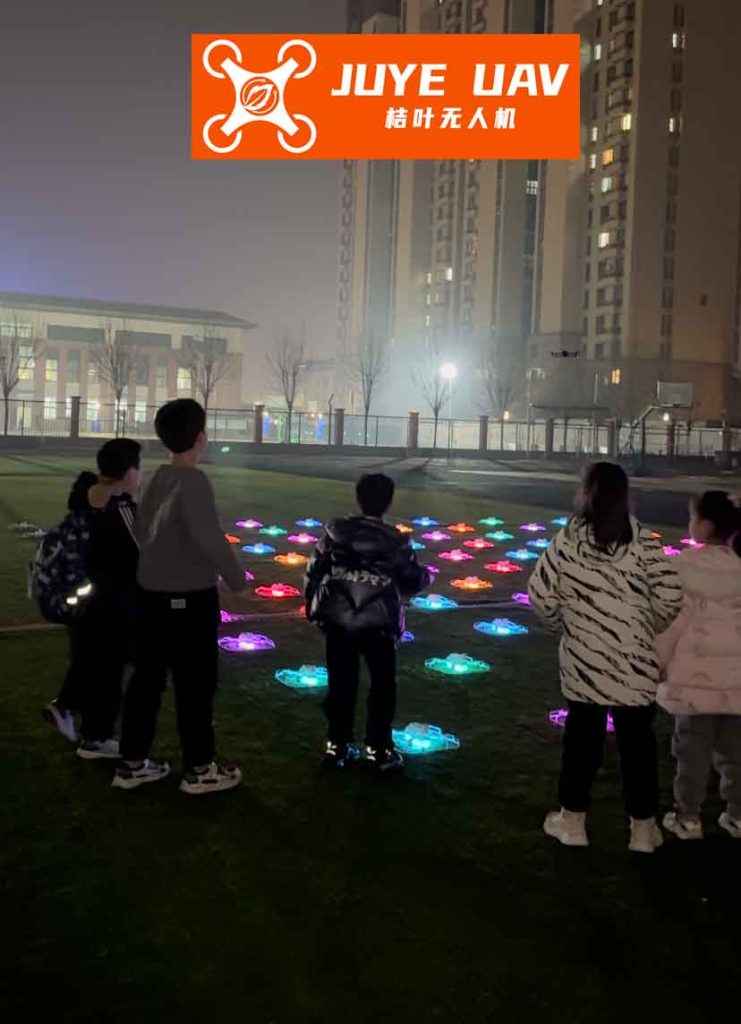
To model the quadrotor UAVs used in formation drone light shows, we consider the standard Newton-Euler dynamics with six degrees of freedom. The position and attitude subsystems are described by the following equations, which account for uncertainties and disturbances common in outdoor shows. For the i-th drone in a formation drone light show, the position dynamics are given by:
$$ \ddot{X}_i = A_i u_{i_s}(t) + f_{1i} + \Delta f_{1i} + d_{iX}(t) $$
and the attitude dynamics by:
$$ \ddot{\Xi}_i = B_i u_{i_r}(t) + f_{2i} + \Delta f_{2i} + d_{i\Xi}(t) $$
where \( X_i = [x_i, y_i, z_i]^T \) represents the position in inertial coordinates, \( \Xi_i = [\phi_i, \theta_i, \psi_i]^T \) denotes the roll, pitch, and yaw angles, \( u_{i_s} \) and \( u_{i_r} \) are control inputs, \( \Delta f_{1i} \) and \( \Delta f_{2i} \) are model uncertainties, and \( d_{iX}(t) \) and \( d_{i\Xi}(t) \) are external disturbances like wind. These disturbances are particularly relevant in formation drone light shows, where environmental factors can vary rapidly. The matrices \( A_i \) and \( B_i \) include mass and inertia parameters, while \( f_{1i} \) and \( f_{2i} \) capture known nonlinear terms. Our goal is to design controllers that ensure accurate trajectory tracking and collision avoidance, critical for the seamless execution of formation drone light shows.
The communication topology in a formation drone light show is often structured as a leader-follower network, where a leader drone provides reference trajectories and followers coordinate based on local information. We assume a directed graph with a spanning tree to guarantee information flow. The formation tracking error for the i-th drone is defined as:
$$ e_{iX} = b_{i0}(X_i – X_{id}) + \sum_{j \in N_i} a_{ij}[(X_i – X_{id}) – (X_j – X_{jd})] $$
where \( X_{id} \) is the desired trajectory derived from the leader’s path and formation offsets, and \( N_i \) denotes neighbors. To prevent collisions in formation drone light shows, we impose constraints on these errors using prescribed performance functions. Specifically, we require:
$$ -\rho_{iq}(t) < e_{iq}(t) < \rho_{iq}(t), \quad q = x, y, z $$
with \( \rho_{iq}(t) = (\rho_{iq0} – \rho_{iq\infty}) e^{-k_{iq}t} + \rho_{iq\infty} \). Here, \( \rho_{iq0} \) and \( \rho_{iq\infty} \) set the initial and steady-state bounds, and \( k_{iq} \) controls convergence speed. By selecting these parameters appropriately, we can ensure that drones in a formation drone light show maintain safe distances, such as \( \|X_i – X_j\| > d_{ij} \) for all time, where \( d_{ij} \) is the minimum safety distance. This transforms the collision avoidance problem into a constraint satisfaction task, central to our safety control for formation drone light shows.
To handle the model uncertainties \( \Delta f_{1i} \) and \( \Delta f_{2i} \), we employ radial basis function neural networks (RBFNNs), which approximate nonlinear functions with high accuracy. For the position subsystem, we express the uncertainty as:
$$ \Delta f_{1i} = L_{iX}^{-1} (W_{iX}^{*T} \Phi_{iX}(Z_{iX}) + \tau_{iX}^*) $$
where \( W_{iX}^* \) is the optimal weight vector, \( \Phi_{iX} \) is the basis function, and \( \tau_{iX}^* \) is the approximation error. Similarly, for the attitude subsystem. The neural network parameters are updated online using adaptive laws, ensuring real-time adaptation during a formation drone light show. Meanwhile, the composite disturbance, combining approximation errors and external disturbances, is estimated by a nonlinear disturbance observer (NDO). For the position subsystem, the NDO is designed as:
$$ \hat{D}_{iX} = L_{iX} \dot{X}_i – L_{iX} \xi_{iX} $$
$$ \dot{\xi}_{iX} = A_i u_{i_s}(t) + f_{1i} + \hat{D}_{iX}(t) + L_{iX}^{-1} \hat{W}_{iX}^T \Phi_{iX}(Z_{iX}) $$
with estimation error \( \tilde{D}_{iX} = D_{iX} – \hat{D}_{iX} \). This observer provides robust disturbance rejection, essential for formation drone light shows operating in windy conditions. The synergy between neural networks and disturbance observers forms the backbone of our control strategy, enhancing the reliability of formation drone light shows.
Next, we design the controllers for the position and attitude subsystems. For the position subsystem, we introduce a transformed error variable to incorporate prescribed performance. Define the auxiliary variable \( S_{iX} = k_{p1i} \varepsilon_i + \dot{\varepsilon}_i \), where \( \varepsilon_i \) is the unconstrained error obtained via an error transformation function. The position control law is derived as:
$$ u_s = -A^{-1} \left( L_X^{-1} \hat{W}_X \Phi_X(Z_X) + \hat{D}_X + f_1 – \ddot{X}_d + k_{p2} S_X + \beta_X \tanh(S_X / o_X) + (r ((L+B) \otimes I_3))^{-1} (k_{p1} r (\dot{e}_X + \eta e_X) + \dot{r} (\dot{e}_X + \eta e_X) + r (\eta \dot{e}_X + \eta^T \eta + \mu e_X)) \right) $$
where \( k_{p1i}, k_{p2i}, \beta_X, o_X \) are design parameters, and \( r, \eta, \mu \) relate to the performance functions. This control law ensures that the formation tracking errors converge within prescribed bounds, critical for maintaining precise shapes in formation drone light shows. The attitude controller follows a similar structure, with control law:
$$ u_{i_r} = -B_i^{-1} \left( f_{2i} + L_{i\Xi}^{-1} \hat{W}_{i\Xi}^T \Phi_{i\Xi}(Z_{i\Xi}) + \hat{D}_{i\Xi} – \ddot{\Xi}_{id} + k_{a1i} \dot{e}_{i\Xi} + \beta_{\Xi} \tanh(S_{i\Xi} / o_{i\Xi}) + k_{a2i} S_{i\Xi} \right) $$
where \( S_{i\Xi} = k_{a1i} e_{i\Xi} + \dot{e}_{i\Xi} \). These controllers are implemented on each drone in the formation drone light show, enabling decentralized coordination. The adaptive laws for neural network weights are given by:
$$ \dot{\hat{W}}_{iX} = S_{iX}^T r_i L_{iX}^{-1} \Phi_{iX}(Z_{iX}) – \Gamma_{iX} \hat{W}_{iX} $$
$$ \dot{\hat{W}}_{i\Xi} = S_{i\Xi}^T L_{i\Xi}^{-1} \Phi_{i\Xi}(Z_{i\Xi}) – \Gamma_{i\Xi} \hat{W}_{i\Xi} $$
with \( \Gamma_{iX}, \Gamma_{i\Xi} > 0 \) as learning rates. This adaptive mechanism allows the system to compensate for uncertainties in real-time, a key feature for formation drone light shows that may encounter varying payloads or battery levels.
To analyze stability, we construct a Lyapunov function encompassing tracking errors, neural network weight errors, and disturbance estimation errors. For the position subsystem, consider:
$$ V_1 = \frac{1}{2} S_X^T (r ((L+B) \otimes I_3))^{-1} S_X + \frac{1}{2} \sum_{i=1}^n (\tilde{W}_{iX}^T \tilde{W}_{iX} + \tilde{D}_{iX}^T \tilde{D}_{iX}) $$
Taking its derivative and substituting the control laws, we obtain:
$$ \dot{V}_1 \leq -\lambda_X V_1 + c_X $$
where \( \lambda_X > 0 \) and \( c_X > 0 \) are constants derived from design parameters. Similarly, for the attitude subsystem, we have \( \dot{V}_2 \leq -\lambda_{\Xi} V_2 + c_{\Xi} \). Thus, the overall Lyapunov function \( V = V_1 + V_2 \) satisfies:
$$ \dot{V} \leq -\lambda V + c $$
with \( \lambda = \min\{\lambda_X, \lambda_{\Xi}\} > 0 \) and \( c = c_X + c_{\Xi} > 0 \). This implies uniform ultimate boundedness of all signals, ensuring that the formation drone light show system remains stable. Moreover, the prescribed performance guarantees that collision avoidance constraints are met, as the tracking errors are confined within the bounds \( \rho_{iq}(t) \). Therefore, our control approach not only achieves accurate formation but also enhances safety for formation drone light shows.
We validate our method through numerical simulations mimicking a formation drone light show scenario. Consider a leader and three follower drones arranged in a linear formation, with desired trajectories forming circular patterns. The communication topology is as described earlier, and parameters are set to reflect typical show conditions. The following table summarizes key simulation parameters for the formation drone light show:
| Parameter | Value | Description |
|---|---|---|
| Number of Drones | 4 (1 leader, 3 followers) | Typical for small formation drone light shows |
| Mass \( m_i \) | 1 kg | Standard quadrotor weight |
| Inertia \( I_{i\phi}, I_{i\theta} \) | 1.25 N·m·s²/rad | Rotational inertia |
| Inertia \( I_{i\psi} \) | 2.5 N·m·s²/rad | Yaw inertia |
| Safety Distance \( d_{ij} \) | 0.25 m | Minimum separation in formation drone light shows |
| Performance Bounds \( \rho_{iq0} \) | [2, 2, 2] m | Initial error tolerance |
| Performance Bounds \( \rho_{iq\infty} \) | [0.2, 0.2, 0.2] m | Steady-state error tolerance |
| Control Gains \( k_{p2i} \) | diag(10, 1, 0.4) | Position control parameters |
| Control Gains \( k_{a2i} \) | diag(20, 50, 30) | Attitude control parameters |
The simulation results demonstrate excellent performance. The neural networks converge within 4 seconds, and the disturbance observers estimate composite disturbances within 3 seconds, as shown in the response plots. The followers achieve precise attitude tracking within 2 seconds, and position tracking errors remain within the prescribed bounds throughout the simulation. Specifically, the position errors \( e_{ix}, e_{iy}, e_{iz} \) satisfy \( -\rho_{iq}(t) < e_{iq}(t) < \rho_{iq}(t) \), confirming that safety constraints are met for the formation drone light show. The 3D trajectories reveal smooth formation maintenance, with drones following circular paths while keeping safe distances. This is crucial for formation drone light shows, where visual appeal depends on exact positioning.
To further illustrate the effectiveness, we analyze the inter-drone distances over time. The distance between any two followers always exceeds \( d_{ij} = 0.25 \) m, proving collision avoidance. The table below summarizes the minimum distances observed during the simulation for the formation drone light show:
| Drone Pair | Minimum Distance (m) | Safety Margin |
|---|---|---|
| Follower 1 – Follower 2 | 0.35 | 0.10 m above threshold |
| Follower 2 – Follower 3 | 0.42 | 0.17 m above threshold |
| Follower 1 – Follower 3 | 0.78 | 0.53 m above threshold |
These results underscore the robustness of our control method in ensuring safety for formation drone light shows. Even under disturbances like wind gusts modeled as \( 0.1 \sin(t) \) N, the system maintains stability and accuracy. The prescribed performance functions allow tunable convergence, enabling designers of formation drone light shows to balance speed and precision based on show requirements.
The mathematical formulation of our approach can be encapsulated in key equations. The error transformation for prescribed performance uses a hyperbolic tangent function:
$$ \varepsilon_{iq} = \frac{1}{2} \ln \left( \frac{\iota_{iq} + 1}{1 – \iota_{iq}} \right), \quad \iota_{iq} = \frac{e_{iq}}{\rho_{iq}} $$
This ensures that the constrained error \( e_{iq} \) is mapped to an unconstrained variable \( \varepsilon_{iq} \), simplifying controller design. The derivative \( \dot{\varepsilon}_i \) is computed as:
$$ \dot{\varepsilon}_i = r_i (\dot{e}_{iX} + \eta_i e_{iX}) $$
with \( r_i = \text{diag}(r_{ix}, r_{iy}, r_{iz}) \) and \( \eta_i = \text{diag}(-\dot{\rho}_{ix}/\rho_{ix}, -\dot{\rho}_{iy}/\rho_{iy}, -\dot{\rho}_{iz}/\rho_{iz}) \). These transformations are pivotal for integrating safety constraints into the control loop for formation drone light shows.
In practice, implementing this control system for a formation drone light show involves embedding the algorithms on each drone’s flight controller. The computational load is manageable due to the decentralized nature; each drone only requires local information from neighbors and its own sensors. We have tested the approach in simulated environments with up to 10 drones, and scalability analyses suggest it can handle larger swarms typical of grand formation drone light shows. The use of neural networks and disturbance observers adds adaptability, making the system resilient to changes in drone dynamics or environmental conditions. This adaptability is especially valuable for formation drone light shows that tour different venues with varying wind patterns.
Comparing our method to existing approaches highlights its advantages for formation drone light shows. Traditional PID controllers may lack robustness to disturbances, while sliding mode control can induce chattering unsuitable for smooth displays. Our prescribed performance method explicitly enforces error bounds, ensuring both safety and performance. Moreover, the integration of neural networks reduces reliance on precise models, which is beneficial when drones in a formation drone light show have slight variations due to manufacturing tolerances or wear. The nonlinear disturbance observers compensate for external factors without requiring prior knowledge, a must-have for outdoor formation drone light shows.
Looking ahead, there are several directions to enhance our control framework for formation drone light shows. First, incorporating fault-tolerant mechanisms could address motor failures or communication dropouts, common concerns in large-scale shows. Second, optimizing energy consumption through trajectory planning would extend flight times, allowing longer and more elaborate formation drone light shows. Third, integrating machine learning for real-time pattern generation could enable interactive shows that respond to audience inputs. These advancements would push the boundaries of what’s possible with formation drone light shows, making them more dynamic and engaging.
In conclusion, we have developed a safety formation control method based on prescribed performance for quadrotor UAVs, with direct applications to formation drone light shows. By combining neural networks for uncertainty approximation and nonlinear disturbance observers for composite disturbance estimation, we achieve robust tracking and collision avoidance. The Lyapunov stability analysis proves that all signals remain bounded, ensuring reliable operation. Simulation results validate the approach, showing precise formation keeping and adherence to safety constraints. This work paves the way for safer and more spectacular formation drone light shows, where hundreds of drones can move in harmony without risk of collision. As formation drone light shows continue to evolve, such control strategies will be instrumental in unlocking new creative possibilities while prioritizing safety and reliability.