
The integration of agricultural drones into wheat pest management has transformed traditional practices through precision targeting and operational efficiency. These agricultural UAV systems enable real-time adjustments based on crop phenology, reducing pesticide usage by over 30% while maintaining efficacy above 85%. This technological shift addresses critical challenges like chemical drift and uneven coverage that plague conventional methods.
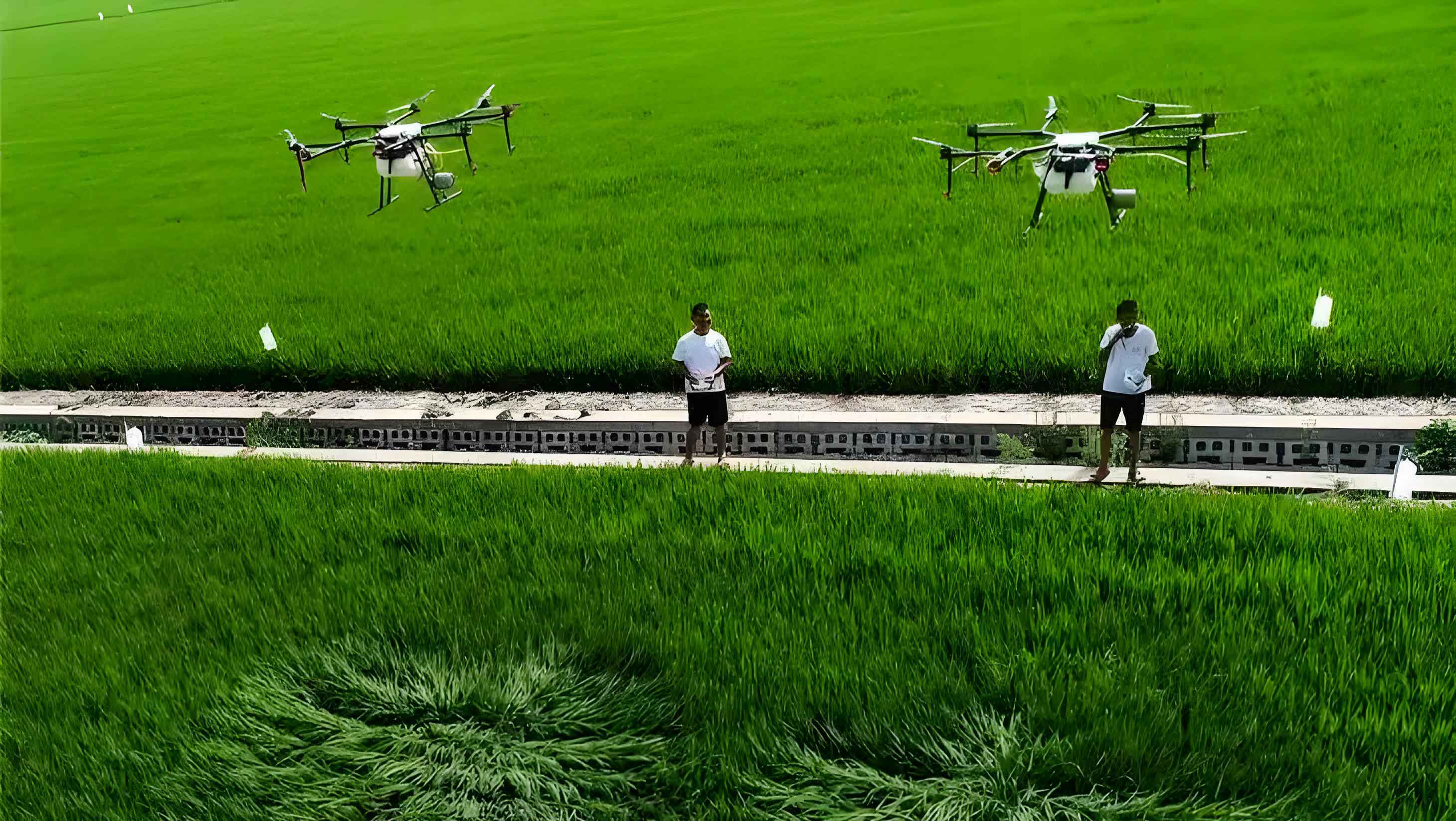
Integrated Workflow for Agricultural UAV Operations
Pre-Operation Protocols
Environmental constraints dictate agricultural drone deployment windows. Critical thresholds include wind speed < 3 m/s and ambient temperature < 35°C. Post-spray precipitation exceeding 5mm within 48h necessitates reapplication. Regulatory compliance requires:
- Flight zone demarcation with 50m clearance from obstacles
- Pesticide registration disclosure via official channels
- Operator certification (20+ flight hours on target UAV model)
Equipment validation follows strict metrics:
$$ \text{Gyroscope error} \leq \pm 0.5^\circ, \quad \text{Flow rate deviation} \leq 3\% $$
| Component | Inspection Standard | Acceptance Threshold |
|---|---|---|
| Battery | Voltage/Cycle count | 22.2±0.5V / ≤200 cycles |
| Nozzles | Droplet size | 80-120 μm |
| Pressure pump | Operating pressure | ≥2.5 Bar |
Dynamic Application Parameters
Agricultural UAV parameters adapt to growth stages:
$$ \text{Spray volume (L/ha)} = \begin{cases}
12 & \text{Green-up stage} \\
18 & \text{Booting stage}
\end{cases} $$
| Growth Stage | Altitude (m) | Speed (m/s) | Overlap (m) |
|---|---|---|---|
| Green-up | 1.8-2.0 | 5.0 | 0.5 |
| Heading | 2.2 | 4.5 | 0.7 |
Real-time adjustments during flight include 0.3m altitude reduction and 10% flow increase when humidity drops below 40%. Nozzle maintenance cycles occur every 15 minutes to prevent 15% flow reduction from clogging.
Post-Application Verification
A three-tier validation system ensures efficacy:
- Immediate: 85% droplet deposition on sampled leaves
- 24h: ≥90% aphid reduction / ≥80% rust suppression
- 72h: Soil residue analysis (e.g., organophosphates ≤0.05mg/kg)
Equipment maintenance protocol post-operation:
$$ \text{Cleaning cycles} = 3 \times \text{pH-neutral detergent rinse} $$
Targeted Pathogen Management with Agricultural Drones
Insect Infestation Protocols
For aphid densities >50/m², agricultural UAV deploy 25% thiamethoxam (20mL/mu) with 0.3% silicone surfactant at 1.5m altitude during 05:00-07:00. Armyworm outbreaks require chlorantraniliprole:emamectin benzoate (1:2) at 1.5L/mu with 15% increased dosage on field perimeters. Post-spray verification requires 85% knockdown rate within 6h.
Fungal Disease Strategies
Fusarium head blight prevention initiates at 10% flowering using 48% cyanogen•tebuconazole (40mL/mu) in >90% humidity conditions. Microencapsulated formulations provide rainfastness during 2h precipitation gaps. Secondary application after 7-10 days utilizes benzoyl•azoxystrobin to prevent resistance:
$$ \text{Inhibition rate} = \frac{\text{Control perithecia} – \text{Treated perithecia}}{\text{Control perithecia}} \times 100 > 75\% $$
| Disease | Chemical Formulation | Agricultural UAV Parameters |
|---|---|---|
| Stripe Rust | 30% kresoxim-methyl + 5% oligosaccharins | 3m H, 5.5m/s, 1.8L/mu |
| Powdery Mildew | Triazole + Strobilurin mixture | 1.5-1.8m H, 70% normal speed |
| Root Rot | Systemic fungicide + penetrants | 6m H, grid flight pattern |
Critical Operational Framework
Pre-Flight Safety System
Agricultural drone operators must complete comprehensive checklists:
| Category | Inspection Items | Threshold |
|---|---|---|
| Airframe | Propeller integrity, GPS signal | 0 visible damage, ≥12 satellites |
| Chemigation | Nozzle flow, filter cleanliness | ±3% variance, no residue |
| Environment | Wind, temperature, precipitation risk | <3m/s, <35°C, <30% probability |
In-Flight Optimization
Agricultural UAV require continuous parameter adjustment during operation. Optimal flight vectors follow:
$$ \text{Optimal altitude} = \text{Crop height} + (0.8 \times \text{Canopy density index}) $$
Chemical compatibility protocols include 72h intervals between acidic/alkaline pesticides. Real-time weather response triggers auto-landing when wind gusts exceed 4m/s or temperature fluctuations >0.5°C/min.
Post-Operation Management
Three-phase monitoring occurs at 72h, 168h, and 360h post-application. Assessment metrics include:
- Pest resurgence hotspots (>10 aphids/plant)
- Phytotoxicity symptoms (leaf margin necrosis)
- Disease progression indices
Data archiving incorporates flight logs, meteorological records, and efficacy reports into cloud-based agricultural UAV management platforms for continuous improvement.
Conclusion
Agricultural drones establish a standardized precision agriculture framework through integrated sensor systems, adaptive control algorithms, and empirical verification protocols. Future development focuses on drift-reduction nozzles and AI-powered obstacle avoidance to enhance the environmental sustainability of agricultural UAV. Cross-sector collaboration will expand these platforms’ role in achieving dual objectives of food security and ecological preservation.