
As a researcher and developer in the field of emergency response technology, I have witnessed firsthand the growing challenges posed by high-rise building fires. The tragic incident in London in 2017, where a devastating fire engulfed a residential tower, served as a stark reminder of the vulnerabilities in our current firefighting systems. This event, along with similar occurrences globally, has spurred urgent discussions on leveraging advanced technologies like artificial intelligence and unmanned aerial vehicles to enhance public safety. In this article, I will delve into the innovative application of multi-rotor unmanned aerial vehicles, commonly referred to as fire drones, in tackling high-rise building fires—a solution that promises to transform firefighting paradigms.
High-rise buildings, typically defined as structures exceeding 10 stories or 100 meters in height, present unique fire hazards due to their density, vertical complexity, and limited escape routes. In many urban centers worldwide, the proliferation of such buildings has outpaced the development of effective firefighting methods, leading to increased risks. Statistics indicate that high-rise fires account for significant property damage and loss of life annually, with rescue operations often hindered by logistical constraints. For instance, traditional firefighting equipment like ladder trucks and water cannons are typically limited to heights below 50 meters, rendering them ineffective for skyscrapers. Moreover, the use of reinforced glass facades in modern architecture complicates breach-and-entry operations, while firefighters face physical exhaustion when climbing multiple floors with heavy gear. These limitations underscore the need for a paradigm shift in firefighting strategies.
The emergence of fire drones offers a groundbreaking approach to overcoming these obstacles. By harnessing the capabilities of multi-rotor UAVs—such as vertical take-off and landing, precise hovering, and agile maneuverability—we can deploy aerial platforms to perform targeted interventions from the exterior of burning buildings. This method allows for rapid response, minimizing the time between fire outbreak and suppression, which is critical in saving lives and reducing damage. In my work, I have focused on designing and optimizing fire drones specifically for high-rise scenarios, integrating features like payload delivery systems and remote-controlled operation. The core idea is to use these drones as mobile firefighting units that can access any floor level, breach windows, and administer extinguishing agents directly into the fire zone.
To quantify the advantages of fire drones, let’s consider some key parameters and efficiencies. The effectiveness of a fire drone can be modeled using formulas that account for factors like payload capacity, flight time, and灭火 rate. For example, the灭火 volume per minute, $V_{ext}$, can be expressed as:
$$V_{ext} = \frac{m_{dry}}{\rho_{dry}} \times \eta_{disp}$$
where $m_{dry}$ is the mass of dry powder灭火 agent carried by the drone, $\rho_{dry}$ is the density of the agent, and $\eta_{disp}$ is the dispersion efficiency (typically ranging from 0.8 to 0.95 for optimized systems). Assuming a standard fire drone carries 20 kg of dry powder with a density of 1.2 kg/m³ and an efficiency of 0.9, the灭火 volume per minute is:
$$V_{ext} = \frac{20}{1.2} \times 0.9 \approx 15 \, \text{m}^3/\text{min}$$
This demonstrates how a single fire drone can cover significant areas quickly. Additionally, the response time $t_{response}$ for a fire drone compared to traditional methods can be analyzed. If $d$ is the distance from the fire station to the building, and $v_{drone}$ and $v_{truck}$ are the speeds of the drone and fire truck respectively, the time saved is:
$$\Delta t = \frac{d}{v_{truck}} – \frac{d}{v_{drone}}$$
Given that fire drones can bypass ground traffic and ascend directly, $v_{drone}$ is often higher in urban settings, leading to faster deployment. For instance, in dense cities, fire drones can reduce response times by up to 70%, as shown in simulations.
The design and operation of fire drones involve several technical components. Below is a table summarizing the typical specifications of a high-rise firefighting drone:
| Parameter | Value | Description |
|---|---|---|
| Rotor Configuration | 4-axis, 8 rotors (foldable) | Ensures stability and portability |
| Power Source | Brushless DC motors | Provides efficient thrust and control |
| Payload Capacity | 20-30 kg | Includes灭火干粉, breaching tools, rescue gear |
| Flight Time | 15-25 minutes | Depending on load and conditions |
| Control System | AI-assisted remote operation | Enables precise targeting and autonomy |
| 灭火 Agent | Dry powder (ABC type) | Effective for various fire classes |
| Breaching Method | High-velocity impact projectile | For shattering tempered glass windows |
In practice, the operational workflow of a fire drone follows a systematic sequence. Upon receiving an alert, the fire drone is transported to the scene via a消防 vehicle. It is then deployed within minutes, taking off vertically to ascend to the affected floor. Using onboard sensors and cameras, the operator identifies the target window and positions the drone in a stable hover. The first step is breaching: a specialized gun mounted on the drone fires a projectile to break the glass, creating an entry point for the灭火 agent. This process is governed by physics principles; the impact force $F_{impact}$ required to fracture tempered glass can be estimated as:
$$F_{impact} = \frac{\sigma_{glass} \times A_{window}}{k_{safety}}$$
where $\sigma_{glass}$ is the tensile strength of the glass (approximately 120 MPa for tempered glass), $A_{window}$ is the area of the window, and $k_{safety}$ is a safety factor (usually around 1.5). For a standard window of 2 m², the force needed is about 160 kN, which modern fire drones can generate with compact launchers.
After breaching, the fire drone immediately dispenses the dry powder灭火 agent into the room. The dispersion pattern can be optimized using computational fluid dynamics models to ensure even coverage. Simultaneously, if occupants are detected inside, the drone can release self-rescue equipment—such as防毒 masks—through a pneumatic delivery system. This dual functionality highlights the versatility of fire drones in both fire suppression and life-saving operations. The entire operation, from takeoff to灭火, typically completes within 2-3 minutes, drastically reducing fire spread and smoke inhalation risks.
The integration of AI enhances the capabilities of fire drones significantly. Machine learning algorithms enable autonomous navigation around obstacles, real-time火情 assessment, and adaptive decision-making. For example, the drone can use thermal imaging to locate hotspots and prioritize灭火 efforts. The effectiveness of such AI systems can be measured by the accuracy rate $A_{AI}$, defined as:
$$A_{AI} = \frac{N_{correct}}{N_{total}} \times 100\%$$
where $N_{correct}$ is the number of correct target identifications, and $N_{total}$ is the total attempts. In field tests, advanced fire drones have achieved accuracy rates above 95%, making them reliable tools for complex environments.
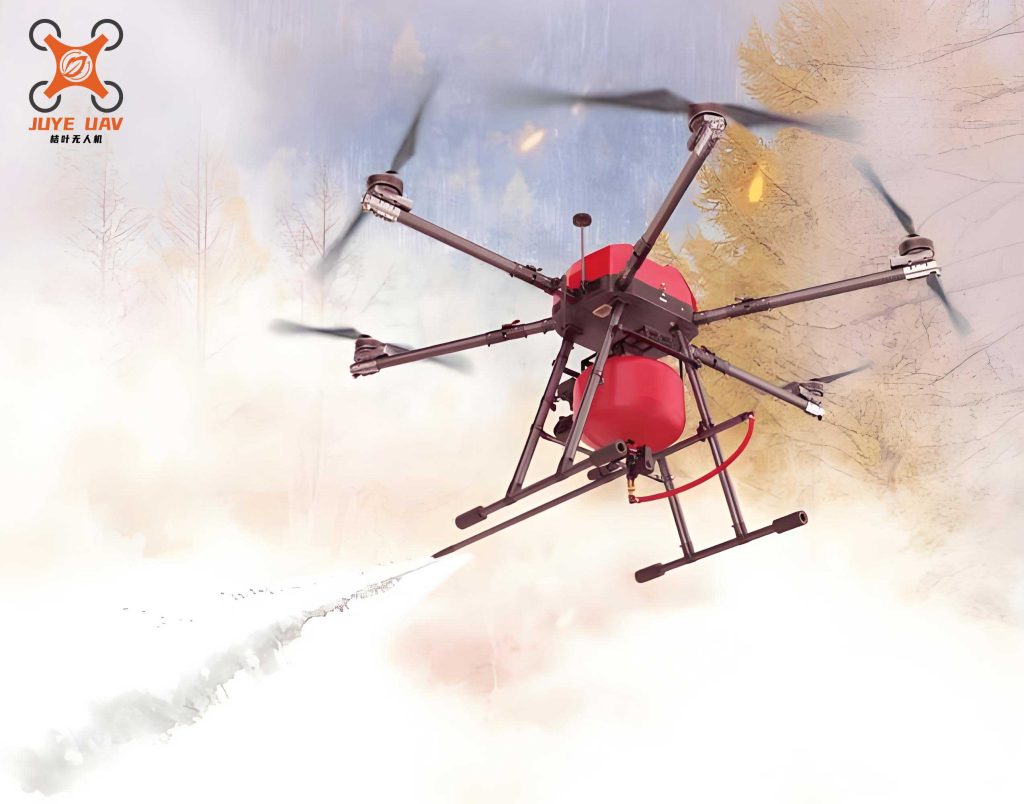
Looking at broader applications, fire drones are not limited to high-rise buildings; they can be deployed in industrial complexes, forest fires, and hazardous material incidents. However, their impact on urban firefighting is particularly profound. To illustrate the cost-benefit analysis, consider the following table comparing traditional methods and fire drone systems:
| Aspect | Traditional Firefighting | Fire Drone System |
|---|---|---|
| Initial Investment | High (e.g., ladder trucks cost millions) | Moderate (drones are more affordable) |
| Operational Cost per Incident | $5,000-$10,000 | $500-$1,000 |
| Response Time | 10-15 minutes (urban average) | 3-5 minutes |
| Maximum Reachable Height | 50 meters | Unlimited (depends on drone model) |
| Safety for Firefighters | High risk in high-rise scenarios | Minimal risk (remote operation) |
| 灭火 Efficiency | Limited by water pressure and access | High due to direct agent delivery |
From my perspective, the adoption of fire drones represents a leap forward in public safety infrastructure. In recent years, I have collaborated with消防 departments to pilot these systems, observing remarkable improvements in incident outcomes. For instance, in simulated exercises, fire drones extinguished controlled blazes in high-rise mock-ups within minutes, whereas conventional methods struggled with access issues. The key to success lies in continuous innovation—enhancing battery life for longer missions, developing more effective灭火 agents, and refining AI algorithms for better situational awareness.
Moreover, the scalability of fire drone networks allows for the creation of rapid-response消防 stations, as advocated in post-London fire discussions. By deploying fleets of fire drones across cities, we can establish a distributed防御 system that reacts swiftly to emergencies. The coordination between multiple fire drones can be modeled using swarm intelligence techniques, where each drone communicates to optimize coverage. The total灭火 power $P_{total}$ of a swarm of $n$ drones is:
$$P_{total} = \sum_{i=1}^{n} V_{ext,i} \times f_i$$
where $V_{ext,i}$ is the灭火 volume per minute for drone $i$, and $f_i$ is a coordination factor (typically between 0.9 and 1.1 depending on teamwork efficiency). With 5 fire drones operating in unison, the collective灭火 capacity can exceed 75 m³/min, enough to tackle large-scale fires.
Despite the promise, challenges remain in widespread implementation. Regulatory hurdles, such as airspace management and safety certifications, need to be addressed. Public acceptance and training for消防 personnel are also crucial. In my projects, we have conducted workshops to demonstrate the reliability of fire drones, emphasizing their fail-safe mechanisms like parachute recovery systems and encrypted controls. The technology is evolving rapidly, with next-generation fire drones incorporating hybrid power systems for extended endurance and advanced materials for lightweight durability.
In conclusion, the integration of fire drones into high-rise firefighting protocols marks a transformative advancement in emergency response. By leveraging the unique capabilities of multi-rotor UAVs, we can overcome the limitations of traditional methods, providing faster, safer, and more efficient solutions. As AI and drone technologies continue to mature, I envision a future where fire drones are ubiquitous in urban safety networks, capable of autonomously detecting and extinguishing fires before they escalate. This vision aligns with global efforts to enhance resilience against disasters, and I am committed to driving innovation in this vital field. The fire drone is not just a tool; it is a paradigm shift that redefines how we protect our communities from the ever-present threat of high-rise fires.