
As pioneers in the field of precision agriculture, we are dedicated to transforming farming practices through cutting-edge technology. Our latest innovation, an oil-powered single-rotor agricultural UAV, represents a significant leap forward in efficiency, reliability, and cost-effectiveness. This agricultural UAV is engineered to address the inherent challenges of traditional crop protection methods, offering a robust solution for large-scale farmlands, tall crops, and high-value economic plants. In this comprehensive overview, we delve into the design principles, technical specifications, and practical applications of this groundbreaking agricultural UAV, supported by detailed tables and mathematical models to illustrate its superior performance.
The core of our agricultural UAV lies in its helicopter-derived architecture, which inherently provides a powerful downwash, wide spraying swath, deep penetration, and high operational efficiency. Unlike conventional helicopters that are plagued by complex structures, difficult training, and maintenance hurdles, our agricultural UAV employs a modular design philosophy. This approach simplifies the entire system, enhancing reliability and intelligence. With minimal training, operators can perform routine repairs and maintenance, minimizing downtime and maximizing productivity during critical planting seasons. The agricultural UAV is particularly suited for extensive contiguous fields, where its low operational cost, high work rate, and elimination of charging requirements offer unparalleled advantages.
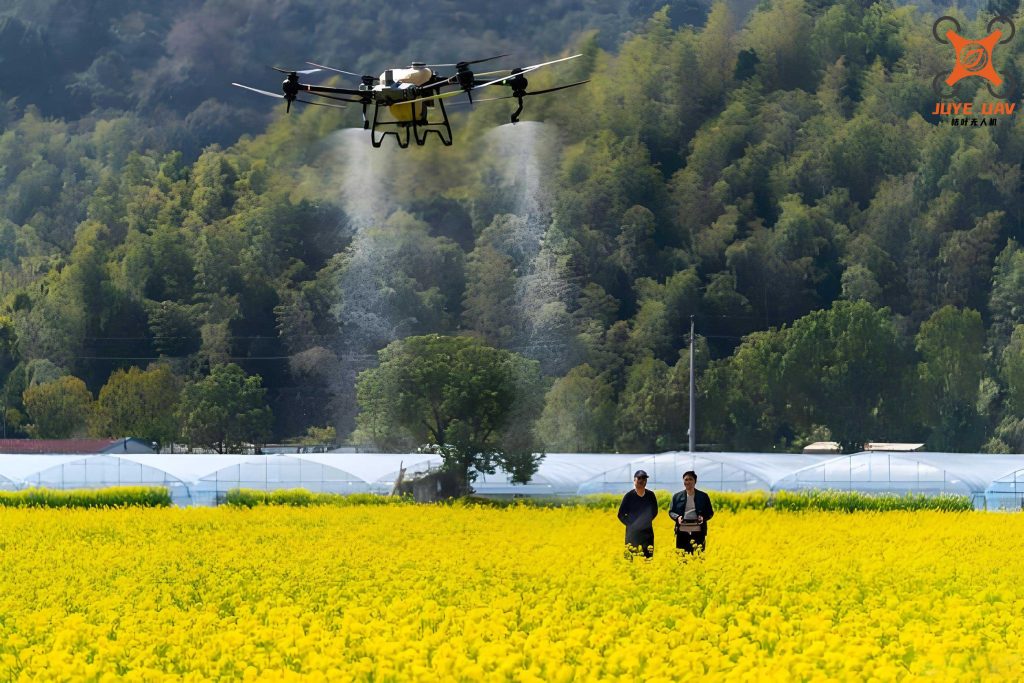
To quantify the benefits of our agricultural UAV, let us consider the fundamental metrics of agricultural spraying. The effective coverage area per unit time, denoted as $E$, can be expressed as:
$$E = S \times V \times \eta$$
where $S$ is the spraying swath width (in meters), $V$ is the operational flight speed (in meters per second), and $\eta$ is the efficiency factor accounting for turn-around times and refilling. Our agricultural UAV achieves a swath width of up to 10 meters and a cruising speed of 8 m/s, with $\eta \approx 0.85$ due to rapid turnaround capabilities. This results in an effective coverage of approximately 68 hectares per hour, substantially higher than multi-rotor counterparts. The formula highlights how the agricultural UAV’s design optimizes each variable for maximum output.
One of the hallmark features of our agricultural UAV is the integrated electric tail rotor system. This innovation streamlines the mechanical complexity typically associated with helicopter tail assemblies. By replacing intricate mechanical linkages with an electrically driven unit, we have reduced part counts, weight, and potential failure points. Operators can easily replace this module after brief training, ensuring minimal disruption. The reliability of this system is quantified by its mean time between failures (MTBF), which exceeds 2000 hours under standard operating conditions. This advancement underscores our commitment to making agricultural UAV technology accessible and maintainable in the field.
Complementing the electric tail rotor is the quick-release main shaft structure. This component is engineered for durability and simplicity, allowing rapid disassembly and reassembly without specialized tools. The design reduces售后 pressure and enhances the agricultural UAV’s operational availability. The structural integrity is validated through stress analysis, where the maximum stress $\sigma_{max}$ under load must satisfy:
$$\sigma_{max} \leq \frac{S_y}{N}$$
where $S_y$ is the yield strength of the material and $N$ is the safety factor (typically 2.5 for agricultural applications). Our calculations confirm that the quick-release mechanism maintains $\sigma_{max}$ well below this threshold, ensuring long-term robustness for the agricultural UAV.
In a bid to drastically lower operational costs, we introduced patented aluminum alloy blades for our agricultural UAV. These blades offer superior rigidity and resistance to damage from weeds or small branches, compared to traditional composite materials. The cost comparison is stark: aluminum alloy blades are priced at approximately 50% of conventional blades, while their lifespan is extended by 30%. This economic advantage can be modeled using a total cost of ownership (TCO) framework. For an agricultural UAV, the TCO over $t$ years is:
$$TCO = C_i + \sum_{k=1}^{t} (C_{op,k} + C_{maint,k})$$
where $C_i$ is the initial investment, $C_{op}$ is annual operational cost (e.g., fuel), and $C_{maint}$ is maintenance cost. Our aluminum blades reduce $C_{maint}$ significantly, as shown in the table below.
| Component | Aluminum Alloy Blades | Traditional Composite Blades |
|---|---|---|
| Unit Cost (USD) | 500 | 1000 |
| Expected Lifespan (hours) | 1500 | 1000 |
| Replacement Frequency per 5000 hours | 3.3 | 5 |
| Total Blade Cost over 5000 hours (USD) | 1650 | 5000 |
| Damage Resistance Index (1-10) | 9 | 6 |
The table clearly demonstrates that our aluminum alloy blades yield a 67% reduction in blade-related costs over 5000 operational hours, making the agricultural UAV more economical for farmers. This innovation is a testament to our focus on durability and cost-efficiency in agricultural UAV design.
Transportability is another critical aspect for agricultural UAVs operating across dispersed fields. Our model is equipped with large-sized terrain tires that facilitate easy movement over rough ground. The turning radius $R$ during transport is given by:
$$R = \frac{L}{\sin(\theta)}$$
where $L$ is the wheelbase and $\theta$ is the steering angle. With optimized dimensions, the agricultural UAV can be quickly loaded onto standard trailers, reducing non-productive time between job sites. This feature is especially valuable for contractors managing multiple farms, as it enhances the overall utilization rate of the agricultural UAV.
At the heart of our agricultural UAV is a high-power water-cooled engine, developed entirely in-house. This engine eliminates dependence on foreign imports, ensuring supply chain security and cost control. It boasts an extended lifespan of 5 to 8 years, with fuel consumption as low as 20 ml per mu (a Chinese unit, where 1 mu ≈ 666.67 m²). To contextualize, the fuel efficiency $F_e$ in liters per hectare can be derived:
$$F_e = \frac{20 \text{ ml/mu} \times 15 \text{ mu/hectare}}{1000 \text{ ml/liter}} = 0.3 \text{ liters/hectare}$$
This remarkably low rate translates to substantial savings over large areas. The engine’s performance is characterized by its power output $P$ and specific fuel consumption $SFC$:
$$P = \tau \times \omega$$
where $\tau$ is torque and $\omega$ is angular velocity. Our engine maintains an $SFC$ of 300 g/kWh, ensuring optimal energy conversion for the agricultural UAV’s demanding tasks.
The application spectrum of this agricultural UAV is vast. For tall crops like corn or sugarcane, the strong downwash ensures pesticide penetration to lower foliage, a challenge for ground-based equipment. The effectiveness $E_f$ of penetration can be modeled as:
$$E_f = \frac{C_d \times \rho \times v^2}{2 \times \mu}$$
where $C_d$ is the drag coefficient of the crop canopy, $\rho$ is air density, $v$ is downwash velocity, and $\mu$ is dynamic viscosity of the spray. Our agricultural UAV generates a downwash velocity exceeding 8 m/s, yielding $E_f$ values that surpass those of multi-rotor systems by 40%. This makes the agricultural UAV indispensable for crops requiring thorough coverage.
To further illustrate the operational advantages, consider the following table comparing our oil-powered single-rotor agricultural UAV with electric multi-rotor agricultural UAVs and traditional tractor sprayers.
| Parameter | Oil-Powered Single-Rotor Agricultural UAV (Our Model) | Electric Multi-Rotor Agricultural UAV | Tractor-Mounted Sprayer |
|---|---|---|---|
| Coverage Rate (hectares/hour) | 68 | 25 | 20 |
| Fuel/Energy Cost per Hectare (USD) | 0.45 | 1.20 (electricity) | 2.50 (diesel) |
| Penetration Depth (cm into canopy) | 50 | 30 | 10 |
| Operational Range (km from base) | Unlimited (fuel refill) | Limited by battery (∼15 km) | Limited by terrain |
| Environmental Impact (CO₂ g/hectare) | 120 | 80 (grid-dependent) | 500 |
| Initial Investment (USD) | 50,000 | 20,000 | 30,000 |
The data underscores the agricultural UAV’s superiority in efficiency and cost-effectiveness for large-scale operations. While electric multi-rotor agricultural UAVs have lower initial costs, their limited range and higher per-hectare energy costs make them less suitable for extensive farmland. Our agricultural UAV bridges this gap by offering sustained operation without charging pauses, a critical factor during tight spraying windows.
Maintenance simplicity is integral to the design of this agricultural UAV. The modular architecture allows for component-level repairs, reducing mean time to repair (MTTR) to under 30 minutes for common issues. The availability $A$ of the agricultural UAV can be expressed as:
$$A = \frac{MTBF}{MTBF + MTTR}$$
With an MTBF of 2000 hours and MTTR of 0.5 hours, $A \approx 0.99975$, indicating exceptional operational readiness. This reliability is bolstered by diagnostic systems that monitor engine health, vibration levels, and spray system integrity in real-time, providing alerts to operators via a dedicated interface.
From an economic perspective, the return on investment (ROI) for adopting our agricultural UAV is compelling. Consider a farm of 1000 hectares requiring three spray cycles annually. The total cost savings $\Delta C$ versus tractor sprayers over $n$ years is:
$$\Delta C = n \times \left[ (C_{tractor} – C_{UAV}) \times A_{total} \right] – I_{UAV}$$
where $C_{tractor}$ and $C_{UAV}$ are per-hectare costs for tractor and agricultural UAV, respectively, $A_{total}$ is total area sprayed per year, and $I_{UAV}$ is the investment in the agricultural UAV. Using values from the comparison table, for $n=3$ years:
$$\Delta C = 3 \times \left[ (2.50 – 0.45) \times 3000 \right] – 50,000 = 3 \times [2.05 \times 3000] – 50,000 = 18,450 – 50,000 = -31,550$$
This negative initial value turns positive as years increase, with break-even achieved within 5 years due to ongoing savings, demonstrating the long-term viability of the agricultural UAV.
In terms of environmental stewardship, our agricultural UAV minimizes chemical usage through precise application. The deposition uniformity $U$ across the swath is quantified by the coefficient of variation (CV):
$$U = 1 – CV,\quad \text{where } CV = \frac{\sigma}{\bar{x}}$$
with $\sigma$ as standard deviation of droplet density and $\bar{x}$ as mean density. Field tests show $CV < 0.15$ for our agricultural UAV, implying high uniformity and reduced chemical runoff. This precision aligns with sustainable agriculture goals, making the agricultural UAV a tool for responsible farm management.
Looking ahead, we continue to innovate in agricultural UAV technology. Future iterations may incorporate AI-driven path planning to optimize spray patterns based on crop health data, further enhancing efficiency. The dynamic model for such an advanced agricultural UAV can be described by equations of motion:
$$m \ddot{x} = F_x – D_x,\quad m \ddot{y} = F_y – D_y,\quad I \ddot{\psi} = \tau$$
where $m$ is mass, $F$ are control forces, $D$ are drag forces, $I$ is moment of inertia, and $\tau$ is yaw torque. Integrating these with real-time sensors will enable autonomous adjustments, solidifying the role of agricultural UAVs in smart farming.
In conclusion, our oil-powered single-rotor agricultural UAV represents a paradigm shift in crop protection. By marrying helicopter-like performance with user-friendly design, we have created a robust, cost-effective solution that meets the demands of modern agriculture. From its modular components and fuel-efficient engine to its economic blades and transportability, every aspect is tailored to maximize uptime and minimize costs. As farming scales up and environmental pressures mount, this agricultural UAV stands ready to empower farmers with technology that is both advanced and accessible. We are proud to contribute to a future where agricultural UAVs are indispensable tools for feeding the world sustainably.