
This study addresses the critical challenge of visual navigation for fixed-wing camera UAVs during high-speed traversal scenarios. Unlike rotorcraft, fixed-wing platforms demand significantly higher processing speeds and precision due to their velocity profiles exceeding 25 m/s. Our methodology integrates cascade filtering for robust gate detection with optimized pose estimation to overcome limitations in traditional approaches.
Coordinate System Definitions
Precise coordinate transformations form the foundation of our visual navigation framework. We define five essential coordinate systems:
- World Frame ($O_0x_0y_0z_0$): NED (North-East-Down) orientation with origin at launch point
- Body Frame ($O_2x_2y_2z_2$): Origin at UAV CG, $x_2$ forward along fuselage
- Image Frame ($O_{xy}$): Pixel coordinates with origin at top-left corner
- Camera Frame ($O_3x_3y_3z_3$): Origin at optical center, $z_3$ along optical axis
- Gate Frame ($O_1x_1y_1z_1$): Origin at gate center, $x_1$ normal to traversal plane
Transformations between frames follow the rigid-body motion model:
$$ \mathbf{p}^a = \mathbf{R}_{ab} \mathbf{p}^b + \mathbf{t}_{ab} $$
where $\mathbf{R}_{ab}$ denotes rotation from frame $b$ to $a$, and $\mathbf{t}_{ab}$ represents translation of frame $b$’s origin in frame $a$.
Gate Detection Methodology
Our detection pipeline employs a hierarchical approach combining color segmentation, structural filtering, and geometric verification for reliable corner extraction under dynamic conditions.
HSV Color Segmentation
Utilizing HSV space’s illumination invariance, we segment red gate structures with:
$$ \begin{cases}
H \in [0^\circ,10^\circ] \cup [160^\circ,180^\circ] \\
S \in [100,255] \\
V \in [30,255]
\end{cases} $$
followed by morphological opening to eliminate noise artifacts.
Cascade Structural Filtering
Post-segmentation contours undergo sequential filtering based on gate geometry priors:
| Stage | Filter Type | Conditions | Purpose |
|---|---|---|---|
| 1 | Contour Hierarchy | Parent-child existence | Remove isolated contours |
| 2 | Aspect Ratio | 0.7 < w/h < 1.5 | Eliminate non-rectangular shapes |
| 3 | Area Validation | Aparent/Achild ∈ [1,2] | Enforce consistent frame dimensions |
| 4 | Perimeter Ratio | Pcontour/Pbbox < 1.3 | Filter irregular boundaries |
| 5 | Orientation | Δθ < 30° | Align inner/outer frame rotations |
Corner Localization
Final corners are derived through:
- LSD line detection on filtered ROIs
- Geometric clustering of line segments
- Intersection calculation using line equations:
$$ \begin{cases}
l_1: a_1x + b_1y + c_1 = 0 \\
l_2: a_2x + b_2y + c_2 = 0
\end{cases} $$ - Roll-compensated corner matching using:
$$ \begin{bmatrix} x’ \\ y’ \end{bmatrix} = \begin{bmatrix} \cos\phi & -\sin\phi \\ \sin\phi & \cos\phi \end{bmatrix} \begin{bmatrix} x – x_c \\ y – y_c \end{bmatrix} $$
where $\phi$ denotes UAV roll
Optimized Pose Estimation
Conventional EPNP exhibits instability beyond 150m. Our approach integrates IMU prior to enhance robustness:
Attitude-Constrained Optimization
Given IMU-measured roll ($\alpha$) and pitch ($\beta$), we refine EPNP output $\mathbf{R}_{31}^e$:
$$ \mathbf{R}_{31}^* = \mathbf{R}_{23}^{-1} \mathbf{R}_x(\alpha)^T \mathbf{R}_y(\beta)^T \mathbf{R}_z(\gamma_e) \mathbf{R}_{10} $$
where $\gamma_e$ is derived from EPNP rotation decomposition:
$$ \gamma_e = \arctan\left( \frac{\mathbf{R}_{20}^e(0,1)}{\mathbf{R}_{20}^e(0,0)} \right) $$
with $\mathbf{R}_{20}^e = \mathbf{R}_{23}\mathbf{R}_{31}^e\mathbf{R}_{10}$. This initial solution undergoes g2o refinement:
$$ \min_{\mathbf{R},\mathbf{t}} \sum_{i=1}^{8} \left\| \pi(\mathbf{R}\mathbf{p}_i^1 + \mathbf{t}) – \mathbf{q}_i \right\|^2 $$
where $\pi(\cdot)$ denotes projection function.
Temporal Filtering
We apply Gaussian weighting to temporal pose sequences:
$$ w_k = \exp\left(-\frac{k^2}{2\sigma^2}\right), \quad \sigma = 3.0 $$
$$ \mathbf{t}_{\text{filtered}} = \frac{\sum_{k=0}^{9} w_k \mathbf{t}_{n-k}}{\sum_{k=0}^{9} w_k} $$
Consistency checking rejects outliers when $\|\mathbf{t}_n – \mathbf{t}_{n-1}^{\text{filtered}}\| > 5$m within 150m range.
Experimental Validation
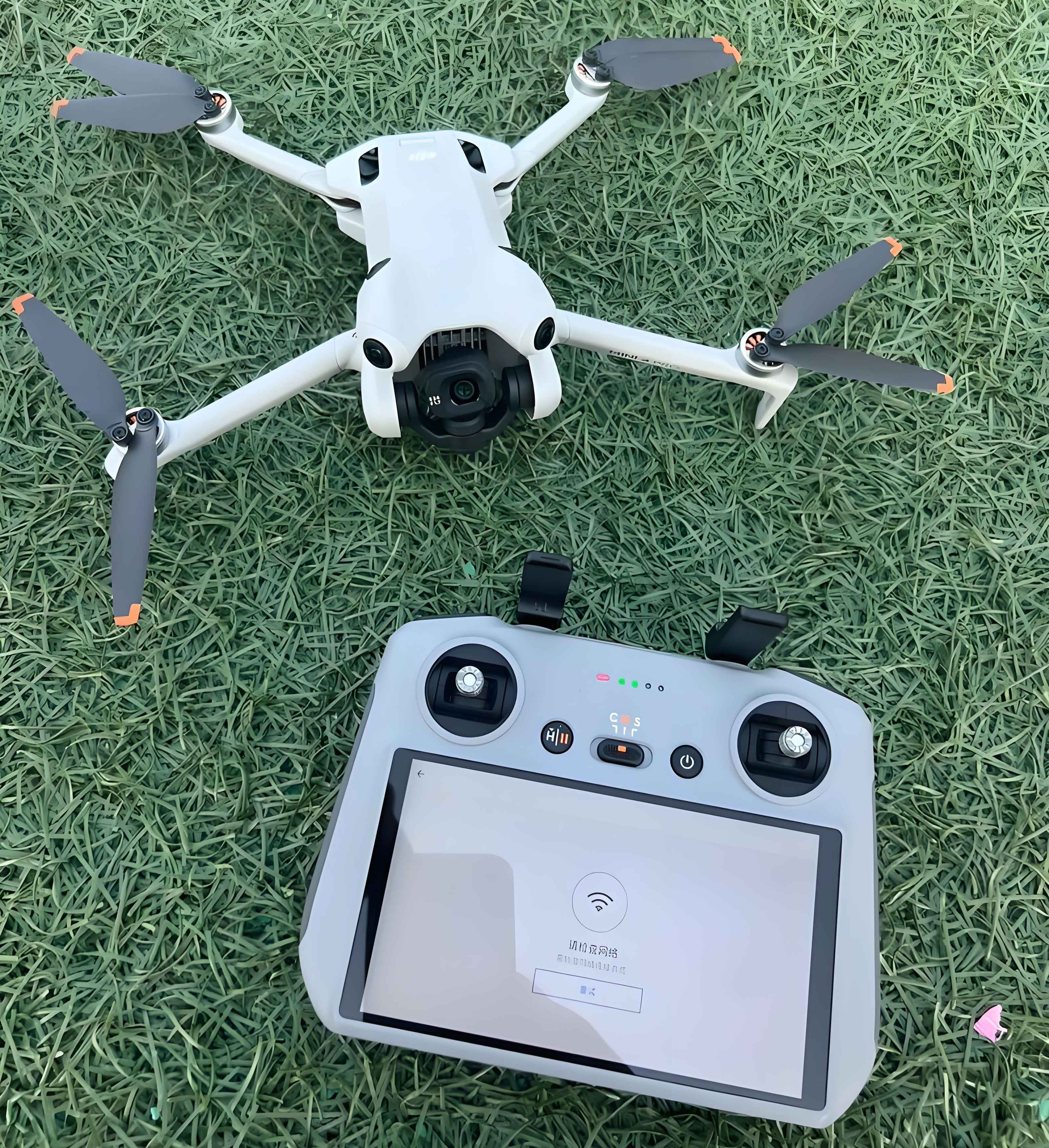
Our fixed-wing camera drone platform features:
- 1.4m wingspan airframe (6.9kg MTOW)
- Dual-propeller propulsion system
- OSG230-150UC camera with 12mm HF-10MP lens
- Intel NUC8i7BEH processing unit
- Pixhawk 4 flight controller
Field tests quantified navigation performance:
| Range (m) | Method | $\sigma_x$ (m) | $\sigma_y$ (m) | $\sigma_z$ (m) |
|---|---|---|---|---|
| 150+ | EPNP | 0.82 | 3.15 | 2.97 |
| Optimized | 0.79 | 1.23 | 1.14 | |
| EPNP + Filter | 0.53 | 1.87 | 1.76 | |
| Optimized + Filter | 0.48 | 0.89 | 0.82 | |
| <50 | EPNP | 0.21 | 0.33 | 0.29 |
| Optimized | 0.19 | 0.18 | 0.17 | |
| EPNP + Filter | 0.12 | 0.14 | 0.13 | |
| Optimized + Filter | 0.10 | 0.09 | 0.08 |
The camera UAV achieved 100% gate traversal success during the UI-STRIVE competition, attaining a peak score of 11.14. Navigation solution convergence is demonstrated by:
$$ \lim_{t\to t_{\text{traversal}}} \mathbf{t}_{12} = \begin{bmatrix} 0 \\ 0 \\ 0 \end{bmatrix} \pm 0.15\text{m} $$
Conclusion
This research demonstrates a robust visual navigation framework for high-speed camera drone operations. Key innovations include cascade structural filtering for reliable gate detection under dynamic conditions and IMU-constrained pose optimization that reduces long-range positional variance by 67%. The fixed-wing camera UAV implementation validates real-time performance at 25m/s traversal speeds, enabling precision navigation without GPS dependency. Future work will extend this approach to multi-drone cooperative traversal scenarios.