
In modern agriculture, the integration of advanced technologies has revolutionized pest and disease management, with variable spraying systems emerging as a cornerstone of precision agriculture. As a researcher in this field, I have observed that the core principle of variable spraying lies in on-demand application, which minimizes pesticide overuse and environmental impact. Crop spraying drones, also known as spraying UAVs, offer unparalleled advantages due to their portability, speed, efficiency, and adaptability to diverse terrains. By combining these drones with variable spraying systems, we can achieve targeted pesticide delivery, reducing waste and enhancing crop protection. This article delves into the components, technologies, and future trends of variable spraying systems for crop spraying drones, emphasizing the role of real-time data acquisition and precise execution. Throughout this discussion, I will highlight key aspects such as information collection methods and variable spraying techniques, using tables and formulas to summarize complex concepts, and ensuring that terms like ‘crop spraying drone’ and ‘spraying UAV’ are frequently referenced to underscore their importance.
The variable spraying system for a crop spraying drone is a sophisticated framework that integrates sensor-based detection with pesticide application technologies. It encompasses processes like target information acquisition, target recognition, spraying decision-making, and variable spray execution, all aimed at depositing pesticides effectively on the intended crops. Compared to traditional uniform spraying, variable spraying reduces pesticide waste and improves utilization rates, as summarized in Table 1. This system relies on three critical steps: collecting field and equipment data, making real-time decisions based on algorithms or pre-loaded prescription maps, and executing variable spraying through technologies like pressure adjustment or pulse-width modulation. For instance, a spraying UAV can adjust its output dynamically based on crop health data, ensuring that each area receives the optimal amount of pesticide.
| Feature | Traditional Uniform Spraying | Variable Spraying |
|---|---|---|
| Spraying Method | Applies the same dose across the entire field | Dynamically adjusts the dose based on real-time needs |
| Underlying Assumption | Assumes uniform field conditions | Acknowledges significant spatial variability in the field |
| Primary Goal | Ensures effectiveness in the worst areas | Optimizes resource use, reduces waste, and minimizes environmental impact |
| Outcome | Often results in over-application in some areas and under-application in others | Provides precise pesticide matching, improving efficiency and sustainability |
Information acquisition is a fundamental component of variable spraying systems, relying heavily on real-time sensor technologies rather than pre-existing geographic information systems. For crop spraying drones, non-contact sensors are preferred due to their ability to capture data without physical interaction. These sensors include RGB cameras, multispectral and hyperspectral imagers, thermal cameras, and LiDAR systems, each with distinct advantages and limitations, as detailed in Table 2. For example, a spraying UAV equipped with multispectral sensors can detect early signs of plant stress by analyzing reflectance in specific bands, while LiDAR provides detailed 3D structural data of the crop canopy. This real-time data is processed onboard or transmitted to cloud-based systems, enabling immediate adjustments in spraying parameters. In my experience, the integration of these sensors allows a crop spraying drone to respond dynamically to field variations, such as identifying weed-infested zones or areas with high pest pressure, thereby facilitating targeted interventions.
| Sensor Type | Advantages | Limitations |
|---|---|---|
| Machine Vision (RGB Camera) | Low hardware cost; intuitive images for direct target localization; deep learning algorithms enhance accuracy | Image quality affected by lighting and weather; high processing speed requirements; difficult in complex scenes |
| Multispectral/Hyperspectral Remote Sensing | Rapid large-area data collection; can infer multiple types of information simultaneously; high precision for early disease detection | Sensitive to light conditions; high cost and data volume; soil background interference with low vegetation cover |
| Thermal Imaging | Unaffected by light; early detection of water stress (3-5 days before visual symptoms); sensitive to physiological abnormalities | Low spatial resolution; temperature influenced by environment; cannot distinguish stress types directly |
| LiDAR Technology | High-precision 3D data; unaffected by light and weather; directly computes canopy volume for spraying | High equipment cost; complex data processing; weak detection of fine components |
In addition to field data, the operational parameters of the crop spraying drone itself are crucial for variable spraying. Speed monitoring, for instance, is essential to maintain a consistent application rate per unit area. Technologies like Global Navigation Satellite Systems (GNSS), Inertial Measurement Units (IMU), airspeed sensors, and multi-sensor fusion are commonly used. GNSS, which includes systems like GPS and BeiDou, calculates ground speed based on positional changes, with an accuracy of 0.1 to 0.5 m/s in open areas. However, it can suffer from signal loss in obstructed environments. IMU sensors, comprising accelerometers and gyroscopes, offer high dynamic response but accumulate errors over time. Airspeed sensors measure relative air velocity but require calibration for ground speed conversion. Often, a combination of these technologies is employed in a spraying UAV to ensure reliable speed data, which is then used to adjust flow rates dynamically. For example, the relationship between speed and flow rate can be modeled using the formula: $$ Q = k \times v \times A $$ where \( Q \) is the flow rate, \( k \) is a constant, \( v \) is the ground speed, and \( A \) is the area coverage factor. This ensures that the crop spraying drone maintains optimal pesticide application even during speed fluctuations.
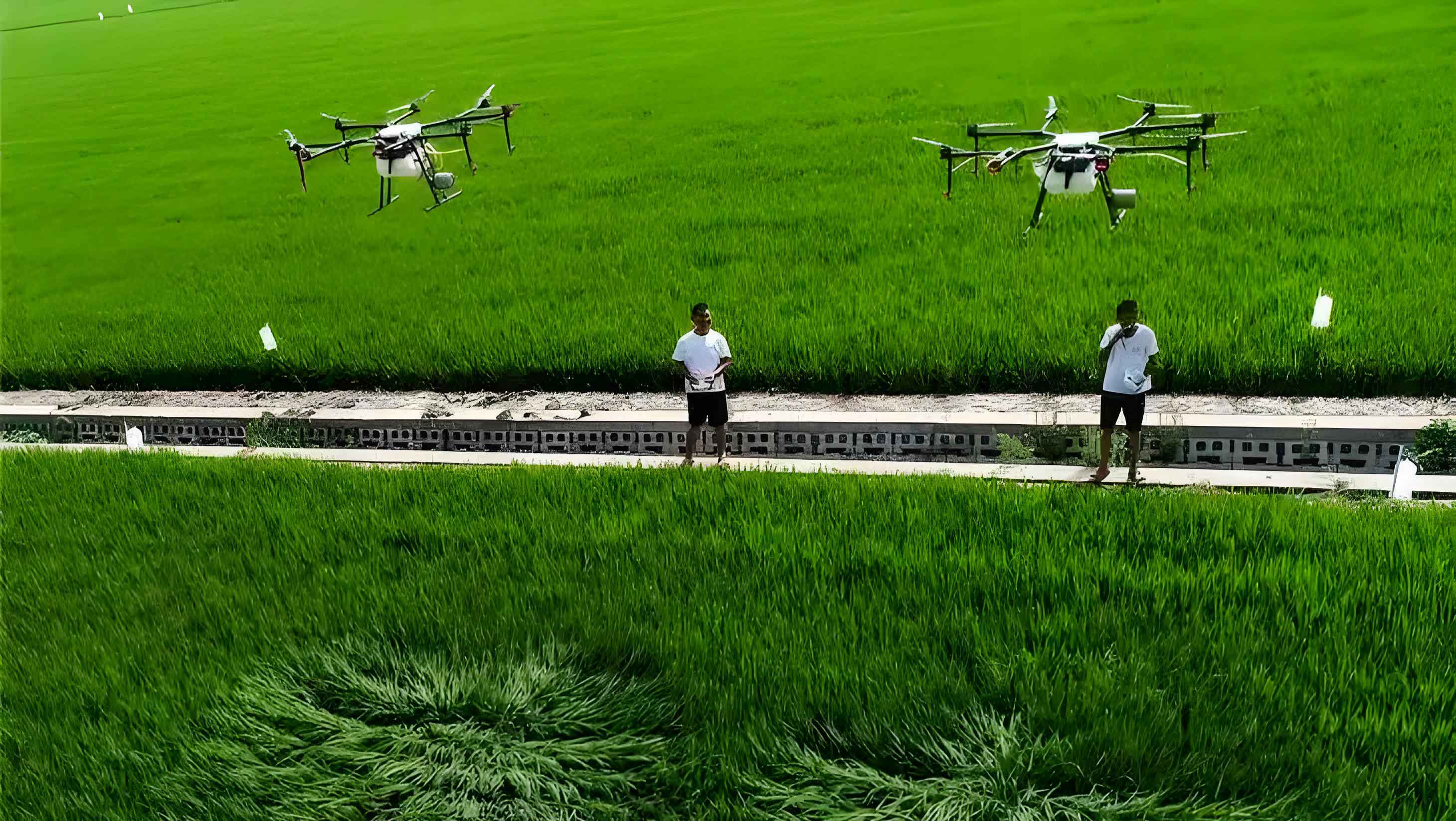
Variable spraying technologies form the execution layer of the system, directly influencing the precision of pesticide application. The main approaches include pressure-based regulation, concentration-based mixing, and pulse-width modulation (PWM). Pressure-based systems alter the flow rate by changing the pressure in the spraying system, as described by the Bernoulli principle: $$ P + \frac{1}{2} \rho v^2 + \rho gh = \text{constant} $$ where \( P \) is pressure, \( \rho \) is fluid density, \( v \) is velocity, \( g \) is gravity, and \( h \) is height. While simple and cost-effective, this method can affect droplet size and lead to drift. Concentration-based systems, such as online mixing, adjust the pesticide concentration in real-time by injecting pure chemical into a water stream, but they add complexity and weight, making them less suitable for lightweight spraying UAVs. PWM-based systems, on the other hand, use electronic control to vary the duty cycle of solenoid valves, effectively changing the open time and thus the flow rate. The duty cycle \( D \) is defined as: $$ D = \frac{T_{\text{on}}}{T_{\text{total}}} \times 100\% $$ where \( T_{\text{on}} \) is the valve open time and \( T_{\text{total}} \) is the total cycle time. This allows for rapid response and precise control without significantly altering droplet characteristics, making it ideal for crop spraying drones that encounter variable field conditions. Additionally, advanced techniques like variable nozzle control enable targeted spraying by adjusting individual nozzles, further enhancing the efficiency of the spraying UAV.
Looking ahead, the future of variable spraying systems for crop spraying drones is poised for significant advancements, driven by multi-sensor fusion, artificial intelligence, and collaborative operations. Multi-sensor integration, combining LiDAR, radar, and visual systems, will provide comprehensive data on crop health and structure. For instance, AI models can process this data to predict pest outbreaks and optimize spraying schedules, reducing response times to seconds. The use of 5G networks will facilitate real-time data transmission to cloud platforms, where machine learning algorithms generate precise spraying prescriptions. Moreover, swarm technology will enable multiple spraying UAVs to work in coordination, covering large areas efficiently while avoiding overlaps. This collaborative approach can be modeled using optimization formulas, such as minimizing total spraying time: $$ \min \sum_{i=1}^{n} t_i $$ subject to constraints like coverage and resource limits, where \( t_i \) is the time for each drone. Such innovations will push the boundaries of precision agriculture, making crop spraying drones more intelligent and sustainable.
In conclusion, the evolution of variable spraying systems for crop spraying drones represents a paradigm shift from经验-driven to data-driven agriculture. As a researcher, I believe that by leveraging advanced sensors, real-time decision-making, and precise execution technologies, we can achieve substantial reductions in pesticide use while improving crop yields. The continued integration of AI, multi-sensor platforms, and swarm robotics will further enhance the capabilities of spraying UAVs, paving the way for a greener and more efficient agricultural future. Through this progress, variable spraying systems will not only address current challenges in pest management but also contribute to the long-term sustainability of farming practices worldwide.