
As an essential aspect of vertical take-off and landing (VTOL) fixed-wing unmanned aerial vehicles (UAVs), the transition corridor defines the safe operational envelope during the conversion from hover to forward flight. This study focuses on ducted VTOL drones, which utilize a forward lift fan and a rear powered lift system to achieve efficient transition. Accurate characterization of the transition corridor is critical for ensuring flight stability and safety, particularly in complex environments where these VTOL drones are deployed for reconnaissance, surveillance, or monitoring tasks. The transition process involves a delicate balance between aerodynamic forces, propulsion system outputs, and control inputs, making it a high-risk phase that requires thorough analysis.
The transition corridor, analogous to the flight envelope of conventional aircraft, is represented as a deflection angle–speed envelope for the powered lift system. This envelope delineates the feasible combinations of deflection angles and airspeeds at which the VTOL drone can maintain steady flight during transition. It is bounded on the low-speed side by aerodynamic stall constraints and on the high-speed side by available power limitations. Understanding and expanding this corridor is paramount for enhancing the operational flexibility and reliability of ducted VTOL drones. In this article, I explore the modeling, computation, and expansion strategies for the transition corridor of ducted VTOL drones, emphasizing the integration of flight mechanics principles.
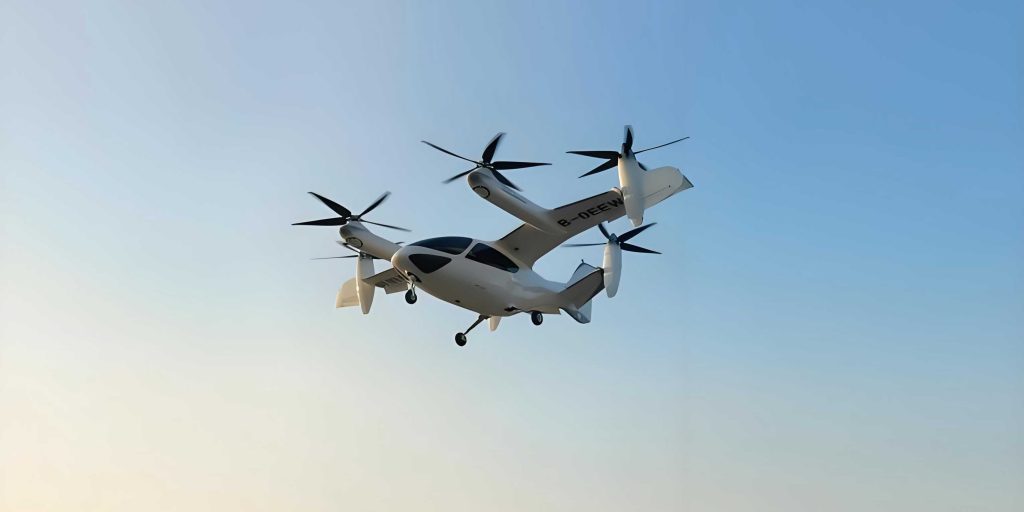
The fundamental dynamics of a ducted VTOL drone during transition involve three primary force contributors: the forward lift fan, the rear powered lift system (comprising a duct and control surfaces), and the wing’s aerodynamic lift. In hover mode, the lift fan and powered lift system provide vertical thrust to balance the drone’s weight. As transition begins, the powered lift system gradually deflects from a near-vertical orientation toward a horizontal position, generating both lift and forward thrust components. Concurrently, the wing’s aerodynamic lift increases with airspeed, eventually taking over as the primary lift source in fixed-wing flight. This process must be managed to avoid stall at low speeds and power deficiencies at high speeds, which forms the basis for the transition corridor model.
Transition Corridor Model Formulation
The transition corridor model is constructed from two key boundaries: the left boundary based on the maximum lift coefficient (stall limit) and the right boundary based on the available power of the propulsion system. These boundaries define a deflection angle–speed envelope within which the VTOL drone can operate safely during transition.
Left Boundary: Maximum Lift Coefficient Constraint
The left boundary of the transition corridor ensures that the wing does not exceed its critical angle of attack during low-speed transition. At low airspeeds, the wing’s lift capacity is limited by stall, which occurs at the maximum lift coefficient $C_{L_{\text{max}}}$. The force equilibrium equations for the VTOL drone during transition are derived from flight mechanics principles. Let $G$ denote the drone weight, $T_f$ the lift fan thrust, $T_{di}$ the powered lift system thrust, and $\alpha$ the body angle of attack. The powered lift system’s resultant force has a deflection angle $i_{di}$, which is a function of the duct deflection angle $i_d$ and the control surface deflection $i_{iw}$, expressed as $i_{di} = f(i_d, i_{iw})$. The balance of forces in the vertical and horizontal directions yields:
$$
\begin{aligned}
T_f \cos \alpha + T_{di} \sin(\alpha + i_{di}) + L_A &= G \\
T_{di} \cos(\alpha + i_{di}) – T_f \sin \alpha &= D_A
\end{aligned}
$$
Here, $L_A$ and $D_A$ represent the total aerodynamic lift and drag, respectively, which include contributions from the wing’s free-stream flow and induced effects from the powered lift system. They are defined as:
$$
L_A = q_w A_{fw} C_L + \frac{1}{2} \rho V_{in}^2 C_L A_{mv} \eta_{L_{mw}}, \quad D_A = q_w A_{fw} C_D + \frac{1}{2} \rho V_{in}^2 C_D A_{mw} \eta_{D_{mw}}
$$
where $q_w$ is the dynamic pressure, $\rho$ is air density, $V_{in}$ is induced velocity, and $\eta$ terms account for efficiency factors. The wing’s angle of attack $\alpha_{lj}$ must not exceed the critical stall angle, given by $\alpha_{lj} = i_w + \alpha$, with $i_w$ as the wing installation angle. By setting $\alpha_{lj}$ to the stall value and solving the equilibrium equations, the left boundary of the deflection angle–speed envelope is determined. This boundary ensures that the VTOL drone avoids stall during initial transition phases.
Right Boundary: Available Power Constraint
The right boundary of the transition corridor is dictated by the available power from the propulsion system. As airspeed increases during transition, the power required to maintain force equilibrium may exceed the system’s rated capacity, leading to instability. The power required $P_r$ for both the lift fan and powered lift system comprises induced power $P_i$, profile power $P_{pr}$, parasite power $P_p$, and climb power $P_c$, formulated as:
$$
P_r = \frac{2}{\eta_p} (P_i + P_{pr} + P_p + P_c)
$$
with $\eta_p$ accounting for transmission losses. Using momentum theory and blade element theory, the components are expressed as:
$$
P_{ipc} = T (U_c + K_{\text{ind}} v_i), \quad P_{pr} = P_{pr0} (1 + 4.7 \mu^2)
$$
where $U_c$ is the vertical velocity at the rotor disk, $v_i$ is the induced velocity, $K_{\text{ind}}$ is a correction factor for non-uniform inflow, $\mu$ is the advance ratio, and $P_{pr0} = \sigma \pi R^2 \rho V_t^3 C_D / 8$ for rotor solidity $\sigma$ and blade drag coefficient $C_D$. The total required power must satisfy $P_r < P_n$, where $P_n$ is the rated power. By solving the force equilibrium equations under this power constraint, the right boundary of the deflection angle–speed envelope is derived. This boundary prevents power-related failures during high-speed transition.
Computation Methodology for Transition Corridor
The computation of the transition corridor involves iterative solving of the equilibrium equations across a range of airspeeds and deflection angles. The process begins with defining the transition windows: the initial hover condition (front window) and the final fixed-wing flight condition (rear window). The rear window requires a safe airspeed $V_{\text{safe}} = 1.2 V_s$, where $V_s$ is the stall speed, and moment equilibrium. The computation steps are summarized in Table 1.
| Step | Description | Key Equations |
|---|---|---|
| 1 | Define hover state parameters from front window | $T_f \cos \theta + T_{di} \sin(\alpha_{di} + \theta) = G$, $T_f \cdot l_f = T_{di} \sin \alpha_{di} \cdot l_{di}$ |
| 2 | Compute left boundary: For each speed $V$, set $\alpha_{lj}$ to stall angle, solve equilibrium for $T_f$, $T_{di}$, $i_{di}$ | Equations (1) and (2) with $C_L = C_{L_{\text{max}}}$ |
| 3 | Compute right boundary: For each $i_{di}$, solve equilibrium for $\alpha$, then check $P_r < P_n$ | Equations (3) and (4), power constraints applied |
| 4 | Combine boundaries to form transition corridor | Intersection of left and right boundary curves |
The left boundary calculation focuses on aerodynamic limits, while the right boundary emphasizes power limits. This methodology ensures a comprehensive envelope that accounts for both stall and power saturation risks. The VTOL drone’s transition corridor thus emerges as a closed region in the deflection angle–speed plane, within which safe transition maneuvers can be executed.
Case Study: Analysis of a Ducted VTOL Drone
To illustrate the transition corridor model, I consider a case study of a ducted VTOL drone with a forward lift fan and a rear powered lift system. The drone’s aerodynamic coefficients, as functions of angle of attack and control surface deflections, are derived from computational fluid dynamics (CFD) simulations or wind tunnel tests. Key parameters for the case study are listed in Table 2.
| Parameter | Symbol | Value |
|---|---|---|
| Drone weight | $G$ | 150 N |
| Wing area | $S$ | 0.8 m² |
| Maximum lift coefficient | $C_{L_{\text{max}}}$ | 1.5 |
| Lift fan rated power | $P_f$ | 26 kW |
| Powered lift system rated power | $P_d$ | 14 kW |
| Transmission efficiency | $\eta_p$ | 0.95 |
| Air density | $\rho$ | 1.225 kg/m³ |
The left boundary of the transition corridor, based on the stall limit, is computed by solving the force equilibrium equations across speeds from hover (0 m/s) up to the stall speed. The results indicate that at hover, the powered lift system deflection angle $i_{di}$ is approximately 75°, and as speed increases, $i_{di}$ decreases gradually. The minimum speed for fixed-wing flight is found to be 43 m/s, below which stall occurs. The forces during this transition are plotted in Table 3, showing the shift from propulsion-based lift to aerodynamic lift.
| Speed (m/s) | $T_f$ (N) | $T_{di}$ (N) | $L_A$ (N) | $D_A$ (N) |
|---|---|---|---|---|
| 0 | 90 | 60 | 0 | 0 |
| 10 | 85 | 55 | 10 | 5 |
| 20 | 70 | 40 | 40 | 15 |
| 30 | 50 | 25 | 75 | 30 |
| 43 | 0 | 0 | 150 | 50 |
The right boundary, based on available power, is computed by evaluating the required power across deflection angles and speeds. The power required $P_r$ varies with airspeed and body attitude, as shown in Table 4 for different angles of attack $\alpha$. The available power limit $P_n = 40$ kW (combined for both systems) defines the boundary where $P_r = P_n$.
| Speed (m/s) | $\alpha = 5^\circ$ | $\alpha = 10^\circ$ | $\alpha = 15^\circ$ |
|---|---|---|---|
| 20 | 25 | 30 | 35 |
| 40 | 30 | 38 | 45 |
| 60 | 35 | 44 | 52 |
| 80 | 42 | 50 | 60 |
The transition corridor for the case study VTOL drone is the region bounded by these left and right curves. It enables the identification of safe operational zones for transition maneuvers. For instance, at a speed of 50 m/s, the powered lift system deflection angle must lie between 20° and 60° to avoid stall and power overload. This corridor is vital for flight control system design, ensuring that the VTOL drone can smoothly convert between flight modes.
Influence of Control Parameters on Transition
Control parameters such as body attitude angle and duct deflection rate significantly impact the transition process. Analyzing these effects helps optimize transition strategies for VTOL drones. The body attitude angle $\alpha$ influences the speed at which lift and drag balance is achieved. As shown in Table 5, lower attitude angles require higher speeds for balance, prolonging transition time, while higher angles allow balance at lower speeds but may increase power demand.
| Attitude Angle $\alpha$ | Balance Speed (m/s) | Transition Time (s) |
|---|---|---|
| 5° | 55 | 12 |
| 10° | 45 | 15 |
| 15° | 35 | 18 |
The duct deflection rate $\dot{i}_d$ affects the dynamic response and stability. Rates between 1°/s and 14°/s are feasible, with higher rates potentially exceeding the lift fan’s trim capability. Based on simulations, an optimal rate of 5°/s for duct deflection and 1.5°/s for control surface deflection at $\alpha = 3^\circ$ ensures stable transition. This highlights the need for coordinated control in VTOL drone operations.
Strategies for Expanding the Transition Corridor
Expanding the transition corridor enhances the operational flexibility of VTOL drones. Two primary approaches are improving aerodynamic parameters and increasing available power. Aerodynamic parameters such as wing area $S$ and maximum lift coefficient $C_{L_{\text{max}}}$ directly affect the left boundary. Increasing these parameters shifts the left boundary toward lower speeds, as quantified in Table 6. For example, a 10% increase in $S$ or $C_{L_{\text{max}}}$ expands the corridor width by approximately 2.33% in terms of speed range.
| Parameter Change | Left Boundary Shift (Speed Reduction) | Corridor Width Increase |
|---|---|---|
| +10% $S$ or $C_{L_{\text{max}}}$ | 2.33% | 2.33% |
| +20% $S$ or $C_{L_{\text{max}}}$ | 4.66% | 4.66% |
| +30% $S$ or $C_{L_{\text{max}}}$ | 6.97% | 6.97% |
Power-related parameters have a more pronounced effect on the right boundary. Increasing the available power $P_n$ allows for higher speeds and deflection angles, as shown in Table 7. A 10% boost in $P_n$ expands the corridor width by 21.43%, significantly more than aerodynamic enhancements. This underscores the importance of propulsion system performance in VTOL drone design.
| Available Power Increase | Right Boundary Shift (Speed Increase) | Corridor Width Increase |
|---|---|---|
| +10% $P_n$ | 21.43% | 21.43% |
| +20% $P_n$ | 41.67% | 41.67% |
Thus, for VTOL drones, prioritizing power system upgrades over aerodynamic tweaks can yield greater gains in transition capability. However, a balanced approach considering both aspects is ideal for optimal performance.
Conclusion
In this study, I have developed and analyzed a transition corridor model for ducted VTOL drones, integrating aerodynamic and power constraints. The deflection angle–speed envelope effectively captures the safe operational limits during transition, with the left boundary defined by stall avoidance and the right boundary by available power. Through a case study, I demonstrated the computation process and highlighted the influence of control parameters like attitude angle and deflection rate. Furthermore, expansion strategies reveal that increasing available power is more effective than improving aerodynamic parameters for enlarging the corridor. These insights contribute to the design and control of VTOL drones, enabling safer and more efficient transition maneuvers in diverse applications. Future work could explore real-time corridor adaptation and integration with flight control systems for autonomous operations.