
In the context of global climate change, China has proposed the “Dual Carbon” goals of achieving carbon peak by 2030 and carbon neutrality by 2060. Forests, as the largest carbon pool in terrestrial ecosystems, play an irreplaceable role in the carbon cycle, with forest carbon storage accounting for 77% of global vegetation carbon storage and 39% of soil carbon storage. Specifically, forest ecosystem carbon storage constitutes 57% of terrestrial ecosystem carbon storage. Studying changes in forest carbon storage and their carbon sequestration capacity is crucial for assessing regional carbon budgets and formulating climate policies. Traditional forest timber volume measurement relies on field surveys and sample plots, estimating volume by measuring diameter at breast height (DBH), tree height, and using volume tables. While applicable to plantation areas, this method has limitations such as low efficiency, high costs, and insufficient representativeness. UAV drones, with their non-contact, high-precision, low-cost, and flexible advantages, offer a new approach for forest resource monitoring. Compared to interferometric radar and airborne laser scanning, UAV drones oblique photography for 3D modeling, although slightly lower in accuracy, simplifies data processing and controls costs, and has been validated as reliable for vegetation carbon storage calculation. By obtaining parameters such as tree canopy area, height, and volume, UAV drones provide an efficient solution for extracting forest structural parameters.
Traditional sample plot survey methods face issues like high labor and material costs and low efficiency, and are gradually being replaced by remote sensing technologies. Current research primarily builds empirical or semi-empirical models based on optical remote sensing data. Empirical models establish volume relationships with remote sensing variables through statistical regression, but suffer from poor external adaptability. Semi-empirical models integrate physiological and ecological processes with remote sensing data, significantly improving model generality. Internationally, countries like Germany and France in Europe incorporate high-precision remote sensing imagery into forest inventories, strengthening ecological service function research. The United States establishes long-term dynamic monitoring networks, combining multiple models to predict volume changes. Canada adopts the National Forest Inventory (NFI) method, integrating ground sample plots with remote sensing data for refined resource management. Domestically, research focuses on single-species model development (e.g., eucalyptus forests in Guangxi, spruce forests in Yunnan), while internationally, emphasis is on multi-source data integration and ecosystem service assessment. These differences stem from regional characteristics of forest types and varying national forestry management objectives. Overall, both domestic and international research exhibit technology-driven trends, and future efforts will continue to optimize forest volume estimation models through interdisciplinary integration and international cooperation, providing technological support for enhancing forest carbon sequestration capacity and sustainable management. With the advancement of global “Dual Carbon” goals, volume monitoring systems integrating emerging technologies like UAV drones oblique photography and 3D modeling are becoming a common direction in research worldwide.
This study is based on UAV drones oblique photography technology to construct 3D models, combined with ground sample plot surveys and biomass modeling methods, aiming to develop an efficient and accurate forest timber volume calculation system. By integrating multi-source data, we quantify the measurement accuracy of UAV drones 3D models and model reliability, providing technical support for dynamic monitoring of forest carbon storage and the implementation of “Dual Carbon” goals.
The research area is located in Guangxi Zhuang Autonomous Region, China, characterized by karst topography, which poses challenges for traditional forest survey methods. We selected a representative eucalyptus plantation area of approximately 3686.61 m² for this experiment. Eucalyptus is widely planted in Guangxi, accounting for over 40% of the national timber production, making it a critical species for forestry management. The use of UAV drones in this region is particularly advantageous due to their ability to capture detailed spatial data in complex terrains.
Data Acquisition and Preprocessing with UAV Drones
Data acquisition includes field measurements of sample trees, such as DBH, tree height, canopy closure, and oblique imagery. The imagery data were primarily obtained through UAV drones oblique photography. We planned flight missions in advance, set UAV drones parameters, and acquired imagery from five orientations (vertical, forward, backward, left, and right). The 3D model of the research area was ultimately completed using the ContextCapture Center platform.
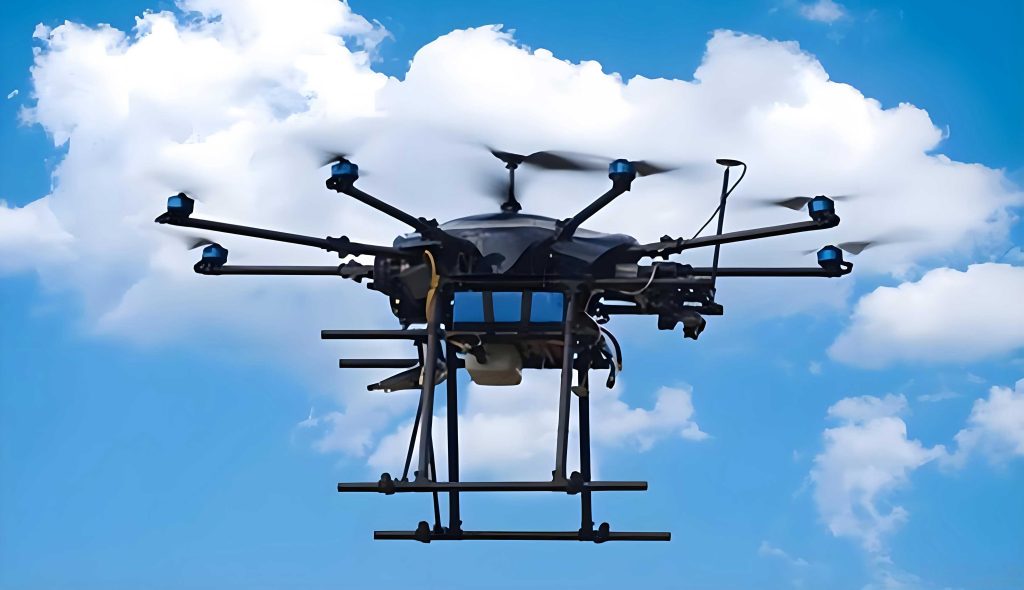
For sample tree data collection, we selected 20 trees with complete trunk and canopy morphology, evenly distributed across the research area. Tools included forestry diameter tapes, rangefinders, and clinometers. We ensured data accuracy and consistency by marking tree positions and avoiding measurement errors. The sample tree measurement scenario is illustrated in the image above, which shows UAV drones in operation. The collected data are summarized in Table 1.
| Sample Tree No. | DBH (D, cm) | First Branch Height (h, m) | Canopy Width (m) | Tree Height (H, m) |
|---|---|---|---|---|
| 1 | 15.6 | 4.1 | 2.6 (EW), 2.4 (NS) | 16.1 |
| 2 | 17.5 | 7.0 | 3.76 (EW), 4.64 (NS) | 14.9 |
| 3 | 12.2 | 5.0 | 3.29 (EW), 4.34 (NS) | 11.2 |
| 4 | 15.3 | 5.9 | 3.67 (EW), 4.32 (NS) | 15.4 |
| 5 | 12.7 | 2.4 | 4.74 (EW), 4.69 (NS) | 10.2 |
| 6 | 14.0 | 7.1 | 3.74 (EW), 2.40 (NS) | 13.6 |
| 7 | 8.1 | 6.0 | 1.73 (EW), 2.57 (NS) | 9.2 |
| 8 | 6.9 | 1.8 | 1.69 (EW), 1.69 (NS) | 7.2 |
| 9 | 12.2 | 1.55 | 2.56 (EW), 3.24 (NS) | 9.4 |
| 10 | 11.0 | 8.7 | 2.14 (EW), 2.42 (NS) | 11.2 |
| 11 | 15.3 | 2.8 | 4.9 (EW), 6.2 (NS) | 25.6 |
| 12 | 20.1 | 3.5 | 5.3 (EW), 7.5 (NS) | 30.2 |
| 13 | 18.7 | 3.1 | 5.0 (EW), 6.8 (NS) | 28.4 |
| 14 | 13.9 | 2.4 | 3.8 (EW), 5.6 (NS) | 22.1 |
| 15 | 22.5 | 4.0 | 6.1 (EW), 8.3 (NS) | 33.7 |
| 16 | 16.2 | 2.9 | 4.6 (EW), 6.5 (NS) | 26.8 |
| 17 | 19.8 | 3.3 | 5.2 (EW), 7.1 (NS) | 29.5 |
| 18 | 14.6 | 2.6 | 4.2 (EW), 5.9 (NS) | 23.6 |
| 19 | 21.3 | 4.2 | 6.4 (EW), 8.7 (NS) | 35.1 |
| 20 | 17.9 | 3.0 | 5.1 (EW), 7.0 (NS) | 27.8 |
For UAV drones equipment and flight planning, we used a DJI Phantom 4 Pro V2.0 drone, as shown in the image. The flight was conducted on May 10, 2024. The specific flight plan included: setting the flight altitude to 50 meters after manual test flights to ensure safety; planning multiple routes for five lenses to improve modeling accuracy; setting photo parameters to 4:3 aspect ratio, auto white balance, side overlap of 70%, forward overlap of 80%, and margin above 16 meters; and using DJI Terra for route planning over the research area. UAV drones oblique photography captured 308 images, with 290 usable after removing those with excessive angles, severe distortion, or duplication.
3D Model Construction Using UAV Drones Data
UAV drones imagery data processing includes three steps: aerial triangulation encryption, point cloud processing, and model reconstruction. We used the ContextCapture Center platform for aerial triangulation and point cloud recovery, reconstructing the forest scene to generate dense point clouds and digital 3D models.
For image aerial triangulation preprocessing, we applied encryption algorithms to match homologous points in the images, building an aerial triangulation model to solve for each image’s exterior orientation elements (position and attitude parameters). This involved relative orientation and absolute orientation calculations, with ground control points used for adjustment to ensure accurate real-world positioning. Based on the aerial triangulation results, ContextCapture Center generated point cloud data for the research area using multi-view image matching technology. The point cloud data represent the 3D spatial information of the forest, with each point having X, Y, Z coordinates and color information. We performed denoising and filtering to separate ground points from non-ground points (e.g., trees, buildings), obtaining Digital Elevation Model (DEM) and Digital Surface Model (DSM). The aerial triangulation and point cloud processing results are illustrated in the technical workflow.
For model reconstruction, we used the ContextCapture Center platform to build the 3D model of the forest based on the processed point cloud data. We employed a Triangular Irregular Network (TIN) data structure, which adapts well to complex terrain and tree morphology changes by connecting adjacent points into triangular facets to form a continuous 3D surface model. Alternatively, a grid model simplifies the data by dividing point clouds into regular grid cells with assigned elevation values, approximating a 3D model. The 3D model construction results allowed us to delineate the research area, automatically calculate its precise area, and estimate canopy volume. The area calculation results are summarized in the context of UAV drones applications.
Timber Volume Calculation Model Development
According to local standards in Guangxi, stand volume refers to the volume of tree trunks with bark for trees with DBH greater than or equal to 5 cm. We established two mathematical models: a unary model without DBH parameter and a binary model with DBH parameter. The equations are as follows:
Unary model for stand mean height (Hf):
$$H_f = 129.99766 \times (1 – e^{-0.0037249 \times H})^{0.97832}$$
where \(e\) is the natural exponent, \(H_f\) is the stand mean height in meters, and \(H\) is the tree height in meters.
Binary model for stand mean height (Hf):
$$H_f = 0.57715 \times D^{-0.28581} \times H^{1.20331}$$
where \(D\) is the stand mean DBH in centimeters.
Stand volume growth rate refers to the relationship between stand volume growth rate and factors such as DBH and stand age, or stand age alone. Similarly, we developed unary and binary models:
Unary model for stand volume growth rate (y):
$$y = 0.000015416 \times (1 – e^{-0.001 \times N})^{-2.5328}$$
where \(N\) is the stand age in years.
Binary model for stand volume growth rate (y):
$$y = (5846.2423 – 2602.1645 \div N) \times (D^{2.368} \times N)^{-0.798884}$$
These models integrate UAV drones data for parameter estimation, enhancing calculation efficiency.
Software Development for Timber Volume Calculation
We developed a calculation system using MATLAB’s AppDesigner, which integrates mathematical model construction, GUI design, and programming. The software interface allows input parameters such as tree height, DBH, and stand age, and outputs results for both unary and binary stand volume and stand volume growth rate models. The GUI design facilitates user interaction and data processing, leveraging UAV drones derived parameters.
To validate accuracy, we randomly selected 10 data sets from local standards and input them into the software, comparing calculated results with measured data. The binary stand volume data accuracy is summarized in Table 2.
| Tree Height (m) | DBH (cm) | Measured Data | Calculated Data | Accuracy (%) |
|---|---|---|---|---|
| 5 | 4 | 2.693 | 2.288 | 84.96 |
| 6.5 | 8 | 3.029 | 2.549 | 84.15 |
| 10.3 | 6 | 5.723 | 4.835 | 84.48 |
| 16.8 | 8 | 9.497 | 7.992 | 84.31 |
| 18.8 | 12 | 9.684 | 8.103 | 83.67 |
| 19.3 | 8 | 11.222 | 9.444 | 84.15 |
| 21.7 | 10 | 12.124 | 10.170 | 83.88 |
| 31 | 16 | 16.282 | 13.570 | 83.34 |
| 31.9 | 14 | 17.508 | 14.044 | 80.21 |
| 36 | 40 | 15.000 | 12.342 | 82.28 |
Similarly, for binary stand volume growth rate, we evaluated accuracy as shown in Table 3.
| Stand Age (years) | DBH (cm) | Measured Data | Calculated Data | Accuracy (%) |
|---|---|---|---|---|
| 1 | 5 | 154.46 | 128.97 | 83.49 |
| 2 | 6 | 88.10 | 70.35 | 79.85 |
| 3 | 9 | 32.42 | 24.42 | 75.32 |
| 4 | 11 | 18.39 | 13.41 | 72.92 |
| 5 | 12 | 13.38 | 9.58 | 71.56 |
| 6 | 13 | 10.10 | 7.12 | 70.49 |
| 7 | 14 | 7.85 | 5.45 | 69.42 |
| 8 | 15 | 6.25 | 4.28 | 68.48 |
| 9 | 16 | 5.07 | 3.43 | 67.65 |
| 10 | 17 | 4.17 | 2.80 | 67.14 |
Overall, the binary stand volume data achieved an average accuracy of 83.5%, and the binary stand volume growth rate data achieved an average accuracy of 72.6%. These results demonstrate that UAV drones based methods can provide reliable estimates for forest timber volume calculation.
Discussion on UAV Drones Applications in Forestry
The use of UAV drones in this study highlights several advantages. UAV drones oblique photography enables the construction of 3D models that capture forest topography, accurately determine forest boundaries, and visualize tree spatial distribution. From these models, key parameters such as tree height and canopy width can be extracted, and high-resolution texture information aids in species identification. This provides essential data for timber volume calculation. By integrating with traditional calculation methods, UAV drones derived 3D models optimize the calculation process, improve accuracy, and allow rapid coverage of large forest areas, enabling efficient large-scale timber volume estimation. The rich texture and 3D spatial features support subsequent timber volume calculations and forest research.
However, challenges remain. UAV drones operations are constrained by weather and airspace regulations, which can limit operational range and efficiency. Additionally, complex forest environments, such as mixed forests or multi-layered forests with varying canopy closure, present issues like tree occlusion and spectral feature differences, affecting timber volume calculation accuracy. For example, in karst regions like Guangxi, terrain variability may reduce model precision. Future research should address these limitations by enhancing UAV drones flight strategies, integrating multi-sensor data (e.g., LiDAR with UAV drones), and developing advanced algorithms for occlusion handling. The integration of UAV drones with other remote sensing technologies could form a comprehensive low-altitude forest survey system.
Compared to traditional forestry survey methods, UAV drones based approaches balance survey accuracy, efficiency, and cost reduction. They minimize labor and material expenses while providing scalable solutions. This method can also serve as a reference for timber volume calculation of other tree species, expanding its applicability in global forestry management.
Conclusion
This research on timber volume calculation of eucalyptus in Guangxi using UAV drones oblique photography has yielded valuable insights through theoretical analysis, experimental studies, and algorithm development. UAV drones facilitate 3D model construction for accurate forest parameter extraction, and when combined with mathematical models, they enhance timber volume estimation. The developed software achieves accuracies above 65% for sample data, demonstrating practical utility. Despite challenges like environmental constraints and forest complexity, UAV drones offer a promising tool for forest carbon storage monitoring and sustainable management. Future work should focus on improving UAV drones adaptability in diverse forest conditions, integrating multi-source data, and refining calculation models to support the “Dual Carbon” goals and global forestry initiatives.
In summary, UAV drones are revolutionizing forestry surveys by providing high-precision, efficient, and cost-effective solutions. As technology advances, the role of UAV drones in environmental monitoring and carbon sequestration assessment will continue to grow, contributing to global efforts in climate change mitigation and forest conservation.