
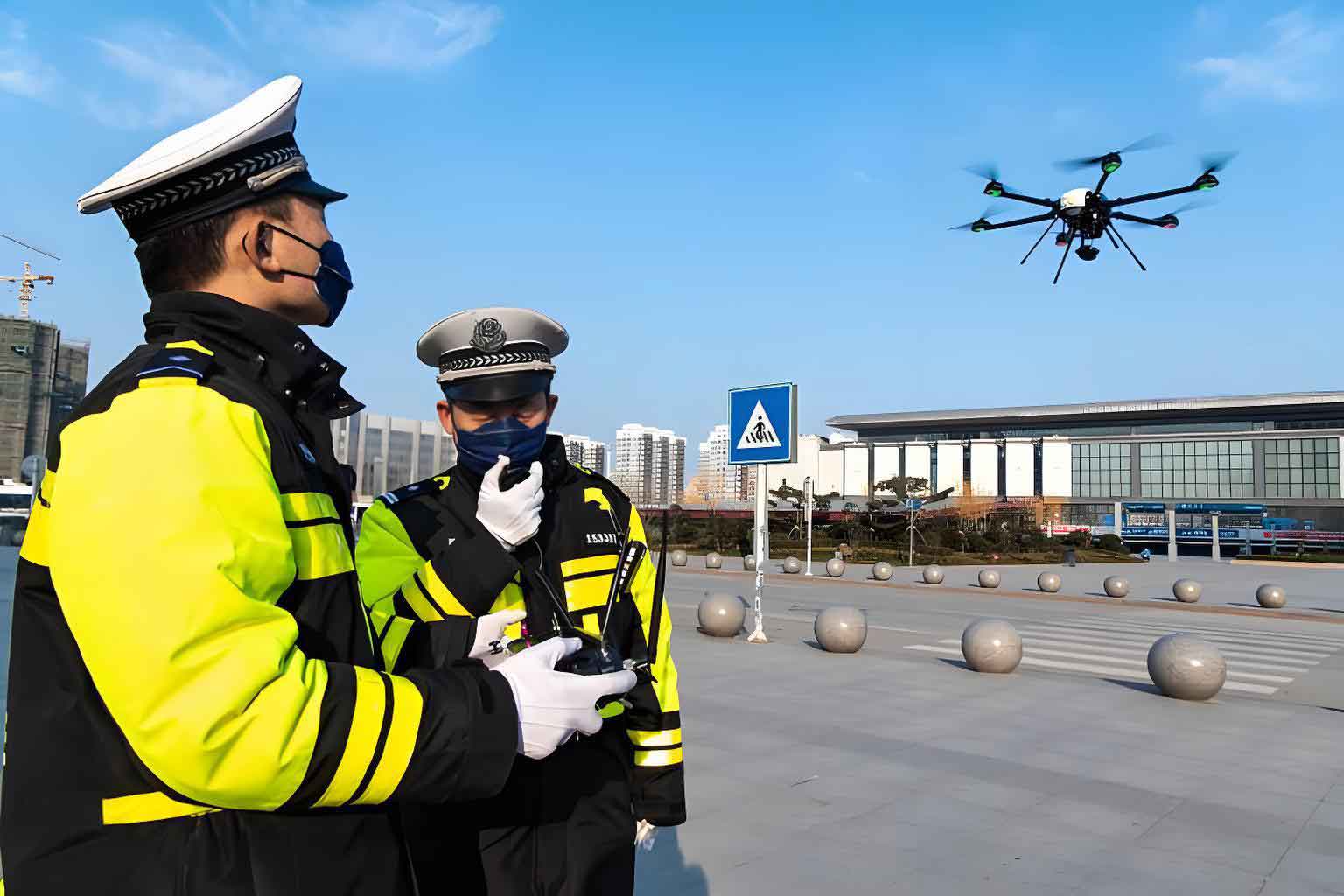
The widespread deployment of police drone systems across various law enforcement operations has undeniably enhanced operational capabilities, from aerial surveillance and crowd monitoring to forensic mapping and search-and-rescue. However, this rapid adoption has surfaced significant systemic challenges. The most pressing issue is the lack of a dedicated, comprehensive standards system governing the entire lifecycle of police drone technology. Without such a framework, the development, procurement, deployment, and maintenance of these systems remain fragmented, leading to interoperability issues, security vulnerabilities, inconsistent operational outcomes, and difficulties in sustainment. This paper argues that applying a life-cycle management (LCM) philosophy to construct a holistic standards system is paramount for ensuring the effective, safe, and reliable application of police drones in mission-critical scenarios.
The current landscape of unmanned aircraft systems (UAS) standards reveals a foundational structure but with critical gaps for specialized applications. National standard systems typically categorize standards into four layers: A. Basic Standards (terminology, classification), B. Management Standards (registration, traffic management), C. Technical Standards (performance, safety, communication), and D. Industry Application Standards. While the number of planned standards is growing, many, especially in management and technical domains, remain under development. Within industry applications, sectors like agriculture, power line inspection, and surveying have made considerable progress in establishing detailed application-specific standards. In contrast, the domain of police drones lags behind, with only a handful of existing standards covering general technical requirements, classification, and basic livery. There is a profound absence of standards addressing mission-specific performance, tactical data link security, operational protocols for diverse law enforcement scenarios, and standardized maintenance procedures. This gap underscores the necessity for a tailored approach to standardizing the police drone ecosystem from conception to retirement.
The core proposition of this research is to structure the police drone standards system around its complete life-cycle. The life-cycle of a police drone system can be scientifically delineated into seven sequential yet interconnected stages, each with distinct objectives and requisite standardization needs. The following table summarizes these stages:
| Life-Cycle Stage | Primary Focus & Objectives | Key Standardization Outputs Needed |
|---|---|---|
| 1. Conceptual Design & Justification | Define operational need; analyze feasibility, cost, and core technological requirements for a new mission profile. | Mission Requirement Specifications; Concept of Operations (CONOPS) Templates; Feasibility Assessment Guidelines. |
| 2. System Architecture & Planning | Develop overall system architecture; plan for R&D, testing, and integration of new technologies/materials. | System Architecture Frameworks; Standardization Outlines; Preliminary Reliability & Maintainability (R&M) Metrics. |
| 3. Prototype Development & Testing | Build and rigorously test engineering prototypes against operational requirements. | Prototype Test and Evaluation (T&E) Protocols; Performance Benchmarking Standards; Environmental Stress Testing Standards. |
| 4. Final Design & Production | Finalize design based on test results; establish stable manufacturing processes and quality controls. | Detailed Technical Design Specifications; Manufacturing Quality Assurance (QA) Standards; Parts Interchangeability Standards. |
| 5. Procurement & Deployment | Acquire systems through fair and transparent processes; distribute and field to operational units. | Procurement Compliance Standards; Acceptance Testing Procedures; Logistics and Deployment Guides. |
| 6. Operational Use & Sustainment | Daily operation, maintenance, training, data management, and system upgrades. | Operational Procedure Manuals; Maintenance & Logistics Support Standards; Training & Certification Standards; Data Security Protocols. |
| 7. Performance Evaluation & Disposal | Assess in-service effectiveness; inform future upgrades; manage safe decommissioning and data sanitization. | Operational Effectiveness Metrics; Life-Cycle Cost Analysis Models; Secure Decommissioning and Data Wiping Standards. |
To effectively govern this life-cycle, the proposed police drone standards system must be architected in two primary, interacting layers: the Governance Layer and the Application Layer. The Governance Layer contains overarching management standards that define processes, responsibilities, and compliance mechanisms across all life-cycle stages. The Application Layer contains the technical, performance, and procedural standards that are applied at specific stages. This layered model ensures both top-down control and bottom-up technical rigor. The interaction can be modeled to show the flow of standardization influence:
$$
\text{Governance\_Standards} \xrightarrow{\text{Define Process}} \text{Life-Cycle Stage} \xleftarrow{\text{Require}} \text{Application\_Standards}
$$
$$
\text{Overall\_System\_Effectiveness} = f(\text{Governance\_Quality}, \sum_{\text{stage=1}}^{7} \text{Application\_Standard\_Adherence}_{\text{stage}})
$$
The content of these layers can be detailed as follows:
| Standards System Layer | Primary Components & Examples |
|---|---|
| Governance Layer (Managerial Standards) |
|
| Application Layer (Technical & Procedural Standards) |
|
The implementation and benefits of such a comprehensive system are quantifiable. A key benefit is the reduction in Total Cost of Ownership (TCO) through improved reliability and streamlined logistics. TCO can be modeled as:
$$
\text{TCO} = C_{\text{acquisition}} + \sum_{t=1}^{L} (C_{\text{operations}_t} + C_{\text{maintenance}_t}) – V_{\text{residual}}
$$
Where a robust standards system reduces $$ C_{\text{maintenance}} $$ and extends the useful life, \( L \), of the police drone fleet. Furthermore, standardized data links and interfaces enable interoperability, allowing police drones from different units or agencies to collaborate seamlessly during joint operations. The operational effectiveness (\( OE \)) gain from standardization can be conceptualized as an enhancement to baseline capability (\( C_{\text{base}} \)), mitigated by the cost of implementation (\( C_{\text{std}} \)):
$$
OE_{\text{standardized}} = \frac{\alpha \cdot C_{\text{base}}}{C_{\text{std}}^{\beta}}
$$
where \( \alpha > 1 \) represents the multiplicative enhancement factor from interoperability and reliability, and \( 0 < \beta < 1 \) reflects the diminishing marginal cost of implementing well-designed standards.
To transition from theory to practice, a strategic development path is essential. First, strengthening top-level planning and coordination is non-negotiable. The national authority responsible for police drones must champion the development of a long-term standards roadmap, prioritizing gaps in tactical data security, operational procedures for high-risk scenarios, and standardized performance metrics for key missions like forensic mapping or night-time pursuit. Second, a “bottom-up” approach should be encouraged. Operational agencies should develop and share detailed best practice manuals and provisional operational standards. Simultaneously, manufacturers should be incentivized to develop and declare compliant police drone product specifications that exceed generic commercial standards, particularly in durability, security, and environmental hardening. This two-pronged approach generates practical input for formal standard drafting. Third, establishing a digital Standards Management Platform is crucial for lifecycle governance. This platform would serve as a dynamic repository for all standards, compliance documents, test reports, and lessons learned. It would link requirements from the Governance Layer to verification evidence in the Application Layer, creating a digital thread through the police drone‘s life. The efficiency (\( \eta \)) of such a platform in reducing administrative overhead and error can be significant:
$$
\eta_{\text{info\_management}} = 1 – \frac{T_{\text{process\_with\_platform}}}{T_{\text{process\_without\_platform}}}
$$
A final, critical area for standardization is post-operational analysis and continuous improvement. Standards must define how data from police drone operations is used to evaluate system performance and inform future iterations. This includes standardized metrics for mission success rates, system failure modes, and user feedback. The cycle of learning and improvement is formalized, ensuring that the standards system itself evolves with technology and tactical needs.
In conclusion, the exponential growth in police drone utilization demands a shift from ad-hoc adoption to a disciplined, life-cycle management approach grounded in a robust standards system. By segmenting the police drone life into defined stages and establishing a two-tiered structure of Governance and Application standards, law enforcement agencies can gain control over the entire process. This system ensures that every police drone is designed for tactical durability, produced with consistent quality, operated with procedural safety and effectiveness, maintained with logistical efficiency, and ultimately evaluated to fuel future innovation. The path forward requires committed leadership to develop the framework, active collaboration from industry and operational end-users to flesh out the details, and investment in digital tools to manage the complexity. The outcome will be a more capable, reliable, and cost-effective police drone fleet, directly enhancing public safety and the efficacy of modern policing.