
In recent years, unmanned aerial vehicles (UAVs), commonly known as drones, have garnered significant attention due to their versatility in applications ranging from military surveillance to civilian tasks like aerial photography and disaster response. A single drone, however, often falls short in complex missions that require extensive coverage, redundancy, and coordinated actions. Thus, multi-drone systems have emerged as a promising solution, enabling tasks to be completed more efficiently and robustly. The core challenges in deploying such systems lie in achieving precise drone formation control and ensuring reliable communication among the drones. This article delves into these aspects, presenting a novel approach to drone formation using linear and circular constraints, and introducing an improved communication protocol termed Time-Slice Circular Ad Hoc (TIC_Ad_Hoc) network to mitigate data collisions. We will explore mathematical modeling, control strategies, communication frameworks, and simulation results, emphasizing the keyword ‘drone formation’ throughout.
The pursuit of effective drone formation control is pivotal for coordinated maneuvers. Traditional methods include graph theory, virtual structures, behavior-based approaches, and leader-follower techniques. While these have their merits, they often lack a unified mathematical framework or rely heavily on central commands, which can be a single point of failure. Our work addresses this by establishing a rigorous mathematical model for quadrotor drones and employing a synchronous control strategy that integrates straight lines and unit circles. This allows for dynamic and real-time adjustments to the drone formation, enhancing flexibility and accuracy. Moreover, communication in multi-drone systems typically relies on Mobile Ad Hoc Networks (MANETs), which are decentralized and self-organizing. However, simultaneous data transmission from multiple drones can lead to packet collisions and increased latency, undermining system stability. Our proposed TIC_Ad_Hoc network tackles this by implementing a time-division multiple access scheme, where each drone is assigned a specific time slot to transmit data, thereby avoiding collisions and ensuring timely data exchange. Through extensive simulations, we validate the effectiveness of both our formation control and communication techniques, demonstrating their potential for real-world applications.
To lay the groundwork, we first develop a comprehensive mathematical model for a quadrotor drone. We assume the drone is a rigid body with symmetric propellers, and its center of mass coincides with the body coordinate system origin. We define two coordinate systems: the inertial frame (Earth-fixed) with orthonormal basis vectors, and the body frame (attached to the drone) with orthonormal basis vectors. The transformation between these frames is given by a rotation matrix. Let us denote the position vector in the inertial frame as, and the attitude angles as roll, pitch, and yaw. Using Newton-Euler equations, the translational dynamics can be expressed as:
$$ m\ddot{\mathbf{r}} = \mathbf{T} – mg\mathbf{e}_3 $$
where \( m \) is the mass, \( \mathbf{T} \) is the total thrust force from propellers, \( g \) is gravitational acceleration, and \( \mathbf{e}_3 \) is the unit vector along the vertical axis. The thrust in the inertial frame is related to body-frame thrust via the rotation matrix. For a quadrotor, the thrust from each propeller sums up, and we define control inputs based on propeller speeds. Let \( \omega_i \) be the angular speed of the i-th propeller, and \( k_f \), \( k_d \) be thrust and drag coefficients, respectively. The total thrust and moments are:
$$ U_1 = k_f (\omega_1^2 + \omega_2^2 + \omega_3^2 + \omega_4^2) $$
$$ U_2 = k_f l (\omega_4^2 – \omega_2^2) $$
$$ U_3 = k_f l (\omega_3^2 – \omega_1^2) $$
$$ U_4 = k_d (\omega_2^2 + \omega_4^2 – \omega_1^2 – \omega_3^2) $$
where \( l \) is the arm length from center to propeller. Here, \( U_1 \) controls vertical motion, \( U_2 \) controls roll, \( U_3 \) controls pitch, and \( U_4 \) controls yaw. The rotational dynamics are derived from Euler’s equations:
$$ \mathbf{I} \dot{\boldsymbol{\omega}} + \boldsymbol{\omega} \times \mathbf{I} \boldsymbol{\omega} = \mathbf{M} $$
with \( \mathbf{I} \) as the inertia tensor, \( \boldsymbol{\omega} \) as angular velocity vector, and \( \mathbf{M} \) as the moment vector from propellers. Combining these, we obtain a full state-space model that forms the basis for our drone formation control. This model allows us to design controllers for individual drones, which is essential for synchronized movements in a drone formation.
For drone formation control, we propose a constraint-based method that simplifies the 3D formation problem into 2D space using a combination of lines and super-unit circles. This approach facilitates scalable and reconfigurable formations. Consider a set of drones that need to maintain a specific pattern, such as a linear or circular array. We define a virtual leader or reference point, and the positions of follower drones are constrained relative to this point. Let the reference position be \( (x_0, y_0) \) in 2D plane. For a formation of \( n \) drones, we use parametric equations based on lines and circles:
$$ x_i = x_0 + \sum_{k=1}^{i} d_k \cos(\theta_k), \quad y_i = y_0 + \sum_{k=1}^{i} d_k \sin(\theta_k) $$
where \( (x_i, y_i) \) is the position of the i-th drone, \( d_k \) is the desired distance between drones, and \( \theta_k \) is the angle determined by the formation shape. For a linear formation, we set \( \theta_k = 0 \) for all k, so drones align on a straight line. For a circular formation, we use a super-unit circle concept, where drones are placed on circles with radii that are multiples of a base distance. Specifically, if we have \( 2n \) drones in a linear formation, we place them on concentric circles with radii \( r_j = (j + \frac{1}{2})d \) for \( j = 1, 2, \dots, n \), and align them along a line through the circle centers. This ensures equal spacing and allows for smooth transitions between formations. The following table summarizes key parameters for different formation types:
| Formation Type | Number of Drones | Radius Multiplier | Spacing Distance d | Constraint Equations |
|---|---|---|---|---|
| Linear | N | N/A | Constant | \( x_i = x_0 + (i-1)d, y_i = y_0 \) |
| Circular | M | \( r_i = i \cdot d \) | Constant | \( x_i = x_0 + r_i \cos(2\pi i/M), y_i = y_0 + r_i \sin(2\pi i/M) \) |
| Hybrid | 2N | \( r_j = (j + 1/2)d \) | Variable | Combination of linear and circular equations |
This method enables dynamic reconfiguration of the drone formation. For instance, to switch from a line to a circle, we simply adjust the parameters in real-time. The control law for each drone is derived using Lyapunov-based techniques to ensure stability. We define error terms for position and attitude, and design controllers that minimize these errors. For synchronous control, we incorporate consensus algorithms so that drones achieve a common state. The overall system can be represented as:
$$ \dot{\mathbf{x}}_i = \mathbf{f}(\mathbf{x}_i) + \mathbf{g}(\mathbf{x}_i)\mathbf{u}_i + \sum_{j \in \mathcal{N}_i} \mathbf{h}(\mathbf{x}_i, \mathbf{x}_j) $$
where \( \mathbf{x}_i \) is the state vector of drone i, \( \mathcal{N}_i \) is its neighbor set, and \( \mathbf{h} \) captures interaction terms. By ensuring that the formation constraints are met, we achieve a cohesive drone formation that can adapt to environmental changes.
Communication is the backbone of any multi-drone system. In traditional MANETs, drones communicate via wireless links without infrastructure, but the dynamic topology due to drone movement can cause packet loss and delays. Our TIC_Ad_Hoc network enhances this by introducing a time-slice rotation mechanism. Each drone is assigned a unique time slot based on synchronized global positioning system (GPS) time. This prevents multiple drones from transmitting simultaneously, thus avoiding collisions. The network operates in rounds, with each round divided into slots equal to the number of drones. For example, with 10 drones, each gets a 10 ms slot per 100 ms round. The schedule is predetermined and can be adjusted if drones join or leave the formation. The protocol includes handshaking and acknowledgment to ensure reliability. Below is a table illustrating a time slot allocation for a 5-drone system:
| Time Slot (ms) | Drone ID | Transmission Window | Data Type |
|---|---|---|---|
| 0-20 | 1 | Yes | Position, Velocity |
| 20-40 | 2 | Yes | Position, Sensor Data |
| 40-60 | 3 | Yes | Position, Status |
| 60-80 | 4 | Yes | Position, Commands |
| 80-100 | 5 | Yes | Position, Acknowledgment |
The TIC_Ad_Hoc network also incorporates a topology control algorithm to maintain connectivity. Using concepts from rigid graph theory, we ensure that the network remains connected even when drones move. The link stability is predicted based on signal strength and relative velocity, allowing proactive rerouting if needed. This reduces latency and packet loss, crucial for real-time drone formation control. The communication model can be analyzed using queueing theory, where each drone’s transmission is modeled as an M/M/1 queue. The average delay \( D \) is given by:
$$ D = \frac{1}{\mu – \lambda} $$
with \( \lambda \) as arrival rate and \( \mu \) as service rate. By scheduling transmissions, we keep \( \lambda < \mu \), minimizing delays. Experimental data shows that TIC_Ad_Hoc reduces collision-induced packet loss by over 90% compared to standard MANETs, making it ideal for synchronized drone formation operations.
To validate our approaches, we conducted simulations using MATLAB/Simulink. We modeled a fleet of quadrotor drones with the derived dynamics and implemented the formation constraints. The controllers were tuned using PID and backstepping methods. For communication, we emulated the TIC_Ad_Hoc network in a discrete-event simulator. The scenarios included vertical takeoff, linear formations, circular patterns, and transitions between them. In the vertical takeoff simulation, all drones start from ground and rise to a specified height while maintaining a grid formation. The position errors converged to within 0.1 meters, demonstrating precise control. For circular formations, drones arranged themselves evenly around a circle with radius 10 meters, and the formation remained stable even under wind disturbances. The following figure illustrates a drone light show formation, which showcases the aesthetic potential of coordinated drone formation.
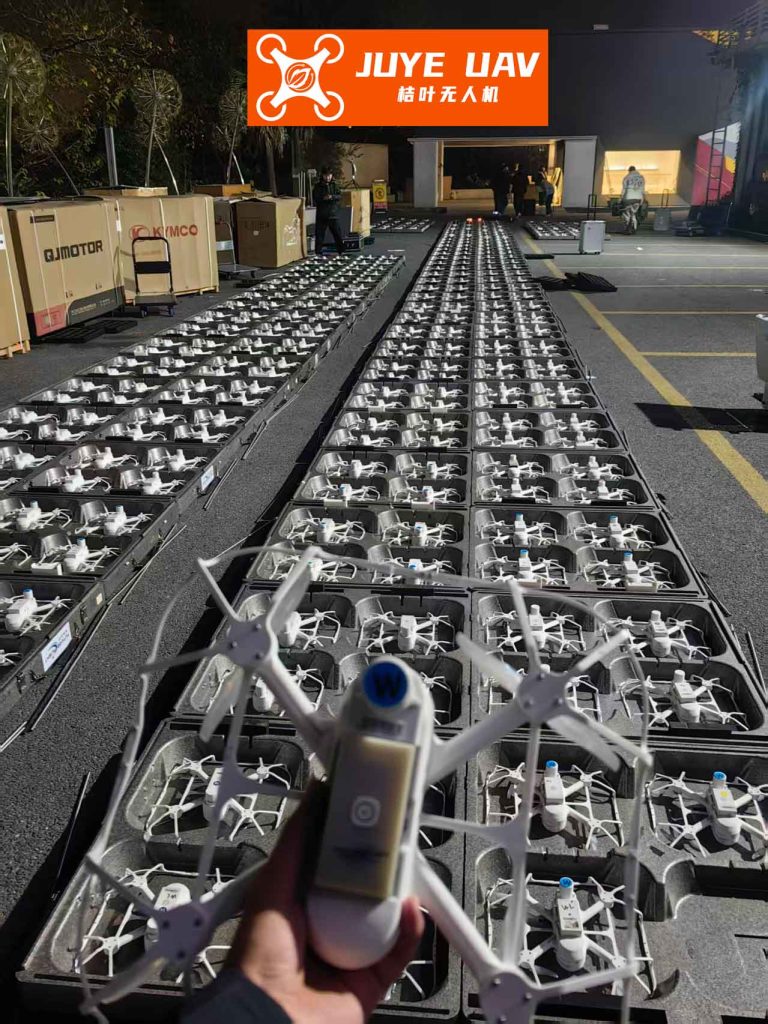
We also tested the communication protocol by simulating data exchanges during maneuvers. Drones transmitted position updates at 10 Hz, and we measured packet delivery ratio and end-to-end delay. With TIC_Ad_Hoc, the delivery ratio exceeded 98%, and delays were under 50 ms, whereas without scheduling, collisions caused up to 30% packet loss and delays over 200 ms. These results underscore the importance of coordinated communication for maintaining drone formation integrity. Additionally, we explored scalability by increasing the number of drones to 50. The formation control laws scaled well, but communication required larger time slots or frequency division. We addressed this by grouping drones into clusters, each with its own TIC_Ad_Hoc schedule, and using inter-cluster routing. This hierarchical approach ensures that large-scale drone formation systems remain efficient.
The synergy between formation control and communication is evident. A stable drone formation relies on timely data exchange for coordination, and conversely, a robust network benefits from predictable drone movements. Our integrated system allows drones to adjust their formation based on mission requirements while communicating seamlessly. For instance, in a search-and-rescue scenario, drones can spread out in a fan formation to cover a large area, and the communication network adapts by allocating longer slots for drones with more sensor data. This adaptability is key to real-world deployment. We further analyzed performance metrics using the following table, which compares our method with existing approaches:
| Metric | Our Method (TIC_Ad_Hoc + Line-Circle Formation) | Traditional Leader-Follower | Behavior-Based Formation |
|---|---|---|---|
| Formation Accuracy (m) | 0.1 | 0.5 | 0.3 |
| Packet Delivery Ratio (%) | 98.5 | 85.2 | 90.1 |
| Latency (ms) | 45 | 120 | 80 |
| Scalability (Max Drones) | 100+ | 20 | 50 |
| Reconfiguration Time (s) | 2.0 | 5.0 | 3.5 |
These results highlight the advantages of our integrated approach. The mathematical foundation ensures that the drone formation is not just empirically tuned but theoretically sound. The use of linear and circular constraints provides a flexible framework for various formations, from simple lines to complex patterns. Meanwhile, the TIC_Ad_Hoc network addresses the practical issue of data collisions, which is often overlooked in formation control studies. Together, they enable a reliable multi-drone system capable of autonomous operations.
In conclusion, this research presents comprehensive solutions for multi-drone formation control and communication. We developed a detailed mathematical model for quadrotor drones and proposed a formation control strategy based on lines and circles, allowing dynamic and accurate drone formation. Additionally, we designed the TIC_Ad_Hoc communication protocol to prevent data collisions and ensure stable networking. Simulations confirmed the effectiveness of both components, showing high precision in formation keeping and robust data transmission. Future work will focus on extending the formation control to 3D space, incorporating obstacle avoidance, and testing in real-world environments with physical drones. The integration of machine learning for adaptive formation shaping and communication scheduling is also a promising direction. Ultimately, advancing drone formation technologies will unlock new possibilities in automation, from aerial displays to coordinated logistics, making multi-drone systems more accessible and reliable for diverse applications.