
In the evolving landscape of unmanned aerial vehicles, Vertical Take-Off and Landing (VTOL) drones have garnered significant attention for their operational flexibility, eliminating the need for runways. Among various lift system configurations, the ducted propeller system stands out due to its enhanced safety, reduced noise signature, and improved aerodynamic efficiency in hover and low-speed flight. For engineers and designers, accurately predicting the performance characteristics of these ducted fan systems across different design phases—from initial concept to detailed analysis—is paramount. This article, from my perspective as a researcher in the field, delves into the development and validation of computational methods for ducted propeller systems used in VTOL drones. I will explore modified momentum theory, blade element-momentum theory, and advanced numerical simulation techniques, emphasizing practical approaches for the design community. The core aim is to establish reliable methods that balance computational efficiency with accuracy, catering to the distinct needs of preliminary design and detailed analysis stages for VTOL drone propulsion.
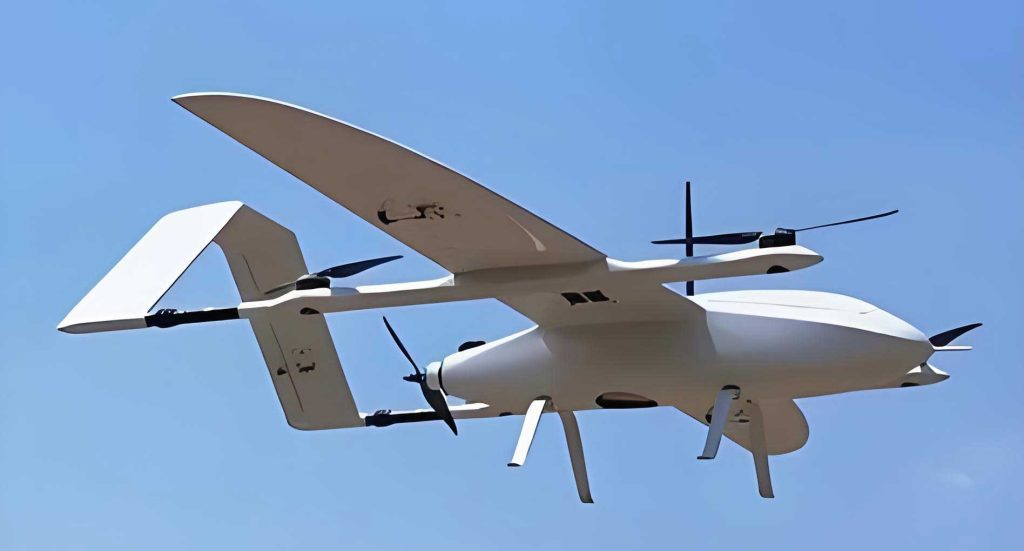
The ducted propeller, or shrouded fan, fundamentally consists of a rotating propeller enclosed within a stationary cylindrical duct. This arrangement modifies the flow field compared to an isolated propeller, primarily by contracting the slipstream and reducing tip vortices, which in turn can increase static thrust and efficiency under certain conditions. For a VTOL drone, where hover efficiency is critical, understanding the nuanced interplay between the duct and the propeller is essential. However, the complexity of the flow, involving rotational effects, duct-induced pressure gradients, and potential separation, makes simple analytical models insufficient for high-fidelity prediction. Therefore, a tiered approach is necessary: faster, simplified models for initial sizing and trade studies, and more computationally intensive methods for final performance validation and optimization. In this work, I will present a progressive study, starting with an enhanced analytical model based on momentum theory, moving to a combined blade element-momentum theory, and finally validating these against high-fidelity unsteady Computational Fluid Dynamics (CFD) simulations. Throughout this discussion, the unique requirements of the VTOL drone application will be the central focus, guiding the development and assessment of each method.
My investigation begins with the foundation of propeller analysis: momentum theory. Classical actuator disk theory often neglects the rotational component of the flow in the slipstream for simplicity, focusing solely on axial momentum. While this is acceptable for initial estimates, it can lead to inaccuracies, particularly when evaluating power and efficiency for a ducted configuration on a VTOL drone. To address this, I have developed a modified momentum theory model that explicitly accounts for the swirling motion of the air. The key modification is the introduction of an axial power coefficient, denoted as \(q_P\). This coefficient represents the fraction of the total power invested in the axial acceleration of the flow versus that expended in imparting swirl. The model assumptions include a uniformly loaded actuator disk, a duct that contributes a fraction \(q\) of the total thrust (the duct thrust ratio), and a linear distribution of tangential induced velocity at the disk, from zero at the hub to a maximum \(v_R\) at the tip radius \(R\).
The governing equations derived from conservation of mass, axial momentum, and angular momentum are as follows. The total thrust \(T\) is given by:
$$ T = \rho A (V_0 + v_1) v_2 $$
where \(\rho\) is air density, \(A\) is the disk area, \(V_0\) is the freestream axial velocity, \(v_1\) is the induced velocity at the disk, and \(v_2\) is the induced velocity in the far wake. The total torque \(M\) required to drive the propeller is:
$$ M = \frac{\rho A (V_0 + v_1) \omega R^2}{2\pi} $$
where \(\omega\) is the induced angular velocity at the disk rim, related to \(v_R\) by \(v_R = \omega R / 2\) in this model. The power input \(P\) is the sum of the axial and rotational kinetic energy increments:
$$ P = \frac{1}{2} \rho A (V_0 + v_1) \left[ (V_0 + v_2)^2 – V_0^2 + 2 v_R^2 \right] $$
The axial power coefficient is defined as:
$$ q_P = \frac{(V_0 + v_2)^2 – V_0^2}{(V_0 + v_2)^2 – V_0^2 + 2 v_R^2} $$
By relating the wake velocities through the disk loading and the duct effect, one can derive an expression linking the induced velocity at the disk \(v_1\) to the thrust and this coefficient:
$$ v_1 = \frac{V_0 + \sqrt{V_0^2 + 2(1-q)q_P \frac{T}{\rho A}}}{2(1-q)q_P} $$
Consequently, the static thrust efficiency \(T/P\) in hover (\(V_0 = 0\)) and the propulsive efficiency \(\eta\) in forward flight become:
$$ \frac{T}{P} \bigg|_{V_0=0} = \frac{2q_P}{\sqrt{2(1-q)q_P \frac{T}{\rho A}}} $$
$$ \eta = \frac{2 V_0 q_P^2}{V_0 + \sqrt{V_0^2 + 2(1-q)q_P \frac{T}{\rho A}}} $$
These equations show that the axial power coefficient \(q_P\) and the duct thrust ratio \(q\) are critical parameters influencing the predicted performance of the VTOL drone’s lift system.
To understand the design implications for a VTOL drone, I analyzed the sensitivity of key performance metrics to these parameters. The axial power coefficient \(q_P\) is not a constant but a function of propeller tip speed \(nD\) (where \(n\) is rotational speed and \(D\) is diameter), disk loading \(T/A\), and the duct thrust ratio \(q\). In general, a higher \(q_P\) indicates that more power is used for useful axial thrust rather than wasteful swirl. My analysis reveals that increasing the duct’s contribution (higher \(q\)) significantly boosts \(q_P\) for the same disk loading and tip speed, underscoring the duct’s role in streamlining the flow. However, increasing disk loading (e.g., by increasing blade pitch) tends to decrease \(q_P\), as a larger fraction of power goes into rotational kinetic energy. This effect is more pronounced for systems with lower duct contribution. Similarly, operating the VTOL drone’s propeller at a higher rotational speed (higher tip speed) with a finer pitch increases \(q_P\), suggesting that such a regime is beneficial for efficiency. The following table summarizes these parametric trends qualitatively.
| Parameter | Change | Effect on Axial Power Coeff. \(q_P\) | Implication for VTOL Drone Design |
|---|---|---|---|
| Duct Thrust Ratio \(q\) | Increase | Increase | Higher duct effectiveness improves energy transfer to axial flow. |
| Disk Loading \(T/A\) | Increase | Decrease | Heavier loading reduces efficiency; necessitates careful propeller design. |
| Tip Speed \(nD\) | Increase | Increase | Favor higher RPM, lower pitch operation for better hover efficiency. |
| Freestream Velocity \(V_0\) | Increase | Increase | Forward flight improves overall propulsive efficiency. |
The static thrust efficiency \(T/P\) in hover, a paramount figure of merit for a VTOL drone, is strongly influenced by \(q\). For a given disk loading, a higher duct thrust ratio yields a higher static thrust efficiency. This mathematically supports the intuitive advantage of a duct for hover-capable aircraft. The trade-off, however, often comes in increased weight and drag in forward flight. Furthermore, my analysis indicates that for a fixed tip speed, increasing disk loading diminishes static thrust efficiency, especially at lower loadings. This highlights the importance of optimizing the propeller disk area for the VTOL drone’s intended take-off weight.
While the modified momentum theory provides valuable qualitative insights and design trends, it cannot predict the performance of a specific propeller geometry. For that, one must turn to blade element theory, which integrates the aerodynamic characteristics of the blade airfoil sections along the span. The classic Blade Element-Momentum (BEM) theory for ducted propellers equates the elemental thrust and torque from blade element theory with the momentum changes in annular streamtubes. A common challenge in implementing BEM for a VTOL drone propeller in hover or low-speed flight is the treatment of the induced velocity. Many formulations use the freestream velocity \(V_0\) as a reference, which becomes problematic in static thrust conditions (\(V_0 \to 0\)). To overcome this, I have developed a modified BEM approach where the axial and tangential induced velocities at the disk, \(v_a\) and \(v_t\), are the primary solved variables, directly obtained from an iterative solution of the governing integral equations.
The system of equations for my modified BEM model is as follows. For an annular element at radius \(r\) with width \(dr\), the equilibrium of thrust and torque from momentum and blade element considerations gives:
$$ \text{Momentum Thrust: } dT = 4\pi \rho r (V_0 + v_a) v_2 dr $$
$$ \text{Blade Element Thrust: } dT = N_b \frac{1}{2} \rho W^2 [C_l \cos\phi – C_d \sin\phi] c dr $$
$$ \text{Momentum Torque: } dM = 4\pi \rho r^2 (V_0 + v_a) v_t dr $$
$$ \text{Blade Element Torque: } dM = N_b \frac{1}{2} \rho W^2 [C_l \sin\phi + C_d \cos\phi] c r dr $$
Here, \(N_b\) is the number of blades, \(W\) is the relative airflow velocity at the element, \(\phi\) is the inflow angle (\(\phi = \tan^{-1}[(V_0+v_a)/(\Omega r – v_t)]\)), \(\Omega\) is the angular velocity, \(c\) is the chord length, and \(C_l\) and \(C_d\) are the airfoil lift and drag coefficients at the effective angle of attack \(\alpha = \theta – \phi\), where \(\theta\) is the blade pitch angle. The far-wake axial induced velocity \(v_2\) is linked to \(v_a\) through the duct and axial power coefficient model: \(v_2 = 2[(1-q)q_P v_a – q V_0]\). The tangential induced velocity at the disk \(v_t\) relates to the swirl at the tip. The axial power coefficient \(q_P\) is updated iteratively based on the computed flow field. The solution algorithm involves guessing distributions for \(v_a\) and \(v_t\), calculating aerodynamic forces on each blade element, and iterating until the momentum and blade element forces match across the entire disk. This method directly yields the performance coefficients for the VTOL drone’s ducted propeller:
Thrust coefficient:
$$ C_T = \frac{T}{\rho n^2 D^4} $$
Torque/power coefficient:
$$ C_P = \frac{P}{\rho n^3 D^5} = \frac{2\pi M n}{\rho n^3 D^5} = 2\pi C_Q $$
Efficiency in forward flight:
$$ \eta = \frac{J C_T}{C_P} $$
where \(J = V_0/(nD)\) is the advance ratio.
This modified BEM model offers a significant improvement for the VTOL drone designer. It provides a quantitative prediction of thrust, power, and efficiency across a range of operating conditions, from hover to forward flight, while accounting for the duct’s influence. To illustrate, I applied this model to compare a ducted propeller with an isolated propeller of the same diameter, typical of those used on a VTOL drone. The results, summarized conceptually below, show that the ducted system produces higher thrust at the same advance ratio but also consumes more power. However, its peak efficiency occurs at a lower advance ratio, implying that the optimal cruising speed for a VTOL drone using a ducted fan might be different than for one using open propellers. Importantly, the model correctly predicts a non-zero power coefficient at zero thrust (\(C_T=0\)), representing the profile power required to overcome blade drag, a feature missing in simple momentum theory.
| Performance Metric | Ducted Propeller | Isolated Propeller | Note for VTOL Drone Application |
|---|---|---|---|
| Thrust Coefficient \(C_T\) at fixed \(J\) | Higher | Lower | Beneficial for hover and vertical climb. |
| Power Coefficient \(C_P\) at fixed \(J\) | Higher | Lower | Increased power demand for the same thrust. | Advance Ratio \(J\) at Peak Efficiency | Lower | Higher | Ducted system efficient at lower speeds, suitable for transition flight. |
| Static Thrust Efficiency (\(J=0\)) | Potentially Higher | Lower | Core advantage for hover endurance. |
Analytical models, while fast, rely on simplifications like steady, inviscid flow and prescribed wake models. For the detailed design phase of a high-performance VTOL drone, higher-fidelity analysis is indispensable. Computational Fluid Dynamics (CFD) provides this capability by solving the Navier-Stokes equations. For rotating machinery like a ducted propeller, a key challenge is handling the relative motion between the stationary duct and the rotating blades. I employed the Sliding Mesh Method (SMM), a robust technique for unsteady simulations of such configurations. The computational domain is divided into two parts: a stationary region containing the duct and far-field boundaries, and a rotating region enclosing the propeller blades. These regions interface via a non-conformal sliding interface where flow data is interpolated and exchanged each time step. This approach captures the unsteady interactions between the blade wakes and the duct, which can be significant for a VTOL drone operating in complex flow regimes like transition.
The governing equations solved are the unsteady Reynolds-Averaged Navier-Stokes (URANS) equations. For the rotating zone, the equations are solved in a rotating reference frame, incorporating centrifugal and Coriolis source terms. The Shear Stress Transport (SST) k-ω turbulence model is often used for its good performance in adverse pressure gradients and separated flows. The solution process typically starts with a steady-state simulation using the Multiple Reference Frame (MRF) model to generate an initial flow field, which is then used as the initial condition for the transient SMM simulation. This two-step process enhances convergence. The mesh for the stationary duct is usually a structured hexahedral grid for accuracy and efficiency, while the complex geometry of the rotating blades is discretized using an unstructured tetrahedral/prismatic mesh, allowing flexibility. The key output from these simulations includes detailed pressure distributions on the blades and duct, time-accurate thrust and torque values, and visualization of complex vortex structures, providing deep insight for optimizing the VTOL drone’s lift system.
To validate the hierarchy of methods, I conducted a series of comparative studies. First, the modified BEM model was tested against published data for a ducted tail rotor. The results showed that the model with the axial power coefficient correction yielded predictions closer to the reference data than the uncorrected BEM, especially at higher blade pitch angles (higher disk loading). The error reduction was around 3-4% for thrust and power predictions. This confirms the importance of accounting for swirl energy loss in the analytical model for a VTOL drone propeller. Second, to validate the CFD methodology, I simulated a well-documented isolated rotor in hover (Caradonna-Tung rotor). The computed pressure distributions on the blade sections showed good agreement with experimental data, with lift coefficient errors within 8.5%, lending credibility to the numerical setup.
The most comprehensive validation involved a practical case: a low-speed propeller intended for a high-altitude long-endurance VTOL drone, tested in a ground-static condition (\(V_0 = 0\)). I compared experimental measurements of thrust and power against predictions from the modified BEM theory and the unsteady CFD simulation. The experimental setup used a six-component balance to measure forces and moments. The results were illuminating. The CFD predictions showed excellent agreement with the test data for both thrust and power across a range of rotational speeds. The modified BEM theory, while capturing trends, consistently over-predicted thrust. The table below quantifies a representative comparison at a specific rotational speed.
| Method | Thrust (N) | Power (W) | Power Coefficient \(C_P\) | Notes |
|---|---|---|---|---|
| Experiment | 42.5 | 292 | 0.122 | Benchmark measurement for the VTOL drone component. |
| Unsteady CFD (SMM) | 43.1 | 298 | 0.124 | Excellent agreement; suitable for detailed design. |
| Modified BEM Theory | 49.8 | 342 | 0.143 | Over-predicts thrust; useful for conservative preliminary sizing. |
The over-prediction by BEM theory can be attributed to several factors not modeled: three-dimensional flow effects at the blade root and tip, viscous losses within the hub region, and inaccuracies in the airfoil data at high angles of attack—a common situation for propellers under high static thrust. This discrepancy underscores the complementary role of these methods. For the preliminary design of a VTOL drone, where rapid iteration over parameters like diameter, blade number, and duct shape is needed, the modified BEM theory offers a fast and reasonably accurate tool. Its results can identify promising configurations and provide initial performance estimates. However, for the final design verification, performance mapping, and analysis of complex interactions (e.g., duct-blade tip clearance effects, aeroacoustics), high-fidelity unsteady CFD is essential. The validated CFD model becomes the virtual testbed for the VTOL drone’s propulsion system, reducing reliance on costly physical prototypes.
Further parametric studies using the CFD model can reveal optimal design points. For instance, varying the blade collective pitch for a given VTOL drone ducted fan shows that thrust increases with pitch until local stall begins on the inboard sections, after which the rate of increase diminishes and power consumption soars. The efficiency curve peaks at a specific advance ratio, guiding the selection of gear ratios and motor KV values for the electric propulsion system of the VTOL drone. The duct’s internal geometry, particularly its lip shape and diffusion angle, can also be optimized via CFD to maximize the thrust ratio \(q\) and minimize drag in forward flight.
In conclusion, the development of effective VTOL drones hinges on sophisticated yet practical analysis tools for their unique ducted propeller systems. In this work, I have presented a structured approach comprising enhanced analytical models and high-fidelity numerical simulation. The modified momentum theory, through the introduction of the axial power coefficient, provides crucial qualitative insights into the influence of duct contribution, disk loading, and tip speed on system efficiency—invaluable knowledge for initial concept development. The refined blade element-momentum theory, which solves directly for the induced velocity field, offers a quantitative, computationally efficient method for performance prediction across the flight envelope, serving the preliminary design phase well despite its tendency towards conservative over-prediction. Finally, unsteady CFD simulations based on the sliding mesh technique deliver the high-fidelity results necessary for detailed design validation and optimization, showing remarkable agreement with experimental data. For engineers working on the next generation of VTOL drones, employing this multi-fidelity strategy—from fast analytical models to rigorous CFD—ensures a robust design process that balances innovation, performance, and development cost. The continuous evolution of these computational methods will undoubtedly propel the capabilities and applications of VTOL drones to new heights.