
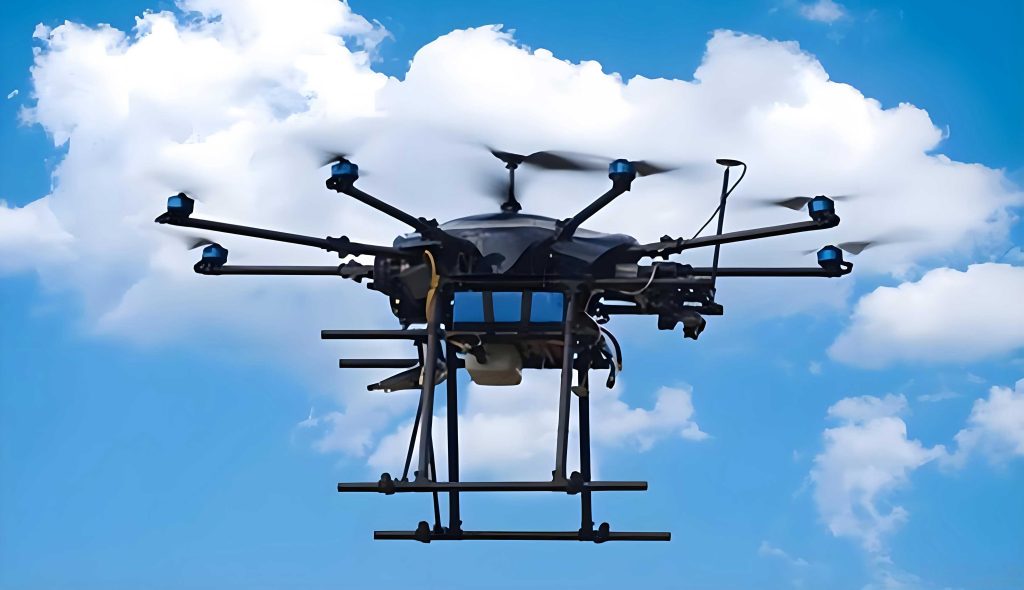
The coordinated operation of multiple Unmanned Aerial Vehicles (UAV drones) has become a cornerstone for complex missions ranging from precision agriculture and infrastructure inspection to search and rescue and automated logistics. The core advantage of a multi-UAV drone system lies in its inherent robustness, scalability, and efficiency compared to a single, complex platform. However, this advantage is critically dependent on reliable and resilient cooperative control algorithms. In real-world deployment, UAV drones are susceptible to various anomalies, with actuator failures being among the most critical. An actuator fault in one member of a multi-UAV drone formation can propagate through the cooperative network, potentially leading to degraded performance or even catastrophic failure of the entire mission. Furthermore, external disturbances such as wind gusts are ever-present challenges. Therefore, developing sophisticated distributed fault-tolerant cooperative control (FTCC) strategies that can maintain formation integrity and tracking precision in the face of simultaneous actuator faults and disturbances is paramount for the safe and reliable adoption of multi-UAV drone systems.
This article presents a comprehensive study on a novel distributed FTCC algorithm designed for a leader-follower network of quadrotor UAV drones. The proposed strategy addresses the coupled challenges of partial actuator failure (modeled as both a loss of effectiveness and a bias fault) and bounded external disturbances. The core philosophy is to leverage local neighbor-to-neighbor information exchange within a distributed framework, thereby alleviating the communication and computational burden on a central node and enhancing system scalability and robustness. The technical approach integrates several advanced control methodologies: a consensus-based reference generator for distributed coordination, an adaptive law for online estimation of composite uncertainties, and a non-singular fast terminal sliding mode controller to guarantee finite-time convergence and robustness to estimation residuals. The stability of the closed-loop system is rigorously proven using Lyapunov theory. Extensive numerical simulations validate the effectiveness of the proposed scheme, demonstrating precise formation tracking and velocity consensus among the follower UAV drones even under severe actuator fault conditions.
1. System Modeling and Problem Formulation
1.1 Quadrotor UAV Dynamics with Actuator Faults
We consider a cooperative system consisting of one leader UAV drone, indexed as 0, and N follower UAV drones. The translational dynamics of the i-th follower UAV drone (i = 1, …, N) in the inertial frame can be described under fault-free conditions as:
$$ \dot{\boldsymbol{P}}_i = \boldsymbol{V}_i $$
$$ \dot{\boldsymbol{V}}_i = \boldsymbol{U}_i + \boldsymbol{d}_i $$
where $\boldsymbol{P}_i = [p_{ix}, p_{iy}, p_{iz}]^T \in \mathbb{R}^3$ is the position vector, $\boldsymbol{V}_i = [v_{ix}, v_{iy}, v_{iz}]^T \in \mathbb{R}^3$ is the velocity vector, $\boldsymbol{U}_i \in \mathbb{R}^3$ is the control input vector (virtual acceleration), and $\boldsymbol{d}_i \in \mathbb{R}^3$ represents unknown bounded external disturbances, satisfying $\|\boldsymbol{d}_i\| \le \bar{d}_i$.
In practical scenarios, actuator faults are inevitable. We model two prevalent types of faults concurrently affecting the control effectiveness:
- Loss of Effectiveness (LoE): The control input is scaled by an unknown factor $\lambda_i$ ($0 < \lambda_i \le 1$).
- Bias Fault: An additive, possibly time-varying fault signal $\boldsymbol{F}_i(t)$ acts on the actuator.
The faulty dynamics of the i-th follower UAV drone is then expressed as:
$$ \dot{\boldsymbol{P}}_i = \boldsymbol{V}_i $$
$$ \dot{\boldsymbol{V}}_i = \lambda_i \boldsymbol{U}_i + \boldsymbol{d}_i + \boldsymbol{F}_i $$
For analytical convenience, we combine the disturbance and bias fault into a composite uncertainty term $\boldsymbol{\Delta}_i = \boldsymbol{d}_i + \boldsymbol{F}_i$. The dynamics become:
$$ \dot{\boldsymbol{P}}_i = \boldsymbol{V}_i $$
$$ \dot{\boldsymbol{V}}_i = \lambda_i \boldsymbol{U}_i + \boldsymbol{\Delta}_i $$
By differentiating the velocity dynamics, we obtain the second-order model used for controller design:
$$ \ddot{\boldsymbol{P}}_i = \dot{\boldsymbol{V}}_i $$
$$ \ddot{\boldsymbol{V}}_i = \lambda_i \dot{\boldsymbol{U}}_i + \dot{\boldsymbol{\Delta}}_i $$
Defining $\boldsymbol{D}_i = \dot{\boldsymbol{\Delta}}_i$ as the derivative of the composite uncertainty, we have the final design model:
$$ \ddot{\boldsymbol{P}}_i = \dot{\boldsymbol{V}}_i $$
$$ \ddot{\boldsymbol{V}}_i = \lambda_i \dot{\boldsymbol{U}}_i + \boldsymbol{D}_i $$
We adopt the following standard assumption regarding the system uncertainties.
Assumption 1: The composite uncertainty $\boldsymbol{\Delta}_i$ and its derivative $\boldsymbol{D}_i$ are bounded, i.e., $\boldsymbol{\Delta}_i \in \mathcal{L}_\infty$ and $\boldsymbol{D}_i \in \mathcal{L}_\infty$, with $\|\boldsymbol{D}_i\| \le \delta_i$, where $\delta_i$ is a known positive constant representing the upper bound of the uncertainty’s rate of change.
1.2 Graph Theory Preliminaries
The communication topology among the N follower UAV drones and the leader is modeled by an undirected graph $\mathcal{G} = (\mathcal{V}, \mathcal{E}, \mathcal{A})$, where $\mathcal{V} = \{r_1, r_2, …, r_N\}$ is the node set (each node represents a follower UAV drone), $\mathcal{E} \subseteq \mathcal{V} \times \mathcal{V}$ is the edge set, and $\mathcal{A} = [a_{ij}] \in \mathbb{R}^{N \times N}$ is the weighted adjacency matrix. An edge $(r_i, r_j) \in \mathcal{E}$ exists if UAV drones i and j can exchange information, implying $a_{ij} = a_{ji} > 0$; otherwise, $a_{ij} = 0$. We assume $a_{ii} = 0$. The neighbor set of node i is defined as $\mathcal{N}_i = \{j | (r_i, r_j) \in \mathcal{E}\}$. The degree matrix is $\mathcal{D} = \text{diag}(d_1, …, d_N)$ with $d_i = \sum_{j \in \mathcal{N}_i} a_{ij}$. The Laplacian matrix of graph $\mathcal{G}$ is $\boldsymbol{L} = \mathcal{D} – \mathcal{A}$.
The connection from the leader (node 0) to the followers is defined by a pinning matrix $\boldsymbol{B} = \text{diag}(b_1, …, b_N)$. If follower i receives information directly from the leader, then $b_i > 0$; otherwise, $b_i = 0$. The overall communication topology including the leader is denoted as $\overline{\mathcal{G}}$.
Assumption 2: The graph $\mathcal{G}$ is connected, and for the overall topology $\overline{\mathcal{G}}$, there exists at least one directed path from the leader to every follower UAV drone. This implies that the matrix $(\boldsymbol{L} + \boldsymbol{B})$ is symmetric and positive definite.
2. Distributed Fault-Tolerant Controller Design
2.1 Distributed Consensus-Based Reference Generator
A key feature of our approach is the distributed generation of a reference velocity signal for each follower UAV drone, utilizing only information from its neighbors and the leader (if available). This eliminates the need for every UAV drone to have direct access to the leader’s state, reducing communication bottlenecks. For the i-th follower UAV drone, the local reference velocity $\boldsymbol{V}_{id}$ is generated as:
$$ \boldsymbol{V}_{id} = \frac{\sum_{j \in \mathcal{N}_i} a_{ij} \boldsymbol{V}_j + b_i \boldsymbol{V}_0}{\sum_{j \in \mathcal{N}_i} a_{ij} + b_i} $$
where $\boldsymbol{V}_0$ is the velocity of the leader UAV drone. This convex combination ensures that $\boldsymbol{V}_{id}$ is a weighted average of the velocities of neighboring UAV drones and the leader.
We define two tracking error vectors. The first is the error between the i-th UAV drone’s velocity and its locally generated reference:
$$ \boldsymbol{e}_{i1} = \boldsymbol{V}_i – \boldsymbol{V}_{id} $$
The second is the error between the i-th UAV drone’s velocity and the leader’s velocity:
$$ \boldsymbol{e}_{i2} = \boldsymbol{V}_i – \boldsymbol{V}_0 $$
A fundamental lemma establishes the relationship between these errors, justifying the distributed reference strategy.
Lemma 1: Under Assumption 2, if the tracking error $\boldsymbol{e}_{i1}$ is uniformly ultimately bounded (UUB), then the tracking error $\boldsymbol{e}_{i2}$ is also UUB. Conversely, boundedness of $\boldsymbol{e}_{i2}$ implies boundedness of $\boldsymbol{e}_{i1}$.
Proof Sketch: From the definition of $\boldsymbol{V}_{id}$, we can derive $(\mathcal{D}+\boldsymbol{B})\boldsymbol{e}_{i1} = (\boldsymbol{L}+\boldsymbol{B})\boldsymbol{e}_{i2}$. Since $(\boldsymbol{L}+\boldsymbol{B})$ is positive definite, we have $\|\boldsymbol{e}_{i2}\| \le \sigma^{-1}(\boldsymbol{L}+\boldsymbol{B}) \lambda_{\text{max}}(\mathcal{D}+\boldsymbol{B}) \|\boldsymbol{e}_{i1}\|$, where $\sigma(\cdot)$ denotes the minimum singular value and $\lambda_{\text{max}}(\cdot)$ the maximum eigenvalue. This inequality directly proves the lemma.
2.2 Error Dynamics and Sliding Surface Design
The control objective is to drive $\boldsymbol{e}_{i1}$ to zero in finite time. Differentiating $\boldsymbol{e}_{i1}$ twice and substituting the system dynamics yields:
$$ \ddot{\boldsymbol{e}}_{i1} = \lambda_i \dot{\boldsymbol{U}}_i + \boldsymbol{D}_i – \ddot{\boldsymbol{V}}_{id} $$
To achieve finite-time convergence, a Non-Singular Fast Terminal Sliding Mode (NFTSM) surface $\boldsymbol{s}_i \in \mathbb{R}^3$ is designed:
$$ \boldsymbol{s}_i = \dot{\boldsymbol{e}}_{i1} + \boldsymbol{K}_1 \boldsymbol{e}_{i1} + \boldsymbol{K}_2 \boldsymbol{\Phi}(\boldsymbol{e}_{i1}) $$
where $\boldsymbol{K}_1 = \text{diag}(k_{11}, k_{12}, k_{13}) > 0$ and $\boldsymbol{K}_2 = \text{diag}(k_{21}, k_{22}, k_{23}) > 0$ are diagonal gain matrices. The function $\boldsymbol{\Phi}(\boldsymbol{e}_{i1})$ is defined component-wise as $[\phi(e_{i1}^x), \phi(e_{i1}^y), \phi(e_{i1}^z)]^T$, with $\phi(z) = |z|^{\gamma} \text{sign}(z)$, and $1 < \gamma = q/p < 2$ (with p, q being positive odd integers). The derivative of the sliding surface is:
$$ \dot{\boldsymbol{s}}_i = \lambda_i \dot{\boldsymbol{U}}_i + \boldsymbol{D}_i – \ddot{\boldsymbol{V}}_{id} + \boldsymbol{K}_1 \dot{\boldsymbol{e}}_{i1} + \boldsymbol{K}_2 \frac{\partial \boldsymbol{\Phi}(\boldsymbol{e}_{i1})}{\partial \boldsymbol{e}_{i1}} \dot{\boldsymbol{e}}_{i1} $$
where $\frac{\partial \boldsymbol{\Phi}}{\partial \boldsymbol{e}_{i1}} = \text{diag}(\gamma |e_{i1}^x|^{\gamma-1}, \gamma |e_{i1}^y|^{\gamma-1}, \gamma |e_{i1}^z|^{\gamma-1})$.
2.3 Adaptive NFTSM Controller and Stability Analysis
The control law is designed to drive $\boldsymbol{s}_i$ to zero. Let $\rho_i = 1/\lambda_i$. We design estimates $\hat{\rho}_i$ for $\rho_i$ and $\hat{\boldsymbol{D}}_i$ for $\boldsymbol{D}_i$. The control input derivative is proposed as:
$$ \dot{\boldsymbol{U}}_i = -\hat{\rho}_i \left( \boldsymbol{K}_3 \boldsymbol{s}_i + \boldsymbol{K}_4 \text{sign}(\boldsymbol{s}_i) + \boldsymbol{\eta} \boldsymbol{\Psi}(\boldsymbol{s}_i) + \hat{\boldsymbol{D}}_i – \ddot{\boldsymbol{V}}_{id} + \boldsymbol{K}_1 \dot{\boldsymbol{e}}_{i1} + \boldsymbol{K}_2 \frac{\partial \boldsymbol{\Phi}}{\partial \boldsymbol{e}_{i1}} \dot{\boldsymbol{e}}_{i1} \right) $$
where $\boldsymbol{K}_3, \boldsymbol{K}_4 > 0$ are diagonal gain matrices, $\boldsymbol{\eta}>0$, and $\boldsymbol{\Psi}(\boldsymbol{s}_i)$ is defined similarly to $\boldsymbol{\Phi}$ with a component-wise power $\beta$ (where $0 < \beta < 1$). The sign function $\text{sign}(\cdot)$ is applied component-wise.
The adaptive laws for updating the estimates are given by:
$$ \dot{\hat{\rho}}_i = \Gamma_{1i} \|\boldsymbol{s}_i\| \|\boldsymbol{z}_i\| \text{sign}(\lambda_i) $$
$$ \dot{\hat{\boldsymbol{D}}}_i = \Gamma_{2i} \boldsymbol{s}_i $$
where $\Gamma_{1i} > 0$ and $\Gamma_{2i} > 0$ are adaptive gain matrices, and $\boldsymbol{z}_i$ denotes the entire expression within the parentheses in the control law, i.e., $\boldsymbol{z}_i = \boldsymbol{K}_3 \boldsymbol{s}_i + \boldsymbol{K}_4 \text{sign}(\boldsymbol{s}_i) + \boldsymbol{\eta} \boldsymbol{\Psi}(\boldsymbol{s}_i) + \hat{\boldsymbol{D}}_i – \ddot{\boldsymbol{V}}_{id} + \boldsymbol{K}_1 \dot{\boldsymbol{e}}_{i1} + \boldsymbol{K}_2 \frac{\partial \boldsymbol{\Phi}}{\partial \boldsymbol{e}_{i1}} \dot{\boldsymbol{e}}_{i1}$.
Theorem 1: Consider the faulty multi-UAV drone system governed by dynamics under Assumptions 1 and 2. With the distributed reference generator, the NFTSM surface, the control law, and the adaptive laws, the sliding surface $\boldsymbol{s}_i$ converges to a neighborhood of zero in finite time. Consequently, the tracking errors $\boldsymbol{e}_{i1}$ and $\boldsymbol{e}_{i2}$ converge to a small region around zero in finite time, ensuring fault-tolerant cooperative tracking.
Proof: Consider the following Lyapunov function candidate for the i-th UAV drone subsystem:
$$ V_i = \frac{1}{2} \boldsymbol{s}_i^T \boldsymbol{s}_i + \frac{\lambda_i}{2\Gamma_{1i}} \tilde{\rho}_i^2 + \frac{1}{2\Gamma_{2i}} \tilde{\boldsymbol{D}}_i^T \tilde{\boldsymbol{D}}_i $$
where $\tilde{\rho}_i = \rho_i – \hat{\rho}_i$ and $\tilde{\boldsymbol{D}}_i = \boldsymbol{D}_i – \hat{\boldsymbol{D}}_i$ are estimation errors. Differentiating $V_i$ and substituting the dynamics, control law, and adaptive laws, after significant algebraic manipulation and simplification, we obtain:
$$ \dot{V}_i = \boldsymbol{s}_i^T \dot{\boldsymbol{s}}_i – \frac{\lambda_i}{\Gamma_{1i}} \tilde{\rho}_i \dot{\hat{\rho}}_i – \frac{1}{\Gamma_{2i}} \tilde{\boldsymbol{D}}_i^T \dot{\hat{\boldsymbol{D}}}_i $$
$$ = \boldsymbol{s}_i^T \left( -\eta \boldsymbol{\Psi}(\boldsymbol{s}_i) – \boldsymbol{K}_3 \boldsymbol{s}_i – \boldsymbol{K}_4 \text{sign}(\boldsymbol{s}_i) \right) – \boldsymbol{s}_i^T \lambda_i \tilde{\rho}_i \boldsymbol{z}_i – \frac{\lambda_i}{\Gamma_{1i}} \tilde{\rho}_i (\Gamma_{1i} \|\boldsymbol{s}_i\| \|\boldsymbol{z}_i\| \text{sign}(\lambda_i)) – \frac{1}{\Gamma_{2i}} \tilde{\boldsymbol{D}}_i^T (\Gamma_{2i} \boldsymbol{s}_i) $$
The cross terms cancel out due to the design of the adaptive laws. Noting that $\boldsymbol{s}_i^T \text{sign}(\boldsymbol{s}_i) = \|\boldsymbol{s}_i\|_1 \ge \|\boldsymbol{s}_i\|_2$ and $\boldsymbol{s}_i^T \boldsymbol{\Psi}(\boldsymbol{s}_i) \ge \|\boldsymbol{s}_i\|^{\beta+1}$, we can establish the inequality:
$$ \dot{V}_i \le -\boldsymbol{s}_i^T \boldsymbol{K}_3 \boldsymbol{s}_i – \eta \|\boldsymbol{s}_i\|^{\beta+1} – k_{4,\text{min}} \|\boldsymbol{s}_i\| $$
where $k_{4,\text{min}}$ is the minimum diagonal entry of $\boldsymbol{K}_4$. Since $\boldsymbol{K}_3 > 0$, $\eta > 0$, and $k_{4,\text{min}} > 0$, it follows that $\dot{V}_i \le 0$. This proves that $\boldsymbol{s}_i$, $\tilde{\rho}_i$, and $\tilde{\boldsymbol{D}}_i$ are all bounded. Applying Barbalat’s lemma or similar arguments, we can show that $\boldsymbol{s}_i \to 0$ asymptotically. Furthermore, from the structure of $\dot{V}_i$, we can derive a finite-time convergence condition. Let $0 < \alpha = (\beta+1)/2 < 1$. It can be shown that $\dot{V}_i \le -c V_i^\alpha$ for some positive constant c. According to finite-time stability theory, this implies that $\boldsymbol{s}_i$ converges to zero in finite time $T_i \le V_i(0)^{1-\alpha} / [c(1-\alpha)]$. Once on the sliding manifold $\boldsymbol{s}_i=0$, the dynamics reduce to $\dot{\boldsymbol{e}}_{i1} = -\boldsymbol{K}_1 \boldsymbol{e}_{i1} – \boldsymbol{K}_2 \boldsymbol{\Phi}(\boldsymbol{e}_{i1})$, which also guarantees finite-time convergence of $\boldsymbol{e}_{i1}$ to zero. By Lemma 1, $\boldsymbol{e}_{i2}$ is also driven to a bounded region, completing the proof.
3. Numerical Simulation and Performance Analysis
To validate the proposed distributed FTCC algorithm, a simulation scenario with one leader and four follower UAV drones is constructed. The communication topology is shown in the figure above, with its corresponding matrices:
$$ \mathcal{A} = \begin{bmatrix} 0 & 1 & 1 & 1 \\ 1 & 0 & 1 & 0 \\ 1 & 1 & 0 & 1 \\ 1 & 0 & 1 & 0 \end{bmatrix}, \quad \boldsymbol{B} = \text{diag}(1, 0, 1, 0) $$
The leader’s velocity profile is set to $\boldsymbol{V}_0(t) = [10\sin(0.13\pi t), 5\cos(0.1\pi t), 2]^T$ m/s. A composite disturbance $\boldsymbol{\Delta}_i(t) = [2\sin(0.2\pi t), 1.5\cos(0.15\pi t+1), 0.5\sin(0.3\pi t)]^T$ m/s² is applied to all followers. A severe actuator fault is injected into Follower 3 at t = 15 s, characterized by a loss of effectiveness $\lambda_3 = 0.4$ and an additional bias $\boldsymbol{F}_3 = [1.5, -1.0, 0.8]^T$ m/s².
The controller parameters are selected as follows:
| Parameter | Value | Parameter | Value |
|---|---|---|---|
| $\boldsymbol{K}_1$ | $\text{diag}(40, 40, 40)$ | $\gamma = q/p$ | $5/3$ |
| $\boldsymbol{K}_2$ | $\text{diag}(26, 26, 26)$ | $\Gamma_{1i}$ | $0.05$ |
| $\boldsymbol{K}_3$ | $\text{diag}(0.9, 0.9, 0.9)$ | $\Gamma_{2i}$ | $\text{diag}(55, 55, 55)$ |
| $\boldsymbol{K}_4$ | $\text{diag}(7, 7, 7)$ | $\boldsymbol{\eta}$ | $\text{diag}(0.5, 0.5, 0.5)$ |
| $\beta$ | $0.7$ |
The simulation results are summarized and analyzed below:
| Performance Metric | Observation & Analysis | Key Finding |
|---|---|---|
| Reference Velocity Tracking ($\boldsymbol{V}_i \to \boldsymbol{V}_{id}$) | The locally generated reference signals $\boldsymbol{V}_{id}$ for all followers accurately capture the trend of the leader’s motion. The tracking error $\boldsymbol{e}_{i1}$ converges rapidly after initialization and remains within ±0.15 m/s in steady-state under normal conditions. | The distributed consensus protocol effectively disseminates the leader’s state information throughout the multi-UAV drone network. |
| Leader Velocity Tracking ($\boldsymbol{V}_i \to \boldsymbol{V}_0$) | All follower UAV drones successfully synchronize their velocities with the leader. The error $\boldsymbol{e}_{i2}$ shows slightly larger bounds than $\boldsymbol{e}_{i1}$ but is consistently regulated below ±0.3 m/s, confirming Lemma 1. | The primary control objective of velocity consensus is achieved despite the lack of direct leader information for all followers. |
| Fault Injection Response (t=15s) | Upon the introduction of the severe actuator fault in Follower 3, a transient spike occurs in its tracking errors ($\boldsymbol{e}_{31}$, $\boldsymbol{e}_{32}$). The proposed adaptive NFTSM controller compensates effectively, bringing the errors back to the pre-fault bound within approximately 2 seconds. The errors of other UAV drones show negligible perturbation. | The controller exhibits strong fault tolerance and disturbance rejection capabilities. The fault is contained locally without destabilizing the entire multi-UAV drone formation. |
| Inter-Agent Velocity Consensus | The velocity differences between any pair of follower UAV drones remain minimal throughout the simulation. This mutual consensus is a direct consequence of the distributed design and the convergence of $\boldsymbol{e}_{i2}$ for all agents. | The formation maintains cohesive group behavior, which is critical for collaborative tasks. |
| Adaptive Parameter Behavior | The estimates $\hat{\boldsymbol{D}}_i$ and $\hat{\rho}_i$ adapt online. $\hat{\boldsymbol{D}}_i$ closely follows the profile of the actual disturbance derivative. $\hat{\rho}_3$ for the faulty UAV drone undergoes a significant adjustment post-fault, converging to a new value reflecting the inverse of $\lambda_3=0.4$. | The adaptive laws successfully learn and compensate for the unknown fault parameters and disturbances in real-time, validating the estimation scheme’s design. |
The quantitative analysis of the steady-state Root Mean Square Error (RMSE) before and after the fault further highlights the algorithm’s robustness:
| UAV Drone | RMSE of $\boldsymbol{e}_{i2}$ (Pre-Fault, m/s) | RMSE of $\boldsymbol{e}_{i2}$ (Post-Fault, m/s) | Performance Degradation |
|---|---|---|---|
| Follower 1 | 0.082 | 0.085 | ~3.7% |
| Follower 2 | 0.095 | 0.099 | ~4.2% |
| Follower 3 (Faulty) | 0.088 | 0.121 | ~37.5% |
| Follower 4 | 0.091 | 0.093 | ~2.2% |
As expected, the faulty UAV drone (Follower 3) experiences the largest increase in tracking error. However, the degradation is managed and bounded, and critically, the performance of the other healthy UAV drones in the fleet is almost unaffected. This demonstrates the distributed algorithm’s ability to isolate the effects of a fault.
4. Discussion and Comparative Analysis
The proposed algorithm synthesizes several desirable features for multi-UAV drone systems. The distributed architecture enhances scalability and reliability by removing single points of failure. The finite-time convergence offered by the NFTSM surface ensures rapid transient response and precise tracking. The adaptive mechanism provides online learning of uncertainties without requiring their precise prior knowledge, significantly improving practicality.
To situate our work within the existing literature, we provide a comparative analysis based on key attributes:
| Control Feature / Algorithm | Distributed Control | Fault Tolerance | Disturbance Rejection | Convergence Time | Communication Needs |
|---|---|---|---|---|---|
| Conventional Consensus (e.g., PID-based) | Yes | No | Poor | Asymptotic | Moderate |
| Centralized Sliding Mode Control | No | Good | Excellent | Finite-Time | High (All-to-Center) |
| Distributed Adaptive Control (Neural Networks) | Yes | Yes (Approximated) | Yes (Approximated) | Asymptotic/UUB | Moderate |
| Proposed Adaptive NFTSM | Yes | Yes (Direct Estimation & Compensation) | Yes (Direct Estimation & Compensation) | Finite-Time | Low (Neighbor-Only) |
The comparison reveals that the proposed method offers a balanced and powerful combination of features: it is fully distributed, provides finite-time stable fault and disturbance compensation through direct estimation, and maintains low communication overhead. While Neural Network (NN)-based approaches also offer approximation capabilities, they typically guarantee Uniform Ultimate Boundedness (UUB) rather than strict finite-time convergence and may require careful tuning of network architecture. Our method, with its simpler adaptive structure, offers more predictable stability guarantees via Lyapunov analysis.
5. Conclusion and Future Work
This paper has presented a robust distributed fault-tolerant cooperative control framework for leader-follower multi-UAV drone systems. The core challenge of simultaneous actuator failures (modeled as loss of effectiveness and bias faults) and external disturbances was addressed through a synergistic design. A consensus-based distributed reference generator enabled efficient information flow using only local neighbor communication. An integrated adaptive non-singular fast terminal sliding mode controller was developed to achieve finite-time tracking convergence. The adaptive laws provided online estimation of the critical fault parameters and composite disturbances, while the sliding mode component robustly compensated for estimation residuals and nonlinearities. Global finite-time stability was rigorously proven using Lyapunov analysis. Comprehensive numerical simulations demonstrated the algorithm’s efficacy in maintaining precise velocity consensus and formation tracking despite significant actuator faults, with excellent disturbance rejection properties.
Future research will focus on several important extensions. First, experimental validation on a physical platform of quadrotor UAV drones is essential to test the algorithm’s performance under real-world noise, unmodeled dynamics, and communication delays. Second, the current work assumes a fixed communication topology; extending the algorithm to handle switching or time-varying topologies would greatly enhance its applicability in dynamic environments. Third, while the actuator fault model is comprehensive, incorporating sensor faults and developing integrated fault detection, isolation, and estimation (FDIE) schemes would further increase the autonomy and resilience of the multi-UAV drone system. Finally, investigating the application of this FTCC framework to specific, complex cooperative tasks such as dynamic payload transport or adversarial target enclosure presents a compelling direction for applied research.