
As a researcher in the field of unmanned aviation, I have observed the rapid growth of drone technology and its applications worldwide. The demand for skilled drone pilots is escalating, necessitating a robust and standardized training system. In this article, I explore the training system for civil multi-rotor drone pilots, focusing on ground theory, practical flight training, regulatory frameworks, and assessment methods. The goal is to establish a comprehensive drone training framework that ensures safety, efficiency, and competency in various operational scenarios.
Unmanned Aircraft (UA), also known as Remotely Piloted Aircraft (RPA), are aircraft managed from a control station, either remotely or autonomously. The Unmanned Aircraft System (UAS) includes the drone, control station, data links, and other components. Unlike traditional radio-controlled models, drones can achieve autonomous flight through pre-programmed instructions. In recent years, advancements in technology have spurred the design, production, and application of drones across industries such as aerial photography, surveying, agriculture, forestry, firefighting, disaster relief, policing, power line inspection, and traffic management. Among these, multi-rotor drones are particularly popular due to their stability, simplicity, and hover capabilities. The healthy development of the civil drone industry requires standardized management of drone pilots, often referred to as operators or flyers.
It is projected that by 2018, China would need around 200,000 professionals related to drones. As of March 2017, over 200 institutions were authorized for drone pilot training, and more than 20,000 individuals held drone pilot certificates. This underscores the urgency of formalizing drone training programs. In this context, I delve into the specifics of multi-rotor drone training, emphasizing the integration of theoretical knowledge and practical skills.
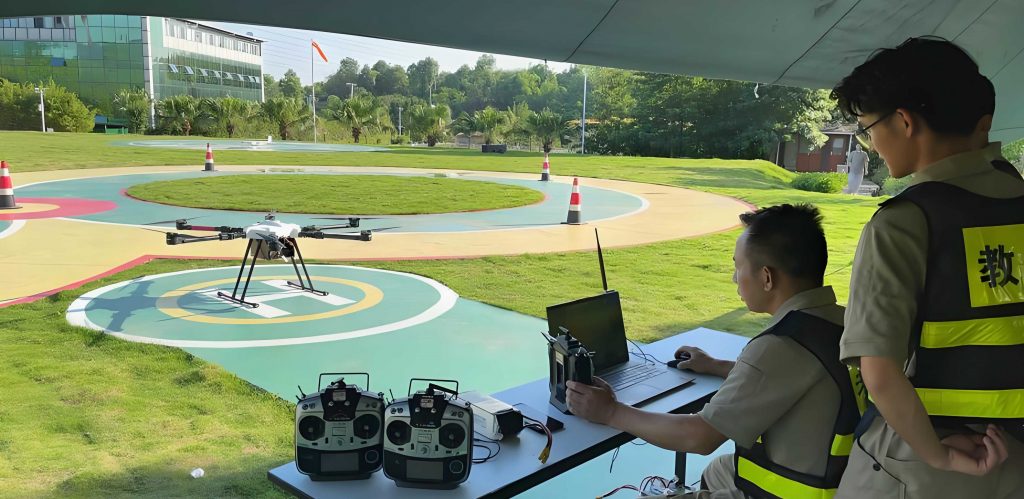
Multi-rotor drones primarily consist of a frame, landing gear, flight controller (the core component), motors, electronic speed controllers, propellers, high-capacity lithium batteries, and payloads. Common configurations include quadcopters, hexacopters, and octocopters. By coordinating the speed of each motor, these drones perform takeoff, landing, hovering, and route flights. Their simple structure, stable flight attitude, low cost, flexibility, mobility, compact size, light weight, and ease of control make them ideal for applications requiring hovering. Unlike fixed-wing drones, they do not need runways, which enhances their utility in fields like aerial photography and surveying. Since 2016, the focus has shifted toward industrial-grade multi-rotor drones with heavy payloads and long endurance, used in power line inspection and agricultural plant protection. This evolution necessitates specialized drone training to handle complex operations.
To quantify the performance of multi-rotor drones, we can use formulas related to lift and power. For instance, the lift force generated by a rotor can be approximated as: $$ L = k \cdot \omega^2 $$ where \( L \) is the lift, \( k \) is a constant dependent on rotor design, and \( \omega \) is the angular velocity. In drone training, understanding such principles is crucial for pilots to optimize flight operations. Another key aspect is battery management; the flight time \( T \) can be estimated as: $$ T = \frac{C \cdot V}{P} $$ where \( C \) is battery capacity in ampere-hours, \( V \) is voltage, and \( P \) is power consumption. These formulas are integral to the theoretical component of drone training.
The regulatory landscape for civil drone pilots has evolved significantly. The International Civil Aviation Organization (ICAO) is developing standards for UAS, prompting many countries to implement management regulations. In China, the Civil Aviation Administration issued notices to strengthen drone pilot qualification management. Key documents include the “Notice on Issues Related to the Qualification Management of Civil Unmanned Aircraft System Pilots” (2015) and the “Provisional Regulations on the Management of Civil Unmanned Aircraft System Pilots” (2013, revised in 2016). The China Aircraft Owners and Pilots Association (AOPA-China) was entrusted with managing pilots for drones with an empty weight over 7 kg operating within visual line of sight or beyond visual line of sight in segregated airspace. Additionally, the “Light and Small Unmanned Aircraft Operation Regulations (Trial)” (2015) classify drones into seven categories based on weight, as shown in Table 1.
| Category | Empty Weight (kg) | Takeoff Total Weight (kg) |
|---|---|---|
| I | 0 < W ≤ 1.5 | – |
| II | 1.5 < W ≤ 4 | 1.5 < W ≤ 7 |
| III | 4 < W ≤ 15 | 7 < W ≤ 25 |
| IV | 15 < W ≤ 116 | 25 < W ≤ 150 |
| V | Agricultural plant protection drones | |
| VI | Unmanned airships | |
| VII | Category I and II drones capable of beyond visual line of sight operation over 100 meters | |
These classifications inform the drone training requirements for different drone types. The revised “Regulations on the Management of Civil Unmanned Aircraft Pilots” (2016) further refined these categories and introduced management agency备案 systems. Such policies underscore the importance of structured drone training to comply with legal standards.
The ground theory training for civil multi-rotor drone pilots is foundational. Applicants must complete ground courses and pass theoretical exams. The curriculum is designed to cover essential knowledge areas, with varying hours for different pilot levels. For instance, pilots and commanders require at least 40 hours of theory, while instructors need at least 25 hours. The content includes: overview and system composition of drones; aeronautical meteorology and flight environment; flight principles and performance; civil aviation regulations and terminology; drone classification, structure, and mainstream layouts; use of charging equipment and batteries; remote control settings; communication links and mission planning (for commanders); characteristics of the drone system used; and drone flight manuals. This comprehensive drone training ensures that pilots understand both technical and regulatory aspects.
To summarize the ground theory hours, we can use a formula: $$ T_{theory} = \sum_{i=1}^{n} H_i $$ where \( T_{theory} \) is the total theory training time, \( n \) is the number of modules, and \( H_i \) is the hours per module. For example, if we consider key modules like flight principles (8 hours), regulations (6 hours), and system composition (10 hours), the total can be calculated. This structured approach enhances the effectiveness of drone training.
| Module | Content | Estimated Hours |
|---|---|---|
| 1 | Drone Overview and System Composition | 8 |
| 2 | Aeronautical Meteorology | 6 |
| 3 | Flight Principles and Performance | 8 |
| 4 | Civil Aviation Regulations | 6 |
| 5 | Drone Classification and Structure | 6 |
| 6 | Battery and Equipment Usage | 4 |
| 7 | Communication and Mission Planning | 8 |
| Total Theory Hours (Pilot/Commander) | 46 | |
Practical flight training is equally critical in drone training. After passing theory exams, applicants undergo flight training specific to their drone system level. Pilots require at least 44 hours of practical training, commanders at least 56 hours, and instructors at least 20 hours, along with prior experience (e.g., 100 hours as commander and two years of work). The training includes: simulated flight; drone assembly and debugging; remote control setup; ground station operation (for commanders); route planning (for commanders); emergency link communication; takeoff and landing; hovering; rectangular and circular routes; horizontal figure-8; slow horizontal 360-degree rotation; drone maintenance and保养; use of balance chargers and lithium batteries; and emergency response exercises. The requirements are detailed in Table 3.
| Training Level | Total Hours | Normal Flight Procedures | Emergency Procedures | Pre-flight Inspection | Teaching Methodology (Instructor) | System Check and Command |
|---|---|---|---|---|---|---|
| Pilot | ≥44 hours | ≥20 hours | ≥20 hours (engine failure, link loss, emergency recovery, forced landing) | – | – | – |
| Commander | ≥56 hours | ≥20 hours | ≥20 hours (aircraft avoidance, engine failure, link loss, emergency recovery, forced landing) | ≥4 hours | – | ≥4 hours |
| Instructor | ≥20 hours | ≥5 hours | ≥5 hours (aircraft avoidance, engine failure, link loss, emergency recovery, forced landing) | – | ≥10 hours | – |
The practical training can be modeled using a performance metric: $$ P_{\text{flight}} = \alpha \cdot T_{\text{normal}} + \beta \cdot T_{\text{emergency}} $$ where \( P_{\text{flight}} \) represents flight proficiency, \( \alpha \) and \( \beta \) are weighting factors for normal and emergency training hours, respectively. This highlights how drone training balances routine and crisis management skills.
The assessment system for drone training involves both theoretical and practical exams. Theoretical exam passing scores are 70% for pilots, 80% for commanders, and 80% for instructors. Practical exams vary by level and flight mode. For multi-rotor drones, the exams are conducted using GPS mode (for pilots) or stabilized mode (for commanders and instructors), where the flight controller participates in control loops. The practical exam科目 are outlined in Table 4.
| Level | Flight Mode | Exam科目 |
|---|---|---|
| Pilot | GPS Mode |
|
| Commander | Stabilized Mode |
|
| Instructor | Stabilized Mode |
|
To evaluate exam performance, we can define a scoring function: $$ S = \sum_{j=1}^{m} w_j \cdot s_j $$ where \( S \) is the total score, \( m \) is the number of exam科目, \( w_j \) is the weight for科目 \( j \), and \( s_j \) is the score per科目. This formalizes the assessment process in drone training.
In conclusion, I have analyzed the training system for civil multi-rotor drone pilots, covering regulatory policies, ground theory training, practical flight training, and assessment mechanisms. The drone training framework emphasizes a blend of theoretical knowledge and hands-on skills, tailored to different pilot levels. As drone technology advances, continuous updates to training content and methods will be essential. Future research could explore integrating virtual reality into drone training or developing adaptive learning models based on pilot performance metrics. Ultimately, a standardized and comprehensive drone training system is vital for ensuring safety, efficiency, and professionalism in the rapidly expanding drone industry.
The importance of drone training cannot be overstated. It not only enhances operational competence but also mitigates risks associated with drone flights. By adhering to structured programs, pilots can navigate complex environments, handle emergencies, and comply with evolving regulations. I recommend that training institutions incorporate real-time data analytics and simulation tools to further optimize drone training outcomes. Moreover, international collaboration on training standards could harmonize practices across borders, fostering global drone adoption. In summary, investing in robust drone training is a cornerstone for the sustainable growth of civil unmanned aviation.
To reinforce key concepts, let’s consider a formula for overall training effectiveness: $$ E = \frac{T_{\text{theory}} \cdot K_{\text{theory}} + T_{\text{practice}} \cdot K_{\text{practice}}}{T_{\text{total}}} $$ where \( E \) is effectiveness, \( K_{\text{theory}} \) and \( K_{\text{practice}} \) are knowledge retention factors, and \( T_{\text{total}} \) is total training time. This illustrates how drone training balances different components. Additionally, the demand for drone training can be projected using growth models: $$ D(t) = D_0 \cdot e^{rt} $$ where \( D(t) \) is demand at time \( t \), \( D_0 \) is initial demand, and \( r \) is growth rate, highlighting the expanding need for skilled pilots.
In practice, drone training programs should be iterative, incorporating feedback from pilots and industry stakeholders. Regular audits and updates to training materials will ensure alignment with technological advancements. For instance, as drones become more autonomous, training may shift toward system monitoring and decision-making skills. Nevertheless, the core principles of safety, regulation, and hands-on practice will remain central to drone training. By fostering a culture of continuous learning, we can build a resilient workforce capable of driving innovation in drone applications.
Finally, I emphasize that successful drone training relies on collaborative efforts among regulators, training institutions, manufacturers, and pilots. Sharing best practices and lessons learned will elevate the quality of training globally. As I reflect on this research, it is clear that a well-designed drone training system is not just a regulatory requirement but a catalyst for unlocking the full potential of unmanned aircraft in society. Through dedicated drone training initiatives, we can ensure that pilots are equipped to meet the challenges of tomorrow’s airspace.