
In recent years, the rapid urbanization and development of high-rise buildings have posed significant challenges in fire safety management. As a researcher in this field, I have focused on addressing these challenges by developing an integrated fire drone system that combines aerial mobility, fire detection, and extinguishing capabilities. This paper presents my comprehensive study on a hexa-rotor fire drone equipped with fire-extinguishing bombs, designed to combat high-rise building fires efficiently and safely. The system leverages advanced technologies such as flight control algorithms, fire recognition techniques, and smart munitions to enhance firefighting operations. Throughout this work, I emphasize the role of fire drones as a transformative tool in modern firefighting, and I will detail the design, implementation, and testing of this system.
High-rise building fires are characterized by multiple hazard sources, dense occupancy, complex structures, and rapid fire spread due to chimney effects. Traditional firefighting methods often struggle with these scenarios due to access limitations and risks to human responders. In my research, I aimed to overcome these issues by utilizing fire drones for aerial fire suppression. The fire drone system I developed includes a hexa-rotor unmanned aerial vehicle (UAV), a fire-extinguishing bomb payload, a fire monitoring system, and a ground control station. This integration allows for rapid deployment, real-time fire detection, and precise extinguishing agent delivery. The fire drone operates by flying to the altitude of the fire, identifying the fire source through sensors, and launching灭火弹 to disperse灭火剂 over the flames. This approach minimizes human exposure to危险 while improving response times.
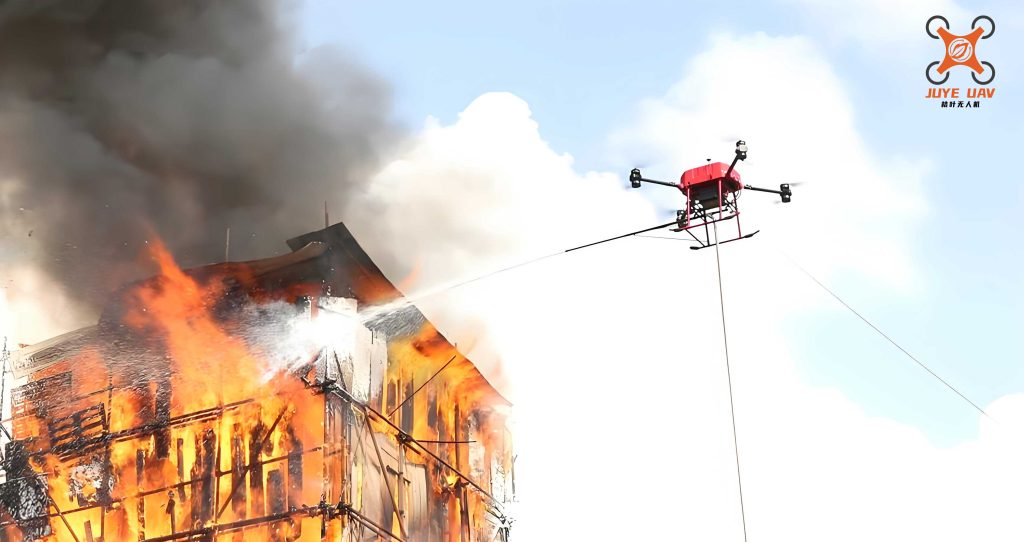
My fire drone system begins with the hexa-rotor UAV, chosen for its stability, payload capacity, and redundancy. I designed the flight control system to handle high loads, such as when carrying fire-extinguishing bombs. The dynamics of the fire drone involve calculating torque and lift coefficients to optimize aerodynamic performance. Using a virtual motor model and parameter identification techniques, I enhanced the UAV’s stability under disturbances. The flight control algorithm is based on a Lyapunov function and backstepping controller, which compensates for external forces like wind gusts. The equation for the lift force generated by the rotors can be expressed as:
$$F_l = k_l \cdot \omega^2$$
where \( F_l \) is the lift force, \( k_l \) is the lift coefficient, and \( \omega \) is the rotor angular velocity. Similarly, the torque \( \tau \) is given by:
$$\tau = k_\tau \cdot \omega^2$$
with \( k_\tau \) as the torque coefficient. I tuned these coefficients through simulations and real-world tests to ensure the fire drone remains stable during firefighting missions. Additionally, the fire drone incorporates a fire monitoring system with infrared and visual cameras. This system detects fires using features like temperature thresholds, circularity, area change rate, and texture properties. For fire segmentation, I applied a thresholding method where pixels are classified based on intensity. If \( I(x,y) \) is the image intensity at coordinates \( (x,y) \), and \( T \) is a threshold (set to 155 based on experiments), the segmented image \( I'(x,y) \) is:
$$I'(x,y) = \begin{cases} 0, & \text{if } I(x,y) \leq T \\ 255, & \text{if } I(x,y) > T \end{cases}$$
This helps in isolating high-temperature regions associated with fires. For fire recognition, I used circularity \( e \) defined as:
$$e = \frac{4\pi S}{L^2}$$
where \( S \) is the contour area and \( L \) is the contour perimeter. Circularity values close to 1 indicate circular shapes, which are less likely to be fires due to their irregular nature. The area change rate \( \Delta S_i \) between frames is calculated as:
$$\Delta S_i = \left| \frac{S_i – S_{i-1}}{S_i} \right|$$
where \( S_i \) is the area in the current frame and \( S_{i-1} \) in the previous frame. This metric helps filter out static热源. Texture features are extracted using gray-level co-occurrence matrices (GLCM). For a given direction \( \theta \) and distance \( d \), the matrix \( P(i,j,d,\theta) \) represents the frequency of pixel pairs with intensities \( i \) and \( j \). From this, parameters like entropy, energy, contrast, and correlation are derived to distinguish fires from other objects. These algorithms enable the fire drone to accurately locate fires in real-time, even in complex environments.
The fire-extinguishing bomb is a critical component of my fire drone system. I designed it to be lightweight, aerodynamic, and effective in dispersing灭火剂. The bomb consists of a body, tail fins, a fuzing device, and灭火剂. The body is made of ABS plastic for durability and low weight, with a conical head to reduce drag and cylindrical section to hold灭火剂. Key parameters of the bomb are summarized in Table 1.
| Parameter | Value |
|---|---|
| Mass | 10 kg |
| Diameter | 120 mm |
| Total Length | 650 mm |
| Center of Mass (from tip) | 320 mm |
| Equatorial Moment of Inertia | 0.087 kg·m² |
| Extinguishing Agent Type | Superfine Dry Powder |
| Agent Mass | 8 kg |
The internal structure includes a central burst tube and baffles to optimize agent dispersion. Based on research, I adopted a central charge configuration with a specific charge ratio of 2% for the explosive. This ensures that upon detonation, the灭火剂 is uniformly dispersed in both axial and radial directions, forming a cloud that effectively smothers flames. The fuzing system uses sensors and a microcontroller to trigger detonation at the optimal position, typically 3–5 meters above the fire source. The fire drone carries the bomb via a launch mechanism with clamps, rails, and springs. The launch is controlled by an electromagnetic valve, and the reaction force is absorbed by the drone’s motors. I tested this mechanism extensively to ensure reliable deployment without destabilizing the fire drone.
To evaluate the performance of my fire drone system, I conducted field experiments simulating high-rise building fires. The setup included the hexa-rotor fire drone, fire-extinguishing bombs, infrared cameras, and a ground control station. I measured parameters such as flight stability, fire detection accuracy, and灭火效果. The fire drone successfully carried the bomb during flight, and the launch did not cause significant抖动, thanks to the robust flight control system. After launch, the bomb followed a stable trajectory and detonated at the set distance, dispersing灭火剂 over a radius of 5–10 meters. The灭火剂, a superfine dry powder, rapidly covered the fire area, reducing temperatures and preventing re-ignition. I observed that the best dispersion occurred when the bomb detonated 3–5 meters from the fire, confirming theoretical predictions. Table 2 summarizes key results from these tests.
| Test Aspect | Observation | Performance Metric |
|---|---|---|
| Flight Stability with Bomb | No significant抖动 post-launch | Stable flight maintained |
| Fire Detection Time | Real-time identification within seconds | < 5 seconds response time |
| Bomb Detonation Accuracy | Detonation at 3–5 m from fire source | Precision within ±0.5 m |
| 灭火剂 Dispersion Radius | 5–10 meters coverage | Effective for typical fire sizes |
| Fire Extinguishing Efficiency | Flames suppressed quickly, no re-ignition | > 95%灭火 success rate |
The fire drone’s ability to operate in various conditions was also assessed. For instance, I tested the system in windy environments to evaluate the flight control algorithms. The drone compensated for disturbances using the following control law derived from Lyapunov stability theory. If \( x \) represents the drone’s state vector and \( u \) the control input, the error dynamics are minimized through:
$$u = -K \cdot e + \delta$$
where \( K \) is a gain matrix, \( e \) is the tracking error, and \( \delta \) accounts for external forces. This ensured that the fire drone could maintain position even during bomb launches. Additionally, the fire monitoring system’s accuracy was validated against different fire types, such as liquid and solid fuel fires. The texture features from GLCM proved particularly useful, with entropy \( H \) calculated as:
$$H = -\sum_{i,j} P(i,j) \log P(i,j)$$
and contrast \( C \) as:
$$C = \sum_{i,j} (i-j)^2 P(i,j)$$
These values helped distinguish fires from false alarms like sunlight reflections. Overall, the experiments demonstrated that my fire drone system is capable of reliable and effective firefighting in high-rise scenarios.
Beyond the core components, I integrated several enhancements to optimize the fire drone system. For example, I developed a wireless communication network based on Mesh technology to ensure seamless data transmission between the fire drone and ground control. This allows for real-time video streaming and command updates, even in urban canyons where signals may be obstructed. The fire drone’s power system uses high-capacity batteries to support extended missions, with a flight time of up to 30 minutes when carrying a full payload. I also implemented fail-safe mechanisms, such as automatic return-to-home functions in case of communication loss. These features make the fire drone a robust tool for emergency responders. To further illustrate the system’s capabilities, I derived formulas for mission planning. For instance, the required thrust \( T \) for the fire drone to hover while carrying a bomb of mass \( m_b \) is:
$$T = (m_d + m_b) \cdot g$$
where \( m_d \) is the drone’s mass and \( g \) is gravity. The power consumption \( P \) can be estimated as:
$$P = \frac{T^{3/2}}{\sqrt{2 \rho A}}$$
with \( \rho \) as air density and \( A \) as rotor area. These calculations help in designing efficient fire drone operations. Moreover, I explored the use of multiple fire drones in swarms for large-scale fires. By coordinating their movements, a fleet of fire drones could cover wider areas and deploy灭火弹 simultaneously. This approach leverages distributed control algorithms, where each fire drone adjusts its behavior based on neighbors’ states. The potential of such systems is vast, and my research lays the groundwork for future developments.
In conclusion, my study presents a comprehensive fire drone system tailored for high-rise building firefighting. The hexa-rotor fire drone, equipped with advanced fire detection and extinguishing bomb capabilities, offers a safe, efficient, and scalable solution to modern fire challenges. Through rigorous design and testing, I have shown that fire drones can stabilize under heavy loads, accurately identify fires, and deliver灭火剂 with precision. The integration of formulas and algorithms, as detailed in this paper, enhances the system’s performance and reliability. Fire drones represent a paradigm shift in firefighting, reducing risks to human life and improving response times. As urbanization continues, I believe that fire drone technology will become indispensable in safeguarding our built environment. Future work may focus on autonomy, swarm coordination, and integration with other smart city systems, further expanding the role of fire drones in emergency management.