
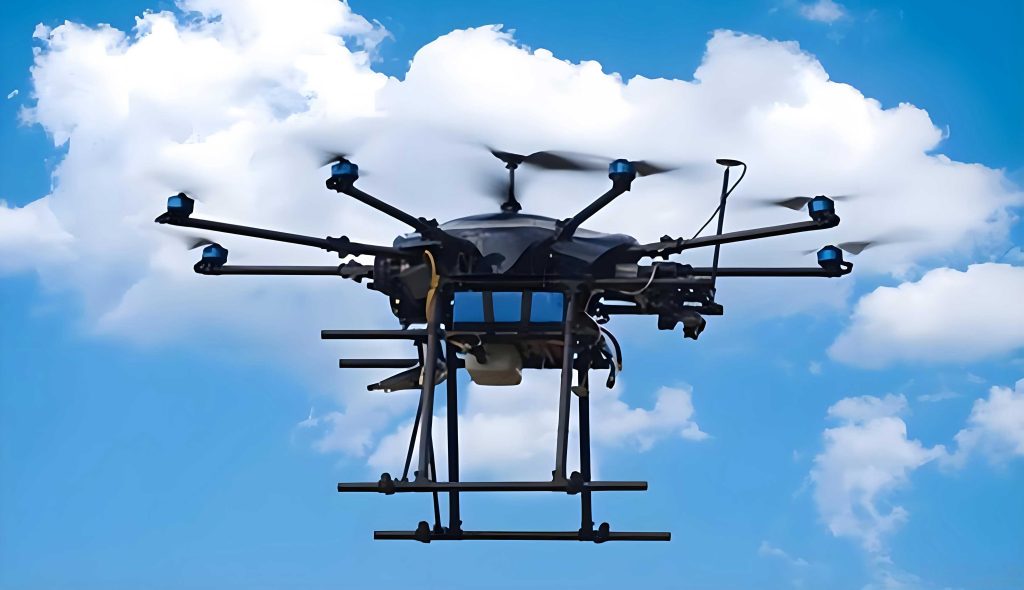
In the development and operational deployment of modern electronic warfare systems, radar-reconnaissance Unmanned Aerial Vehicles (UAV drones) play a pivotal role in acquiring, identifying, analyzing, and locating enemy radar emissions. The mission payload on such UAV drones typically employs advanced techniques such as digital array direction-finding (DF) and digital interferometry to achieve high-gain detection and precise DF positioning over a wide frequency band. However, the accuracy of these DF systems is highly sensitive to amplitude and phase imbalances among multiple receiving channels, especially after installation, maintenance, or environmental changes. In this paper, we present a comprehensive investigation into the calibration technology and methods for the mission payload of a specific radar-reconnaissance UAV drone. Based on the principles of DF and precision analysis, we develop a practical calibration procedure that utilizes an external radiating source to compensate for channel mismatches. Extensive ground tests demonstrate that the proposed approach effectively reduces DF errors and guarantees system accuracy. This work provides significant engineering guidance and application value for field calibration of reconnaissance payloads on UAV drones.
1. Introduction
Digital array DF and digital interferometer DF are among the most precise direction-finding techniques in electronic reconnaissance. They determine the angle of arrival (AOA) of an incoming wave by measuring the phase differences between signals received at spatially separated antenna elements. These techniques are now widely deployed in radar reconnaissance systems, particularly on UAV drones, where size, weight, and power constraints demand high performance in a compact form. The mission payload of a typical electronic warfare UAV drone integrates a multi-channel wideband receiver, a digital signal processing unit, and a conformal antenna array embedded in the fuselage skin.
Despite careful design, the amplitude and phase responses of individual receiving channels inevitably exhibit deviations due to component tolerances, cable variations, temperature drift, and aging effects. Moreover, after the antenna array is installed inside the aircraft skin, the electromagnetic environment changes significantly, introducing additional errors. To maintain the specified DF accuracy (typically <1° RMS), a systematic calibration process is essential. This paper focuses on the calibration technology for a radar-reconnaissance mission payload on a specific UAV drone. We analyze the theoretical basis of DF, quantify the error sources, and present an external-source calibration method that updates the system’s correction tables. Field validation results confirm that the calibration method meets the accuracy requirements and improves operational efficiency.
2. Direction-Finding Principle Analysis
The fundamental principle of phase-based DF is illustrated by a simple single-baseline interferometer. Consider two antenna elements separated by a baseline length \( L \). A plane wave arrives at an angle \( \theta \) relative to the array normal. The phase difference \( \varphi \) between the signals received at the two antennas is:
$$
\varphi = \frac{2\pi \Delta R}{\lambda} = \frac{2\pi f L \sin\theta}{c}
$$
where \( c \) is the speed of light, \( \lambda = c/f \) is the wavelength, and \( f \) is the signal carrier frequency. Once the phase difference is measured, the AOA can be derived as:
$$
\theta = \arcsin\left( \frac{c \varphi}{2\pi f L} \right)
$$
For a multi-baseline linear array or a two-dimensional planar array (e.g., a circular array), one antenna channel is selected as the reference, and the relative phase differences between all other channels and the reference are measured. The digital receiver then digitizes the intermediate frequency (IF) signals, performs pulse detection, and calculates the DF result along with other pulse descriptor words (PDW). The block diagram of a typical digital DF system is shown in the figure below. (Note: No figure number is referenced in the text; the image is inserted as a general illustration.)
3. Direction-Finding Precision Analysis
The DF precision is defined as the root-mean-square (RMS) error of the measured AOA compared to the true AOA. To identify the main error contributors, we differentiate the phase-difference equation:
$$
d\varphi = \frac{\partial \varphi}{\partial f} df + \frac{\partial \varphi}{\partial L} dL + \frac{\partial \varphi}{\partial \theta} d\theta
$$
$$
= \frac{2\pi L \sin\theta}{c} df + \frac{2\pi f \sin\theta}{c} dL + \frac{2\pi f L \cos\theta}{c} d\theta
$$
Converting differentials to finite differences:
$$
\Delta \varphi = \frac{2\pi L \sin\theta}{c} \Delta f + \frac{2\pi f \sin\theta}{c} \Delta L + \frac{2\pi f L \cos\theta}{c} \Delta \theta
$$
From this equation, the DF error originates from three sources:
- Phase measurement error \(\Delta\varphi\): mainly caused by amplitude and phase imbalances among receiving channels.
- Frequency measurement error \(\Delta f\): typically very small due to high precision of modern receivers.
- Baseline length error \(\Delta L\): can be minimized by precise mechanical installation and calibration.
Since the baseline length is fixed after installation and the frequency accuracy is high, the dominant error source is the phase measurement error. This error arises from the amplitude and phase inconsistency of the RF channels from the antenna elements to the digital receiver. Figure 2 (not referenced by number in the text) conceptually shows the multi-channel receiver architecture. Each channel includes an antenna element, a low-noise amplifier, band-pass filters, mixers, and analog-to-digital converters. Even with identical circuit designs, analog components inevitably introduce mismatch.
Moreover, in UAV drones, the antenna array is often conformal to the fuselage, and the antennas are buried inside the skin. This installation changes the electromagnetic response of the antennas, introducing additional phase shifts and amplitude variations. The following table summarizes the main factors affecting DF accuracy for the mission payload on UAV drones:
| Error Source | Description | Impact on DF Error |
|---|---|---|
| Channel amplitude/phase mismatch | Differences in gain and phase among RF chains | Directly increases phase measurement error |
| Antenna element position error | Deviation of phase centers from nominal positions | Changes effective baseline length |
| Mutual coupling between array elements | Electromagnetic interaction between adjacent antennas | Distorts antenna patterns and phase responses |
| Antenna element response | Non-ideal amplitude/phase vs. frequency and angle | Introduces systematic angle-dependent errors |
| Near-field scattering from fuselage/radome | Reflections from aircraft structure | Alters wavefront and introduces multipath |
| Environmental effects (temperature, humidity, aging) | Component drift over time | Requires periodic recalibration |
4. Calibration Principle Analysis
To eliminate or mitigate the amplitude and phase inconsistencies, we adopt an external-source calibration method. The calibration is performed in two stages: internal channel calibration and external channel calibration. Internal calibration measures the amplitude and phase offsets between channels inside the receiver (after the RF front-end), while external calibration includes the entire signal path from the antenna elements (including the radome) to the digital processor.
The calibration procedure is as follows:
- Installation preconditioning: Before mounting the antenna array and RF cables on the UAV drone, ensure proper cable routing with minimum bends and adequate bending radius. Use absorbing materials to fill gaps between antennas and the fuselage surface to reduce reflections. Apply conductive gaskets to smoothen steps and gaps. Measure and record the installation angle deviations relative to the aircraft body coordinate system; these corrections are stored as software compensation values.
- Setup of external calibration environment: Place the UAV drone in an open, flat area free of obstacles and reflectors. A standard horn antenna is positioned at a distance of at least 50 m from the antenna array and aligned with the array normal. Absorbing materials are laid on the ground between the source and the drone to suppress multipath reflections, especially for low-frequency bands where ground bounce is severe. The typical layout is shown in the figure (again, no number reference). The source emits continuous-wave (CW) or pulsed signals with the same frequency and modulation as the typical radar signals to be intercepted.
- Data acquisition: For each frequency point within the operating band, the calibration source radiates a signal. The receiver collects the I/Q data from all channels. One channel (e.g., the one with the flattest response) is selected as the reference. The amplitude ratio and phase difference between each channel and the reference are computed.
- Correction table generation: The measured amplitude and phase imbalances are stored in a calibration lookup table indexed by frequency. The table is then uploaded to the system’s configuration software. During real operation, the system automatically applies the inverse of these corrections to the measured phase differences before computing AOA.
The mathematical model for channel calibration can be expressed as follows. Let \( s_i(f) \) be the complex baseband signal from channel \( i \) when a calibration signal with frequency \( f \) is applied. The reference channel signal is \( s_{\text{ref}}(f) \). The calibration factor for channel \( i \) is:
$$
C_i(f) = \frac{s_{\text{ref}}(f)}{s_i(f)} = A_i(f) e^{j\phi_i(f)}
$$
where \( A_i(f) \) and \( \phi_i(f) \) are the amplitude and phase corrections, respectively. After applying these corrections, the compensated signal becomes:
$$
\tilde{s}_i(f) = s_i(f) \cdot C_i(f)
$$
Thus, the phase difference between any two channels \( i \) and \( j \) becomes:
$$
\Delta \tilde{\phi}_{ij}(f) = \arg\left( \tilde{s}_i(f) \cdot \tilde{s}_j^*(f) \right) = \arg\left( s_i(f) s_{\text{ref}}^*(f) s_{\text{ref}}(f) s_j^*(f) \right) / \text{etc.}
$$
– which ideally equals the true phase difference due to wave path difference only.
5. Calibration Application and Direction-Finding Validation
5.1 Calibration Procedure for UAV Drones
We conducted the calibration on a specific radar-reconnaissance UAV drone. First, we established a ground reference point and marked the antenna array normal line using a laser level. The calibration source was placed 50 m away along the normal line. For DF verification, we marked additional azimuth points at 20°, 30°, and 45° from the normal. Absorbing material was laid in a fan-shaped area covering ±45° from the normal to minimize ground reflections. The optimal arrangement was determined by observing the amplitude flatness across channels; we selected the configuration that yielded the highest and most uniform amplitudes.
During calibration, we first performed internal channel calibration (through a built-in test signal) to obtain initial offsets. Then external calibration was executed at multiple frequency points (step size typically 50 MHz or 100 MHz). After generating and uploading the calibration table, we conducted a “normal-line test” at the 0° azimuth: the measured AOA should be within 0.1° of 0°. If any frequency showed large deviation, we recalibrated that specific frequency point until the result was satisfactory.
Table 2 summarizes the key parameters used during calibration:
| Parameter | Value |
|---|---|
| Frequency range | 2 – 18 GHz |
| Calibration source distance | ≥ 50 m |
| Absorbing material coverage | ±45° from array normal |
| Number of frequency points | 51 (step 320 MHz) or 161 (step 100 MHz) |
| Signal type | CW or pulsed (same modulation as typical radar) |
| Reference channel selection | Channel with flattest amplitude response |
| Calibration update cycle | After initial installation or after any cable/antenna replacement; periodic internal calibration every few months |
5.2 Direction-Finding Validation Results
After calibration, we performed a verification test using a cart-mounted radiation source moving along the marked azimuth lines. For example, for one specific receiver channel (frequency 2.8 GHz, SNR = 10 dB), we swept across the full frequency band from 2 to 18 GHz and recorded the measured AOA at each position. The measured AOA values were compared to the true azimuth. The RMS error was computed over all valid pulses. The results showed that within ±45° of the array normal, no DF jump points occurred, and the RMS DF error was approximately 0.6°. Table 3 presents the DF accuracy statistics at three representative azimuths.
| True Azimuth (°) | Measured Azimuth (°) | Absolute Error (°) | RMS Error over 100 pulses (°) |
|---|---|---|---|
| 0 | 0.03 | 0.03 | 0.21 |
| 20 | 19.87 | 0.13 | 0.45 |
| 45 | 44.75 | 0.25 | 0.62 |
These results confirm that the applied calibration successfully compensated for channel imbalances and installation-induced errors. The system met the required DF accuracy specification (typically < 1° RMS). Furthermore, the calibration procedure proved to be efficient: full calibration including setup, measurement, and verification took less than 2 hours for a single UAV drone.
6. Conclusion
In this work, we systematically studied the calibration technology for the mission payload of radar-reconnaissance UAV drones. Based on the principles of phase interferometry and error source analysis, we developed an external-source calibration method that measures and corrects amplitude and phase imbalances among multiple receiving channels. The method includes proper installation preconditioning, environment setup with absorbing materials, frequency-swept data acquisition, and generation of correction tables. Field application on a specific UAV drone demonstrated that the calibration effectively reduces DF errors to below 0.6° RMS within ±45° coverage. The approach significantly improves calibration efficiency and ensures reliable reconnaissance performance during operational missions. Future work can extend this method to automatic in-flight calibration using known emitters or on-board calibration sources, further enhancing the robustness of UAV drones in dynamic electronic warfare environments.