
In recent years, the utilization rate of unmanned aerial vehicles (UAVs) has been steadily increasing. The agricultural UAV, specifically designed for plant protection, represents a novel type of agricultural machinery that plays a significant role in safeguarding crops in the modern era. Currently, the development of agricultural UAVs is at a nascent stage. Although there is a variety of technologies and products available, their quality is inconsistent, making it difficult to adapt to large-scale, high-intensity plant protection operations. The advancement of UAVs should not only leverage the current favorable market environment but also strive for transformation through innovative thinking, aiming to break through technical barriers and ensure sustainability. Agriculture is progressing towards modernization, marketization, intellectualization, ecological health, and sustainable development. Correspondingly, agricultural UAVs should also evolve towards greater efficiency, labor savings, reduced agricultural investment, increased farmer income, and the promotion of rapid agricultural progress. Based on this context, this research employs user-centric studies as a theoretical guide. Taking the fixed-wing vertical take-off and landing (VTOL) configuration as the innovative design focal point, and following an analysis of existing products, this project involves the optimization and redesign of aspects such as color, form, function, and structure. The goal is to enhance the operational efficiency of plant protection UAVs and provide an innovative design solution for this field.
Research Overview of Agricultural UAVs for Plant Protection
Definition and Significance
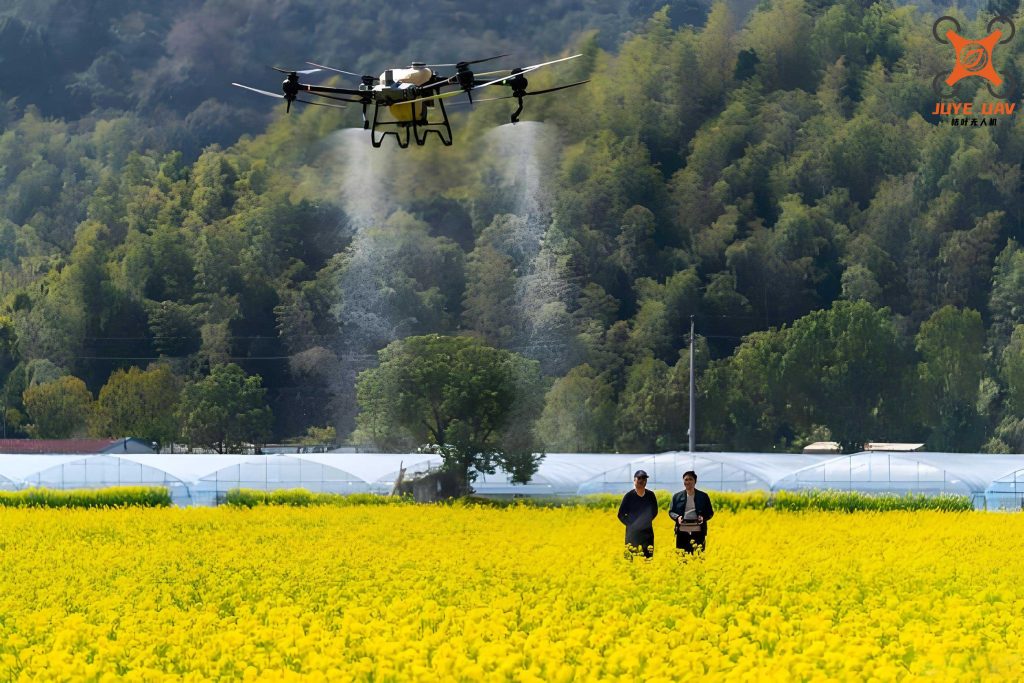
An agricultural UAV, also known as an unmanned aerial vehicle, is an aircraft operated without a human pilot onboard, used for plant protection operations in agriculture and forestry. This type of UAV consists of three main parts: the flight platform, the navigation and flight control system, and the spraying mechanism. Operations are conducted via ground remote control or autonomous navigation flight control, enabling the spraying of chemicals, seeds, or powders. To cover diverse plant protection environments and keep pace with technological advancements, agricultural UAVs require continuous improvement to meet evolving demands.
The agricultural UAV carries significant importance in agricultural development by enhancing production efficiency, reducing pesticide usage, and alleviating labor intensity. It enables the rapid and precise detection and identification of field-related information. In recent years, market demands for agricultural UAVs have escalated, and existing models often fail to meet the needs of agricultural workers. The innovative design and enhancement of agricultural UAVs play a crucial role in the progress of modern agriculture.
Current State of Design Research for Agricultural UAVs
Product Analysis and Problem Identification
Current agricultural UAVs have limited adaptability to different crops and operational conditions, necessitating more versatile UAVs and supporting equipment. Furthermore, operational and management standards for these UAVs still require refinement. An analysis of representative products reveals several common issues:
| Category | Specific Problems |
|---|---|
| Technical Immaturity | Unstable flight control systems, uneven chemical spraying, short endurance, low positioning accuracy, low operational efficiency, and poor integration of platform, payload, and software. |
| Lack of Standardization | Absence of industry-wide standards leading to inconsistent product quality and service levels. Differences in design, components, and manuals among manufacturers confuse users. |
| Safety Risks | Involvement of chemicals in spraying operations poses inherent safety risks, requiring the establishment of comprehensive safety management protocols. |
Proposed Solutions
- Modular Functional Analysis: Using an intelligent fixed-wing VTOL structure as the platform, decompose and re-optimize various functional modules of the agricultural UAV to address performance shortcomings.
- Simplified Interaction: Analyze user behavior and experience to streamline operational procedures and standardize usage protocols, resolving usability issues.
- Enhanced Monitoring: Implement a multi-functional camera with auto-switching modules to monitor flight status and position, enabling timely detection and response to anomalies.
These solutions highlight the fixed-wing VTOL configuration as a feasible and operational method for realizing and expressing specific functions in agricultural UAV design.
The following table provides a comparative analysis of common UAV platform configurations, underscoring the rationale behind selecting a fixed-wing VTOL design for this agricultural UAV project.
| Platform Type | Advantages | Disadvantages |
|---|---|---|
| Fixed-Wing UAV | Long endurance, large coverage area; High flight speed and altitude; High payload capacity; Strong wind resistance. | Requires runway or launcher for conventional take-off/landing; Complex operation often requiring professional training; Higher procurement cost. |
| Multi-Rotor UAV | Vertical Take-off and Landing (VTOL), compact size, lightweight; High maneuverability and flexibility; Simple structure, easy to operate and maintain; Lower cost. | Short endurance and flight range; Limited payload capacity; Susceptible to extreme weather; Lower stability compared to fixed-wing. |
| Unmanned Helicopter | VTOL capability, long flight range; Less restricted by landing site; Relatively high payload. | Complex mechanical structure, higher failure rate; Difficult to operate; High cost. |
The fixed-wing VTOL configuration merges the key advantages of both fixed-wing and rotorcraft platforms, offering long endurance, high speed, and significant payload capacity combined with VTOL flexibility, making it highly suitable for diverse agricultural operations.
Product Design Analysis and Preliminary Research
Innovation Positioning
The core innovation of this design lies in adopting a fixed-wing VTOL airframe. A typical fixed-wing UAV system comprises five main components: airframe structure, avionics, propulsion system, launch/recovery system, and ground control station. The fixed-wing VTOL variant enhances this by integrating vertical lift mechanisms. This configuration aims to significantly improve the efficiency, operational range, and stability of plant protection missions, thereby contributing to sustainable agricultural practices. The expected performance enhancement can be conceptually modeled by comparing key metrics. For instance, the effective coverage rate $E_c$ (hectares per hour) is a function of swath width $W_s$, flight speed $V$, and operational efficiency $\eta$:
$$E_c = W_s \times V \times \eta$$
A fixed-wing agricultural UAV typically offers a higher $V$ compared to multi-rotors, directly boosting $E_c$.
User Requirement Research and Analysis
User Segmentation
The primary users are agricultural workers. Segmentation is based on operational scale:
- Large-scale Farm Owners/Teams: Prioritize high efficiency, large-area coverage, and long endurance.
- Small-scale Farmers: Prioritize flexibility, maneuverability, and ease of use for smaller plots.
User Psychological Profile and Needs
Analyzing the psychological state during farming reveals key needs that an intelligent agricultural UAV must address:
| Psychological State | Manifested Behavior | Implied Need |
|---|---|---|
| Anxiety & Worry | Concern about poor crop health, pests, diseases. | Need for automated detection, spraying, and fertilization. |
| Impatience | Frustration with slow, manual large-area spraying. | Need for autonomous task execution to reduce manual labor. |
| Fatigue | Exhaustion from manual work, especially in harsh conditions. | Need for remote operation and real-time monitoring. |
| Health Concerns | Fear of exposure to harmful chemicals during spraying. | Need for remote-controlled operation to ensure safety. | Uncertainty | Lack of understanding about agricultural UAVs, focus on cost-saving. | Need for affordable, reliable, and easy-to-use products. |
Questionnaire Survey and Analysis
A questionnaire was distributed to agricultural workers, with 57 valid responses collected. Key findings are summarized below:
| Survey Dimension | Key Finding | Design Implication |
|---|---|---|
| Geographic Distribution | Respondents from diverse regions (East, West, North, South). | The agricultural UAV must have high adaptability to different terrains and climates. |
| Education Level | Majority have undergraduate degree or lower. | Operation must be simplified; training materials must be clear. |
| Prior Usage | Over 54% have never used an agricultural UAV. | Design must lower the barrier to entry, be intuitive and user-friendly. |
| Preferred Platform | Highest preference (64.91%) for fixed-wing VTOL configuration. | Validates the chosen design direction. |
| Key Performance Focus | Top concerns: Spraying Technology (54.39%), Software System (52.63%), Positioning Accuracy (38.6%). | Design must prioritize precision spraying, intelligent software, and accurate navigation. |
User interviews, conducted both online (via documentaries/reports) and offline (field visits), reinforced these findings, highlighting needs related to extreme weather monitoring, safety, cost, and operational efficiency.
Synthesis of User Pain Points
Based on the research, user pain points can be categorized into three areas, guiding the design objectives for the new agricultural UAV:
- Product Performance: Low efficiency for large areas, inability to monitor crop status in real-time, short battery life, uneven spraying.
- User Experience: Physically demanding traditional methods, complex operations, safety hazards from chemical exposure.
- Scenario Limitations: Limited adaptability of current agricultural UAVs to varied terrains, weather, and crop types.
Design Principles for the Intelligent Agricultural UAV
The development of the intelligent fixed-wing agricultural UAV is guided by the following core principles:
- Safety Principle: The design must comply with national aviation regulations for light UAVs. Operational protocols must emphasize maintaining safe distances from people and obstacles, using personal protective equipment (PPE), and implementing safety cut-offs during maintenance.
- Adaptability Principle: Given China’s vast and varied geography, the agricultural UAV must be highly adaptable to different terrains, crop types, and climatic conditions.
- Innovation Principle: Innovation is pursued in multiple dimensions: the fixed-wing VTOL platform structure; a multi-functional camera system for imaging, obstacle avoidance, and night vision; seamless system integration for smart farm management; bio-mimetic form design; and improved spraying mechanisms like lightweight high-pressure pumps.
- Practicality Principle: The design must ensure high efficiency and precision in operations to reduce waste. It should feature integrated functionalities (spraying, scouting, transport). The agricultural UAV must be easy to operate and maintain, with consideration for sustainable practices such as using recyclable materials.
Product Factor Analysis
The design requirements are broken down into a hierarchical factor analysis table to ensure all aspects are addressed.
| Primary Factor | Secondary Factor | Tertiary Factor | Specific Requirements |
|---|---|---|---|
| Function | Core Functions | Automatic Spraying | Capable of uniform, automated chemical application. |
| Auxiliary Functions | Automatic Patrol & Detection | Capable of autonomous巡航 for anomaly detection. | |
| Form & Aesthetics | Overall Appearance | Color | Blue-green tones with grey base to emphasize technology. |
| Material & Texture | Corrosion-resistant materials for durability. | ||
| Volume & Weight | Optimized for sufficient spray tank capacity and battery size. | ||
| Modeling | Bio-mimetic, streamlined shape. | ||
| Structure | Mechanical Design | Connection Structure | Modular design for easy disassembly and maintenance. |
| Flight Stability | Inherently stable fixed-wing design with VTOL control. | ||
| Detachability | Key components easily removable. | ||
| Usability | Human-Machine Interface | Operation | Simplified interaction steps; intuitive controls. |
| Service | Support Systems | After-sales Service | High-quality, reliable support and warranty. |
| Documentation | Clear manuals, supported by offline/online guidance. | ||
| Connectivity | Data transmission via WiFi/Bluetooth. |
Design Practice: The Intelligent Fixed-Wing VTOL Agricultural UAV
Guided by the preceding analysis, the design for the intelligent fixed-wing agricultural UAV was developed. The primary design objectives are:
- Target Users: Agricultural workers across different farm scales.
- Usage Scenarios: Farm inspection, pesticide/fertilizer spraying, seeding, data collection (terrain, soil, crop health), and light cargo transport.
- Functional Positioning: Modular design, long-endurance patrol, high payload (60kg seeds, 50kg liquid), precision spraying, fixed-wing VTOL hybrid structure, dual-battery system, and simplified app-based interaction.
Form Design and Biomimicry
The造型 employs morphological biomimicry, using the manta ray as the biological prototype. The manta ray’s efficient, hydrodynamic form inspires the无人机’s streamlined fuselage, which reduces aerodynamic drag and improves flight efficiency. The pointed front mimics the ray’s cephalic lobes, while the rear features a slender, wing-like empennage that houses the pusher propeller for forward thrust. The pronounced dihedral of the main wings echoes the manta’s pectoral fins, enhancing inherent lateral stability. The color scheme, dominated by black and grey with cyan accents, reflects a technological aesthetic while subtly alluding to aquatic and natural environments. This bio-mimetic approach not only optimizes functional performance for the agricultural UAV but also imbues it with an organic, harmonious visual language that connects on a cultural and emotional level.
Innovative Design Features
This agricultural UAV incorporates several key innovations:
- Transparent Upper Cover: Replaces a fully enclosed shell with a glass canopy, allowing visual inspection of internal components for easier maintenance and status checks.
- Tail Pusher Propeller: Provides primary forward thrust in fixed-wing mode. Combined with the VTOL rotors and control surfaces, it enables smooth transitions, efficient cruise, and agile maneuvering.
- Integrated Sensor Array & Lights: Houses multiple environmental sensors (e.g., for wind) and automatic lighting for low-visibility conditions or status indication.
- Detachable Landing Gear with Wheels: Facilitates both vertical landing and ground maneuverability for storage and transport.
- Quad-nozzle Spraying System: Increases spray volume and coverage rate. Coupled with AI-powered visual recognition, it can adjust spraying parameters based on real-time crop health analysis, moving towards fully autonomous decision-making. The spray flow rate $Q$ can be modulated based on flight speed $V$ and desired application rate $A_r$: $$Q = A_r \times W_s \times V$$ where $W_s$ is the effective swath width.
- Dual-Battery System: Utilizes high-capacity, fast-charging battery packs arranged in a redundant configuration to extend operational endurance $T_{op}$: $$T_{op} = \frac{C_{total}}{P_{avg}}$$ where $C_{total}$ is the total battery capacity and $P_{avg}$ is the average power consumption during flight.
- Multi-sensor Camera System: Equipped with a gimbal supporting RGB, multispectral, and infrared cameras for comprehensive crop health monitoring, pest/disease detection, and data collection.
- Fixed-Wing VTOL Airframe: The core innovation. The lift $L$ in forward flight is generated primarily by the wings: $$L = \frac{1}{2} \rho V^2 S C_L$$ where $\rho$ is air density, $S$ is wing area, and $C_L$ is the lift coefficient. This is far more efficient than generating lift via rotors, enabling long range and high speed.
- Lightweight High-Pressure Pump: Ensures consistent and efficient discharge of spraying liquids even over large areas.
User Journey Mapping
The user’s interaction with the agricultural UAV system is mapped across three main phases:
- Pre-operation Planning: User powers on the UAV, logs into the companion mobile application, inputs field boundaries, and sets the mission parameters (e.g., spray type, area, flight path).
- In-operation Execution: The UAV executes the mission autonomously (patrol, spray, scout). The user monitors real-time data and video feed, with the option to intervene or adjust parameters if necessary.
- Post-operation Analysis: The application provides reports on completed operations, crop health analytics derived from collected data, and maintenance alerts, facilitating informed decisions for the next cycle.
This journey emphasizes automation and data-driven insights, significantly departing from traditional manual labor.
Ergonomic and Dimensional Design
The overall dimensions of the agricultural UAV are designed to be 3700 mm (length) × 1540 mm (width) × 800 mm (height). These dimensions balance multiple factors:
- Length (3700mm): Provides ample space for internal components (spray tank, batteries, avionics) and contributes to longitudinal stability.
- Width/Wingspan (1540mm): Offers sufficient wing area for lift generation while maintaining agility for operations in constrained spaces like orchards.
- Height (800mm): Allows for adequate ground clearance and accommodates the vertical lift rotors and landing gear without excessive drag.
This sizing ensures the agricultural UAV is robust enough for demanding farm work while remaining transportable and manageable.
Interaction Design
A dedicated mobile application serves as the primary ground control station, designed for simplicity and clarity to lower the skill barrier for agricultural workers. The interface is logically divided into three core modules corresponding to the UAV’s main functions: Survey Mapping, Plant Protection, and Logistics. Key features include:
- Easy field area planning using GPS or map-based drawing tools.
- One-click automated mission planning (path generation, parameter setting).
- Real-time dashboard displaying video feed, flight telemetry (battery, location, speed), and spraying status.
- Post-mission data review and analysis reports.
The design philosophy is to make complex data and controls accessible, transforming the agricultural UAV from a mere flying machine into an integrated smart farming tool.
Conclusion
To support sustainable agricultural development, this paper has presented a comprehensive design scheme and research process for an intelligent fixed-wing VTOL agricultural UAV. The design process commenced with an analysis of user needs and existing product pain points. The proposed solution centers on a hybrid fixed-wing VTOL configuration, balancing the endurance and speed of fixed-wing aircraft with the operational flexibility of rotorcraft. The form incorporates biomimetic principles inspired by the manta ray, enhancing aerodynamic performance and aesthetic value. Detailed design principles, a factor analysis, and specific innovations in structure, spraying, power, and sensing systems were elaborated. Furthermore, the importance of user-centric interaction design was addressed through a streamlined mobile application. This research provides a valuable reference for the technological advancement of agricultural UAVs and contributes to the broader goals of agricultural intelligence and sustainability. As technology continues to evolve and market demands grow, intelligent fixed-wing agricultural UAVs are poised to become indispensable tools for efficient and precise crop protection and farm management.