
In the context of global technological revolution and industrial transformation, the low-altitude economy has emerged as a strategic emerging industry in China. Among its core applications, UAV drone delivery is rapidly evolving, particularly with the integrated development model of “low-altitude + rail transit,” which combines unmanned aerial vehicles with urban rail systems for logistics distribution. This fusion presents unprecedented challenges for regulatory frameworks, as traditional aviation and transportation laws struggle to keep pace with innovation. To address this, the concept of a “regulatory sandbox,” originally pioneered in the financial sector by the UK’s Financial Conduct Authority, has been introduced to the UAV drone delivery domain. This approach provides a controlled, risk-managed testing environment where innovative enterprises can pilot new technologies without full compliance with existing regulations. In this article, I explore the practice and system construction of a regulatory sandbox for China UAV drone delivery, drawing from international experiences and domestic pilot explorations. I will analyze the current regulatory landscape, the legal essence of sandbox mechanisms, and propose a detailed institutional design path, emphasizing the need for a balanced approach that fosters innovation while ensuring safety and order in the low-altitude economy.
The rapid growth of China UAV drone delivery services, including urban parcel delivery, fresh food logistics, and emergency medical supply drops, is driven by advancements in automation and connectivity. However, this growth is hampered by regulatory hurdles such as stringent准入 standards, unclear jurisdictional boundaries among multiple authorities, and a lack of adaptive legal exemptions. For instance, while regulations like the “Interim Regulations on Flight Management of Unmanned Aircraft” and “Rules for the Safety Management of Civil Unmanned Aircraft Operations” provide a foundational framework, they often impose rigid requirements that stifle experimentation. The regulatory sandbox offers a solution by creating a safe space for testing, where temporary exemptions allow for real-world validation of new delivery models, especially in the “low-altitude + rail transit” context. This article aims to outline how China can construct a robust UAV drone delivery regulatory sandbox system, incorporating mechanisms for准入, testing, exemption, and exit, to support the sustainable development of its low-altitude economy and enhance the synergy between UAV drones and rail networks.
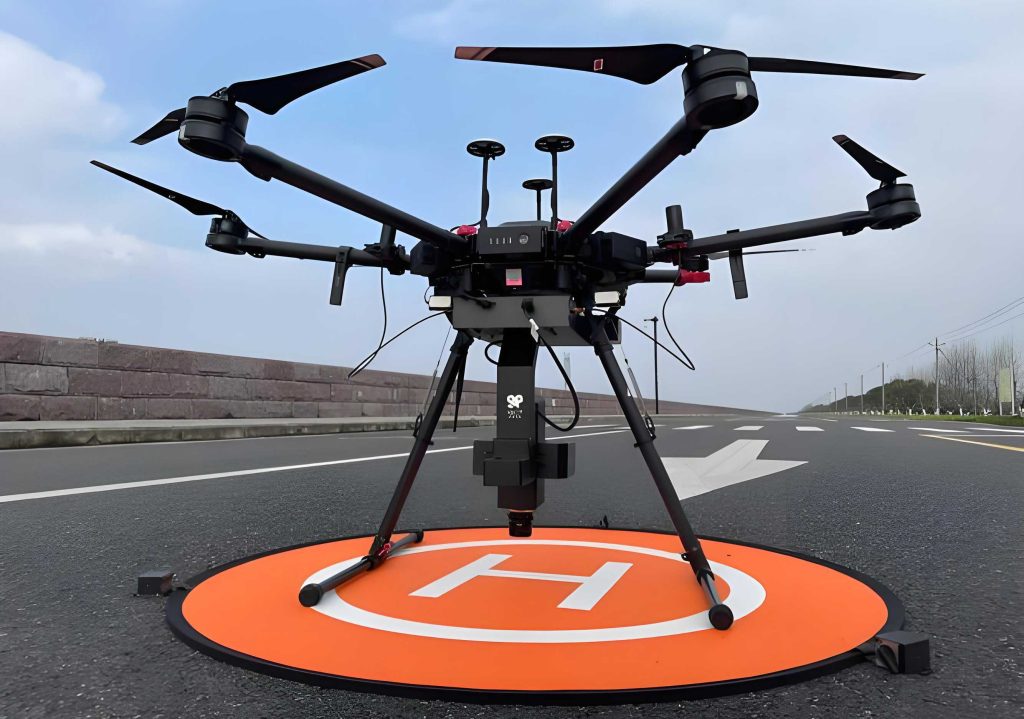
China’s current regulatory framework for UAV drones involves multiple agencies, leading to a complex and sometimes fragmented oversight structure. The primary bodies include the Civil Aviation Administration of China (CAAC), responsible for national air traffic management; the Ministry of Transport, focusing on logistics applications; the Ministry of Industry and Information Technology, overseeing technical standards and radio spectrum; local governments, handling regional coordination; and public security departments, ensuring daily safety and emergency response. This multi-actor system can result in overlaps or gaps in监管, particularly for emerging applications like UAV drone delivery integrated with rail transit. The “Interim Regulations” classify UAV drones into micro, light, small, medium, and large categories, with varying rules for each. For example, micro and light UAV drones are permitted to fly in适飞空域 without prior approval, but commercial delivery drones often fall into small or medium categories, subject to stricter controls. This classification, while intended for safety, can limit innovation in China UAV drone delivery by imposing burdensome licensing and operational requirements. The table below summarizes key regulatory bodies and their roles in the context of China UAV drone delivery.
| Regulatory Body | Primary Responsibilities in UAV Drone Delivery | Challenges in Sandbox Context |
|---|---|---|
| Civil Aviation Administration of China (CAAC) | Airspace management, flight standards, air traffic control, certification of medium/large UAV drones. | Balancing safety with flexibility for testing in controlled environments. |
| Ministry of Transport | Logistics standards, integration with transportation networks, “low-altitude + rail” projects. | Coordinating with aviation authorities for seamless监管. |
| Ministry of Industry and Information Technology | Technical specifications, radio frequency allocation, data security, manufacturing oversight. | Ensuring interoperability and security during sandbox trials. |
| Local Governments | Regional planning, infrastructure development, public safety coordination. | Managing local concerns (e.g., noise, privacy) in test areas. |
| Public Security Departments | Enforcement of flight rules, emergency response, privacy protection. | Handling incidents during sandbox operations without stifling innovation. |
The regulatory sandbox制度, as applied to China UAV drone delivery, is fundamentally a legal exemption mechanism that embodies the principles of prudent and包容监管. Prudent监管 involves pre-emptive risk assessment and mitigation, while包容监管 encourages and supports innovation through flexible oversight. In practice, this means that within the sandbox, enterprises can test UAV drone delivery services under relaxed regulatory conditions, provided they adhere to agreed-upon safety protocols and risk management plans. The sandbox operates through a cycle of准入, testing, exemption, and exit, mirroring models used in fintech and other sectors. For China UAV drone delivery, this cycle allows for iterative learning and adaptation, crucial for integrating drones with rail systems where operational complexities are high. The legal内核 of the sandbox lies in its ability to temporarily suspend certain regulatory requirements, creating a “safe haven” for experimentation. This is not a free pass but a structured process where监管 agencies monitor progress and intervene if risks escalate, thus balancing technological advancement with public safety interests in the低空 economy.
The运作模式 of a UAV drone delivery regulatory sandbox typically involves four interconnected stages:准入机制,测试评估机制,豁免容错机制, and退出机制. First, the准入机制 requires enterprises to submit detailed proposals outlining their innovation, risk assessments, and mitigation strategies.监管 agencies, likely led by a centralized body such as the市场监督管理局 in China, evaluate these based on criteria like novelty, safety, and potential economic impact. For China UAV drone delivery, this准入 process should prioritize projects that explore “low-altitude + rail” integration, as these represent cutting-edge applications. Second, the测试评估机制 involves ongoing monitoring during the trial period, using quantifiable Key Performance Indicators (KPIs) to measure success. I propose that for China UAV drone delivery, KPIs could include accident rates, delivery efficiency, and noise levels, tracked through real-time data feeds. Third, the豁免容错机制 provides legal exemptions for minor infractions or deviations, allowing enterprises to learn from mistakes without severe penalties. This mechanism should be tiered, with higher-risk tests requiring more robust safeguards. Finally, the退出机制 determines whether a project graduates to full-scale operation, extends its testing period, or is terminated due to failures. The table below illustrates this运作模式 with specific examples for China UAV drone delivery.
| Stage | Key Components | Application to China UAV Drone Delivery |
|---|---|---|
| 准入机制 (Entry Mechanism) | Application review, innovation assessment, safety evaluation, agreement signing. | Focus on projects testing drone-rail synergy, with simplified审批 for small-scale pilots. |
| 测试评估机制 (Testing and Evaluation Mechanism) | Real-time monitoring, KPI tracking, periodic reviews, stakeholder feedback. | Use metrics like accident rate per 10,000 flights or delivery time per 1,000 orders. |
| 豁免容错机制 (Exemption and容错 Mechanism) | Risk exemption lists, graded容错 for violations, liability界定 and compensation schemes. | Exempt minor噪音 violations during night tests, with mandatory insurance for damages. |
| 退出机制 (Exit Mechanism) | Final evaluation, decision on commercialization, extension, or termination,经验反馈. | Graduate successful “low-altitude + rail” pilots to broader运营 after one year. |
The necessity of a regulatory sandbox for China UAV drone delivery stems from several pressing issues in the current监管 landscape. First,准入 standards are overly strict, as seen in the “Interim Regulations” that limit micro and light UAV drones by weight and speed, excluding many commercial delivery models. This stifles innovation, especially for startups exploring new delivery methods. Second, there is a problem of多头管辖, where multiple agencies—CAAC, transport, local governments—claim authority without clear coordination, leading to regulatory gaps or conflicts. For instance, in “low-altitude + rail” projects, it’s unclear whether aviation or rail authorities take precedence for airspace near stations. Third, the lack of a formal豁免容错 mechanism discourages experimentation, as enterprises fear penalties for inevitable trial-and-error issues. Without a sandbox, China UAV drone delivery may lag behind global peers, hindering the growth of the低空 economy. To quantify these challenges, consider a simple formula for regulatory burden: $$ RB = \frac{C_s}{I_f} $$ where \( RB \) is regulatory burden, \( C_s \) is compliance stringency, and \( I_f \) is innovation flexibility. For China UAV drone delivery, high \( C_s \) and low \( I_f \) result in a high \( RB \), which a sandbox aims to reduce by adjusting these variables through controlled exemptions.
To address these issues, I propose a detailed design path for the UAV drone delivery regulatory sandbox in China, structured around the four mechanisms. For the准入机制,监管 should be streamlined under a lead agency, such as the市场监督管理局, with criteria emphasizing innovation and safety. Enterprises must demonstrate how their China UAV drone delivery project advances technology, particularly in “low-altitude + rail” contexts, and provide risk mitigation plans. Approval should be granted within a fixed timeline to avoid delays. The测试评估机制 requires robust monitoring tools. I suggest using a Sandbox Performance Index (SPI) to evaluate progress: $$ SPI = \frac{EV}{PV} $$ where \( EV \) is earned value (actual performance) and \( PV \) is planned value (targets). For China UAV drone delivery, \( EV \) could be measured by实际 delivery accuracy or safety records, while \( PV \) includes expected benchmarks. If \( SPI \geq 0.85 \) with no major incidents (e.g., fatalities or severe privacy breaches), the project may proceed to exit; if \( 0.70 \leq SPI < 0.85 \), extended testing is needed; and if \( SPI < 0.70 \), termination may occur. Additionally, economic viability can be assessed via Net Present Value (NPV): $$ NPV = \sum_{t=1}^{n} \frac{(B_t – C_t)}{(1 + r)^t} $$ where \( B_t \) and \( C_t \) are benefits and costs in period \( t \), and \( r \) is the discount rate. Benefits for China UAV drone delivery might include time savings and reduced congestion, while costs cover equipment and运维.
The豁免容错机制 should be clearly defined to encourage risk-taking. I recommend a tiered approach: for low-risk tests, such as daytime UAV drone deliveries in rural areas, exemptions could cover minor altitude deviations; for high-risk tests, like night flights over urban rail hubs, enterprises must submit detailed contingency plans and obtain insurance. A liability framework should hold enterprises accountable for gross negligence but exempt them from strict liability for unforeseen issues. This aligns with the包容监管 principle, fostering a culture of innovation in China UAV drone delivery. Finally, the退出机制 must be dynamic. Successful projects, after a typical one-year sandbox period, should undergo a comprehensive评估 based on SPI, NPV, and stakeholder feedback. Those meeting criteria can transition to常态化运营 under standard regulations, while others may extend or terminate. The table below outlines this design path with specific actions for China UAV drone delivery.
| Mechanism | Design Elements | Implementation for China UAV Drone Delivery |
|---|---|---|
| 准入机制 | Lead agency: Market Regulatory Bureau; criteria: innovation, safety plan, scalability; fast-track approval. | Prioritize projects integrating drones with rail stations, waiving some weight limits for tests. |
| 测试评估机制 | KPI tracking (e.g., accident rate < 0.1‰ per 10,000 flights), SPI calculation, real-time data reporting. | Monitor delivery times and noise levels near rail corridors using IoT sensors. |
| 豁免容错机制 | Tiered exemptions: low-risk (e.g., weather-related delays), high-risk (requires insurance); liability caps. | Exempt临时起降许可 fees for sandbox participants testing in designated “low-altitude + rail” zones. |
| 退出机制 | Annual review, SPI-based decision (graduate, extend, terminate), feedback loop for regulatory updates. | Graduate successful pilots to city-wide drone-rail logistics networks after meeting SPI > 0.85. |
Looking ahead, the application of the regulatory sandbox in the “low-altitude + rail transit” mode holds significant promise for China UAV drone delivery. This fusion involves using UAV drones for last-mile distribution from rail hubs, enhancing efficiency and reducing urban congestion. The sandbox can serve as a bridge between aviation and rail监管 systems, allowing for phased experimentation. I envision a three-stage approach: first,封闭 testing in controlled environments like logistics parks or rail depots to assess basic safety and noise impact; second,半开放 testing along rail corridors with limited public exposure, evaluating interactions with rail schedules and weather conditions; and third,开放 testing in full-scale urban networks, optimizing coordination between multiple drones and rail nodes. For example, in emergency medical supply delivery, the sandbox could grant “green通道” exemptions for无人机 flights from rail stations to remote clinics, testing response times and reliability. The success of such trials depends on跨部门 collaboration, involving CAAC, rail operators, and local governments in a joint监管小组. This approach not only advances China UAV drone delivery technology but also generates valuable data for refining national regulations, ultimately supporting the strategic growth of the低空 economy.
In conclusion, the construction of a regulatory sandbox for China UAV drone delivery is imperative to balance innovation with safety in the rapidly evolving low-altitude economy. By借鉴 international experiences and adapting them to domestic contexts, China can develop a system that includes streamlined准入, rigorous testing with quantifiable metrics like SPI and NPV, flexible豁免容错, and clear退出 pathways. This system will particularly benefit “low-altitude + rail” integration, unlocking new物流 potentials and fostering economic growth. As China continues to promote its UAV drone industry, the regulatory sandbox offers a pragmatic tool to navigate complexities, encourage experimentation, and build a resilient legal framework. Future efforts should focus on立法 to formalize the sandbox制度, ensuring it becomes a cornerstone of China UAV drone delivery governance, driving sustainable development and technological leadership in the global arena.