
In my research on radar countermeasures against anti-radiation drones, I have systematically analyzed the inherent weaknesses of these weapons and developed a comprehensive set of technical and tactical responses. Anti-radiation drones represent a significant evolution in electronic warfare, capable of loitering for extended periods and striking radar systems the moment they emit signals. However, through careful study, I have identified several critical vulnerabilities that can be exploited. The key to effective defense lies in integrating advanced radar technologies with tactical maneuvers, all while adhering to strict drone regulation principles that govern the electromagnetic spectrum and weapon engagement rules. In this article, I will present my findings in detail, supported by mathematical formulations and comparative tables, to provide a practical guide for enhancing radar survivability.
1. Weaknesses of Anti-Radiation Drones
Based on my analysis, anti-radiation drones suffer from five major weaknesses that form the foundation of our countermeasures. These weaknesses are summarized in the table below, along with the corresponding exploitation strategies I recommend.
| Weakness | Description | Exploitation Strategy |
|---|---|---|
| Dependence on Pre-surveyed Radar Parameters | The drone must be pre-loaded with accurate radar parameters (frequency, pulse width, PRF, etc.). Errors cause mission failure. | Use frequency agility, emission control, and deceptive parameter changes to disrupt targeting. |
| Susceptibility to Navigation Electronic Interference | Relies on GPS/SINS for navigation; GPS signals are weak and easily jammed. | Deploy GPS jammers to force the drone to rely solely on inertial navigation, causing drift. |
| Lack of Self-Protection Capability | Slow speed, low altitude, fixed flight path, no countermeasures; once detected, it is defenseless. | Engage with kinetic or directed-energy weapons; use decoys to lure it away. |
| Fixed Patrol Airspace | Loiters at ~4 km altitude, ~174 km/h speed, repeatedly passes through same area. | Pre-position jammers or ambush systems along predicted patrol routes. |
| Poor Resistance to Active Decoys | Small antenna size leads to large resolution angle; cannot distinguish multiple adjacent emitters. | Deploy multiple decoys emitting similar signals to confuse the seeker. |
The issue of drone regulation is critical here: the tactical employment of anti-radiation drones must follow strict operational regulations regarding flight corridors, emission windows, and engagement zones. By understanding these regulations, I can design countermeasures that specifically exploit the constraints they impose.
2. Technical Countermeasures
I have identified five primary technical measures to counter anti-radiation drones. Each measure is detailed below with relevant formulas.
2.1 Low Probability of Intercept (LPI) Radar
LPI radar is designed to minimize the probability of detection by hostile receivers. The key techniques include:
- High-gain ultra-low sidelobe antennas: Using phased array technology to achieve sidelobe levels of -50 dB to -70 dB.
- Large time-bandwidth product signals: Spread spectrum waveforms that reduce the receiver’s processing gain.
- Power management: Transmit only the necessary power in the direction of interest.
- Emission control: Intermittent transmission with duty cycle around 0.5 to disrupt seeker tracking.
The detection range ratio between an LPI radar and a conventional radar can be expressed as:
$$ \frac{R_{LPI}}{R_{conv}} = \left( \frac{G_t G_r \sigma}{4\pi k T_0 B F L} \cdot \frac{1}{SNR_{min}} \right)^{1/4} \cdot \left( \frac{B T}{\text{processing gain}} \right)^{1/4} $$
Where \(G_t\) and \(G_r\) are transmit and receive gains, \(\sigma\) is target RCS, \(B\) is bandwidth, \(T\) is pulse width, and \(F\) is noise figure. For anti-radiation drone seekers, the processing gain is much lower, thus \(R_{LPI}\) is significantly reduced. This directly impacts drone regulation compliance because drones are required to engage only when radar emissions exceed a certain threshold; LPI radars make it nearly impossible to satisfy that threshold.
2.2 Bistatic / Multistatic Radar
In a bistatic radar, the transmitter and receiver are separated. The receiver is passive and cannot be targeted. The transmitter can be placed in a safe rear area. The bistatic radar equation for the receiver is:
$$ P_r = \frac{P_t G_t G_r \lambda^2 \sigma_b}{(4\pi)^3 R_t^2 R_r^2 L} $$
Where \(\sigma_b\) is the bistatic RCS, \(R_t\) is transmitter-to-target distance, \(R_r\) is target-to-receiver distance. This configuration forces the anti-radiation drone to either attack the transmitter (which is remote) or the receiver (which emits no signal). Under current drone regulation frameworks, drones are programmed to prioritize emitting sources, making bistatic networks highly effective.
2.3 Passive Radar
Passive radar uses existing emitters (e.g., TV, radio, cellular) as illuminators. It emits nothing, so it is invisible to anti-radiation drones. The detection range is limited by the external signal strength but provides total stealth. This aligns perfectly with drone regulation principles that prohibit attacks on non-emitting assets.
2.4 Radar Warning System
A dedicated warning sensor detects approaching anti-radiation drones and cues countermeasures. The warning system can automatically shut down the radar and activate decoys. The probability of detection \(P_d\) can be modeled as:
$$ P_d = \int_{0}^{\tau} \frac{1}{\sqrt{2\pi} \sigma_n} \exp\left( -\frac{(S – \mu_n)^2}{2\sigma_n^2} \right) dS $$
Where \(S\) is the signal strength, \(\mu_n\) is noise mean, and \(\sigma_n\) is noise standard deviation. Rapid warning allows for timely implementation of drone regulation enforcement actions such as emission blackout.
2.5 Radar Decoys
Decoys replicate the radar’s signal characteristics. For low-sidelobe radars, large decoys with higher power are used. The decoy must ensure that the arrival time difference at the drone seeker is less than 0.1 μs. The condition for successful decoying is:
$$ \left| \frac{R_{decoy} – R_{radar}}{c} \right| < 0.1 \times 10^{-6} \text{ s} $$
Where \(R_{decoy}\) and \(R_{radar}\) are distances from the drone to decoy and radar respectively. Three decoys spaced 120° apart can protect one radar. This technique is a direct application of drone regulation guidelines for deceptive electronic warfare.
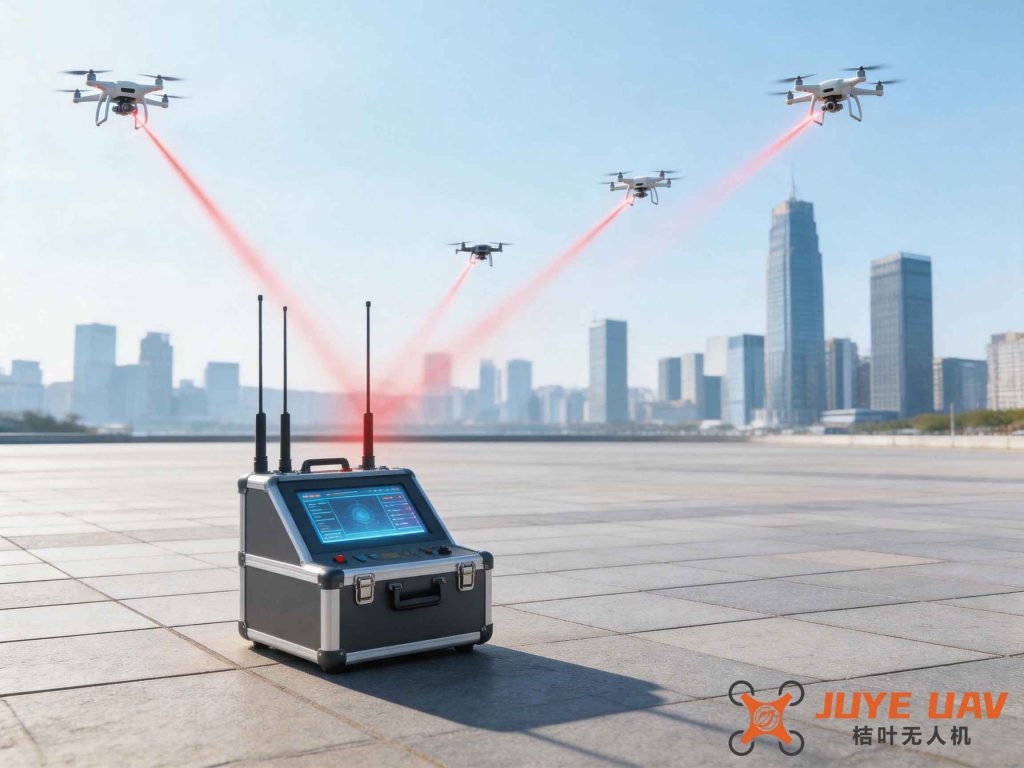
The image above illustrates the concept of drone regulation in contested electronic environments, where decoys and emission control are employed to confuse enemy drones.
3. Tactical Countermeasures
Beyond technical fixes, tactical employment is crucial. I have developed four categories of tactical measures, each reinforced by mathematical or operational principles.
3.1 Enhanced Radar Concealment and Counter-Reconnaissance
This includes frequency deception, camouflage, natural concealment, and simulation decoys. Frequency deception involves using false frequencies during peacetime and controlling the use of new radars. The probability of enemy reconnaissance success \(P_{rec}\) can be reduced by a factor:
$$ P_{rec} = \frac{1}{1 + \left( \frac{T_{false}}{T_{true}} \right) \cdot \left( \frac{N_{false}}{N_{true}} \right)} $$
Where \(T_{false}\) and \(T_{true}\) are the transmission times of false and true signals, and \(N\) are the number of emitters. Strict adherence to drone regulation during wartime ensures minimal operational signature.
3.2 GPS Navigation Jamming
GPS jamming is highly effective because GPS signals are extremely weak (as low as -160 dBW). A jammer with power \(P_j\) and gain \(G_j\) at distance \(R_j\) can deny reception if:
$$ \frac{P_j G_j G_{r,GPS} \lambda^2}{(4\pi R_j)^2} > \frac{P_s G_s G_{r,GPS} \lambda^2}{(4\pi R_s)^2} + \text{thermal noise threshold} $$
Where \(P_s\) is satellite power, \(R_s\) is satellite distance (~20,200 km). For a 2 W jammer at 1.575 GHz, the jamming range can exceed 200 km line-of-sight. This severely disrupts the drone’s navigation, violating the drone regulation requirement for precise positioning before engagement. I recommend two deployment methods:
- Ground deployment: Place jammers at intervals along expected approach routes.
- Airborne pre-positioning: Launch a UAV or balloon carrying a GPS jammer to loiter over the patrol area.
3.3 Passive Interference (Chaff, Smoke, Plasma)
Chaff clouds, smoke screens, and plasma clouds attenuate or scatter radar signals. The attenuation coefficient \(\alpha\) for a chaff cloud with density \(N\) and radar cross-section \(\sigma_c\) per dipole is:
$$ \alpha = N \sigma_c $$
For smoke or aerosols, the extinction coefficient follows the Mie theory. Plasma clouds can be generated by high-power microwave weapons to create a region of high ionization, which refracts or absorbs signals. These methods force the anti-radiation drone to lose lock, thereby failing the drone regulation test of continuous target tracking.
<h3.3.4 and="" fuze="" h3="" hard="" jamming="" kill
Modern anti-radiation drones use laser proximity fuzes. High-repetition-rate laser jammers can pre-detonate the warhead. High-power microwave weapons can also disable the drone’s electronics. The jamming equation for a laser receiver is:
$$ P_{rec}^{jam} = \frac{P_j G_j}{4\pi R^2} \cdot \frac{\pi D^2}{4} \cdot \tau_{opt} $$
Where \(D\) is the receiver aperture diameter and \(\tau_{opt}\) is optical transmission. If \(P_{rec}^{jam}\) exceeds the threshold, the fuze fires prematurely. This directly exploits the drone regulation which mandates a narrow engagement window; by forcing early detonation, the drone misses the radar.
4. Conclusion
My research concludes that anti-radiation drones, while formidable, have exploitable vulnerabilities. By combining LPI radar, bistatic/passive configurations, decoy systems, GPS jamming, and passive interference, radar operators can significantly enhance survivability. Tactical measures such as concealment, frequency deception, and pre-positioned jammers further strengthen the defense. The consistent application of drone regulation principles—encompassing emission control, navigation integrity, and engagement protocols—creates a framework that turns the drone’s strengths into weaknesses. As drone technology evolves, so must our counter-drone strategies, always adhering to the fundamental drone regulation that governs both offense and defense in modern electronic warfare.
In summary, the key to defeating anti-radiation drones lies not only in advanced hardware but also in disciplined tactical employment that respects the regulatory constraints under which these weapons must operate. By staying ahead in both technology and tactics, we can ensure that our radars remain effective even in the most hostile drone-threat environments.