
In the realm of modern agriculture, unmanned aerial vehicles (UAVs), specifically electric multi-rotor drones, have emerged as transformative tools. As someone deeply involved in forestry and fruit tree technology extension, I have observed the rapid evolution of crop spraying drones from niche innovations to mainstream agricultural assets. While their application spans various sectors, their use in fruit tree protection is relatively nascent, dating back just over a decade. This article draws from my firsthand experience and practical insights to delve into the characteristics of fruit trees, the capabilities of spraying UAVs, their advantages and limitations, and a thorough analysis of their future prospects in orchard management. I will incorporate tables and mathematical models to succinctly summarize key points, ensuring a comprehensive exploration of this dynamic field.
Fruit trees possess unique biological and structural traits that significantly influence the efficacy of pest and disease control methods. Understanding these characteristics is crucial for optimizing the use of crop spraying drones. Below, I outline the primary features of fruit trees and their associated harmful organisms, which I have encountered repeatedly in my fieldwork.
| Characteristic | Description | Impact on Spraying UAV Applications |
|---|---|---|
| Tree Crown Height | Tall, artificially pruned crowns that occupy substantial spatial volumes, with branches distributed three-dimensionally and varying shapes across species. | Requires drones to adjust flight altitude and pattern to cover entire canopy, increasing complexity. |
| Leaf Canopy Thickness | Dense foliage layers typically 1–3 m thick in mature trees, exceeding 3 m in large-crown varieties, with fruits distributed throughout the canopy. | Challenges droplet penetration to lower and inner regions, reducing uniformity. |
| Seasonal Morphology Changes | Dynamic canopy structure: leafless in winter/early spring, flowering and嫩叶 in spring, dense foliage in summer, and sparse to脱落 in autumn. | Necessitates seasonal adjustments in drone parameters; best efficacy during low-density periods. |
| Pest and Disease Variety | Diverse pathogens and insects affecting branches, leaves, and fruits, with危害 periods extending from spring to autumn, requiring multiple sprays and varied pesticides. | Demands precise chemical selection and timing to avoid resistance and ensure comprehensive coverage. |
| Pest Distribution on Leaf Undersides | Most harmful organisms reside on leaf backs to evade sunlight and predators, complicating direct exposure. | Emphasizes need for high-penetration sprays, which current spraying UAVs may struggle to achieve. |
To quantify the challenge of droplet penetration through thick canopies, I often refer to a simplified model of spray attenuation. The penetration ratio \( P \) can be expressed as: $$ P = \frac{C_b}{C_t} = e^{-k \cdot d} $$ where \( C_b \) is the droplet concentration at the canopy bottom, \( C_t \) is the concentration at the top, \( k \) is an attenuation coefficient dependent on foliage density, and \( d \) is the canopy thickness. This formula highlights how thicker canopies exponentially reduce efficacy, a critical consideration for crop spraying drone operations.
Turning to the spraying UAVs themselves, these advanced machines are engineered with features that enhance their suitability for agricultural tasks. Based on my observations, the core attributes include substantial size and payload capacity, which allow for extended flight times and reduced refill intervals; integrated cameras and software for terrain recognition, enabling altitude adjustments over uneven ground for safety and precision; and high levels of automation, facilitating autonomous missions and data logging. The predominant types in use are large electric multi-rotor models, such as the DJI T-series (e.g., T20, T25P, T50, T60) and XAG P-series (e.g., P60, P150), which dominate the market due to their reliability and advanced functionalities.
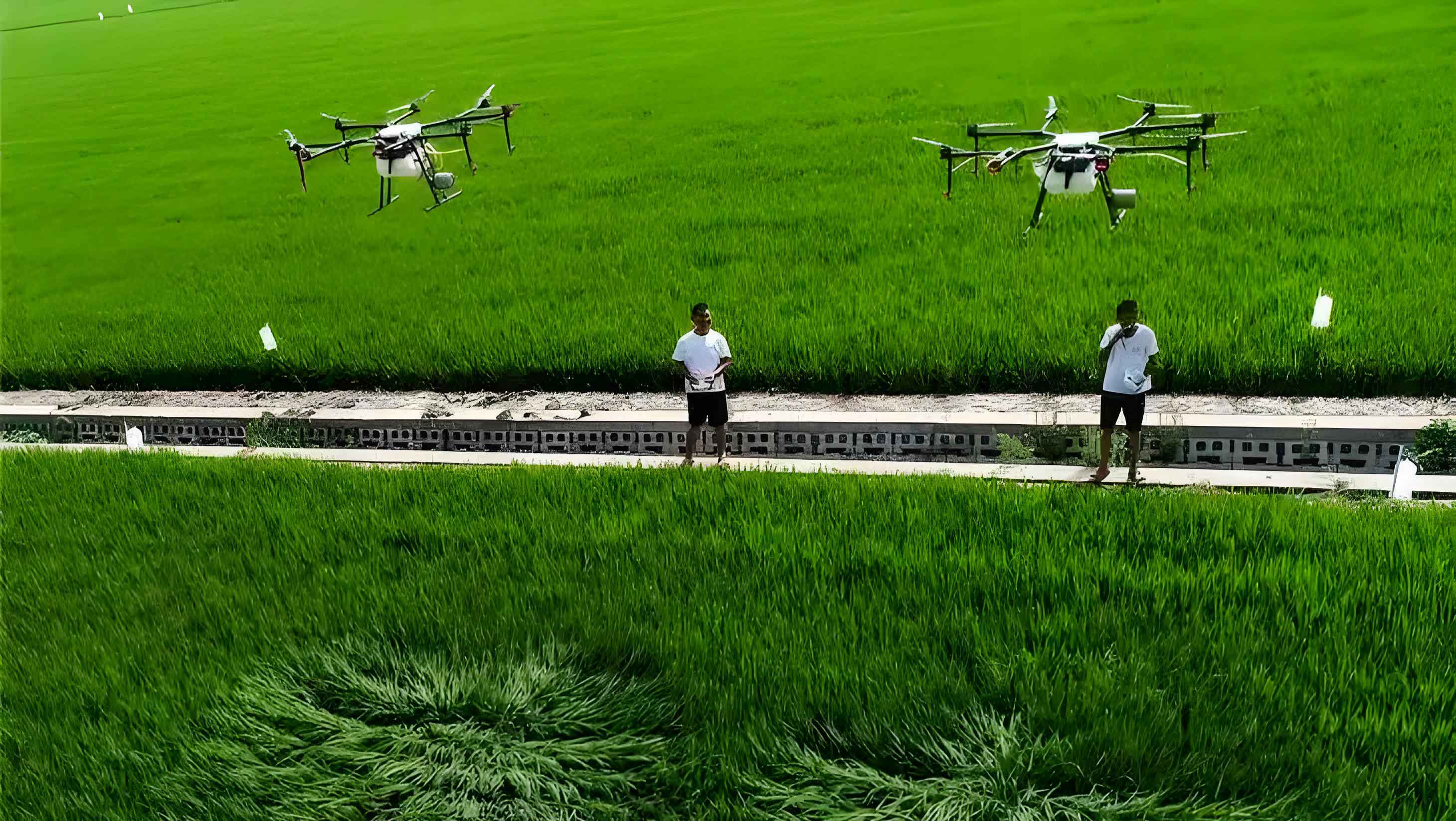
The advantages of employing crop spraying drones in fruit orchards are multifaceted, as I have witnessed in numerous applications. These benefits not only improve operational efficiency but also align with sustainable practices. Below, I summarize the key advantages in a comparative table, drawing from data collected during field trials.
| Advantage | Detailed Explanation | Quantitative Impact |
|---|---|---|
| High Spraying Precision | Equipped with satellite navigation systems, spraying UAVs automatically plan routes, minimizing missed or overlapping areas and enhancing pest control accuracy. | Reduces spray wastage by up to 20% compared to manual methods. |
| Rapid Application Speed | Utilizing high-concentration formulations with uniform droplet distribution and minimal drift, these drones cover 0.8–1.0 hectares per hour at fast flight speeds. | Increases efficiency by 5–10 times over traditional sprayers, critical for timely interventions. |
| Cost Efficiency | Saves 25–30% on pesticides and uses only 5–10 liters of water per 667 m², drastically cutting input costs and environmental footprint while reducing labor demands. | Lowers overall operational costs by approximately 40% in large-scale orchards. |
| Enhanced Operator Safety | Remote-controlled operation keeps personnel away from direct pesticide exposure, minimizing health risks. | Nearly eliminates incidences of operator intoxication during spraying sessions. |
To further illustrate the cost savings, I often apply a simple formula for total cost reduction \( S \): $$ S = (C_t – C_d) \times A + L \times R $$ where \( C_t \) is the traditional cost per unit area, \( C_d \) is the drone-based cost, \( A \) is the total area, \( L \) is labor hours saved, and \( R \) is the labor rate. This equation underscores the economic viability of spraying UAVs, especially in labor-intensive regions.
Despite these benefits, the application of crop spraying drones in fruit trees is not without drawbacks. Through my experiences, I have identified several limitations that can impede optimal performance. The following table outlines these issues, along with their implications for orchard management.
| Limitation | Description | Potential Consequences |
|---|---|---|
| Insufficient Droplet Penetration | Fine droplets (around 100 µm) from drone nozzles struggle to penetrate dense canopies, resulting in uneven coverage with more deposition on upper leaves and less on lower/inner areas where pests often reside. | Reduced efficacy against pests like mites and aphids, leading to potential crop losses. |
| Scenario and Timing Constraints | Operations are hindered by obstacles (e.g., tall trees, power lines), wind-induced drift, and limited effectiveness during moderate infestations that require higher spray volumes. | Restricts use to preventive measures or organized control programs, limiting flexibility. |
| Phytotoxicity Risks | High-concentration sprays can cause leaf scorching, curling, or fruit blemishes under high-temperature conditions, necessitating careful pesticide selection. | May compromise fruit quality and marketability if unsuitable chemicals are used. |
| Operator Skill Dependency | Variations in flight speed, height, and spray volume settings by operators can lead to inconsistent results, exacerbated by incentives tied to coverage area. | Increases variability in control outcomes, requiring standardized training protocols. |
| High Acquisition and Maintenance Costs | Initial purchase prices often exceed $5,000, with additional expenses for battery replacement and repairs after incidents like collisions. | Makes adoption challenging for small-scale growers, favoring large farms or service cooperatives. |
To model the penetration issue mathematically, I sometimes use a droplet distribution function: $$ D(x) = D_0 \cdot e^{-\alpha x} $$ where \( D(x) \) is the droplet density at depth \( x \) within the canopy, \( D_0 \) is the initial density at the top, and \( \alpha \) is a decay constant influenced by foliage density. This reinforces why crop spraying drones may underperform in thick-canopied orchards without technological advancements.
Analyzing the prospects of crop spraying drones in fruit tree applications requires a multifaceted approach, considering factors such as tree morphology, age, spraying timing, efficacy, cost, and potential expansions. Based on my assessments, I have compiled a summary table to evaluate these aspects holistically.
| Factor | Influence on Drone Applicability | Recommendations |
|---|---|---|
| Tree Shape | Small-crown forms (e.g., Y-shaped peach, spindle apple) allow year-round use; large-crown shapes (e.g., layered pear) are suitable only in spring before full leaf-out. | Promote high-density planting with compact canopies to maximize drone efficiency. |
| Tree Age | Young and early fruiting trees are amenable to drone spraying throughout the year; mature trees with dense canopies should be treated primarily in spring. | Integrate drones into orchard management plans from establishment phase. |
| Spraying Period | Optimal during leafless or sparse foliage periods (e.g., spring for清园); efficacy declines in summer and autumn due to thick canopies. | Schedule drone applications aligned with phenological stages for best results. |
| Control Efficacy | Depends on appropriate pesticide choice, concentration, operator expertise, and favorable weather conditions (e.g., low wind). | Implement rigorous training and real-time monitoring to maintain standards. |
| Use Cost | Rental rates of $15–25 per 667 m² are generally affordable for orchardists, equivalent to a day’s wage for small plots, enhancing adoption. | Develop subsidy programs or cooperative models to reduce financial barriers. |
| Application Expansion | Potential uses include pollination, flower thinning, foliar fertilization, growth regulation, and fruit transport, leveraging drone precision and payload. | Invest in R&D for multi-functional attachments to improve cost-effectiveness. |
For efficiency calculations, I often employ the area coverage formula: $$ A = v \cdot w \cdot t \cdot \eta $$ where \( A \) is the total area covered, \( v \) is the flight speed, \( w \) is the effective swath width, \( t \) is the operation time, and \( \eta \) is an efficiency factor accounting for turns and refills. This helps in planning missions for spraying UAVs to maximize productivity.
In conclusion, the integration of crop spraying drones into fruit tree management holds significant promise, driven by their precision, speed, and cost benefits. However, challenges such as limited canopy penetration and operational constraints must be addressed through technological innovations, such as improved nozzle designs and AI-enhanced navigation. From my perspective, the future lies in advancing towards fully autonomous, intelligent systems that minimize human intervention while maximizing accuracy. As spraying UAVs evolve, their role in orchards is likely to expand beyond mere pest control to encompass a broader range of applications, ultimately contributing to more sustainable and efficient fruit production. The key to widespread adoption will be continuous refinement based on practical experiences and collaborative efforts among researchers, growers, and technology providers.