
In my extensive work in agricultural mechanization, I have witnessed a transformative shift driven by the integration of informatization and machinery. The fusion of agricultural mechanization and information technology, often referred to as the “two-integrations,” is a critical pathway for accelerating the upgrading and transformation of farming practices. It serves as a powerful means to enhance management services and operational efficiency comprehensively, holding significant practical importance for realizing smart agriculture, cloud farms, and intelligent farming systems. Among various innovations, the application of agricultural UAVs stands out as a quintessential case study of modern informatization technology in agricultural mechanization.
National policies, such as the Guiding Opinions on Accelerating Agricultural Mechanization and the Transformation and Upgrading of Agricultural Machinery Equipment Industry (State Council Document [2018] No. 42), emphasize the necessity of integrating mechanization with informatization. This directive advocates for a development path that combines agricultural machinery with agronomic practices, aligns mechanization with information technology, and adapts service models to moderate-scale farming. The goal is to drive high-quality development through technological and institutional innovations, addressing weaknesses and promoting coordination to support agricultural modernization. Similarly, the “Thirteenth Five-Year Plan for National Agricultural Mechanization Development” highlights the “Internet +” agricultural mechanization initiative, aiming for deep integration of informatization with machinery equipment, production operations, and management services. Here, agricultural UAVs equipped with informatization devices represent a pivotal frontier in this integration plan.
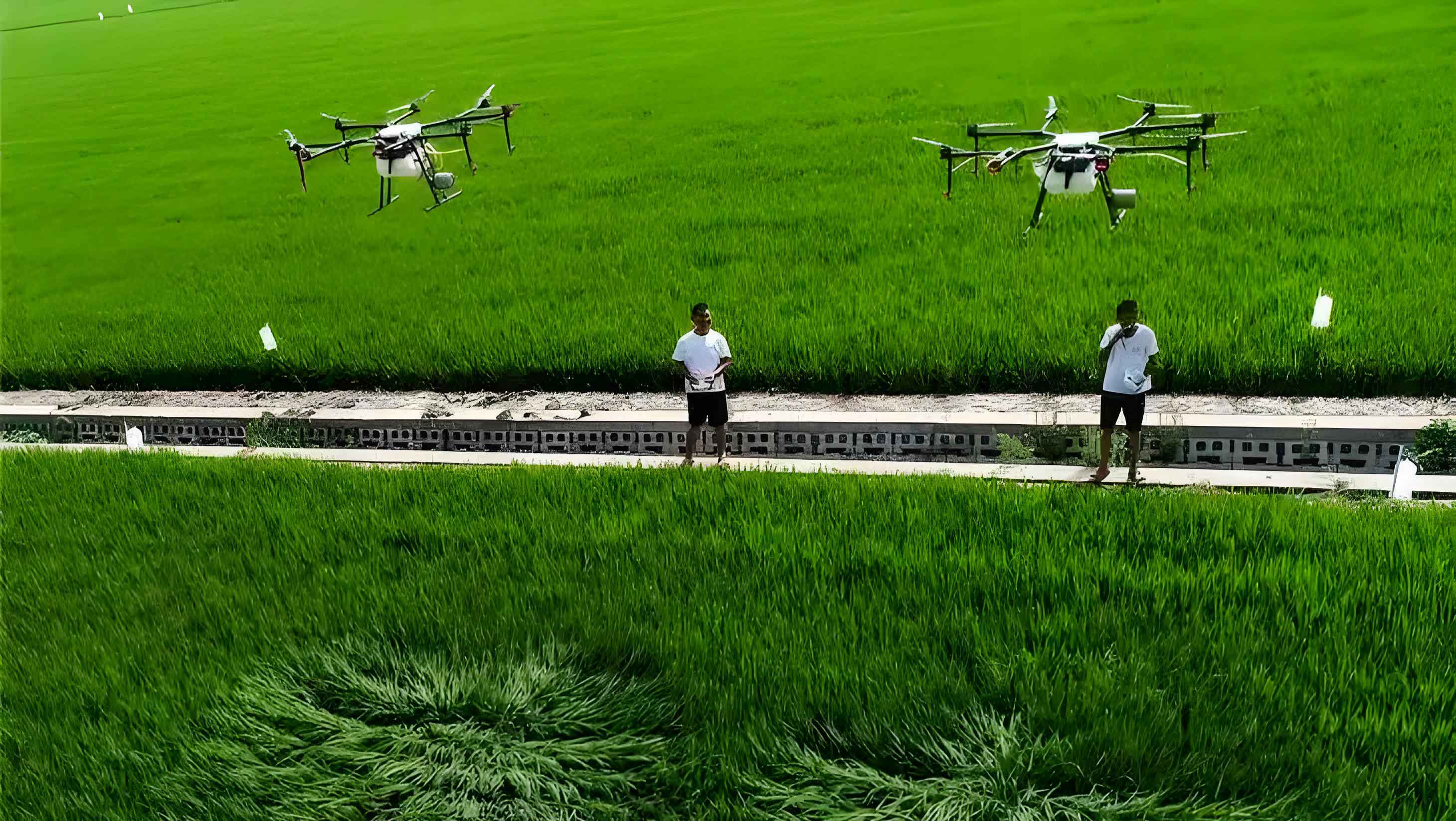
In recent years, based on my observations and involvement, our region has explored and advanced the two-integration of agricultural mechanization and informatization, with particular emphasis on agricultural UAVs. This article delves into the current state of promotion and application, management services, pilot subsidy schemes, and future trends for agricultural UAVs, drawing from practical experiences and data analyses.
Current Status of Agricultural UAV Promotion and Application
The adoption of agricultural UAVs in our region began around 2013, when companies like Guangzhou XAG Electronics Technology Co., Ltd. initiated trials for pest control in cotton fields. This led to the establishment of local entities such as Xinjiang XAG Agricultural Technology Co., Ltd. in 2014. Subsequently, other players like Xinjiang Tianshan Yuren Agricultural Aviation Technology Co., Ltd. and Shenzhen DJI Innovation Technology Co., Ltd. entered the market, conducting large-scale promotions and applications. Events like the Xinjiang Agricultural Machinery Expo have consistently featured forums and live demonstrations for agricultural UAVs over four consecutive years, with extensive trial demonstrations across various prefectures including Changji, Ili, Bortala, Tacheng, and Altay.
In 2015, a project team was formed to undertake a national UAV trial demonstration project, developing technical protocols such as the “Field Verification and Evaluation Test Plan for UAVs” and the “Field Verification and Evaluation Test Plan for UAV Spraying Pesticides in Cotton Fields.” These efforts yielded guiding documents like the “Field Efficacy Test Report on UAV Application for Cotton Aphid Control” and the “Summary of UAV Trial Demonstration Pilots,” laying a solid technical foundation for further application. From my analysis, the growth in agricultural UAV adoption has been exponential. In 2017, the estimated保有量 of unmanned plant protection aircraft was around 1,600 units, covering an作业面积 of 16 million mu-times (equivalent to 5 million natural mu). By 2018, this surged to approximately 3,600 units and 35 million mu-times of作业面积. As of mid-2019, the market保有量 for agricultural and forestry植保无人机 reached 3,295 units (sets), with cumulative农作物植保作业面积 exceeding 20.01 million mu-times; projections for the year end estimated a保有量 of 5,000 units (sets) and a cumulative作业面积 of 40 million mu-times. This rapid expansion underscores the recognition and欢迎 of agricultural UAVs by farmers and cooperatives, attributed to their high efficiency, cost-effectiveness, precise spraying, and safety.
To encapsulate this growth, I present the following table summarizing key metrics over the years:
| Year | Estimated保有量 of Agricultural UAVs | 作业面积 (Million Mu-Times) | Notes |
|---|---|---|---|
| 2017 | ~1,600 units | 16.0 | Initial widespread adoption |
| 2018 | ~3,600 units | 35.0 | Rapid growth phase |
| 2019 (Mid-Year) | 3,295 units (sets) | 20.01 (cumulative) | Projected to reach 5,000 units and 40.0 by year-end |
The efficiency of agricultural UAVs can be quantified using a basic formula for operational effectiveness. Let \( E \) represent the作业效率 (efficiency in mu per hour), \( A \) the作业面积 covered, and \( t \) the time taken. Then, we have:
$$E = \frac{A}{t}$$
For instance, if an agricultural UAV covers 100 mu in 2 hours, its efficiency is \( E = \frac{100}{2} = 50 \) mu/hour. This high efficiency, compared to traditional methods, is a key driver for adoption.
Management Services for Agricultural UAVs
From my perspective, effective management is crucial for the sustainable integration of agricultural UAVs. Our region has implemented several measures to regulate and support their use. Firstly, a pilot subsidy program was initiated to guide standardized application. This involved collaboration between agricultural machinery, finance, and civil aviation authorities, issuing a joint notice titled “Notice on Carrying Out the Pilot Work of Guiding Standardized Application of Plant Protection UAVs through Agricultural Machinery Purchase Subsidies.” This program aims to incentivize proper usage while ensuring safety and compliance.
Secondly, regulatory frameworks have been established. In 2018, the “Xinjiang Uygur Autonomous Region Civil Unmanned Aerial Vehicle Safety Management Regulations” were promulgated, effective July 1, 2018. These regulations cover production, sales, use, and safety management activities, including agricultural UAVs. They delineate responsibilities among relevant departments,日常管理 (daily management), and飞行管理 (flight management), providing a legal basis for oversight. Key provisions include实名制登记 (real-name registration) and adherence to飞行空域 (flight airspace) restrictions.
Thirdly,监管平台 (supervision platforms) are leveraged for monitoring. Based on national requirements for实名制登记 and飞行管理, existing enterprise information platforms for agricultural UAVs and planned comprehensive information service platforms for civil UAV safety management are utilized. These platforms integrate agricultural UAVs into监控和监管 (monitoring and supervision) systems, employing卫星导航定位 (satellite navigation positioning) and作业管理系统 (operation management systems) to delineate作业区域 (operation zones) and ensure safe usage. Currently, UAV manufacturers are required to register their products with public security departments, enhancing traceability and control.
To illustrate the regulatory framework, consider the following table outlining key management components:
| Management Aspect | Description | Implementation Mechanism |
|---|---|---|
| Pilot Subsidy Program | Guides standardized use through financial incentives | Joint notices from agricultural, financial, and aviation authorities |
| Safety Regulations | Legal framework for production, sales, and operation | “Civil Unmanned Aerial Vehicle Safety Management Regulations” (2018) |
| Supervision Platforms | Monitors UAV operations via informatization | Integration with enterprise and public security platforms; use of GPS and operation systems |
| Real-Name Registration | Ensures accountability for UAV users | Mandatory registration with unique identifiers and QR codes |
In terms of safety, a risk assessment formula can be applied. Let \( R \) denote the overall risk, \( P \) the probability of an incident, and \( S \) the severity of consequences. Then:
$$R = P \times S$$
By implementing上述管理措施 (the above management measures), we aim to minimize \( P \) through training and monitoring, and reduce \( S \) via insurance and应急响应 (emergency response) plans, thereby lowering \( R \) for agricultural UAV operations.
Pilot Scheme for Agricultural UAV Subsidies
Based on my involvement in policy design, the pilot scheme for agricultural UAV subsidies is a cornerstone of promotion efforts. It outlines specific technical conditions, subsidy standards, and application procedures to ensure规范应用 (standardized application). Below, I detail the key elements of this scheme.
Technical Conditions for Pilot Products
To qualify for subsidies, agricultural UAVs must meet stringent criteria. These include:
– 空机质量 (Empty weight) not exceeding 116 kg, with a最大起飞全重 (maximum take-off weight) ≤ 150 kg and a载药量 (payload capacity) ≥ 10 L.
– Design飞行速度 (flight speed) ≤ 15 m/s, design飞行真高 (flight altitude) ≤ 20 m, and operation within视距内或扩展视距内 (visual line of sight or extended visual line of sight).
– Fixed药箱安装位置 (tank installation position) with unique matching fasteners; each model must match only one tank type, featuring a unique铭牌 (nameplate) with QR code and serial number.
– Operation人员身份密钥接入装置 (operator identity key access device) to enable flight only after key connection; equipped with飞行控制芯片 (flight control chip),电子围栏 (electronic fence),避障系统软件 (obstacle avoidance software),作业飞行数据实时记录存储设备 (real-time flight data recording storage device), and施药作业系统 (spraying operation system) for identifiability, monitoring, and traceability.
– Additional requirements: capability for全自主飞行 (fully autonomous flight) with飞行精度 (flight accuracy) ≤ 0.50 m; uniform喷雾量 (spray volume) with functions to prevent重喷漏喷 (over-spraying or missed spraying) and农药漂移 (pesticide drift); for multi-rotor aircraft, battery数量 ≥ 4 sets with a charger capable of charging ≥ 4 sets simultaneously, and悬停时间 (hover time) ≥ 10 minutes with full tank; certification from省级以上有资质的检验检测或鉴定机构 (provincial-level or above qualified inspection or鉴定机构) in the form of检测合格报告或鉴定证书 (inspection report or鉴定证书). For UAVs under适航管理 (airworthiness management), separate regulations from civil aviation authorities apply.
These conditions ensure that subsidized agricultural UAVs are safe, reliable, and effective. From an engineering perspective, we can model the payload efficiency. Let \( \eta \) represent the payload efficiency, \( W_{payload} \) the载药量, and \( W_{total} \) the最大起飞全重. Then:
$$\eta = \frac{W_{payload}}{W_{total}}$$
For example, if \( W_{payload} = 10 \) kg and \( W_{total} = 150 \) kg, then \( \eta = \frac{10}{150} \approx 0.067 \). Higher \( \eta \) indicates better design, but safety margins must be maintained.
Requirements for Pilot Product Manufacturers
Manufacturers must also comply with standards to participate in the subsidy scheme. They are expected to:
– Establish an智能化管控平台 (intelligent control platform) for remote real-time monitoring and safety control of their products, with direct or indirect access to the民航局无人机云交换系统 (Civil Aviation Administration UAV cloud exchange system).
– Possess a健全的培训考核体系 (sound training and assessment system) for operators, covering法律法规知识 (legal knowledge),安全飞行常识 (safety flight常识),基本操作技能 (basic operation skills),安全用药技术 (safe pesticide application techniques), and突发情况应急处置 (emergency response).
– Set up售后服务点 (after-sales service points) in areas with concentrated usage within the region, ensuring supply of常用零配件 (common spare parts) and维修服务 (maintenance services).
– Sign a承诺书 (commitment letter) as per regional requirements, taking responsibility for the accuracy and compliance of product information during自主投档 (independent filing).
This ensures that manufacturers support the lifecycle of agricultural UAVs, enhancing sustainability. The cost of ownership can be expressed as:
$$C_{total} = C_{acquisition} + C_{operation} + C_{maintenance}$$
where \( C_{acquisition} \) is the purchase cost (partially offset by subsidies), \( C_{operation} \) includes costs like batteries and labor, and \( C_{maintenance} \) covers repairs. By mandating service points, we aim to reduce \( C_{maintenance} \) and downtime.
Subsidy Standards and Pilot Fund Scale
The pilot funds are allocated from central财政农机购置补贴资金 (financial agricultural machinery purchase subsidy funds), capped at 10 million yuan. Subsidy amounts are tiered based on payload capacity, as shown in the table below:
| Product Category | Basic Configuration and Parameters | Subsidy Amount (Yuan) | Type |
|---|---|---|---|
| 10-15L Electric Agricultural UAV | Electric multi-rotor, 10L ≤额定载药量 < 15L, includes at least 4 battery sets | 15,000 | Non-universal class |
| 15-20L Electric Agricultural UAV | Electric multi-rotor, 15L ≤额定载药量 ≤ 20L, includes at least 4 battery sets | 20,000 | Non-universal class |
The subsidy calculation can be formulated as:
$$S = f(C)$$
where \( S \) is the subsidy amount and \( C \) is the product category. For the 10-15L category, \( f(C) = 15,000 \); for the 15-20L category, \( f(C) = 20,000 \). This tiered approach incentivizes the adoption of higher-capacity agricultural UAVs, which may offer greater efficiency.
Subsidy Application Procedures
The application process follows the principle of “自主购机、定额补贴、先购后补、县级兑付、直补到卡(户)” (self-purchase, fixed subsidy, purchase before subsidy, county-level disbursement, direct subsidy to card/account). Eligible purchasers—specifically agricultural production organizations registered with industrial and commercial departments, such as farmer (machinery) cooperatives, plant protection operation organizations, and crop disease and pest统防统治组织 (unified prevention and control organizations)—can apply after purchasing qualifying agricultural UAVs. Individuals are暂不予补贴 (not subsidized for now). Applicants must provide documents like purchase invoices, subsidy application forms, operator certificates, management systems, real-name registration proofs, operation contracts,作业量证明 (operation volume proofs), and insurance records. Other procedures align with existing regional农机购置补贴实施方案 (agricultural machinery purchase subsidy implementation plans).
The eligibility criteria for补贴对象 (subsidy recipients) are strict: they must have a certain number of trained operators,健全的运营管理制度 (sound operation management systems) covering inventory registration,专人保管 (designated保管), operation流程,安全飞行管控 (safety flight control), and作业记录统计 (operation record statistics); complete实名登记或国籍登记 (real-name or nationality registration) with粘贴登记标志 (posted registration marks) on the UAVs; insure against财产损失险和第三者责任险 (property damage and third-party liability); and demonstrate a certain scale of植保作业量 (plant protection operation volume) with proofs. Recipients are responsible for the authenticity of their applications and must comply with监管 (supervision) from public security departments, bearing consequences for any violations.
To model the economic impact, consider the net benefit for a cooperative. Let \( B_{net} \) be the net benefit, \( Y \) the yield increase per mu due to agricultural UAV use, \( P_{crop} \) the crop price, \( A_{total} \) the total area covered, \( C_{operation} \) the operational cost per mu, and \( S_{subsidy} \) the subsidy per UAV. Then:
$$B_{net} = (Y \times P_{crop} \times A_{total}) – (C_{operation} \times A_{total}) + S_{subsidy}$$
Assuming a yield increase of 20-30 kg/mu, crop price of 2.2 yuan/kg, area of 1,000 mu, operational cost savings of 20-30 yuan/mu, and subsidy of 20,000 yuan, we can calculate significant positive returns, encouraging adoption.
Future Trends for Agricultural UAVs
Looking ahead, I believe the future of agricultural UAVs is promising but requires addressing several challenges. Globally, UAV technology is advancing rapidly, with China holding a领先地位 (leading position).农用植保机 (agricultural plant protection machines) have seen improvements in飞控技术 (flight control technology),自动避障 (automatic obstacle avoidance),自主规划路径 (autonomous path planning), reliability, and compatibility. Regulations and standards are gradually emerging, and the匹配性 (compatibility) between UAVs and plant protection equipment is improving, with more专用药剂 (dedicated pesticides) becoming available. However, issues persist: a lack of法律法规和标准 (laws, regulations, and standards), uneven product quality, difficulties in安全监管 (safety supervision), and insufficient basis for购机补贴 (purchase subsidies). Additionally, the variety and quantity of专用药剂 for agricultural UAVs are inadequate, and the应用范围 (application scope) remains limited, with实用功能 (practical functionalities) not yet fully developed.
To ensure healthy development, several actions are needed. First, accelerate the健全监管体系 (improvement of监管体系). While our region has regulations clarifying departmental responsibilities, and efforts are underway to establish无人机管理服务中心 (UAV management service centers) and安全检查中心 (safety inspection centers),以及 national standards like the “Quality Evaluation Technical Specification for Plant Protection UAVs” (NY/T3213-2018) have been released, more is required. We must further深化监管体系建设 (deepen监管体系建设),完善法律法规 (improve laws and regulations), and establish a分工明确、监管有效的监管体系 (clear分工, effective监管体系). This includes cracking down on illegal, shoddy products and enterprises that扰乱市场 (disrupt the market), linking R&D with监管体系 organically, and intensifying research on agricultural applications of UAVs to maximize their advantages.
Second, accelerate technological development for agricultural UAVs. Current limitations include lower作业效率 (operation efficiency) compared to manned fixed-wing aircraft, higher作业成本 (operation costs) despite declining hardware prices (人工成本 labor costs are rising faster), suboptimal作业效果 (operation effects), short作业时间 (operation time) under high payloads, and weak续航能力 (endurance). Technologically, we can address these through innovations in battery technology, aerodynamics, and automation. For instance, the endurance \( T \) of an agricultural UAV can be modeled as:
$$T = \frac{E_{battery}}{P_{power}}$$
where \( E_{battery} \) is the battery energy and \( P_{power} \) is the power consumption. Improving battery energy density or reducing \( P_{power} \) through efficient motors can extend \( T \).
Moreover, the植保部分 (plant protection component) needs enhancement. Research on pesticides suitable for agricultural UAVs is in early stages, and施药效果 (spraying效果) requires further validation.精准喷施作业技术 (precision spraying technology) must be深入研究 (deeply studied) to achieve true precision. Beyond traditional tasks like pesticide spraying, fertilizer application, and seeding, agricultural UAVs should evolve to offer richer智能化功能 (intelligent functionalities). For example, they can monitor crop pests and diseases in real-time, assess nutrient deficiencies, and integrate with networks and北斗导航 (BeiDou navigation) for real-time control, improving喷药准确率 (spraying accuracy) and enabling精准喷施叶面肥 (precision foliar fertilizer application). Data analytics can reduce costs for precision agriculture and maximize yields. Applications can expand to草原灭蝗 (grassland locust control),设施种植业 (facility cultivation),养殖业 (animal husbandry), and more.
Future agricultural UAV products should meet basic needs: user-friendly operation and easy maintenance; affordable pricing considering users are farmers or entities with limited resources; operational costs lower than traditional methods; and performance meeting agronomic requirements—no over-spraying or missed spraying, uniform coverage, and adequate accuracy. Higher aspirations include improved endurance, reliability, precision, and safety避障性能 (obstacle avoidance性能). We should also broaden the应用范围 of agricultural UAVs in plant protection to more crops, and extend applications to other agricultural areas like fertilization, positioning, forestry, crop pollination (e.g., for fruit trees requiring人工授粉 artificial pollination), and农情监测 (farm condition monitoring). Emphasizing研发 (R&D) for专用药物 is crucial, as is exploring wider作业范围.
To summarize these trends, I present a table highlighting key focus areas:
| Focus Area | Current Challenges | Future Directions |
|---|---|---|
| Regulatory Framework | Incomplete laws and standards;监管困难 | 深化监管体系;完善法律法规;打击非法产品 |
| Technology Development | Low efficiency, high cost, short endurance | Improve battery tech, automation, precision spraying; enhance reliability |
| Application Scope | Limited to basic spraying; few专用药剂 | Expand to monitoring, pollination, forestry; develop专用药剂; integrate with IoT and AI |
| User Accessibility | High operational costs; complex maintenance | Simplify operation; reduce costs via subsidies and scale; provide training and support |
A holistic model for the future adoption rate \( A(t) \) of agricultural UAVs over time \( t \) can be expressed as a logistic growth function:
$$A(t) = \frac{K}{1 + \left(\frac{K – A_0}{A_0}\right) e^{-rt}}$$
where \( K \) is the carrying capacity (maximum adoption potential), \( A_0 \) is the initial adoption level, and \( r \) is the growth rate influenced by technology, policies, and market acceptance. By addressing the above areas, we can increase \( r \) and \( K \), accelerating integration.
Conclusion
In my assessment, the rapid growth of agricultural UAVs in our region underscores their transformative potential. From a modest start around 2013, adoption has skyrocketed, with thousands of units covering millions of mu-times annually, supported by proactive management services and pilot subsidy schemes. The integration of agricultural UAVs exemplifies the two-integration of mechanization and informatization, aligning with national strategies for agricultural modernization. However, challenges remain in regulation, technology, and application breadth. By strengthening监管体系, advancing R&D, and expanding use cases, we can propel agricultural UAVs toward a future where they are not just tools for植保 but integral components of智慧农业 (smart agriculture). This journey requires continuous collaboration among policymakers, manufacturers, researchers, and farmers to ensure sustainable and efficient farming practices. As I reflect on these developments, it is clear that agricultural UAVs are poised to play a pivotal role in shaping the future of agriculture, driving efficiency, safety, and productivity to new heights.