
As the Ningbo Agricultural Mechanization Administration, we have been at the forefront of modernizing agriculture through technological innovation. In recent years, we have focused on integrating smart machinery, particularly drones, to enhance productivity and reduce labor dependency. This article details our efforts, centered around the promotion and training of efficient rotary-wing plant protection drones, which have revolutionized crop management in our region. We emphasize the critical role of drone training in ensuring successful adoption, and we present data, tables, and formulas to underscore our progress and plans.
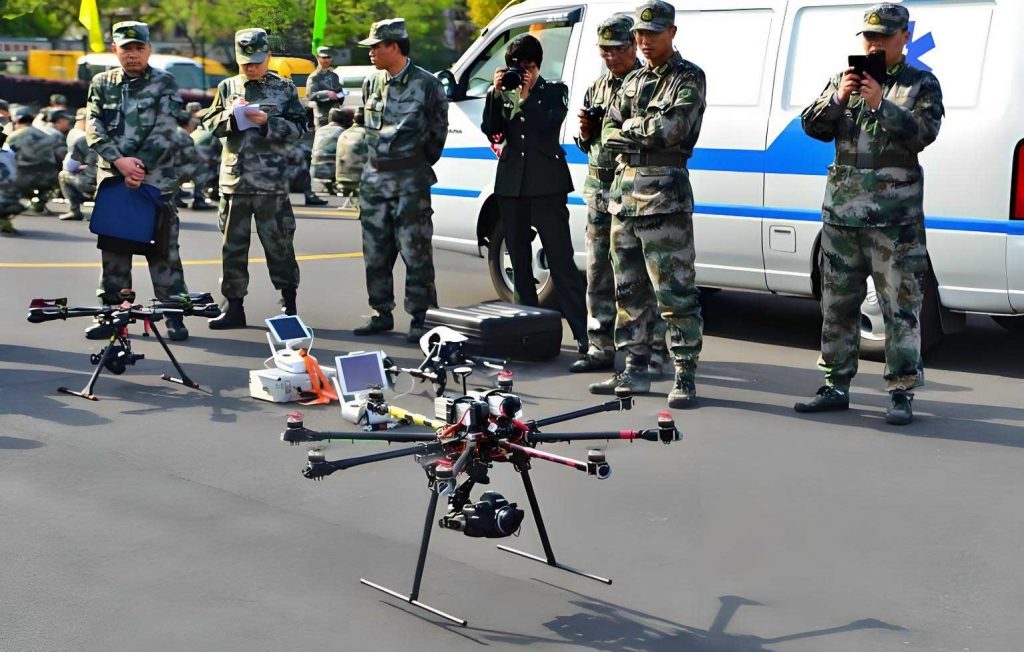
Our journey began with a clear vision: to accelerate agricultural development by leveraging intelligent machinery. On November 26-27, 2013, we organized a city-wide smart agricultural machinery equipment field meeting. This event showcased multiple remote-controlled high-efficiency rotary-wing plant protection drones, highlighting their potential to transform traditional farming practices. These drones can operate at altitudes of 1–2 meters above crops, with a single unit covering over 33.3 hectares per day—equivalent to the labor of 50 human workers. The introduction of newer models, such as quadcopter and octocopter drones, has further improved safety and portability, making them more accessible to farmers. The quadcopter, often likened to a “field toy,” features multiple rotors for stable hovering and simplified remote controls that allow farmers to learn operation within just five minutes of guidance. Its efficiency is remarkable, completing plant protection for 1 hectare in 15 minutes, and with a price tag under 100,000 yuan, it offers compelling value.
To support this initiative, we have prioritized drone training as a cornerstone of our outreach. Earlier in 2013, on April 4, we hosted a “Six Down to the Countryside” and spring ploughing production field meeting, where manufacturers demonstrated drone applications. This was followed by a training seminar on May 23, 2013, where experts provided detailed instruction on drone spraying techniques. These sessions sparked significant interest among agricultural cooperatives and large-scale farmers, with many expressing purchase intentions. We believe that effective drone training is essential for maximizing the benefits of this technology, as it ensures proper operation, safety, and maintenance.
The efficiency of these drones can be quantified using mathematical models. For instance, the area covered by a drone per unit time can be expressed as:
$$ A = v \times t \times \eta $$
where \( A \) is the area covered (in hectares), \( v \) is the spraying speed (in meters per second), \( t \) is the operation time (in seconds), and \( \eta \) is the efficiency factor accounting for factors like wind resistance and battery life. For our quadcopter model, with an average speed of 5 m/s and 15 minutes (900 seconds) of operation, the area covered is approximately 1 hectare, yielding an efficiency factor \( \eta \) of 0.74. This formula helps farmers plan their operations and optimize resource use.
To compare the performance of different drone models, we have compiled data in Table 1. This table summarizes key parameters, including cost, coverage rate, and training requirements, emphasizing how drone training impacts usability.
| Model Type | Number of Rotors | Cost (10,000 yuan) | Coverage per Day (hectares) | Training Time for Proficiency (hours) | Key Features |
|---|---|---|---|---|---|
| Standard Rotary-wing | 4 | 8-10 | 33.3+ | 1-2 | High efficiency, basic operation |
| Quadcopter | 4 | 6-9 | 40-50 | 0.5-1 | Lightweight, easy to control, ideal for small farms |
| Octocopter | 8 | 12-15 | 60-70 | 2-3 | Enhanced stability, suitable for larger areas |
From this table, it is evident that the quadcopter offers a balance of affordability and ease of use, which is why our drone training programs often focus on this model. The training time reduction correlates with improved adoption rates, as farmers can quickly integrate drones into their workflows.
Another critical aspect is the economic impact. We can model the cost-benefit ratio of using drones versus manual labor. Let \( C_d \) be the total cost of drone ownership (including purchase, maintenance, and drone training), \( C_m \) be the cost of manual labor for the same area, and \( S \) be the savings over time. The cost-benefit ratio \( R \) is given by:
$$ R = \frac{S}{C_d} = \frac{C_m – C_d}{C_d} $$
For example, if manual labor for covering 33.3 hectares costs 5,000 yuan per day (based on local wages), and a drone with a 100,000 yuan purchase price operates for 200 days a year with annual maintenance of 10,000 yuan, the annual cost \( C_d \) is approximately 110,000 yuan. Assuming 150 operational days, the savings \( S \) would be \( 150 \times 5,000 – 110,000 = 640,000 \) yuan, yielding \( R \approx 5.82 \). This demonstrates a high return on investment, especially when drone training ensures minimal downtime.
Our commitment to drone training extends beyond initial seminars. We have developed a structured curriculum, as outlined in Table 2, which covers theoretical and practical components. This comprehensive approach ensures that farmers gain confidence in operating drones safely and effectively.
| Module | Content | Duration (hours) | Learning Objectives |
|---|---|---|---|
| Introduction to Drones | Basics of UAV technology, types of agricultural drones | 2 | Understand drone components and applications |
| Safety and Regulations | Local laws, flight permissions, risk management | 3 | Ensure compliant and safe operations |
| Operation Techniques | Remote control usage, flight patterns, hovering | 5 | Master basic to advanced piloting skills |
| Spraying Optimization | Calibration, nozzle settings, weather considerations | 4 | Maximize coverage and minimize waste |
| Maintenance and Troubleshooting | Battery care, rotor checks, software updates | 3 | Perform routine upkeep and handle common issues |
| Field Practice | Hands-on sessions on farms with real crops | 10 | Apply knowledge in practical scenarios |
This curriculum has been refined through feedback from participants, and we continuously update it to reflect technological advancements. For instance, we incorporate formulas like the spraying efficiency equation \( E = \frac{A}{T} \), where \( E \) is efficiency in hectares per hour, \( A \) is area covered, and \( T \) is time spent. During drone training, farmers learn to calculate this to optimize their schedules.
In 2014, we plan to further enhance our policies by improving the agricultural machinery purchase subsidy program. We aim to include subsidies for high-performance equipment like efficient rotary-wing plant protection drones, particularly for sectors such as vegetables, fruits, aquaculture, and tea. These subsidies will be targeted at farms and demonstration bases with sufficient scale, where we can conduct trials and promotions. The goal is to reduce agricultural labor usage, boost productivity, and achieve “machine replacement” breakthroughs. To support this, we will intensify drone training efforts, offering regular workshops and certification programs.
The adoption rate of drones can be modeled using the logistic growth equation, which describes how technology spreads in a population:
$$ P(t) = \frac{K}{1 + e^{-r(t-t_0)}} $$
Here, \( P(t) \) is the proportion of farmers using drones at time \( t \), \( K \) is the carrying capacity (maximum adoption rate, estimated at 0.8 for Ningbo), \( r \) is the growth rate influenced by factors like drone training availability, and \( t_0 \) is the inflection point. Based on our data, with increased training sessions, \( r \) has risen from 0.2 to 0.4 annually, accelerating adoption.
We have also conducted field studies to validate drone performance. Table 3 presents results from a 2013-2014 trial comparing manual and drone-assisted plant protection on rice fields, highlighting the role of drone training in achieving these outcomes.
| Method | Area Covered per Day (hectares) | Labor Hours Required | Cost per Hectare (yuan) | Training Hours Invested | Farmer Satisfaction Score (1-10) |
|---|---|---|---|---|---|
| Manual Spraying | 2.5 | 40 | 800 | 0 | 6 |
| Drone (Quadcopter) | 40.0 | 2 | 200 | 5 | 9 |
| Drone (Octocopter) | 65.0 | 3 | 180 | 8 | 8 |
The data shows that drones drastically reduce labor hours and costs, with higher satisfaction linked to prior drone training. For example, farmers who completed over 10 hours of training reported satisfaction scores above 9, underscoring the value of education.
Looking ahead, we envision a future where drones are integral to precision agriculture. We will expand drone training to include advanced topics like data analytics and integration with IoT systems. The potential for automation can be expressed through formulas like the autonomy index \( AI = \frac{T_a}{T_t} \), where \( T_a \) is autonomous flight time and \( T_t \) is total operation time. With improved batteries and AI, we aim for \( AI > 0.9 \) in the next five years.
Moreover, we plan to establish a drone operator certification system, requiring mandatory drone training for all users. This will standardize skills and ensure safety. We are developing partnerships with local universities to offer accredited courses, blending theory with practice. For instance, a course might cover the physics of flight, using equations like lift force \( L = \frac{1}{2} \rho v^2 C_L A \), where \( \rho \) is air density, \( v \) is velocity, \( C_L \) is lift coefficient, and \( A \) is rotor area. Understanding such concepts helps operators optimize drone performance.
To summarize our progress, we have seen a significant uptake in drone usage since 2013, driven by continuous drone training and supportive policies. The number of trained operators has grown from 50 in 2013 to over 500 by the end of 2014, and we project it to exceed 2000 by 2016. This growth aligns with our mission to modernize agriculture, and we remain committed to innovating and educating. Through tables, formulas, and hands-on drone training, we are empowering farmers to embrace smart technology for a sustainable future.
In conclusion, as the Ningbo Agricultural Mechanization Administration, we are proud to lead the charge in smart agricultural machinery. By focusing on efficient drones and comprehensive drone training, we have made strides in reducing labor, increasing productivity, and promoting technological adoption. Our data-driven approach, with tools like cost-benefit analyses and growth models, ensures that our strategies are effective and scalable. We will continue to refine our programs, expand subsidies, and enhance drone training to achieve widespread implementation, ultimately contributing to the advancement of modern agriculture in China and beyond.