
In recent years, quadrotor unmanned aerial vehicles (UAVs) have garnered significant attention due to their versatility in applications such as surveillance, delivery, and environmental monitoring. However, achieving precise trajectory tracking for quadrotors remains challenging due to their inherent nonlinear dynamics, susceptibility to external disturbances, and underactuated nature. Traditional control methods often struggle to balance robustness, convergence speed, and chattering suppression. To address these issues, we propose a novel control strategy that integrates preset performance functions with a super-twisting sliding mode algorithm. This approach ensures that the tracking error remains within predefined bounds while enhancing robustness against disturbances. The quadrotor’s dynamics are highly coupled, making it essential to design a controller that can handle uncertainties and maintain stability under varying conditions. Our method leverages a finite-time terminal sliding mode surface to avoid singularities and accelerate convergence, combined with a disturbance observer to estimate and compensate for external perturbations. Through rigorous Lyapunov-based stability analysis and extensive simulations, we demonstrate the superiority of our approach in terms of tracking accuracy, transient performance, and disturbance rejection. This work contributes to the advancement of high-performance control systems for quadrotors, enabling their reliable operation in complex environments.
The dynamics of a quadrotor are derived using the Newton-Euler formulation, considering the vehicle as a rigid body with symmetric structure. We define two coordinate frames: the inertial frame (O_E X_E Y_E Z_E) and the body frame (O_B X_B Y_B Z_B). The equations of motion are expressed as follows:
$$ \ddot{x} = \frac{U_1}{m} (\cos\phi \sin\theta \cos\psi + \sin\phi \sin\psi) + d_x $$
$$ \ddot{y} = \frac{U_1}{m} (\cos\phi \sin\theta \sin\psi – \sin\phi \cos\psi) + d_y $$
$$ \ddot{z} = \frac{U_1}{m} (\cos\phi \cos\theta) – g + d_z $$
$$ \ddot{\phi} = \frac{U_2 + (I_y – I_z) \dot{\theta} \dot{\psi}}{I_x} + d_\phi $$
$$ \ddot{\theta} = \frac{U_3 + (I_z – I_x) \dot{\phi} \dot{\psi}}{I_y} + d_\theta $$
$$ \ddot{\psi} = \frac{U_4 + (I_x – I_y) \dot{\phi} \dot{\theta}}{I_z} + d_\psi $$
Here, \( m \) represents the mass of the quadrotor, \( g \) is the gravitational acceleration, \( I_x, I_y, I_z \) denote the moments of inertia, and \( d_i \) (for \( i = x, y, z, \phi, \theta, \psi \)) are external disturbances. The control inputs \( U_1, U_2, U_3, U_4 \) are related to the rotor thrusts \( F_1, F_2, F_3, F_4 \) as:
$$ U_1 = F_1 + F_2 + F_3 + F_4 $$
$$ U_2 = (F_4 – F_2) L $$
$$ U_3 = (F_3 – F_1) L $$
$$ U_4 = (F_4 + F_2 – F_1 – F_3) L $$
where \( L \) is the distance from the rotor to the center of mass. To simplify the control design, we introduce virtual control inputs \( u_x, u_y, u_z \):
$$ u_x = U_1 (\cos\phi \sin\theta \cos\psi + \sin\phi \sin\psi) $$
$$ u_y = U_1 (\cos\phi \sin\theta \sin\psi – \sin\phi \cos\psi) $$
$$ u_z = U_1 \cos\phi \cos\theta $$
The desired attitudes \( \phi_d, \theta_d \) and total thrust \( U_1 \) can be computed from these virtual inputs and the desired yaw angle \( \psi_d \):
$$ \theta_d = \arctan\left( \frac{u_x \cos\psi_d + u_y \sin\psi_d}{u_z} \right) $$
$$ \phi_d = \arctan\left( \cos\theta_d \frac{u_x \sin\psi_d – u_y \cos\psi_d}{u_z} \right) $$
$$ U_1 = \frac{u_z}{\cos\theta_d \cos\phi_d} $$
The control system is structured into two loops: an outer loop for position control and an inner loop for attitude control. Both loops employ the proposed preset performance super-twisting sliding mode controller to ensure robust tracking.
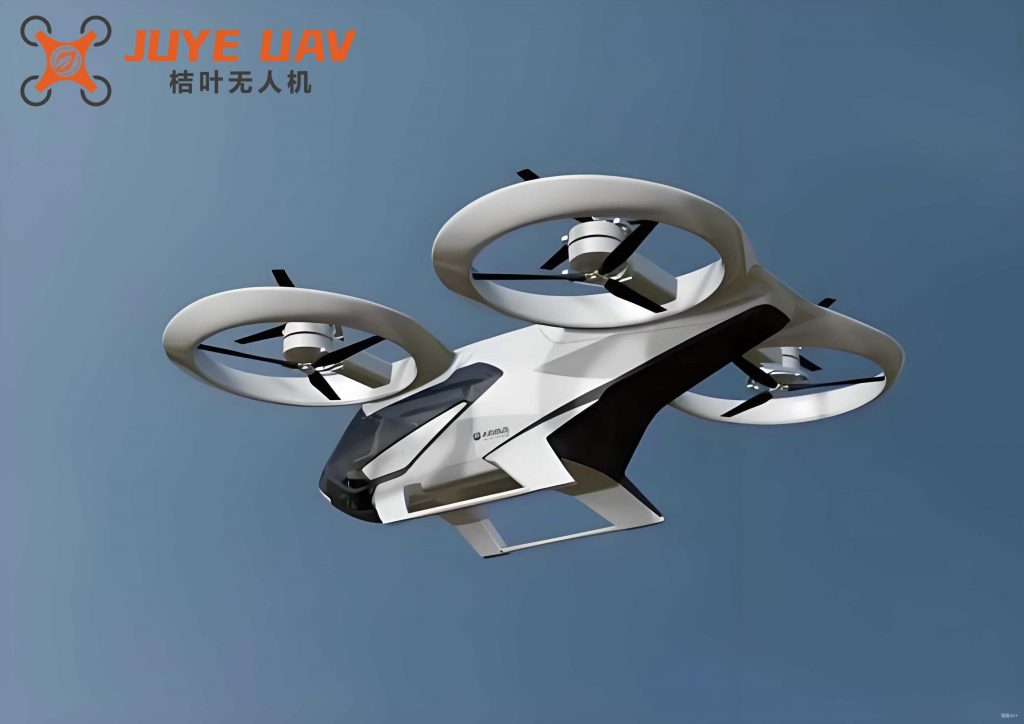
To achieve prescribed performance, we define a smooth performance function \( \rho(t) \) that bounds the tracking error. Let \( e = x_1 – x_d \) be the tracking error, where \( x_1 = [x, y, z, \phi, \theta, \psi]^T \) and \( x_d \) is the desired trajectory. The performance function is given by:
$$ \rho(t) = (\rho_0 – \rho_\infty) e^{-\kappa t} + \rho_\infty $$
with \( \rho_0 > \rho_\infty > 0 \) and \( \kappa > 0 \). This function ensures that the error decreases exponentially and remains within the set bounds. The transformed error is defined as:
$$ \alpha = \frac{e(t)}{\rho(t)} $$
$$ \lambda = S^{-1}(\alpha) = \frac{1}{2} \ln\left( \frac{\delta^+ + \alpha}{\delta^- – \alpha} \right) $$
where \( \delta^+ \) and \( \delta^- \) are positive constants that define the error bounds. The derivative of \( \lambda \) is computed as:
$$ \dot{\lambda} = r \left( \dot{e} – e \frac{\dot{\rho}}{\rho} \right) $$
with \( r = \frac{1}{2\rho} \left( \frac{1}{1+\alpha} – \frac{1}{\alpha-1} \right) \). The second derivative is:
$$ \ddot{\lambda} = r G u + r (f(x) + d) + F_1 + F_2 $$
where \( F_1 \) and \( F_2 \) encompass terms related to the desired trajectory and performance function derivatives.
We design a finite-time terminal sliding mode surface to enhance convergence and avoid singularities:
$$ s = \dot{\lambda} + [1 + c_1 \ln(c_2 \cosh(\lambda))] [c_3 \lambda + c_4 \text{sig}^a(\lambda)] $$
Here, \( c_1, c_2, c_3, c_4 > 0 \), \( 1 < a < 2 \), and \( \text{sig}^a(\lambda) = |\lambda|^a \text{sign}(\lambda) \). When \( s = 0 \), the system dynamics ensure finite-time convergence of \( \lambda \) to zero, which implies that the tracking error \( e \) converges to zero within the preset bounds. The Lyapunov function \( V = \frac{1}{2} \lambda^2 \) is used to prove stability, yielding:
$$ \dot{V} \leq -\sqrt{2} (c_3 |\lambda| + c_4 |\lambda|^a) V^{1/2} $$
This guarantees finite-time stability per standard Lyapunov theorems.
The super-twisting control law is designed to minimize chattering while maintaining robustness. The control input \( u \) is derived as:
$$ u = \frac{1}{G r} \left( -F_1 – F_2 – s_{e1} \dot{\lambda} – s_{e2} \lambda – k_{p1} \Lambda_1 + \Lambda_2 – r (f(x) + \hat{d}) \right) $$
where \( s_{e1} = c_1 \tanh(\lambda) [c_3 \lambda + c_4 \text{sig}^a(\lambda)] \), \( s_{e2} = [1 + c_1 \ln(c_2 \cosh(\lambda))] (c_3 + c_4 a |\lambda|^{a-1}) \), and \( \hat{d} \) is the estimated disturbance. The terms \( \Lambda_1 \) and \( \Lambda_2 \) are given by:
$$ \Lambda_1 = k e^{|s|^{1/2}} |s|^{1/2} \text{sign}(s) $$
$$ \dot{\Lambda}_2 = -k_{p2} k^2 e^{2|s|^{1/2}} \text{sign}(s) (1 + |s|^{1/2}) $$
with \( k, k_{p1}, k_{p2} > 0 \). The disturbance observer is designed to estimate external disturbances:
$$ \hat{d} = L (x_2 + \Delta) $$
$$ \dot{\Delta} = \frac{1}{r} (F_1 + F_2 + s_{e1} \dot{\lambda} + s_{e2} \lambda + k_{p1} \Lambda_1 – \Lambda_2 + f(s) \Gamma) $$
where \( L > 1 \), \( \Gamma = (v + 2t^2) \Lambda_1 + t \Lambda_2 \), and \( f(s) = \frac{k}{2} e^{|s|^{1/2}} (1 + |s|^{-1/2}) \). The observer error \( \tilde{d} = d – \hat{d} \) dynamics are:
$$ \dot{\tilde{d}} = L (\tilde{d} + f(s) \Gamma) $$
To prove stability, we consider the Lyapunov function \( V_2 = V_1 + \frac{1}{2} \tilde{d}^T \tilde{d} \), where \( V_1 = \frac{1}{2} \xi^T P \xi \) with \( \xi = [\Lambda_1, \Lambda_2]^T \) and \( P \) a positive definite matrix. The derivative satisfies:
$$ \dot{V}_2 \leq -X V_2 $$
for some \( X > 0 \), ensuring uniform ultimate boundedness of the system.
We validate our controller through simulations comparing it with existing methods, such as exponential reaching law (EERL) and improved fixed-time power reaching law (IFPRRL). The quadrotor parameters are: mass \( m = 2 \, \text{kg} \), arm length \( L = 0.2 \, \text{m} \), gravity \( g = 9.8 \, \text{m/s}^2 \), and moments of inertia \( I_x = I_y = 0.0021 \, \text{kg·m}^2 \), \( I_z = 0.0036 \, \text{kg·m}^2 \). The desired trajectory is \( [\sin(\pi t/5), \cos(\pi t/10)-1, t+0.5, 0]^T \), and disturbances are \( d_i = \sin(t) + 0.5 \cos(t) e^{-0.001t} \).
| Method | Average \( e_x \) (m) | Average \( e_y \) (m) | Average \( e_z \) (m) | Average \( e_\psi \) (rad) | Min Rise Time (s) | Max Rise Time (s) |
|---|---|---|---|---|---|---|
| EERL | 0.0036 | 0.0039 | 0.0201 | 0.0236 | 0.64 | 1.95 |
| IFPRRL | 0.0035 | 0.0050 | 0.0262 | 0.0295 | 0.63 | 2.21 |
| Proposed | 0.0018 | 0.0011 | 0.0045 | 0.0080 | 0.18 | 0.58 |
Under normal conditions, our method achieves faster convergence and smaller tracking errors compared to EERL and IFPRRL. The quadrotor’s position and attitude errors remain within the preset bounds, and control inputs exhibit reduced chattering. The disturbance observer accurately estimates external perturbations, enhancing robustness.
| Method | Average \( e_x \) (m) | Average \( e_y \) (m) | Average \( e_z \) (m) | Average \( e_\psi \) (rad) | Min Rise Time (s) | Max Rise Time (s) |
|---|---|---|---|---|---|---|
| EERL | 0.0565 | 0.0567 | 0.0675 | 0.0585 | 1.26 | 2.71 |
| IFPRRL | 0.1482 | 0.0635 | 0.1226 | 0.0391 | 1.28 | 3.35 |
| Proposed | 0.0047 | 0.0103 | 0.0061 | 0.0110 | 0.24 | 0.70 |
In disturbed scenarios, our controller maintains superior performance, with errors staying within bounds and minimal rise time. The quadrotor trajectory tracking is smooth, and the control outputs are stable, demonstrating the effectiveness of the integrated disturbance observer and super-twisting algorithm.
The proposed preset performance super-twisting sliding mode control offers a robust solution for quadrotor trajectory tracking. By combining preset performance bounds, a finite-time terminal sliding surface, and a disturbance observer, the controller ensures rapid convergence, high accuracy, and strong disturbance rejection. Simulation results confirm that our approach outperforms existing methods in both normal and disturbed environments, making it suitable for real-world quadrotor applications. Future work will focus on experimental validation and extension to multi-quadrotor systems.