
The integration of vertical take-off and landing (VTOL) capability with efficient fixed-wing cruise represents a significant advancement in unmanned aerial vehicle (UAV) technology. Electric-powered, miniature VTOL drones (hereafter referred to as VTOL drones) offer unparalleled operational flexibility by eliminating the need for runways while maintaining the range and endurance benefits of winged flight. This capability opens avenues for applications in surveillance, mapping, inspection, and delivery in complex or confined environments. However, the conceptual and preliminary design of such aircraft presents unique multidisciplinary challenges not encountered in conventional fixed-wing or multi-rotor design. This article outlines a structured preliminary design methodology tailored for electric-powered VTOL drones, focusing on the critical trade-offs and special parameters that govern their performance, with particular emphasis on tail-sitter configurations employing a unified propulsion system.
1. Fundamental Design Challenges for VTOL Drones
The design of a VTOL drone is fundamentally an exercise in reconciling contradictory requirements from its distinct flight regimes: the vertical/hover phase and the horizontal/cruise phase. The primary challenges manifest in two key areas: propulsion system matching and aircraft balance/control.
1.1 Propulsion System Thrust Matching
The propulsion system for a VTOL drone must satisfy drastically different thrust demands. During hover, the total thrust must exceed the vehicle’s weight to achieve lift-off, typically requiring a thrust-to-weight ratio (T/W) greater than 1.25-1.5 to allow for adequate control authority and stability margins.
$$ T_{hover} \ge k \cdot W \cdot g $$
where $k$ is a safety factor (e.g., 1.3), $W$ is the total weight, and $g$ is gravitational acceleration.
In contrast, during high-speed cruise, the required thrust is primarily to overcome aerodynamic drag. For a well-designed fixed-wing aircraft, the lift-to-drag ratio (L/D) can range from 10 to 20, implying a required T/W in the range of only 0.05 to 0.1.
$$ T_{cruise} = \frac{W \cdot g}{(L/D)} $$
$$ \therefore \left(\frac{T}{W}\right)_{cruise} \approx \frac{g}{(L/D)} \approx 0.05 \text{ to } 0.1 $$
This order-of-magnitude discrepancy poses significant challenges. The propulsion system must be powerful enough for vertical flight, which often leads to oversized motors and propellers that are not operating at peak efficiency during cruise. Conversely, a system optimized for cruise may lack the necessary thrust for hover. Selecting a single propulsion system (common in tail-sitters) that can operate reasonably efficiently across both regimes is a core design challenge.
1.2 Aircraft Balance and Control
A VTOL drone must be trimmable and controllable in both vertical and horizontal attitudes. For a tail-sitter VTOL drone, this is particularly complex. In hover mode, the aircraft behaves like a multi-rotor. The net thrust vector must pass through the center of gravity (CG) to prevent pitching or rolling moments. Any control surfaces immersed in the propeller slipstream experience altered effective angles of attack, complicating moment balance predictions.
Furthermore, the large wing area, while beneficial for cruise, creates significant rotational damping in hover, often leading to insufficient yaw control authority if relying solely on differential torque from counter-rotating propellers. In cruise mode, the aircraft must be longitudinally stable. The presence of the propeller slipstream over parts of the wing and control surfaces modifies local dynamic pressure and flow angles, affecting trim calculations for lift, drag, and pitching moment. These interactions make the aerodynamic and control design of a VTOL drone more intricate than that of a conventional aircraft.
2. Common VTOL Drone Configurations
Several configurations exist to achieve VTOL capability, each with its own trade-offs in complexity, weight, and efficiency. The choice of configuration heavily influences the preliminary design process.
| Configuration | Description | Advantages | Disadvantages |
|---|---|---|---|
| Tilt-Rotor/Tilt-Wing | Propellers/rotors and motors tilt between vertical and horizontal orientations. | High hover and cruise efficiency; intuitive transition. | Complex, heavy tilting mechanisms; control challenges during transition. |
| Lift + Cruise | Dedicated vertical lift rotors and separate cruise propeller(s). | Simultaneous hover/cruise optimization; mechanically simpler than tilt systems. | Dead weight of unused system in each phase; potentially larger frontal area. |
| Tail-Sitter | Entire aircraft pitches 90° between vertical (takeoff/landing) and horizontal (cruise) flight. | Structurally simple; no redundant systems; high aerodynamic efficiency with flying-wing layouts. | Requires complex flight controller for transition; challenging pilot perspective; potential yaw control deficiency in hover. |
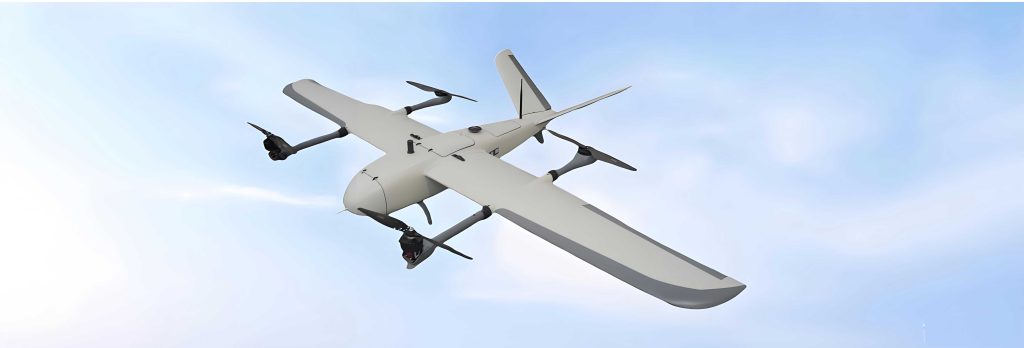
This methodology will focus on the tail-sitter configuration, specifically an X-wing flying-wing layout, as it presents a high-efficiency, lightweight solution with significant design challenges that illuminate the core principles of VTOL drone design.
3. Structured Preliminary Design Flow
The design process begins with a clear definition of mission requirements, which dictate the key performance parameters (KPPs). A typical mission profile for a VTOL drone includes vertical takeoff, transition to cruise, level cruise, possible loiter or climb segments, transition back to hover, and vertical landing. The primary KPPs derived from this profile are:
- Payload Mass ($m_{pl}$): The mass of sensors, cameras, or other mission equipment.
- Cruise Speed ($V_{c}$): The desired horizontal flight speed.
- Endurance ($t_{total}$): Total required flight time, often broken into hover time ($t_h$) and cruise time ($t_c$).
- Operational Ceiling/Range: May influence power system sizing.
Given these inputs, the preliminary design follows an iterative process to converge on a feasible set of parameters. The core of this process revolves around the interplay between wing loading ($W/S$), power-to-weight ratio ($P/W$), and total take-off weight ($W_{TO}$).
4. Core Preliminary Design Methodology
4.1 Initial Sizing: Wing Loading and Power-to-Weight Ratio
Wing loading ($W/S$) is a fundamental parameter that influences stall speed, cruise performance, gust response, and structural weight. For a VTOL drone, the hover performance is largely independent of wing loading (depending primarily on disk loading), but the cruise, climb, and loiter performance are strongly dependent on it. The power required for steady, level flight is given by:
$$ P_{req} = \frac{D \cdot V}{\eta_{prop} \eta_{motor} \eta_{esc}} $$
Where drag $D$ is:
$$ D = \frac{1}{2} \rho V^2 S C_D = \frac{1}{2} \rho V^2 S \left( C_{D,0} + \frac{C_L^2}{\pi e AR} \right) $$
and lift $L$ equals weight in level flight:
$$ L = W = \frac{1}{2} \rho V^2 S C_L $$
$$ \Rightarrow C_L = \frac{W}{\frac{1}{2} \rho V^2 S} = \frac{(W/S)}{\frac{1}{2} \rho V^2} $$
Substituting, the power-to-weight ratio for cruise becomes:
$$ \frac{P}{W} = \frac{1}{\eta_{total}} \left[ \frac{\frac{1}{2} \rho V^3 C_{D,0}}{(W/S)} + \frac{2 (W/S) K}{\rho V} \right] $$
where $K = 1/(\pi e AR)$ and $\eta_{total} = \eta_{prop} \eta_{motor} \eta_{esc}$.
Similar equations can be derived for climb (adding a $V \sin \theta$ term) and loiter (optimizing for minimum power speed). The power required for hover is derived from momentum theory:
$$ P_{hover} = \frac{T^{3/2}}{\eta_{total} \sqrt{2 \rho A}} \approx \frac{(k W g)^{3/2}}{\eta_{total} \sqrt{2 \rho (n_{prop} A_{prop})}} $$
where $A$ is the total propeller disk area.
The designer plots $(P/W)$ against $(W/S)$ for each flight condition (cruise, climb, loiter, hover). The feasible design space lies above all these curves. The selected $(W/S)$ is often a compromise. A lower $(W/S)$ reduces stall and landing speed and may reduce cruise power at the expense of larger wings (increased structure weight and drag). Statistical data from existing UAVs in the same class (1-5 kg) provides a useful sanity check; typical wing loadings range from 50 to 150 N/m².
| Design Parameter | Symbol | Typical Range / Estimation Method |
|---|---|---|
| Wing Loading | $W/S$ | 70 – 100 N/m² (for 1-3 kg UAVs) |
| Aspect Ratio | $AR$ | 6 – 10 (flying wing, balance w/ structural constraints) |
| Oswald Efficiency | $e$ | 0.7 – 0.85 for flying wings |
| Zero-Lift Drag Coeff. | $C_{D,0}$ | 0.02 – 0.04 (clean flying wing) |
| Hover Thrust/Weight | $T/W$ | 1.3 – 1.8 (per motor group, for control) |
4.2 Weight Estimation and Iteration
The total take-off weight $W_{TO}$ is the sum of its components:
$$ W_{TO} = W_{payload} + W_{avionics} + W_{structure} + W_{battery} + W_{propulsion} $$
where $W_{propulsion}$ includes motors, ESCs, and propellers.
An initial guess for $W_{TO}$ is made based on the payload and typical empty weight fractions. For small electric UAVs, the battery and propulsion system can constitute 40-60% of $W_{TO}$. The design process is iterative:
- Estimate $W_{TO}$ (e.g., $W_{TO} = W_{payload} / 0.2$).
- Size Propulsion: Based on hover thrust requirement $T_{hover} = k \cdot W_{TO} \cdot g / n_{motors}$, select motor/propeller combinations. Empirical data sheets are crucial. A statistical relation between motor mass $m_m$ and max static thrust $T_{max}$ can guide selection:
$$ T_{max} \approx \alpha \cdot m_m + \beta $$ - Size Battery: Energy required $E_{req}$ is the sum of energy for each mission segment:
$$ E_{req} = (P_{hover} \cdot t_h + P_{cruise} \cdot t_c + …) $$
Battery mass $m_b$ is related to its energy capacity $E_b$ (in Wh) and specific energy $E_{sp}$ (Wh/kg):
$$ m_b = \frac{E_{req}}{E_{sp} \cdot \text{(Depth of Discharge)}} $$
Typical $E_{sp}$ for LiPo batteries is 150-250 Wh/kg. - Estimate Structural Weight: Based on selected geometry, materials (e.g., foam composite, carbon fiber), and layout.
- Sum Weights: Compare new $W_{TO}$ estimate with initial guess. Iterate from step 2 until convergence.
4.3 Propulsion System Matching and Operating Points
This is a critical step unique to VTOL drones using a single propulsion system for both flight modes. The selected motor-propeller combination must have operating points in both the hover (high thrust, zero axial velocity) and cruise (lower thrust, high axial velocity) regimes that are within the efficient region of its performance map.
The propeller performance is characterized by coefficients for thrust ($C_T$) and power ($C_P$):
$$ T = C_T \rho n^2 D_p^4 $$
$$ P_{shaft} = C_P \rho n^3 D_p^5 $$
where $n$ is rotational speed (rps) and $D_p$ is propeller diameter. $C_T$ and $C_P$ are functions of the advance ratio $J = V / (n D_p)$.
The motor’s performance is described by its torque-speed-current relationships:
$$ Q_m = K_Q (I – I_0) $$
$$ n = \frac{(V – I R_m)}{K_V} $$
where $K_Q$ is torque constant, $I_0$ is no-load current, $R_m$ is resistance, and $K_V$ is velocity constant.
The operating point is where the motor torque equals the propeller torque requirement. We must check two key points:
- Hover Point ($V=0$, $J \approx 0$): Solve for $n$ and $I$ where $Q_m(n, I) = C_P(J=0) \rho n^2 D_p^5 / (2\pi)$. Ensure $T_{hover}$ is achieved and $I$ is within motor/ESC limits.
- Cruise Point ($V=V_c$): Solve for $n$, $I$, and $J$ where $Q_m(n, I) = C_P(J) \rho n^2 D_p^5 / (2\pi)$ and $T = C_T(J) \rho n^2 D_p^4 = D_{aircraft}$. Ensure efficiency $\eta = (T V) / (V_{batt} I)$ is acceptable.
This analysis often reveals that a propeller optimized for hover is too coarse for efficient cruise, or vice-versa. The designer must find a compromise propeller (diameter and pitch) that yields acceptable efficiency at both points.
| Parameter | Hover Condition | Cruise Condition |
|---|---|---|
| Advance Ratio, $J$ | ~0 | $V_c / (n D_p)$ (~0.5-0.7) |
| Thrust Coefficient, $C_T$ | ~0.10 – 0.15 | ~0.02 – 0.05 |
| Power Coefficient, $C_P$ | ~0.07 – 0.10 | ~0.04 – 0.06 |
| Propeller Efficiency, $\eta_{prop}$ | ~0.5 – 0.65 ($= J C_T/C_P$) | ~0.7 – 0.8 |
| System Efficiency Goal | $> 50\%$ | $> 65\%$ |
4.4 Aerodynamic and Stability Design (Flying Wing)
For tail-sitter VTOL drones, a flying-wing planform is advantageous due to its structural efficiency and high lift-to-drag ratio. Stability is achieved without a horizontal tail by using airfoils with reflexed (positive) camber at the trailing edge and/or geometric twist (washout).
The longitudinal static margin (SM) is defined as:
$$ SM = \frac{x_{cg} – x_{ac}}{\bar{c}} $$
where $x_{cg}$ is the CG location, $x_{ac}$ is the aerodynamic center location, and $\bar{c}$ is the mean aerodynamic chord. For flying wings, a SM of 5-10% is typical. The reflex in the airfoil generates a positive pitching moment at zero lift ($C_{m,0} > 0$), which helps trim the aircraft with slight downward elevator deflection.
Vortex Lattice Method (VLM) tools are highly effective at this stage for estimating lift distribution, induced drag, and stability derivatives for these unconventional planforms.
4.5 Balance, Trim, and Control Analysis
Cruise Trim: The aircraft must be in force and moment equilibrium. The equations must account for slipstream effects. The dynamic pressure over portions of the wing covered by the propeller wash ($q_{slip}$) is higher than the freestream ($q_{\infty}$). A simplified model assumes:
$$ q_{slip} = q_{\infty} \left(1 + \frac{v_i}{V}\right)^2 $$
where $v_i$ is the propeller induced velocity in cruise. Lift and drag are integrated over slipstream and non-slipstream areas. The trim condition solves for elevator deflection $\delta_e$, angle of attack $\alpha$, and required thrust $T$ such that:
$$ \Sigma F_x = 0, \quad \Sigma F_z = 0, \quad \Sigma M_y = 0 $$
Hover Control: For an X-configuration tail-sitter VTOL drone with four motors, control in hover is achieved by differential thrust. Pitch and roll moments are generated by increasing/decreasing thrust on opposite motor pairs. Yaw moment is generated by differentially changing the speed of clockwise and counter-clockwise rotating propellers, exploiting the difference in their reaction torques. The maximum available control moments dictate the agility and wind rejection capability of the VTOL drone.
5. Analysis of Special Design Parameters and Their Impact
5.1 Power-to-Weight Ratio ($P/W$) Optimization
As derived earlier, the $(P/W)$ for cruise has a minimum at a specific $(W/S)$. Taking the derivative of the cruise power equation with respect to $(W/S)$ and setting to zero finds this optimum:
$$ \left(\frac{W}{S}\right)_{opt, cruise} = \frac{1}{2} \rho V_c^2 \sqrt{\frac{3 C_{D,0}}{K}} \quad \text{(for max endurance)} $$
$$ \left(\frac{W}{S}\right)_{opt, range} = \frac{1}{2} \rho V_c^2 \sqrt{\frac{C_{D,0}}{K}} \quad \text{(for max range)} $$
The choice between optimizing for max endurance or max range directly impacts the initial sizing of the VTOL drone. For missions requiring long loiter, a lower wing loading is favored. Furthermore, the $(P/W)$ required for hover often dominates the system sizing. If $P_{hover} / W_{TO} > P_{cruise, min} / W_{TO}$, then the propulsion system is effectively sized by the hover requirement, and the cruise propeller match becomes the limiting factor for efficiency. This underscores the importance of the propulsion matching analysis in Section 4.3.
5.2 Propulsion System Installation Angle for Yaw Control Augmentation
A significant challenge for tail-sitter VTOL drones is weak yaw authority in hover due to the limited differential torque available. A powerful design solution is to cant the motors inward (or outward) by a small angle $\gamma$ in the plane perpendicular to the wing.
Consider motors mounted at a distance $R$ from the aircraft’s centerline. If motors 1 & 3 rotate CW and motors 2 & 4 rotate CCW, and all are canted inward by angle $\gamma$, their thrust vectors have components in the horizontal plane. The horizontal components for adjacent motors point in opposite directions tangentially. By differentially varying motor speeds, one can create a pure yawing couple without inducing significant roll or pitch.
Let $T_i$ be the thrust of motor $i$. The yaw moment from differential thrust of canted motors is approximately:
$$ N_{thrust} \approx 2 R (T_2 + T_4 – T_1 – T_3) \sin \gamma $$
This adds to the yaw moment from differential torque $N_{torque} = \sum Q_{motor}$.
The total yaw control power is:
$$ N_{total} = N_{torque} + N_{thrust} $$
A modest cant angle (e.g., 5-10°) can double or triple the available yaw authority. The trade-off is a slight reduction in vertical thrust component ($\cos \gamma$ factor) and the introduction of small, coupled roll/pitch moments during differential thrust commands, which the flight controller must compensate for. This parameter $\gamma$ is a critical lever in tailoring the handling qualities of the VTOL drone in hover mode.
5.3 Impact of Motor-Propeller Matching on Overall Efficiency
The choice of propeller diameter $D_p$ and pitch $Pitch$ relative to the motor’s $K_V$ constant is paramount. A poor match can lead to the motor operating outside its efficient zone (typically 70-85% efficiency for brushless motors) in one or both flight regimes.
- Hover-Optimized Propeller: A large diameter, low-pitch propeller maximizes static thrust (high $C_T$ at $J=0$). This allows the motor to operate at a moderate RPM to produce the required thrust, often within a good efficiency band.
- Cruise-Optimized Propeller: A smaller diameter, higher-pitch propeller operates efficiently at high advance ratios $J$, converting shaft power into thrust power ($T \cdot V$) effectively.
The VTOL drone designer must analyze the matched system curves. Plotting motor RPM vs. Torque lines for different throttle settings against propeller torque demand curves for different forward speeds ($V=0, V_c$) reveals the operating points. The goal is to have both the hover and cruise operating points lie on high-efficiency islands of the motor map. Often, a medium-pitch propeller represents the best compromise, accepting slightly lower hover efficiency for substantially better cruise efficiency, which usually governs overall endurance for a VTOL drone performing useful missions.
The power balance for the mission directly dictates battery size. The total energy consumed is:
$$ E_{batt} = \int_{mission} \frac{P_{prop}(t)}{\eta_{motor}(t) \eta_{esc}(t)} dt $$
Accurately estimating the efficiency $\eta_{motor}(t)$ at different operating points (hover vs. cruise) via the matching analysis is essential for predicting achievable endurance, making this parameter study vital for a credible VTOL drone design.
| Special Parameter | Primary Influence | Design Trade-off |
|---|---|---|
| Power-to-Weight Ratio $(P/W)$ at Sizing Points | Drives motor/battery sizing, ultimate endurance. | Hover $P/W$ vs. Cruise $P/W$. Compromise on propeller selection. |
| Motor Cant Angle ($\gamma$) | Hover yaw control authority. | Increased yaw power vs. slight thrust loss & control coupling. |
| Propeller Pitch-Diameter Ratio $(Pitch/D_p)$ | Efficiency split between hover and cruise. | High pitch favors cruise, low pitch favors hover. Medium is compromise. |
| Disk Loading in Hover $(T/A_{disk})$ | Hover power required, downwash velocity. | Low disk loading (big props) is efficient but may limit cruise speed due to low $J$. |
| Wing Aspect Ratio ($AR$) | Cruise L/D, structural weight/bending. | High $AR$ improves cruise efficiency but increases weight and reduces roll rate in hover. |
6. Conclusion
The preliminary design of a miniature electric VTOL drone is a complex, iterative process that balances the conflicting demands of rotary-wing and fixed-wing flight. A successful methodology must center on the simultaneous analysis of wing loading and power-to-weight ratio across all mission segments, with a deep focus on the propulsion system’s matching characteristics at both hover and cruise conditions. The tail-sitter configuration, particularly with a flying-wing planform, offers a lightweight and aerodynamically efficient solution but introduces distinct challenges in stability, trim, and low-speed yaw control.
Key to navigating these challenges is the detailed analysis of special parameters such as the motor-propeller operating points, which dictate overall system efficiency, and strategic design choices like motor cant angles, which can dramatically improve handling qualities without severe performance penalties. Employing statistical weight estimation, vortex-lattice aerodynamic analysis, and physics-based propulsion models allows the designer to converge on a feasible and optimized configuration. This structured approach ensures that the unique capabilities of the VTOL drone—vertical agility and efficient forward flight—are realized in a robust and effective aerial platform. Future work in this domain will continue to refine these models, particularly for transition dynamics and aero-propulsive interactions, enabling even more capable and versatile VTOL drone designs.