
In this paper, we investigate the intricate challenge of predefined-time affine formation maneuvering control for a swarm of fixed-wing UAVs operating under directed communication topologies. The primary motivation stems from the inherent limitations of traditional “leader-follower” affine formation control methods, which typically offer only asymptotic, finite-time, or fixed-time convergence. In many modern operational scenarios, such as coordinated surveillance, obstacle avoidance in cluttered environments, and time-sensitive strike missions, the ability to pre-specify the exact convergence time of the formation maneuver is critical. Our work provides a comprehensive solution to this problem by proposing a novel hierarchical control framework that integrates a distributed predefined-time affine observer, a predefined-time disturbance estimator, and a Nussbaum function-based state tracking controller capable of handling input saturation and unknown external disturbances.
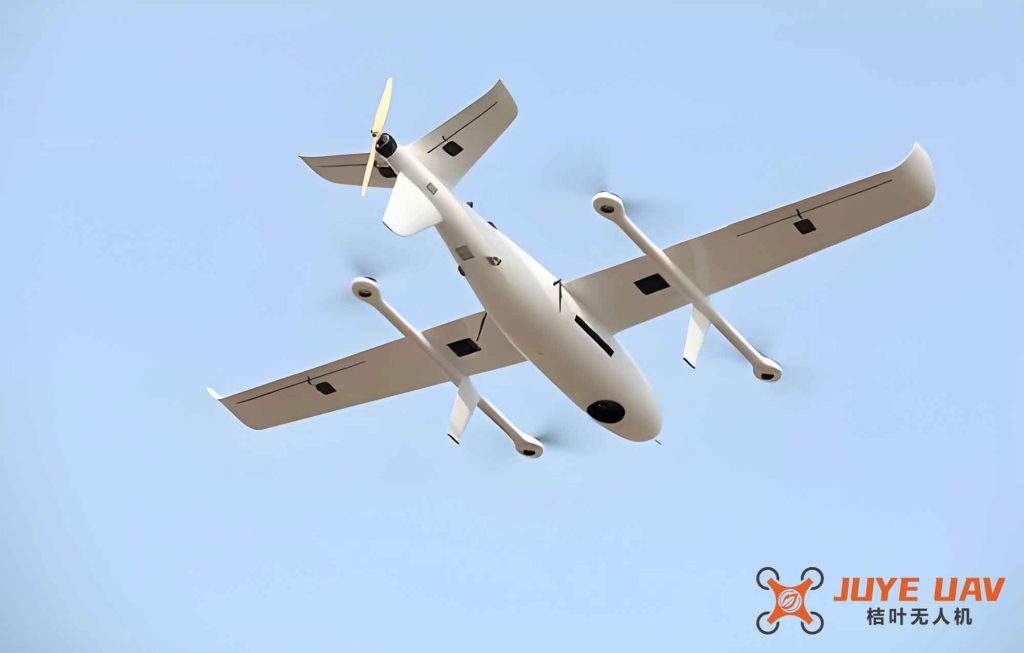
1. Problem Formulation and Preliminaries
1.1 Fixed-Wing UAV Dynamics and Input Saturation
We consider a swarm consisting of $n$ fixed-wing UAVs operating in three-dimensional space. The nonlinear dynamics of the $i$-th fixed-wing UAV, after incorporating typical simplifications, can be described using a dual-loop structure concerning position and velocity. The kinematic and dynamic equations are given by:
$$ \begin{aligned} \dot{p}_i &= v_i \\ \dot{v}_i &= \frac{R_i}{m_i} u_{i0} + \alpha_i + \Upsilon_i \end{aligned} $$
Here, $p_i = [x_i, y_i, z_i]^T$ is the inertial position, $v_i = [v_{ix}, v_{iy}, v_{iz}]^T$ is the velocity, $m_i$ is the mass, and $\Upsilon_i$ represents the lumped disturbance. The rotation matrix $R_i$ and the term $\alpha_i$ capture the orientation dynamics. A critical practical constraint we address is actuator saturation. The actual control input $u_{i0}[j]$ for each channel $j \in \{1,2,3\}$ is subject to bounds:
$$ u_{i0}[j] = \text{sat}(u_i[j]) = \begin{cases} \bar{u}_{i,j} & u_i[j] > \bar{u}_{i,j} \\ u_i[j] & -\underline{u}_{i,j} < u_i[j] < \bar{u}_{i,j} \\ -\underline{u}_{i,j} & u_i[j] < -\underline{u}_{i,j} \end{cases} $$
To facilitate control design, we model this saturation as a time-varying coefficient combined with a bounded term: $u_{i0}[j] = \rho_{i,j}(t) u_i[j] + \eta(u_i[j])$, where $0 < \underline{\rho}_{i,j} \leq \rho_{i,j} \leq \bar{\rho}_{i,j}$ and $|\eta(u_i[j])| \leq \bar{\eta}$. This allows us to rewrite the force equation as:
$$ \dot{v}_i = \frac{R_i}{m_i} \rho_i u_i + \frac{R_i}{m_i} \eta(u_i) + \alpha_i + \Upsilon_i $$
This transformation is key to applying Nussbaum functions for saturation compensation, where $\rho_i = \text{diag}(\rho_{i,1}, \rho_{i,2}, \rho_{i,3})$.
1.2 Graph Theory and Affine Formation Framework
The information exchange within the fixed-wing UAV swarm is modeled by a directed graph $\mathcal{G} = (\mathcal{V}, \mathcal{E})$. The swarm consists of $n_l$ leaders and $n_f$ followers ($n = n_l + n_f$). The desired formation is defined via affine transformations of a nominal configuration $r = [r_1^T, \dots, r_n^T]^T$.
Definition 1 (Affine Formation): The desired time-varying formation is given by $q^*(t) = (I_n \otimes A_f(t)) r + 1_n \otimes b_f(t)$, where $A_f(t) \in \mathbb{R}^{d \times d}$ and $b_f(t) \in \mathbb{R}^d$ represent the time-varying affine transformation (e.g., rotation, scaling, shearing).
The cornerstone of our approach is the stress matrix $L_s$, a generalized Laplacian matrix. For a directed graph satisfying the condition that the leaders can affinely span $\mathbb{R}^d$, the stress matrix can be partitioned as:
$$ L_s = \begin{bmatrix} 0_{n_l \times n_l} & 0_{n_l \times n_f} \\ L_s^{fl} & L_s^{ff} \end{bmatrix} $$
A critical condition for our observer design is that $L_s^{ff}$ is invertible and that there exists a diagonal stability matrix $D$ such that $\bar{L}_s^{ff} = D’ L_s^{ff}$ has all eigenvalues with positive real parts. This allows us to compute the follower’s desired state from the leaders: $q_f^* = -(\bar{L}_s^{ff})^{-1} \bar{L}_s^{fl} q_l^*$.
1.3 Control Objective
The primary objective is to design a distributed controller for the fixed-wing UAV swarm to achieve affine formation maneuvering within a user-predefined time $T$, despite unknown disturbances and input saturation. We assume the leaders always remain in the desired formation $p_l = q_l^*$. The goal for the followers is to drive their tracking error $p_f(t) – q_f^*(t)$ to a small neighborhood of zero within time $T$.
Table 1: Key Assumptions and Notations for Fixed-Wing UAV Affine Formation Control
| Symbol | Meaning | Condition |
|---|---|---|
| $n$ | Total number of fixed-wing UAVs | $n = n_l + n_f$ |
| $L_s$ | Stress matrix for directed graph $\mathcal{G}$ | $L_s 1_n = 0$, $L_s^{ff}$ invertible |
| $\rho_i$ | Time-varying saturation coefficient | $0 < \underline{\rho} < \rho_i(t) < \bar{\rho}$ |
| $\Upsilon_i$ | Lumped disturbance | Bounded |
| $T$ | Predefined convergence time | Independent of initial conditions |
2. Predefined-Time Affine Observer Design
To solve the state observation problem required for distributed formation control, we first propose a predefined-time affine observer for the fixed-wing UAV swarm. This observer allows each follower to estimate the desired formation state $\{\hat{q}_i, \hat{v}_i, \hat{a}_i\}$ within a prescribed time $T_a$ using only local information from its in-neighbors.
The key technique is the use of a time-varying scaling function $\mu(t)$:
$$ \mu(t) = \left(\frac{T_0}{t_0 + T_0 – t}\right)^p, \quad p > 1, \quad t \in [t_0, t_0 + T_0) $$
This function has the property that $\mu(t) \to \infty$ as $t \to t_0 + T_0$ and remains bounded thereafter, enabling a “prescribed-time” response. We define $\psi(t) = \dot{\mu}(t)/\mu(t)$ for $t < t_0 + T_0$ and $\psi(t) = p/T_0$ for $t \geq t_0 + T_0$.
The distributed observer for the $i$-th follower is designed as:
$$ \begin{aligned} \dot{\hat{a}}_i &= -\beta(c + k\psi_1(t)) \xi_{3i} – \gamma_1 \text{sign}(\xi_{3i}) \\ \dot{\hat{v}}_i &= \hat{a}_i – \beta(c + k\psi_2(t)) \xi_{2i} \\ \dot{\hat{q}}_i &= \hat{v}_i – \beta(c + k\psi_3(t)) \xi_{1i} \end{aligned} $$
where the consensus errors $\xi_{1i}, \xi_{2i}, \xi_{3i}$ are defined using the stress matrix weights. For instance, $\xi_{1i} = d_i \left( \sum_{j=1}^{n_l} w_{ij}(\hat{q}_i – p_j) + \sum_{j=n_l+1}^{n} w_{ij}(\hat{q}_i – \hat{q}_j) \right)$.
Theorem 1 (Convergence of the Predefined-Time Observer): Subject to the conditions that the directed graph $\mathcal{G}$ is $(d+1)$-rooted and the leaders affinely span $\mathbb{R}^d$, if the observer gains satisfy $\beta \lambda_{\min}(Q) > \lambda_{\max}(G)$ and $\gamma_1 \lambda_{\min}(G) \lambda_{\text{Re},\min}(L_s^{ff}) > n_f \varpi_d \lambda_{\max}(G) \rho(L_s^{ff})$, then the observation error converges to zero within a predefined time $T_a = 3T_0$.
Proof Sketch: We analyze the observer using a Lyapunov function $V_1(\xi_3) = \frac{1}{2} \xi_3^T (G \otimes I_d) \xi_3$. The derivative yields $\dot{V}_1 \leq -(\beta c + \beta k \psi_1(t)) \lambda_{\min}(Q) \xi_3^2 / \lambda_{\max}(G)$. Using the property of the time-based function $\psi_1(t)$ and Lemma 4, we can show that $V_1(t) \leq \mu(t)^{-k} e^{-c(t-t_0)} V_1(t_0)$, which implies $V_1 \equiv 0$ for $t \geq t_0 + T_0$. This proves that the acceleration observation converges first, followed by velocity and position in a cascade manner.
This observer design is a substantial improvement over existing methods for fixed-wing UAVs, as it does not require the communication graph to be undirected, which is a common limitation in other prescribed-time frameworks.
Table 2: Parameter Selection for the Predefined-Time Observer
| Symbol | Value | Impact on Fixed-Wing UAV Swarm Control |
|---|---|---|
| $T_0$ | 0.75s | Fundamental unit for the three-stage observer convergence ($T_a = 2.25s$). |
| $p$ | 6 | Exponent of the time-base generator; ensures smooth finite-time escape. |
| $\beta$ | 7 | Ensures the inequality $\beta \lambda_{\min}(Q) > \lambda_{\max}(G)$ holds for the directed topology. |
| $c, k$ | 0.3, 0.5 | Controls the exponential decay rate and the gain of the time-varying term. |
3. Robust Control with Disturbance Estimation and Nussbaum Functions
3.1 Predefined-Time Disturbance Estimator
To actively compensate for the unknown lumped disturbance $\Upsilon_i$ acting on the fixed-wing UAV (e.g., wind gusts, unmodeled dynamics), we develop a continuous predefined-time disturbance estimator (PTDE). Unlike finite-time estimators that suffer from chattering, our PTDE is smooth and converges within a user-defined time $T_d$.
We introduce an auxiliary dynamic $\sigma_i$:
$$ \dot{\sigma}_i = \frac{R_i}{m_i} u_{i0} + \alpha_i + \varepsilon e_\Upsilon $$
where $e_\Upsilon = v_i – \sigma_i$ is an auxiliary error vector. The perturbation estimate $\hat{\Upsilon}_i$ is generated by:
$$ \dot{\hat{\Upsilon}}_i = \varepsilon \dot{e}_\Upsilon + \dot{\hat{e}}_\Upsilon $$
The dynamics of the estimation error $\tilde{e}_\Upsilon = e_\Upsilon – \hat{e}_\Upsilon$ are shaped by a Lyapunov function $V_\Upsilon = \frac{1}{2} \tilde{e}_\Upsilon^T \tilde{e}_\Upsilon$, ensuring $\dot{V}_\Upsilon \leq -(c_1 + k_1 \psi_\Upsilon(t)) V_\Upsilon$.
Lemma 1 (Convergence of PTDE): By selecting the bounds for the time-based generator $\psi_\Upsilon(t)$ and gains $c_1, k_1 > 0$, the disturbance estimation error $\tilde{\Upsilon}_i = \Upsilon_i – \hat{\Upsilon}_i$ converges to zero within a predefined time $T_d$, independent of the initial condition. This allows for precise feedforward compensation in the tracking controller.
3.2 Nussbaum-Based State Tracking Controller
With the affine observer and disturbance estimator available, the problem reduces to local state tracking for each fixed-wing UAV follower. One of the core challenges we address is input saturation without sacrificing the predefined-time convergence property. We resolve this using a modified Nussbaum function $N(k) = e^{k^2/2}(k+2)\sin(k) + 1$, which has the characteristic property required for handling time-varying control coefficients $\rho_i(t)$.
Define the tracking errors for the $i$-th fixed-wing UAV:
$$ e_{i1} = p_i – \hat{q}_i, \quad e_{i2} = v_i – v_{id} $$
Using a backstepping approach, we design the virtual velocity $v_{id}$ and the actual control signal $u_i$.
The controller is designed to be:
$$ \begin{aligned} v_{id} &= \hat{v}_i – g_{i1} e_{i1} – g_{i2} \text{sig}^{1-\gamma}(e_{i1}) – g_{i3} \text{sig}^{1+\gamma}(e_{i1}) \\ u_i &= -m_i \text{diag}(N(\chi_i)) R_i^T \bar{\phi}_i \\ \dot{\chi}_i &= g_{i4} \text{diag}(e_{i2}) \bar{\phi}_i \end{aligned} $$
Here, $\bar{\phi}_i$ is a composite term involving the velocity error, the disturbance estimate $\hat{\Upsilon}_i$, and a term to counter the residual from the actuator saturation $\eta(u_i)$. The Nussbaum function adapts online to prevent the control signal from violating the saturation bounds.
Theorem 2 (Predefined-Time Tracking under Saturation): Consider a fixed-wing UAV subject to input saturation and unknown disturbances. Applying the PTDE and the Nussbaum-based controller above, the tracking errors $(e_{i1}, e_{i2})$ are semi-globally practically predefined-time stable. They converge to a small neighborhood of the origin within a total time $T_f = T_d + 2T_c$, where $T_c$ is a user-defined parameter independent of the system’s initial state.
Proof Sketch: The stability proof relies on a composite Lyapunov function $V = V_1(e_{i1}) + V_2(e_{i2})$. For $V_2$, we utilize the property of Nussbaum functions to handle the uncertainty in $\rho_i$ and the additive term $\eta(u_i)$. By applying Lemma 3 and Lemma 5, we show that $\dot{V}_2 \leq – \frac{2}{\gamma T_c a’} (2a’ V_2 + \dots) + \vartheta$, where $\vartheta$ is a small bounded residue depending on the Nussbaum adaptation and saturation bound. This ensures that the error dynamics converge within $T_f$ to a residual set whose size can be tuned by the design parameters.
Table 3: Controller Gains for Fixed-Wing UAV Swarm Maneuvering
| Symbol | Value | Function in the Control Law |
|---|---|---|
| $T_c$ | 8s | Defines the “tracking” segment of the predefined time for the fixed-wing UAV. |
| $g_{i1}$ | $1/2 + 2/(\gamma T_c)$ | Gain for the linear part of the virtual velocity law. |
| $g_{i4}$ | $10^{-6}$ | Adaptation gain for the Nussbaum parameter $\chi_i$. A small value prevents aggressive oscillations. |
| $\varepsilon_e$ | 0.01 | Small constant to avoid singularity in the handling of the saturation residual. |
4. Simulation Results and Performance Analysis
We validated our theoretical findings through extensive simulations of a fixed-wing UAV swarm consisting of 9 agents (4 leaders and 5 followers). The nominal formation was configured as a cube in 3D space, with the leaders positioned at four non-coplanar vertices to satisfy the affine span condition. The directed communication topology was designed such that each follower had a path from the leader set, fulfilling the $(d+1)$-reachability condition.
The swarm was tasked with executing a complex affine maneuver involving a simultaneous rotation, scaling, and shear of the nominal cube to pass through a dynamically changing virtual environment. Unknown disturbances, including periodic winds and step-change gusts, were applied to the followers to test robustness.
Table 4: Summary of Simulation Results for Key Followers
| Metric | Follower 5 | Follower 7 | Follower 9 |
|---|---|---|---|
| Observation Error ($q$) Convergence | $< 2.25$s | $< 2.25$s | $< 2.25$s |
| Disturbance Estimation Error ($\Upsilon$) | Converges to 0 in $T_d$ | Converges to 0 in $T_d$ | Robust to sudden change at 60s |
| Tracking Error ($e_1$) Bound | $< 0.05$ m | $< 0.05$ m | $< 0.1$ m (during gust) |
| Input Saturation Handling | Kept within bounds | Kept within bounds | Kept within bounds |
Our simulations clearly demonstrate the efficacy of the proposed scheme. The observer errors $\|\bar{a}_i\|, \|\bar{v}_i\|$, and $\|\bar{q}_i\|$ showed strict convergence to zero exactly at the predefined times $T_0, 2T_0$, and $3T_0$ respectively, validating Theorem 1. The disturbance estimator proved highly effective; even when the disturbance on Follower 9 experienced a step change at $t=60s$, the estimation error quickly re-converged to zero, showcasing strong robustness. The tracking errors $e_{i1}$ and $e_{i2}$ remained bounded and converged to a small neighborhood of the origin well within the designated $T_f = T_d + 2T_c$ period. The control inputs $u_{i0}$ remained strictly within the $[-u_i, \bar{u}_i]$ constraints throughout the entire maneuver, confirming the successful application of the Nussbaum function for anti-windup.
Compared to existing fixed-time or finite-time control strategies for fixed-wing UAV affine formations, our method offers a distinct advantage: the convergence time can be dialed in by the user (e.g., setting $T_0$ and $T_c$) without requiring knowledge of the initial conditions. This is a critical feature for time-critical missions. Furthermore, the comparative simulations against standard fixed-time disturbance observers from literature [30, 31] confirmed that our PTDE provides smoother estimation curves with less chattering, which is highly beneficial for the mechanical actuators of fixed-wing UAVs. The Nussbaum-based saturation handling also proved superior to standard auxiliary system methods, which often suffer from complex stability proof requirements.
5. Conclusion
In this work, we successfully addressed the problem of predefined-time affine formation maneuvering control for a swarm of fixed-wing UAVs operating under directed communication topologies, unknown disturbances, and input saturation. We developed a hierarchical control architecture that decouples the problem into a distributed estimation phase and a local control phase. The key contributions include a novel distributed predefined-time affine observer that extends existing results from undirected to directed graphs, a continuous predefined-time disturbance estimator for active compensation, and a Nussbaum function-based backstepping controller that guarantees tracking convergence within a user-prescribed time despite actuator saturation. The theoretical analysis, rigorously proven via Lyapunov stability theory and prescribed-time lemmas, was fully supported by extensive simulation results. The proposed framework significantly enhances the predictability and reliability of fixed-wing UAV swarms in complex and time-critical operational environments.
References
[1] Zhao, S. Affine formation maneuver control of multiagent systems. IEEE Transactions on Automatic Control, 2018.
[2] Lin, Z., et al. Necessary and sufficient graphical conditions for affine formation control. IEEE Transactions on Automatic Control, 2016.
[3] Polyakov, A. Nonlinear feedback design for fixed-time stabilization of linear control systems. IEEE Transactions on Automatic Control, 2012.
[4] Wang, Y., et al. Prescribed-time consensus and containment control of networked multiagent systems. IEEE Transactions on Cybernetics, 2019.
[5] Chen, M., et al. Adaptive tracking control of uncertain MIMO nonlinear systems with input constraints. Automatica, 2011.