
The evolution of agriculture towards intelligence and sustainability has positioned the plant protection operation as a critical node for enhancing production quality and efficiency. Traditional methods of pesticide application are often plagued by high labor intensity, low precision, significant waste of chemicals, and adverse environmental impacts. In this context, the China UAV drone, or Unmanned Aerial Vehicle, has emerged as a transformative force. As a cornerstone of smart agriculture, the plant protection China UAV drone integrates flight control, navigation, spraying, and sensing technologies into a single, intelligent platform. In recent years, its application within China and across the global agricultural sector has seen rapid and widespread growth.
Compared to traditional mechanized spraying, the China UAV drone offers remarkable advantages: superior operational efficiency, strong adaptability to complex terrains such as hills and small plots, and precise control over pesticide dosage. These attributes make the China UAV drone a viable technological pathway for precision plant protection, particularly in topographically challenging regions. Research efforts have increasingly focused on core challenges like flight path planning, variable-rate spraying control, crop recognition, and multi-source information fusion. While nations like the United States, Japan, and Israel pioneered early research in areas like variable-rate application models, wind-field modeling, and LiDAR-based targeting, the development and deployment of the China UAV drone have accelerated at an unprecedented pace. Domestic research institutions and leading enterprises have made substantial contributions, propelling the China UAV drone to the forefront of practical agricultural solutions.
This article, from a first-person perspective of a researcher and observer in this field, aims to systematically explore the research progress in precision control for pesticide spraying using agricultural UAVs, with a particular focus on the ecosystem surrounding the China UAV drone. We will dissect key technological pathways, analyze persistent challenges, and forecast future trends, emphasizing the integration of advanced perception, intelligent decision-making, and robust execution systems that define the next generation of the China UAV drone.
The China UAV Drone: Platform and Proliferation
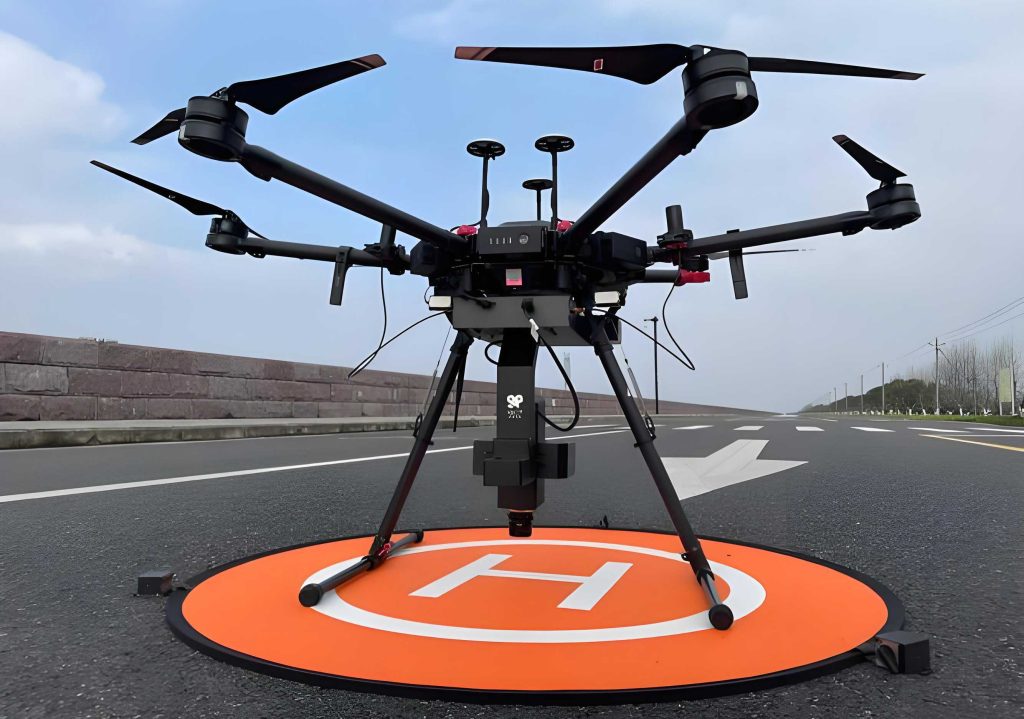
The ecosystem of the China UAV drone is diverse, encompassing multi-rotor, fixed-wing, and hybrid VTOL (Vertical Take-Off and Landing) platforms. Multi-rotor China UAV drones, favored for their stability, hover capability, and ease of operation, dominate the market for small to medium-sized fields and complex crops. Their agility makes the China UAV drone ideal for precise, targeted applications. The proliferation of the China UAV drone is supported by robust manufacturing, active research in path planning and adaptive algorithms, and widespread adoption by cooperatives and individual farmers. This rapid integration underscores the pivotal role of the China UAV drone in modernizing Chinese agriculture.
Analysis of Key Technological Pathways
The precision of a China UAV drone spraying operation hinges on the seamless integration of several interdependent technological pathways. These form the core intelligence of the system, transforming it from a simple flying sprayer into a responsive, decision-making agricultural tool.
1. Flight Path Planning and Dynamic Adjustment
Path planning is the foundational layer for precise spraying with a China UAV drone. Its quality directly impacts spray coverage uniformity, operational efficiency, and chemical usage economy. Moving beyond fixed patterns, modern path planning for the China UAV drone emphasizes efficient obstacle avoidance, terrain following, and adaptability to variable-rate zones. Common methodologies are compared below:
| Path Planning Method | Principle & Strategy | Advantages | Limitations | Typical Use-Case for China UAV Drone |
|---|---|---|---|---|
| Rule-Based Coverage | Pre-defined “Zig-zag” or “Boustrophedon” patterns. | Simple to implement, reliable for regular fields. | Lacks dynamic adjustment; rigid path structure. | Large, rectangular fields of staple crops. |
| Heuristic Algorithms (A*, Ant Colony) | Optimizes path based on map data and objectives, avoiding obstacles. | Adapts to irregular field shapes; path can be optimized. | Computationally intensive; requires real-time processing power. | Orchards or fields with numerous permanent obstacles. |
| Terrain-Adaptive Flight | Adjusts flight altitude in real-time using LiDAR or DEM data to maintain constant spray height. | Ensures consistent droplet deposition on undulating terrain. | Requires high-accuracy sensors; errors need real-time correction. | Hilly regions, terraced fields – a key strength of the China UAV drone. |
| Swarm Cooperative Planning | Coordinates multiple drones to work simultaneously without interference. | Drastically increases operational efficiency for large areas. | Complex communication and synchronization algorithms required. | Large-scale farms employing fleets of China UAV drones. |
The evolution is towards real-time dynamic optimization. By fusing data from LiDAR, infrared, and ultrasonic sensors, the China UAV drone can achieve autonomous obstacle avoidance and terrain-hugging flight. Furthermore, integrating AI for “experience learning” from historical flight data allows the China UAV drone system to continuously refine its route planning. A significant research trend is “flight-spray linkage,” where the path is co-optimized with spraying strategy based on real-time crop variables (species, vigor, density), minimizing overlap and chemical use. The fundamental objective is often to minimize the total flight path length $L_{total}$ while ensuring coverage:
$$L_{total} = \sum_{i=1}^{n-1} d(p_i, p_{i+1})$$
where $d(p_i, p_{i+1})$ is the distance between consecutive waypoints $p_i$ and $p_{i+1}$, optimized under constraints of turning radius $R_{min}$ and coverage swath width $W$.
2. Variable-Rate Spraying Control Technology
This is the core mechanism enabling “on-demand, targeted” application, a defining feature of an advanced China UAV drone. It moves beyond uniform spraying to dynamically adjust volume and spray pattern based on multi-source data. The system comprises three integrated subsystems: Perception, Decision, and Execution.
2.1 Perception of Crop and Environment
The perception subsystem provides the data foundation. Modern China UAV drones are equipped with multispectral, hyperspectral, or RGB cameras. Using Convolutional Neural Networks (CNNs), these systems can identify pests, diseases, weeds, and assess crop vigor (e.g., via NDVI – Normalized Difference Vegetation Index) in real-time. The NDVI is calculated from reflectance in the red (R) and near-infrared (NIR) bands:
$$\text{NDVI} = \frac{\text{NIR} – \text{R}}{\text{NIR} + \text{R}}$$
This index, among others, serves as a key input for the decision-making engine of the China UAV drone.
2.2 Variable-Rate Decision Models
This is the “brain” of the China UAV drone spraying system. It translates perceptual data into precise spraying commands. Several model paradigms exist, as summarized below:
| Decision Model Type | Core Methodology | Mathematical/Logical Representation | Suitability for China UAV Drone |
|---|---|---|---|
| Rule-Based Thresholding | Uses preset thresholds on indices (e.g., NDVI) to zone the field and assign spray rates. | IF NDVI < 0.3 THEN Rate = High; IF 0.3 ≤ NDVI < 0.6 THEN Rate = Medium; ELSE Rate = Low. | Simple, widely implemented in current commercial China UAV drone systems. |
| Spatial Map-Driven | Uses pre-generated prescription maps (e.g., NDVI map, soil map) geo-referenced with RTK-GPS. | $R(x,y) = f(M(x,y))$, where $R$ is spray rate at coordinates $(x,y)$, and $M$ is the value from the prescription map. | Effective for large, surveyed fields; common in precision agriculture workflows. |
| Machine Learning Predictive | Trains models (e.g., Random Forest, SVM, ANN) on historical data to predict optimal spray rate. | $R_{pred} = \text{Model}(I_1, I_2, …, I_n)$, where $I_i$ are input features (NDVI, density, weather, etc.). | High adaptability; represents the future of intelligent decision-making for the China UAV drone. |
| Multi-Factor Dynamic Weighting | Combines multiple input factors with adaptive weights for a composite decision. | $S = w_1 \cdot f_1(\text{NDVI}) + w_2 \cdot f_2(\text{Pest Index}) + w_3 \cdot f_3(\text{Weather}) + \ldots$ where $S$ is final spray intensity, $w_i$ are dynamic weights, $f_i$ are normalization functions. |
Flexible and robust for complex, dynamic field conditions encountered by the China UAV drone. |
2.3 Spraying Execution Control System
This is the final, critical actuation layer of the China UAV drone. It must accurately and swiftly translate decision commands into physical spraying actions. The system typically includes a liquid delivery pump, solenoid valves or PWM-controlled motors, nozzles, and feedback sensors (flow meters, pressure sensors). The core control equation often involves maintaining a constant application rate per unit area ($AR$, in L/ha) despite changes in flight speed ($v$, in m/s) and swath width ($W$, in m):
$$Q_{target} = \frac{AR \cdot v \cdot W}{60000}$$
where $Q_{target}$ is the target flow rate in L/min. The execution system on a China UAV drone continuously adjusts the pump speed or valve duty cycle to match $Q_{target}$ based on real-time $v$ from the flight controller. Integration with the flight control system is paramount, allowing for actions like spray shut-off during turns or acceleration/deceleration phases.
3. Crop Recognition and Environmental Perception Fusion
The efficacy of a China UAV drone hinges on its ability to intelligently perceive both the target (crop) and the context (environment). This fused perception drives adaptive control.
Crop Recognition: Leveraging computer vision and deep learning, the China UAV drone can classify crops, segment individual plants, and identify stress signatures. This allows for species-specific spraying protocols and targeted intervention. The process often involves real-time image analysis onboard the China UAV drone or via edge computing devices.
Environmental Perception: A sophisticated China UAV drone is equipped with an array of sensors: anemometers for wind speed/direction, IMUs for attitude, RTK-GPS for centimeter-level positioning, and ultrasonic/LiDAR for altitude and obstacle detection. This data is crucial for compensating for wind drift, ensuring accurate flight path following, and maintaining optimal spray height.
The fusion of these data streams creates a real-time situational awareness model for the China UAV drone. For instance, wind compensation models use current wind vector $\vec{w}$ to adjust the drone’s flight vector $\vec{v_d}$ or the timing of spray release to ensure droplets land on the intended target area, countering drift. A simplified offset calculation might be:
$$\text{Spray\_Offset} = k \cdot \frac{h \cdot \vec{w}}{v_d}$$
where $h$ is flight height, and $k$ is an empirical drift coefficient specific to the China UAV drone’s spray system and droplet spectrum.
Persistent Challenges for China UAV Drone Deployment
Despite significant advances, several challenges impede the full realization of precision spraying with the China UAV drone. These challenges span technical, operational, and regulatory domains.
| Challenge Category | Specific Issues | Impact on China UAV Drone Operations |
|---|---|---|
| Technical & Adaptive Capacity | Insufficient real-time response to sudden wind gusts, micro-climate changes, or dynamic obstacles. Latency in sensor-data-decision-actuation loop. | Reduced spraying accuracy, increased chemical drift, potential safety hazards. Limits the China UAV drone’s performance in complex, real-world environments. |
| System Integration Gap | Poor fusion between real-time pest/disease identification modules and the variable-rate spraying control system. Often separate, non-communicating subsystems. | The China UAV drone cannot perform true “see-and-spray” targeted therapy. Leads to continued blanket application or reliance on pre-set maps, reducing efficiency gains. |
| Data Standardization & Regional Adaptability | Lack of uniform data formats, communication protocols, and model standards across different China UAV drone manufacturers and platforms. Models trained in one region may fail in another due to different crop varieties, climates, and practices. | Hinders interoperability, scalability, and the development of universal best practices. Increases cost and complexity for large-scale adoption of the China UAV drone technology. |
| Regulatory Frameworks & User Adoption | Absence of nationwide, standardized operational regulations, pesticide use guidelines, and safety certification for China UAV drone spraying. Variable levels of farmer trust and technical expertise. | Results in inconsistent application quality and safety standards. Creates market uncertainty and slows down the coordinated, safe proliferation of the China UAV drone for plant protection. |
Future Trends and Evolutionary Pathways
The trajectory for the China UAV drone in precision agriculture points towards greater intelligence, integration, and ecological harmony. Several key trends are poised to shape its future.
1. Deep AI Integration and Edge-Cloud Synergy: The next-generation China UAV drone will feature deeply embedded AI, enabling real-time, in-flight perception-decision cycles with minimal latency. Lightweight models for pest identification and spray decision will run directly on the drone’s edge computing unit. This will be complemented by cloud-based platforms for fleet management, historical analysis, and model retraining, creating a self-improving ecosystem for the China UAV drone.
2. Advanced Multi-Sensor Fusion and Digital Twins: Perception will move beyond 2D imaging to 3D understanding. The integration of LiDAR, multispectral imaging, and millimeter-wave radar on a single China UAV drone platform will allow for detailed crop canopy modeling, biomass estimation, and sub-canopy target detection. This rich data stream will feed into digital twin models of fields, enabling ultra-precise simulation and planning of China UAV drone operations before execution.
3. Hyper-Modular and Adaptive Spraying Systems: The physical spraying system of the China UAV drone will become more sophisticated. Expect to see independently controllable nozzle banks for different chemicals, active droplet size modulation (e.g., via electrostatic charging or PWM-driven nozzle vibration), and integrated spray drift modeling that dynamically adjusts parameters like release height and droplet spectrum based on real-time atmospheric data.
4. Swarm Intelligence and Heterogeneous Fleet Coordination: The future will not rely on a single China UAV drone but on coordinated fleets. Swarm intelligence algorithms will allow dozens of China UAV drones to collaboratively cover a large area, optimizing paths in real-time to avoid collisions and coverage gaps. Furthermore, heterogeneous fleets comprising different types of China UAV drones (e.g., large payload carriers for liquid, small scouts for sensing) will work in concert, managed by a central AI “orchestrator.”
5. Regulatory Technology (RegTech) and Full Traceability: Blockchain and IoT technologies will be leveraged to create immutable records for every China UAV drone spraying operation. Data such as flight path, pesticide type and volume, weather conditions, and operator ID will be automatically logged and stored. This will facilitate regulatory compliance, enable precise traceability from farm to fork, and build consumer trust in produce protected by the China UAV drone.
Conclusion
The journey of the China UAV drone from a novel aerial platform to an indispensable tool for precision agriculture illustrates a powerful convergence of robotics, AI, and agronomic science. Through systematic advancements in intelligent path planning, variable-rate decision models, fused perception, and precise execution control, the China UAV drone has demonstrated its potential to revolutionize plant protection, making it greener, more efficient, and less resource-intensive. However, the path forward requires addressing significant hurdles in real-time adaptability, system integration, data standardization, and regulatory harmony. The future of the China UAV drone lies in its evolution into an autonomous, cognitive node within a larger agricultural internet-of-things. By embracing deep AI, swarm coordination, and robust regtech frameworks, the China UAV drone will transition from being merely a “usable” tool to a truly “reliable,” “pervasive,” and “trusted” partner in building a sustainable and productive global food system. The continued innovation and thoughtful deployment of the China UAV drone will undoubtedly remain a central narrative in the story of 21st-century agriculture.