
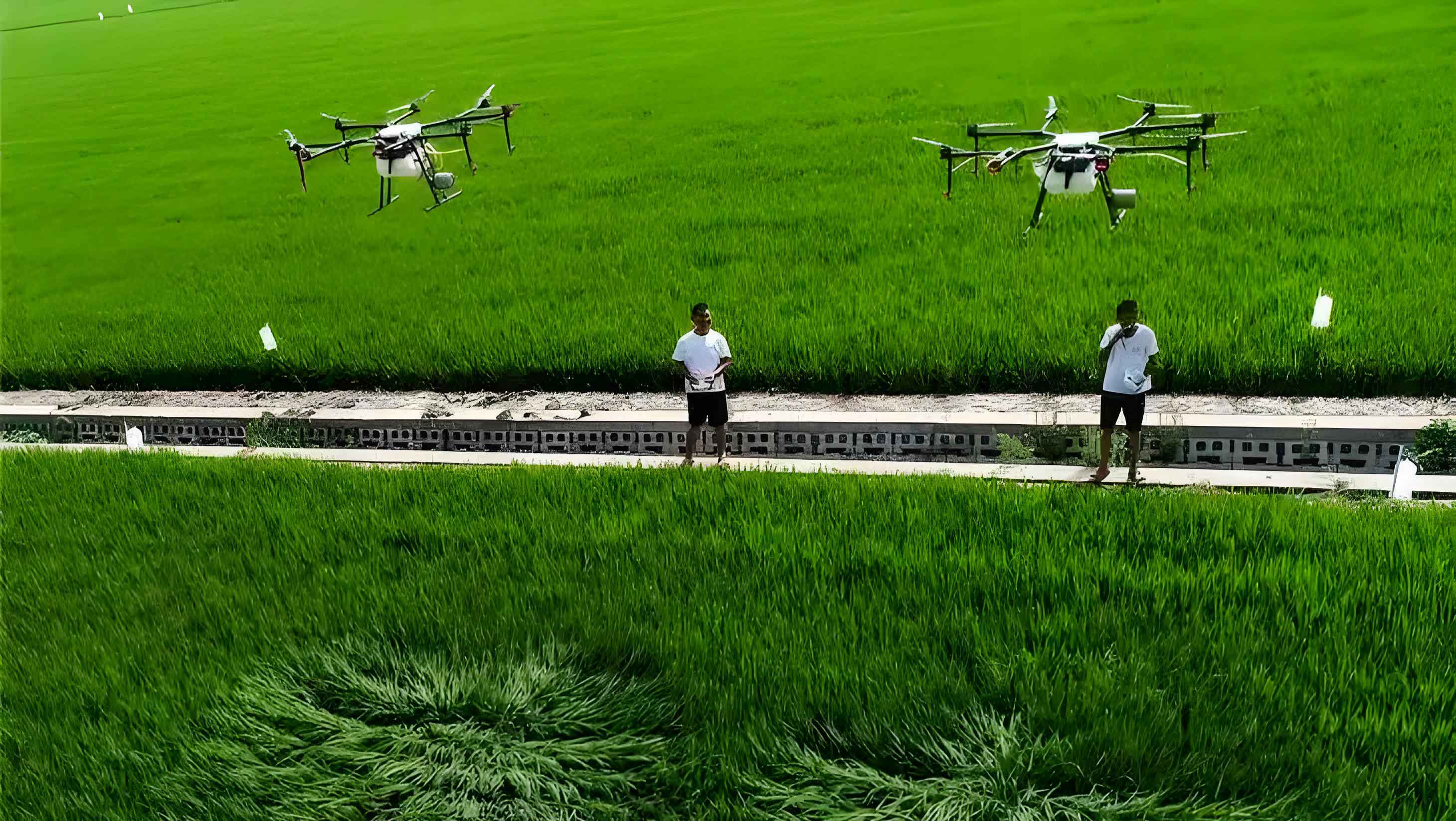
The integration of advanced technology into traditional farming practices marks a pivotal shift towards smart agriculture. Among these technologies, the agricultural drone, particularly the multi-rotor type, has rapidly evolved from a specialized tool for plant protection into a versatile platform capable of multiple farm operations. A significant innovation in this domain is the retrofitting of sowing systems onto existing agricultural drone platforms. This synthesis provides a detailed, first-person analysis of this technology’s principles, comparative advantages, and its transformative potential for modern crop establishment, expanding significantly on foundational reports from regions pioneering its use.
1. Technological Evolution and Operational Rationale
The journey of the agricultural drone began with crop spraying, offering unparalleled advantages in speed, precision, and safety by eliminating human exposure to chemicals. The logical progression was to adapt this agile, GPS-guided platform for other input applications, notably sowing. The core challenge was converting a liquid-dispensing system into one capable of metering and distributing dry, often irregular, solid particles like seeds or fertilizer uniformly across a field.
The sowing attachment for a multi-rotor agricultural drone is an engineered assembly designed to address this challenge. Its operation is a sequence of controlled mechanical and aerodynamic actions. The primary components and their functional interplay are described below, with mathematical models illustrating key physical principles.
1.1 Core Components and Functional Workflow
The system comprises three major sub-assemblies: the seed hopper, the ducted fan, and the broadcasting duct. Their coordinated function enables precise sowing.
- Seed Hopper & Metering Mechanism: Pre-cleaned seeds are loaded into the hopper. Inside, a combination of a cross-shaped agitator and a vibration component prevents seed bridging and ensures a consistent flow towards the metering gate. A roller-type quantitative feeder acts as the primary control point, regulating the seed flow rate ($Q_s$) into the duct. This rate is crucial for achieving the target seeding density.
- Ducted Fan & High-Speed Airflow Channel: This is the propulsion heart of the system. An electrically powered ducted fan generates a high-velocity airstream. The relationship between the power input, fan design, and airflow velocity ($v_a$) can be simplified using the basic thrust equation and Bernoulli’s principle for incompressible flow. The pressure rise ($\Delta P$) across the fan relates to the air density ($\rho$) and the change in kinetic energy of the air:
$$ \Delta P \approx \frac{1}{2} \rho (v_a^2 – v_i^2) $$
where $v_i$ is the inlet air velocity (often near zero). This $\Delta P$ accelerates air through the constricted broadcasting duct. - Broadcasting Duct & Seed Projection: Seeds from the metering mechanism are introduced into this high-speed airflow channel. The seeds are instantly entrained and accelerated by the drag force ($F_d$) exerted by the air:
$$ F_d = \frac{1}{2} C_d \rho A_p (v_a – v_s)^2 $$
where $C_d$ is the drag coefficient of the seed, $A_p$ is its projected area, and $v_s$ is the instantaneous seed velocity. The seeds are ejected from the duct outlet with significant horizontal velocity, achieving a wide and far broadcast swath ($S_w$). The swath width is a function of ejection velocity, ejection angle ($\theta$), and drone flight altitude ($H$), neglecting air resistance for initial projection:
$$ S_w \propto v_a \cdot \cos(\theta) \cdot \sqrt{\frac{2H}{g}} $$
where $g$ is acceleration due to gravity.
2. Comparative Advantage Analysis: A Quantitative Perspective
The adoption of a sowing-enabled agricultural drone must be evaluated against established seeding methods. The following analysis, grounded in operational data, contrasts key performance indicators across different technologies.
| Method | Key Processes | Theoretical Efficiency (ha/day) | Labor Required | Key Agronomic Challenges | Relative Cost Index |
|---|---|---|---|---|---|
| Mechanical Transplanting (Rice) | Nursery preparation (18-20d), soil processing, seeding trays, dark treatment, transportation, placement, nursery management, lifting, transplanting. | 2.67 – 3.33 | High (3 persons/machine + nursery labor) | High capital and operational complexity, strict seedling age requirement. | 1.00 (Baseline) |
| Mechanical Direct Seeding (Dry/Wet) | Land preparation, calibrated seeding via tractor-mounted drill. | 4.0 – 6.0 | Medium (1-2 persons) | Seed loss in wet conditions, uneven distribution leading to weed patches, higher risk of lodging. | 0.65 |
| Manual Broadcasting | Simple manual scattering of seed. | ~0.53 | Very High | Extremely low efficiency, poor seed-soil contact, shallow rooting, severe lodging, highly uneven distribution. | 0.90 (due to high labor cost) |
| Agricultural Drone Sowing | Seed loading, automated flight path execution. | 32.0 – 48.0 (4-6 ha/hr, 8-hr day) | Very Low (1 operator for multiple drones) | Initial investment, sensitivity to very strong wind, requires proper seed calibration. | 0.50 – 0.70 |
2.1 Deconstructing the Advantages
The table underscores the transformative efficiency of the agricultural drone. The benefits are multi-faceted:
Labor and Cost Savings: The agricultural drone collapses the multi-step, labor-intensive transplanting pipeline into a single-step, direct seeding operation. It eliminates needs for nursery infrastructure, seedling transport, and the associated manual labor. This directly translates to lower variable costs and mitigates chronic farm labor shortages, especially during peak seasons. The cost index in Table 1 reflects savings from reduced labor, fuel, and machinery wear.
Superior Operational Efficiency and Flexibility: An agricultural drone is not constrained by field terrain or soil moisture. It can operate over wet fields where tractors would bog down. With lighting systems, operation can extend into night hours. Advanced flight control systems enable precise geofencing, overlap control, and variable rate seeding ($VRS$), where the seeding rate $Q_s$ is adjusted in real-time based on a prescription map:
$$ Q_s(x,y) = f( \text{SoilMap}(x,y), \text{YieldMap}(x,y) ) $$
This level of control is impractical with traditional methods. The achieved sowing pattern, while not as precise as drilling, results in a well-spaced, semi-regular plant stand that promotes good ventilation, reduces disease pressure, and enhances lodging resistance compared to random broadcast.
Enhanced Application Accuracy and Input Savings: Modern agricultural drone systems feature integrated weighing sensors and AI-driven spread calibration. This allows for highly accurate total application and, through $VRS$, optimal placement. It minimizes seed waste—common in water-seeded conditions where tractor waves displace seeds—and ensures more uniform germination and crop establishment. The uniformity of spread can be quantified by the Coefficient of Variation ($CV$) across multiple collection trays:
$$ CV = \frac{\sigma}{\mu} \times 100\% $$
where $\sigma$ is the standard deviation of seed mass per tray and $\mu$ is the mean mass. Advanced agricultural drone systems aim for a $CV < 15\%$, rivaling or surpassing manual and mechanical broadcast methods.
3. Technical Specifications of Leading Platforms and Future Trajectory
The commercial viability of drone sowing is propelled by rapid advancements in platform design. Manufacturers are now producing agricultural drone models with payload capacities and spreading mechanisms specifically engineered for dry granular materials.
- Platform A (e.g., DJI T30): Offers a payload capacity of 40 kg. Its spreading system utilizes a three-gate outlet and an 8-rib spreading disc to ensure omnidirectional uniformity. With a flow rate of 40-50 kg/min and a swath of up to 7 meters, its theoretical field capacity can exceed 6 hectares per hour for sowing, demonstrating the sheer scalability of agricultural drone technology.
- Platform B (e.g., XAG P80): Features a 40 kg payload and a 60-liter hopper. It employs a screw conveyor for quantitative metering and a centrifugal spreader plate, achieving a wide, adjustable fan-shaped swath of 6-10 meters. Its operational speed of up to 8 m/s enables rapid area coverage.
The progression towards higher payloads, smarter metering, and integrated task planning software underscores a promising future. Supportive policies and growing market acceptance are creating an ecosystem where the multi-role agricultural drone becomes a central hub for precision input management.
4. Operational Hurdles: Troubleshooting the Sowing System
Despite its advantages, practical operation of a sowing-enabled agricultural drone presents specific failure modes. A systematic approach to diagnostics and resolution is essential for maintaining field efficiency.
| Fault Symptom | Probable Cause | Diagnosis & Resolution | Preventive Measure |
|---|---|---|---|
| Complete blockage; no seed discharge. | Overload or jamming at the roller quantitative feeder. Seed flow impedance causes a backlog leading to a solid bridge. | Immediately land the agricultural drone. Inspect and clear the feeder and duct inlet. A permanent fix often involves installing a soft brush at the feeder outlet to gently guide seeds and prevent bridging. | Use only clean, graded seed. Calibrate the feed rate appropriately for seed size and shape. Conduct a static test before full operation. |
| Uneven seed distribution across the swath. | Partial obstruction on the duct fan blades or spreader disc (e.g., by plant fibers, dust clumps). This disrupts the symmetric airflow or centrifugal force pattern. | Land and visually inspect the duct fan assembly and spreader mechanism. Carefully remove all debris. Verify blade integrity. | Perform pre- and post-flight inspections. Clean the system thoroughly after each use, especially when switching between different materials (e.g., fertilizer to seed). |
| Inconsistent seeding rate (patches of over/under seeding). | 1. Incorrect calibration for seed type. 2. Vibration causing feed gate setting to shift. 3. Low battery voltage affecting feeder motor consistency. |
1. Re-calibrate on a tarp for the specific seed. 2. Secure all adjustment locks and dampen feeder mount vibrations. 3. Ensure batteries are above minimum operational voltage. |
Maintain a calibration log for different crops. Use thread-locking compounds on adjustment screws. Follow strict battery management protocols. |
| Reduced swath width or throwing distance. | 1. Worn or damaged fan blades/spreader vanes. 2. Low fan motor RPM due to power issue. 3. Flying in excessive headwind. |
1. Inspect and replace worn components. 2. Check power connections and motor health. 3. Adjust flight pattern and swath overlap to compensate for wind. |
Implement a regular maintenance schedule for rotating parts. Monitor real-time motor data via the controller app. Schedule operations for periods of calm wind. |
Fundamental Safety Protocol: Beyond system-specific faults, a universal pre-flight checklist for the agricultural drone is non-negotiable. This includes surveying the field for obstacles (wires, trees), checking weather conditions, verifying GPS signal integrity, ensuring all components are securely fastened, and confirming failsafe procedures are set. Continuous visual monitoring during flight is mandatory to preempt any anomalous behavior.
5. Conclusion: An Integral Tool for Sustainable Intensification
The convergence of aerial mobility, precision guidance, and granular material handling has given rise to a highly effective tool: the sowing-enabled agricultural drone. Its technical principle—using controlled aerodynamic force for seed distribution—provides a unique solution that bridges the gap between the high cost of precision drill seeding and the inefficiency of broadcast methods. The quantitative analysis reveals decisive advantages in labor productivity, operational flexibility, and input use efficiency. While attentive management is required to handle specific failure modes like feeder blockages or uneven spread, the operational protocols are well-defined.
As platform capabilities expand and integration with farm management information systems deepens, the role of the agricultural drone will evolve from a novel application tool to a fundamental component of responsive, data-driven crop management systems. Its ability to perform sowing, fertilizing, and plant protection with a single platform positions it as a cornerstone technology for achieving sustainable agricultural intensification, optimizing resource use, and bolstering farm resilience against labor and climatic uncertainties.