
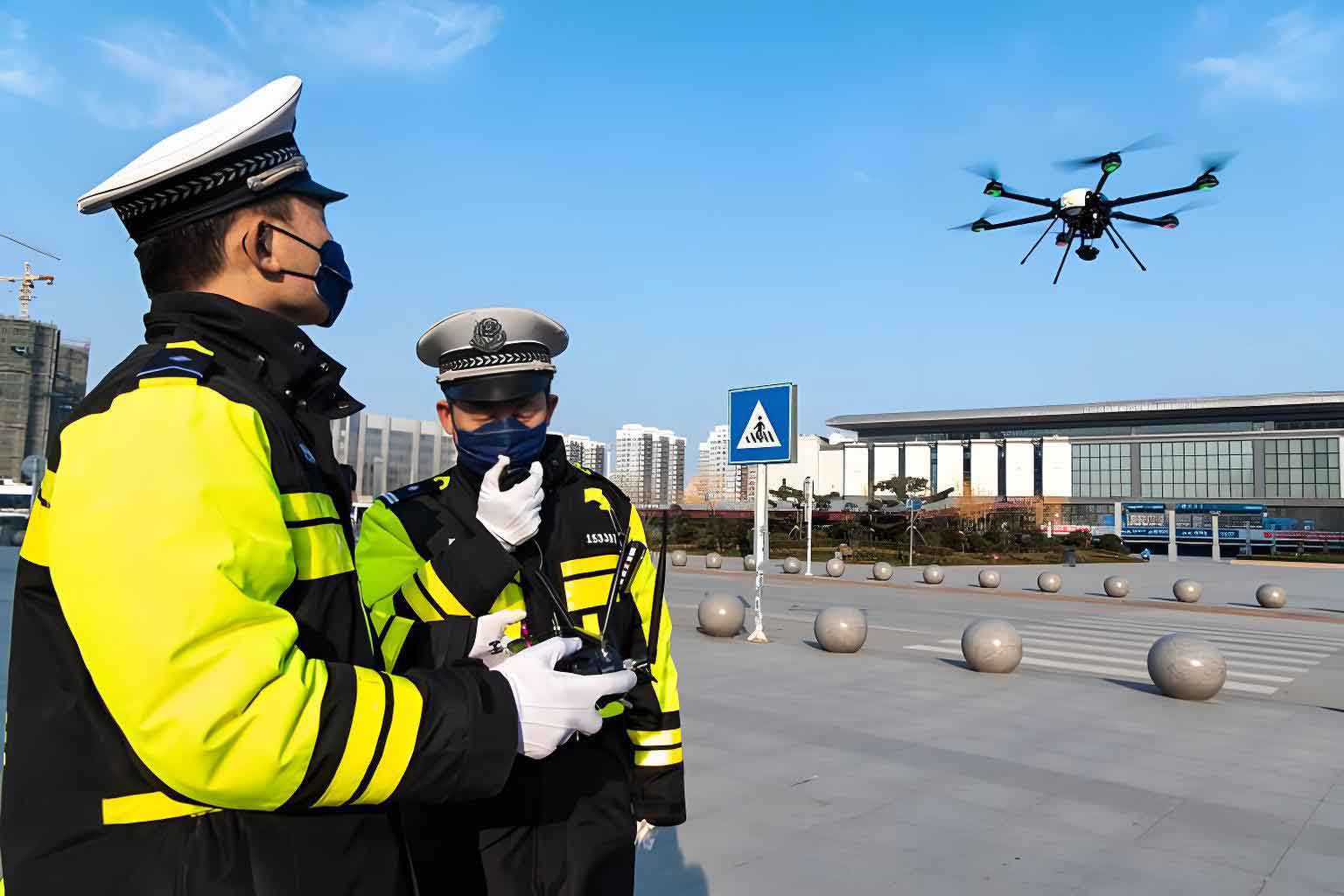
As an expert deeply involved in the field of law enforcement technology, I have witnessed the rapid integration of police UAV (Unmanned Aerial Vehicle) systems into modern policing. Police UAVs, distinct from consumer-grade drones, are specialized aerial platforms equipped with mission-specific modules to execute tasks such as reconnaissance, intervention, and strike operations with precision. Their adoption across various police departments—including criminal investigation, traffic management, public security, patrol, SWAT, narcotics control, and firefighting—has revolutionized responses to terrorism, emergencies, disasters, riots, large-scale events, search and rescue, and traffic surveillance. In this article, I will delve into the application characteristics and development trends of police UAVs, emphasizing their transformative role through detailed analysis, tables, and mathematical models.
The core value of police UAVs lies in their ability to enhance operational efficiency and safety. From my perspective, the integration of police UAV systems is not merely an addition of equipment but a paradigm shift in law enforcement methodologies. Let me begin by outlining the key application characteristics that define police UAVs.
Application Characteristics of Police UAVs
Police UAVs serve as critical特种装备 for public security agencies, supporting seven major police branches and twenty-three types of警务工作. Their design and deployment are tailored to meet the unique demands of law enforcement, resulting in distinct features.
1. Rapid Deployment Capability
Law enforcement operations are often突发性 and uncertain, requiring swift responses. Police UAVs must be deployable within minutes to seize fleeting opportunities. This capability is quantified by the deployment time \( T_d \), which includes preparation, takeoff, and mission initiation. For optimal performance, \( T_d \) should minimize to under 5 minutes, as expressed in the efficiency equation:
$$ T_d = t_{prep} + t_{takeoff} + t_{stabilize} $$
where \( t_{prep} \) is the preparation time (e.g., system checks), \( t_{takeoff} \) is the time to ascend, and \( t_{stabilize} \) is the time to achieve stable flight. Advanced police UAV systems reduce \( T_d \) through modular designs and automated processes.
2. Enhanced Stealth and隐蔽能力
For侦察, tracking, and apprehension missions, stealth is paramount to avoid alerting suspects. Police UAVs incorporate noise reduction, low-visibility coatings, and specialized propulsion systems. The acoustic signature \( S_a \) of a police UAV can be modeled as:
$$ S_a = 10 \log_{10}\left( \frac{P}{P_0} \right) – \alpha d $$
where \( P \) is the sound power, \( P_0 \) is the reference power, \( \alpha \) is the attenuation coefficient, and \( d \) is the distance. Designs aim to minimize \( S_a \) through aerodynamic桨叶 and electric propulsion, ensuring隐蔽性 in urban and rural environments.
3. Diversified and Integrated Systems
The broad scope of police work necessitates versatile police UAV platforms with modular payloads. These systems exhibit high集成度 and通用性, adapting to diverse scenarios. Table 1 summarizes common police UAV payloads and their applications.
| Payload Type | Application | Key Features |
|---|---|---|
| High-resolution Camera | Surveillance, Evidence Collection | Optical zoom, Thermal imaging |
| Loudspeaker | Crowd Control, Communication | Long-range audio projection |
| Searchlight | Night Operations, Search and Rescue | Adjustable intensity, LED technology |
| Non-lethal Weapons | Riot Dispersal, Targeted Strikes | Precision aiming, Safety mechanisms |
| Environmental Sensors | Hazard Detection, Disaster Response | Gas detection, Radiation monitoring |
The modularity allows police UAVs to be configured rapidly, with payload integration governed by the compatibility equation:
$$ C = \sum_{i=1}^{n} w_i \cdot I_i $$
where \( C \) is the overall compatibility score, \( w_i \) is the weight for payload \( i \), and \( I_i \) is the integration index (0 to 1). High \( C \) values indicate seamless adaptation to multi警种 needs.
4. High Safety and Reliability
Police UAVs are professional-grade systems subjected to rigorous testing beyond consumer standards. They undergo高低温测试, corrosion resistance, endurance, and stability assessments. Reliability \( R \) is defined as the probability of failure-free operation over time \( t \), often modeled with the exponential distribution:
$$ R(t) = e^{-\lambda t} $$
where \( \lambda \) is the failure rate. For police UAVs, \( \lambda \) is minimized through robust design, with typical values below 0.001 failures per hour. Data security and communication links adhere to industrial or military standards, ensuring保密性 against interception. Table 2 compares police UAVs with consumer drones.
| Aspect | Police UAV | Consumer Drone |
|---|---|---|
| Endurance | > 60 minutes | 20-30 minutes |
| Payload Capacity | 5-20 kg | < 2 kg |
| Communication Security | Encrypted, Redundant | Basic, Vulnerable |
| Environmental Resilience | Operates in extreme conditions | Limited to mild weather |
| Regulatory Compliance | Meets公安 standards | Basic FAA guidelines |
These characteristics underscore why police UAVs are indispensable in modern law enforcement. As technology evolves, the trends in police UAV development promise even greater capabilities.
Development Trends of Police UAVs
The police UAV sector has moved beyond its nascent stage into a phase of refinement and成熟. Based on my observations, several key trends are shaping the future of police UAV systems, driven by technological advancements and operational需求.
1. Innovation in Airframe Platforms
Traditional platforms like fixed-wing, helicopter, and multi-rotor police UAVs each have trade-offs. Fixed-wing offers long endurance and speed but requires runways; multi-rotor allows vertical takeoff and hover but has limited航时. The emergence of vertical takeoff and landing (VTOL) fixed-wing hybrids (复合翼机) addresses runway dependency, yet lacks optimal low-altitude performance. The倾转旋翼机 (VTOL tilt-rotor) represents a breakthrough, combining efficiency and versatility. Its aerodynamic efficiency \( \eta \) can be expressed as:
$$ \eta = \frac{L}{D} \cdot \frac{V}{P} $$
where \( L \) is lift, \( D \) is drag, \( V \) is velocity, and \( P \) is power. Tilt-rotor police UAVs achieve higher \( \eta \) than hybrids or helicopters, enabling extended missions with hover capabilities. Research focuses on optimizing this platform for police UAV applications, with prototypes showing 30% improvements in endurance over current models.
2. Diversification of Equipment Based on警务工作需求
As police UAV technology advances, operational demands drive platform and payload多元化. The approach involves selecting suitable police UAV platforms and integrating diverse, reliable mission modules. For instance, a police UAV for traffic surveillance might combine LiDAR sensors with AI processors for real-time accident analysis, while one for禁毒 missions could employ spectral analyzers for drug detection. The effectiveness \( E \) of a police UAV system in solving警务实战难题 is given by:
$$ E = \alpha \cdot P_{plat} + \beta \cdot P_{mod} $$
where \( \alpha \) and \( \beta \) are weighting factors, \( P_{plat} \) is the platform suitability score, and \( P_{mod} \) is the module reliability score. This trend emphasizes customization, with police agencies adopting tailored police UAV solutions.
3. Establishment of Professional Police UAV Teams
Effective deployment of police UAV systems requires skilled operators with expertise in无人机技术, aviation laws, and警务设备. I advocate for专业培训 programs through police academies and校企合作 with manufacturers. Training covers政治理论,航空法规, and operational skills, culminating in a police UAV pilot license. The competency level \( CL \) of an operator can be modeled as:
$$ CL = \frac{T_{theory} + T_{practical}}{T_{total}} \cdot P_{pass} $$
where \( T_{theory} \) is theory training hours, \( T_{practical} \) is hands-on hours, \( T_{total} \) is total training time, and \( P_{pass} \) is the pass rate on exams. Standardized licensing ensures that every police UAV operator contributes legally and effectively to执法执勤 and安保维稳.
4. Increasing智能程度 with Advanced Technologies
Artificial intelligence, cloud computing, and big data are elevating the智能程度 of police UAVs. Innovations include:
- Wearable Control Systems: Using gesture control and AR, operators can maneuver police UAVs without ground stations, freeing hands for combat. The control accuracy \( A_c \) is enhanced by AI algorithms:
$$ A_c = 1 – \frac{E_{track}}{E_{total}} $$
where \( E_{track} \) is tracking error and \( E_{total} \) is total operational error.
- Force Multiplication Technology: Integrates data from police UAVs, officers, and command centers for real-time态势共享. This improves situational awareness, with information fusion效率 \( \eta_f \) calculated as:
$$ \eta_f = \frac{I_{shared}}{I_{total}} \cdot 100\% $$
where \( I_{shared} \) is shared information volume and \( I_{total} \) is total information gathered by police UAVs.
- One-Station Multi-UAV Coordination: Cluster control and multi-link transmission enable a single ground station to manage multiple police UAVs simultaneously. The efficiency gain \( G \) is:
$$ G = \frac{n \cdot M_{avg}}{M_{single}} $$
where \( n \) is the number of police UAVs, \( M_{avg} \) is average mission success rate per police UAV, and \( M_{single} \) is the success rate for a single police UAV. This maximizes the utilization of police UAV resources during critical incidents.
5. Deep Integration with公安业务信息系统
Currently, most police UAVs operate as standalone tools rather than integrated components of公安信息化 systems. To address this, future developments must focus on standardizing data ports and links for seamless接入. The integration level \( I_{sys} \) can be expressed as:
$$ I_{sys} = \sum_{j=1}^{m} \frac{C_{UAV,j}}{C_{total,j}} $$
where \( C_{UAV,j} \) is the connectivity of police UAVs to system \( j \) (e.g., PGIS, fugitive databases), and \( C_{total,j} \) is the total required connectivity. By linking police UAVs to systems like警用地理信息系统 (PGIS) and情报管理信息系统, they can enable远程情报搜集,预警, and even direct command center control. This transforms the信息搜集优势 of police UAVs into rapid处置和打击优势, enhancing decision-making效率.
In summary, the evolution of police UAVs is marked by technological sophistication and operational integration. From my experience, the continued emphasis on platform innovation, equipment diversification, professional training,智能化, and system融合 will propel police UAVs to become even more vital in law enforcement. As these trends unfold, police UAVs will not only assist in current tasks but also unlock new capabilities for future警务工作, ensuring public safety in an increasingly complex world. The journey of police UAVs is far from over, and I am confident that their impact will deepen with each advancement.
To further illustrate the technical parameters, Table 3 provides a comparison of next-generation police UAV platforms based on the trends discussed.
| Platform Type | Endurance (hours) | Max Speed (km/h) | Payload Capacity (kg) | Key Advantage | Typical Use Case |
|---|---|---|---|---|---|
| Multi-rotor Police UAV | 1-2 | 80 | 5-10 | Vertical takeoff, Hover | Urban surveillance |
| Fixed-wing Police UAV | 6-12 | 150 | 15-20 | Long range, High speed | Border patrol |
| VTOL Hybrid Police UAV | 4-6 | 120 | 10-15 | Vertical takeoff, Efficient cruise | Disaster response |
| Tilt-rotor Police UAV | 5-8 | 180 | 12-18 | Combined hover and speed | SWAT operations |
The mathematical modeling of police UAV performance, such as endurance optimization, can be derived from the power consumption equation:
$$ E_{total} = P_{hover} \cdot t_{hover} + P_{cruise} \cdot t_{cruise} $$
where \( E_{total} \) is total energy, \( P_{hover} \) and \( P_{cruise} \) are power rates, and \( t_{hover} \) and \( t_{cruise} \) are times spent in respective modes. For police UAVs, minimizing \( E_{total} \) while maximizing mission coverage is a key research area.
In conclusion, the future of police UAVs is bright, with innovations poised to address emerging challenges. As I reflect on the journey, it is clear that police UAVs have transitioned from niche tools to cornerstone assets in law enforcement. By embracing these trends, agencies can harness the full potential of police UAV systems, creating safer communities through technology and expertise. The ongoing development of police UAVs will undoubtedly shape the landscape of public security for years to come, and I look forward to contributing to this dynamic field.