
In the contemporary landscape of law enforcement, the integration of technology is not merely an advantage but a necessity. Among the most transformative tools in this technological arsenal is the Unmanned Aerial Vehicle (UAV). Specifically, the deployment of police UAV systems has revolutionized operational paradigms, offering unprecedented capabilities in surveillance, reconnaissance, emergency response, and public management. The rapid proliferation of these systems within public security agencies has, however, outstripped the development of standardized, systematic educational frameworks to produce proficient operators, tacticians, and administrators. While numerous police colleges have begun to explore this domain, the pedagogical approaches, content structuring, and talent cultivation mechanisms remain largely experimental and fragmented. This article, drawing from our direct experience and research in the field, argues for the urgent establishment of a unified, scientifically-grounded curriculum for police UAV education. We posit that a service-oriented,实战-oriented curriculum must employ a多元化 pedagogical model, strategically applying接受式, 自学—辅导式, 范例, and探究式 teaching methods across distinct theoretical, practical, and applicative modules. This holistic approach, coupled with specific operational procedures, implementation conditions, and multi-dimensional evaluation systems, is essential for transitioning police UAV training from an ad-hoc skill set to a professional discipline.
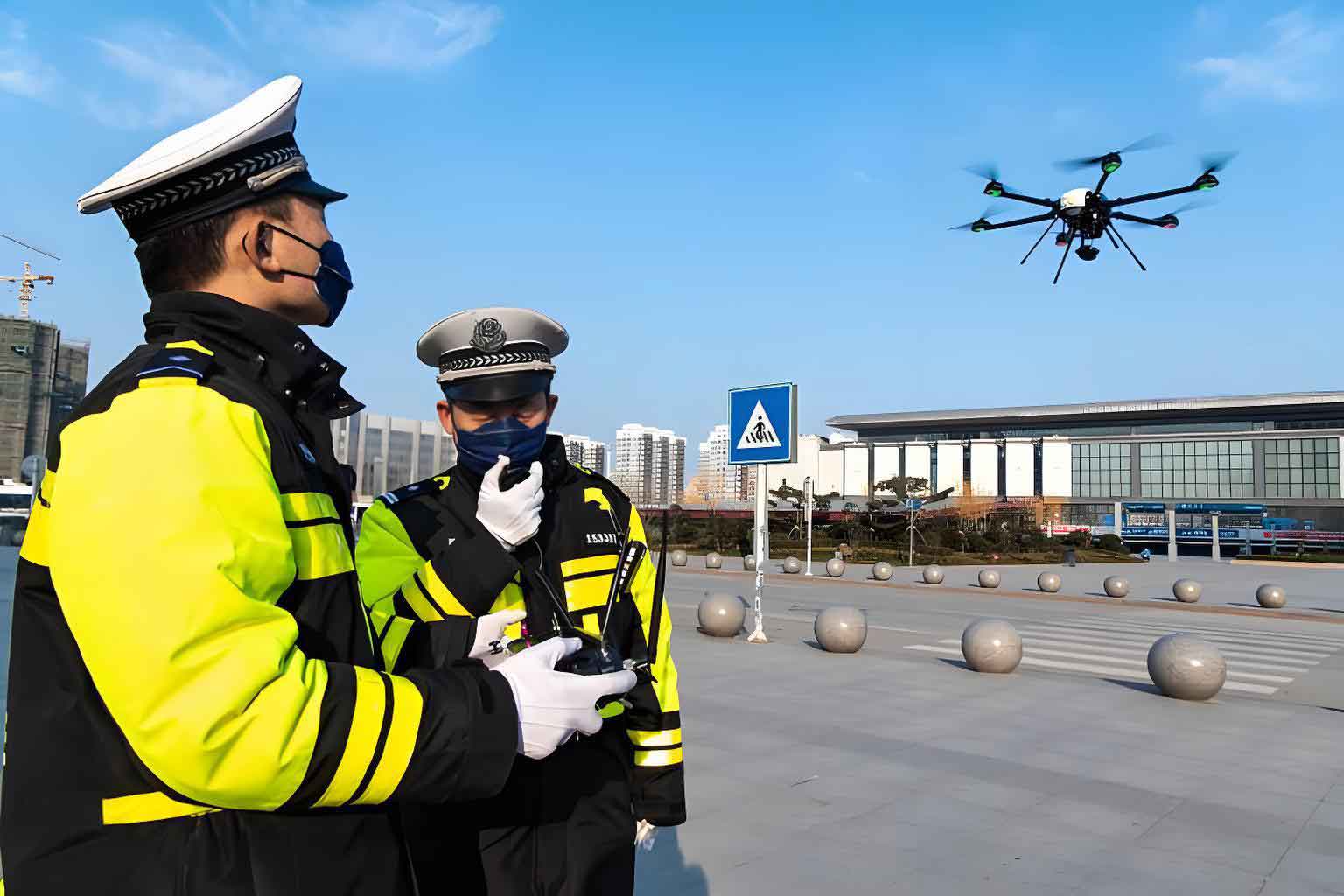
The visual representation above underscores the operational reality of modern policing. To effectively harness such technology, a robust educational foundation is paramount. Our discussion begins by tracing the evolution and defining the core concept of the police UAV. The historical trajectory of UAVs is firmly rooted in military applications, evolving from rudimentary target drones in the early 20th century to sophisticated, remotely piloted and autonomous systems for reconnaissance and combat. The adoption of this technology by law enforcement represents a significant cross-domain migration. Documented large-scale use in Chinese policing can be traced to the 2008 Beijing Olympic Games, where police UAV units were deployed for aerial patrols to augment ground security forces. This marked a pivotal moment, leading to the formation of specialized units, such as the aerial video reconnaissance squadron established in Wuhan in 2012. The global COVID-19 pandemic further catalyzed innovative applications, with police UAV platforms being utilized for “non-contact” missions including aerial broadcasting, thermal screening, and disinfection, proving their critical value in public health emergency management. Operationally, a police UAV is defined as an uncrewed aircraft system equipped by public security organs, suitable for executing a wide range of policing tasks. This excludes hobbyist models, balloons, and other special-purpose craft. The defining characteristics of modern police UAV systems—compact size, operational隐蔽性, and high system integration—unlock a vast spectrum of applications. These can be broadly categorized through their payloads and missions, as summarized in the table below.
| Payload Type | Exemplary Equipment | Primary Policing Applications |
|---|---|---|
| Imaging & Sensing | High-resolution visual cameras, Thermal/Infrared cameras, Multispectral sensors | Crowd monitoring, Search & Rescue (SAR), Crime/Accident scene investigation, Narcotics detection (e.g., identifying specific plant signatures), Traffic flow analysis, Fire assessment. |
| Delivery & Intervention | Loudspeakers, Payload release mechanisms (for life-saving equipment), Non-lethal payloads (nets, irritants) | Public address/communication in crises, Delivery of medical supplies or flotation devices, Tactical incapacitation and apprehension in high-risk scenarios. |
| Specialized Enforcement | Signal jammers, Tracking beacons | Counter-Unmanned Aerial System (C-UAS) operations against “黑飞” or rogue drones, Covert tracking of targets or vehicles. |
The potential of police UAV technology is immense, but its effective exploitation is contingent upon the availability of a skilled workforce. This creates a significant supply-demand矛盾. Currently, the educational landscape within police academies is characterized by pioneering but isolated efforts. The People’s Public Security University of China has taken a leading role by establishing a designated police UAV training and examination center. It has contributed to foundational knowledge through the development of standardized training outlines and textbooks covering basic theory, flight training, mission planning, and aerial investigation tactics. Their programs address both pilot licensing and instructor certification. Zhengzhou Police College pioneered formal学历教育 by launching an undergraduate program in Investigation Science with a concentration on UAV policing applications in 2018, creating a blueprint for comprehensive curriculum design, laboratory development, and industry-academia collaboration. Other institutions, including the China People’s Police University, Nanjing Police College, Yunnan Police College, Jiangsu Police College, and our own institution in Anhui, are actively engaged in资质申报, professional program exploration, research center establishment, and the integration of UAV modules into existing tactical courses. Despite these advancements, a cohesive, universally adopted curriculum framework is absent. The pedagogical models, content depth, and qualification pathways vary significantly, hindering the development of a truly standardized and professionalized police UAV corps.
To bridge this gap, we advocate for a purpose-driven,多元化 teaching model. A one-size-fits-all approach is ineffective for a subject that spans theoretical knowledge, complex psychomotor skills, and strategic tactical application. The choice of教学模式 must be deliberately matched to specific learning objectives within the curriculum’s architecture. The core instructional models we integrate are:
- Receptive Teaching Model: Ideal for the theoretical foundation module. The instructor is the primary source of knowledge transmission, ensuring efficient coverage of a large body of essential information, including regulations, aeronautical principles, and overarching tactical doctrines for police UAV deployment.
- Self-Learning with Tutoring Model: Critical for the flight training module. Students take primary responsibility for skill acquisition through simulators and guided practice, while instructors provide personalized feedback, corrective guidance, and safety oversight tailored to individual learner progress.
- Example-Based and Inquiry-Based Models: Essential for the practical application and tactical innovation module. Learning is driven by analyzing real-world case studies (examples) and by engaging in problem-solving cycles where students hypothesize, test, and evaluate solutions to authentic policing challenges using police UAV technology.
The overarching goal of this integrated curriculum is unequivocally service to实战. This goal decomposes into three core talent profiles: the Operator, the Regulator, and the Innovator. The Operator must achieve high proficiency in flight control, data acquisition (imaging, LiDAR), post-processing (3D modeling, photogrammetry), and data dissemination. The Regulator requires mastery of the legal landscape governing civilian and police UAV operations, including registration, airspace authorization protocols, and C-UAS tactics to manage “black flight” incidents. The Innovator needs foundational skills in software development and programming to tailor police UAV systems to specific警务实践需求, such as programming automated object detection/alerting through machine learning or developing swarming algorithms for coordinated multi-drone operations.
The operationalization of these models follows distinct教学操作程序. For theoretical modules (Receptive Model), we employ a structured sequence: Review Previous Knowledge → Stimulate Learning Motivation (via case studies, scenarios) → Present New Material → Conduct Consolidation Exercises → Assess Understanding → Schedule Spaced Repetition. This ensures systematic knowledge integration and retention. The sequence can be formalized as a reinforcement function for knowledge retention $R(t)$, where review sessions at intervals $t_i$ strengthen memory traces:
$$ R(t) = \sum_{i=1}^{n} \alpha_i e^{-\beta (t – t_i)} $$
Here, $ \alpha_i $ represents the strength of the $i$-th learning/review session, and $\beta$ is the decay rate. Scheduled reviews ($t_i$) combat this decay.
For the flight training module (Self-Learning/Tutoring Model), the procedure is more fluid: Self-Directed Practice (on simulators) → Group Discussion of Techniques → Instructor-Led启发 & Demonstration → Summary of Key Principles → Supervised Live-Flight Practice and Consolidation. This maximizes hands-on engagement within安全 constraints. A simplified model for skill progression $S$ could consider practice time $T$, quality of feedback $F$, and initial aptitude $A$:
$$ S(T) = A + \gamma \int_{0}^{T} F(t) \cdot \ln(1 + t) \, dt $$
where $\gamma$ is a learning rate constant, emphasizing the importance of quality feedback $F(t)$ over time.
The practical application module (Inquiry/Example Model) follows a scientific problem-solving cycle: Identify Real-World Problem → Formulate Hypotheses/Solutions → Develop & Simulate Plan → Validate in Practical Exercise → Analyze & Summarize Results → Refine for Operational Implementation. This cycle, depicted below, is core to developing tactical ingenuity.
$$
\text{Problem} \rightarrow \text{Hypothesis} \rightarrow \text{Plan} \rightarrow \text{Validation} \rightarrow \text{Analysis} \rightarrow \text{Implementation}
$$
The successful implementation of this curriculum hinges on three key教学实现条件:师资,场地, and教学方法. For师资, we promote a collaborative “bring in, send out” strategy, partnering with certified external教官 from aviation authorities and industry to complement internal faculty, especially for advanced technical and certification training. Regarding场地, a hybrid approach is practical: utilizing on-campus laboratories for simulation and virtual reality (VR) training, while partnering with or leasing established off-campus airfields that meet regulatory净空条件 for live-flight training. The教学方法 must be technologically enriched and practice-focused:
- Simulation & Virtual Reality (VR): Essential for initial技能 acquisition and high-risk战术演练. Platforms like DJI Flight Simulator or PhoenixRC allow safe, repetitive practice of complex maneuvers. VR can immerse students in reconstructed 3D scenarios of real案例, allowing them to plan and execute police UAV missions, test tactics, and analyze outcomes without real-world risks or costs.
- Competition-Driven Learning: Organizing实战-oriented competitions (e.g., search pattern efficiency, target identification speed, coordinated swarm missions) fosters innovation, peer learning, and direct alignment with operational needs. A competition score $C$ could be a weighted sum of mission completion time $t_{comp}$, accuracy $Acc$, and resource efficiency $Eff$:
$$ C = w_1 \cdot f(t_{comp}) + w_2 \cdot Acc + w_3 \cdot Eff $$
where $w_i$ are weights reflecting operational priorities. - Interdisciplinary Exchange: Encouraging student clubs and facilitating exchanges with FPV (First-Person View) racing communities can dramatically enhance piloting reflexes, spatial awareness, and comfort with aggressive maneuvering, skills transferable to dynamic policing scenarios.
A transformative curriculum demands an equally transformative教学评价方法. Moving beyond单一 paper-based exams, we propose a multi-dimensional assessment framework with both formative (ongoing) and summative (final) components. The overall grade $G$ is a weighted composite:
$$ G = 0.2 \cdot G_{theory} + 0.4 \cdot G_{flight} + 0.4 \cdot G_{practical} $$
This weighting reflects the practical, skill-based emphasis of police UAV operations. Formative assessment includes regular quizzes, flight skill checks, and participation in tactical discussions. Summative assessment comprises a final written exam, a graded live-flight test (with one allowable补考 as per standard guidelines), and a capstone practical project or scenario-based evaluation. Crucially, the system must accommodate个性化考核 for exceptional talent—students who demonstrate profound innovation, such as developing a novel police UAV战术 or software tool. Their assessment can be based on a peer-reviewed project defense or a demonstrated capability, bypassing conventional exams to nurture groundbreaking contributions to the field.
The detailed structure of our proposed core curriculum modules is outlined in the following table. This design integrates the pedagogical models, operational procedures, and assessment strategies discussed.
| Curriculum Module | Primary Content | Recommended Pedagogy | Key Assessment Methods | Implementation Tools/Facilities |
|---|---|---|---|---|
| Module 1: Theoretical Foundation | • National & International UAV Regulations • Basic Aeronautics & Meteorology • Police UAV Platform Types & Payloads • Airspace Management & Flight Planning • Ethics & Privacy Law | Receptive Teaching Model | Formative: Quizzes, Case Analyses. Summative: Written Exam. | Classroom, LMS (Learning Management System), Regulatory Databases. |
| Module 2: Core Flight Skills | • Simulator Training (Orientation, Basic Maneuvers) • Live-Flight Training (Basic Patterns, Mission Profiles) • Emergency Procedures • Maintenance & Pre-flight Checks | Self-Learning with Tutoring Model | Formative: Simulator Skill Checks, Progress Logs. Summative: Practical Flight Test (Take-off, Navigation, Landing, Emergency Sim.). | Flight Simulators (e.g., DJI Sim, PhoenixRC), Designated Training Airfield, Training UAVs. |
| Module 3: Data Acquisition & Processing | • Mission-Specific Payload Operation (Camera, LiDAR) • Data Link Management • Basics of Photogrammetry & 3D Modeling • GIS Integration for Data Analysis | Blended: Receptive & Example-Based | Formative: Data Collection Exercises, Model Quality Review. Summative: Project creating an orthomosaic/3D model from a simulated scene. | Advanced Police UAV with multiple payloads, Photogrammetry Software (e.g., Pix4D, Metashape), GIS Software. |
| Module 4: Tactical Application & Innovation | • Case Studies of Police UAV Deployment (Crowd Control, SAR, CBRN) • Tactical Planning for Complex Operations • Counter-UAS (“黑飞” Interdiction) Tactics • Introduction to Swarm Logic & Basic Programming for Automation | Example-Based & Inquiry-Based Models | Formative: Tactical Plan Presentations, Participation in Simulations. Summative: Comprehensive Practical Scenario, Capstone Research/Innovation Project. | VR Simulation Lab, Scenario Planning Software, Collaboration with Tactical Units, Programming Environments (e.g., Python, ROS). |
The path forward is not without challenges. Curriculum development must continuously evolve alongside technological and regulatory changes. Key challenges include the high cost of advanced platforms and sensors, the rapidly shifting legal environment, ensuring cybersecurity of police UAV data links, and achieving true interdisciplinary integration between aviation technology, data science, and policing theory. Future optimization will depend on strengthening产学研 partnerships, where police academies, technology firms, and operational police departments collaborate closely. This ensures that curriculum content remains实战-relevant, that students have access to cutting-edge technology for research, and that graduate capabilities directly meet the needs of the field. Furthermore, the establishment of nationally recognized, tiered professional certifications—beyond the basic pilot’s license—for police UAV tacticians, data analysts, and instructors would provide clear career pathways and standards.
In conclusion, the integration of UAV technology into law enforcement is irreversible and expanding. The current ad-hoc and inconsistent approach to training police UAV professionals is a significant impediment to realizing the full potential of this technology for public safety and security. We have presented a comprehensive framework for a police UAV curriculum built on the principle of service to实战. This framework advocates for a多元化 pedagogical strategy, meticulously aligned教学操作程序, robust implementation conditions leveraging simulation and collaboration, and a fair yet demanding multi-dimensional assessment system. By adopting such a structured, scientific, and dynamic approach to课程建设及优化, police academies can transition from merely teaching how to fly a drone to educating a new generation of strategic police UAV professionals capable of innovation, regulation, and highly effective operational deployment. This is not merely an educational imperative but an operational necessity for modern, effective, and technologically adept law enforcement agencies worldwide.