
As a researcher and practitioner in the field of public security, I have witnessed the transformative potential of police drones in modern治安防控. In this article, I will delve into the application of police drones within the three-dimensional social security prevention and control system, exploring their theoretical foundations, practical logic, and future directions. The integration of police drones is not merely a technological upgrade but a paradigm shift in how we approach societal safety.
The concept of a three-dimensional social security prevention and control system emphasizes multi-layered, multi-dimensional, and holistic approaches to crime prevention and order maintenance. It requires coverage across time, space, and psychological dimensions, involving diverse actors and comprehensive measures. Police drones, with their aerial capabilities and technological versatility, naturally align with this立体化 vision. I believe that by examining the synergy between police drones and this system, we can unlock new efficiencies and innovations in public security.
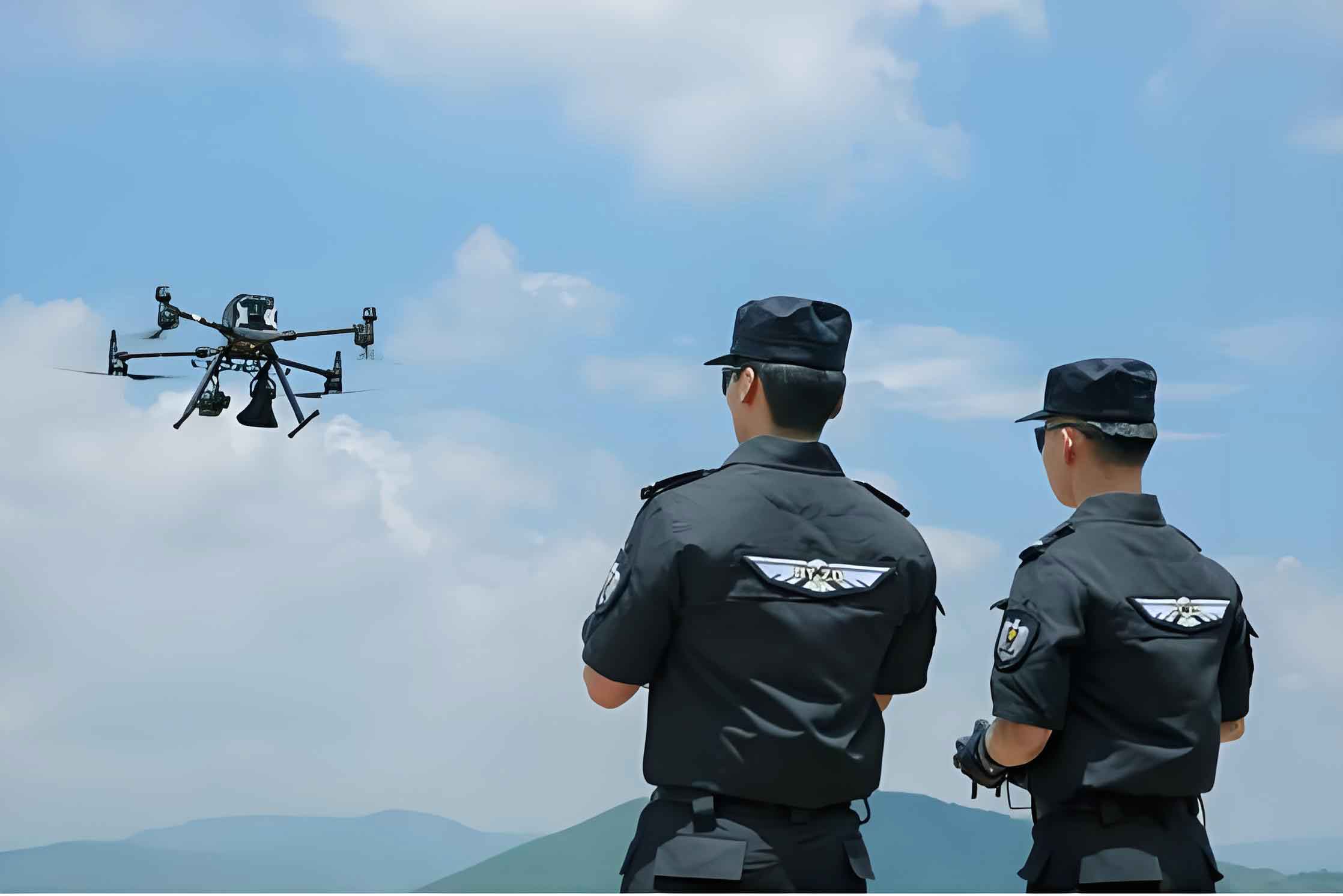
From my perspective, the value of police drones lies in their ability to extend policing into the aerial domain, enabling spatial governance that was previously unattainable. A police drone is not just a tool; it is a system that includes the unmanned aerial vehicle itself, control stations, and communication links. When deployed, police drones create a new layer of surveillance and intervention, making the skies a controllable space. This aligns perfectly with the three-dimensional system’s demand for omnipresent and omniscient coverage. In practice, I have seen police drones enhance situational awareness, accelerate response times, and reduce risks to officers.
The theoretical alignment between police drones and the three-dimensional system can be summarized in terms of functional and structural compatibility. Abstractly, police drones contribute to立体化 by providing temporal and spatial ubiquity, as shown in Table 1 below.
| Dimension | Three-Dimensional System Requirement | Police Drone Contribution |
|---|---|---|
| Temporal | Full-time coverage, no dead angles in time | Continuous patrols, day and night operations |
| Spatial | Full-space coverage, no dead angles in space | Aerial surveillance, access to hard-to-reach areas |
| Psychological | Deterrence and public awareness | Visible presence, communication via speakers |
| Virtual | Integration of physical and virtual societies | Data collection for digital twin建模, cyber-physical links |
Concretely, police drones enable diversified functions and integrated measures. For instance, a single police drone can be equipped with various payloads—such as cameras, sensors, or loudspeakers—to perform multiple tasks. This modularity allows police drones to adapt to different scenarios, from routine patrols to emergency responses. The energy release and feedback between police drones and the three-dimensional system create a耦合共进 relationship: police drones enhance system效能, while the system provides a framework for police drone development and validation.
To understand the application logic, I propose a model based on technological evolution. It begins with technology diffusion, where police drone technology spreads from economic to social and political domains. This can be modeled using the Bass diffusion formula:
$$ \frac{dN(t)}{dt} = p \left( M – N(t) \right) + q \frac{N(t)}{M} \left( M – N(t) \right) $$
Here, \( N(t) \) represents the number of adopters of police drones at time \( t \), \( M \) is the total potential market, \( p \) is the coefficient of innovation, and \( q \) is the coefficient of imitation. In the context of public security, \( M \) could be the total number of police units, and the diffusion drives the initial adoption of police drones.
Next, technology fusion occurs, where police drones integrate with other technologies like AI, IoT, and big data. This fusion enhances capabilities and leads to innovation. I view this as a combinatorial process where the overall utility \( U \) of a police drone system can be expressed as:
$$ U = \sum_{i=1}^{n} w_i f_i(x_i) + \sum_{i<j} $$=""
In this formula, \( f_i(x_i) \) represents the function of individual technologies (e.g., camera resolution), \( w_i \) are weights, and \( g_{ij}(x_i, x_j) \) captures synergy effects between technologies, with \( \alpha_{ij} \) as interaction coefficients. For police drones, fusion with AI improves object recognition, leading to autonomous operations.
Finally, technological innovation spurs social innovation, necessitating institutional frameworks for police drone deployment. This includes regulations, training protocols, and ethical guidelines. The transition from technology to society can be seen as a co-evolutionary process, where each innovation in police drones prompts adjustments in governance structures.
In terms of structural optimization, I advocate for a “peacetime-wartime integration” (平战结合) architecture that ensures全时性 application. This involves two mechanisms: routine collaborative patrols and rapid emergency response. For routine operations, police drones work in synergy with ground forces, forming an “air-ground协同” mechanism. This enhances efficiency and coverage, as shown in Table 2.
| Patrol Type | Traditional Approach | With Police Drones |
|---|---|---|
| Temporal Coverage | Shift-based, limited by human fatigue | 24/7 operations, unaffected by weather |
| Spatial Coverage | Ground-only, constrained by terrain | Aerial views, 3D mapping of areas |
| Action Form | Direct contact, potential risks | Non-contact, remote monitoring and interaction |
| Capability Diversity | Specialized units for different tasks | Multi-role police drones with swappable payloads |
Mathematically, the effectiveness \( E \) of such patrols can be modeled as:
$$ E = \int_{0}^{T} \left( \alpha A(t) + \beta G(t) \right) dt $$
where \( A(t) \) and \( G(t) \) represent aerial and ground patrol intensities at time \( t \), and \( \alpha, \beta \) are efficiency coefficients. Police drones increase \( A(t) \), leading to higher \( E \).
For emergency response, police drones enable quick deployment and situational control. They can be equipped with payloads like thermal cameras for search and rescue, or loudspeakers for crowd management. The response time \( R \) can be reduced significantly:
$$ R = \frac{D}{v} + t_{deploy} $$
Here, \( D \) is distance, \( v \) is speed of the police drone, and \( t_{deploy} \) is deployment time. Police drones, with high \( v \) and low \( t_{deploy} \), minimize \( R \), allowing faster intervention.
Furthermore, I propose a “intelligence-command-action integration” (情指行一体) scheme for全域性 application. This involves three modes: three-dimensional patrol for intelligence, synthetic command for decision-making, and cluster intelligence for action. In intelligence gathering, police drones provide panoramic surveillance, creating a Foucaultian panopticon effect that deters crime. The data collected can be processed using machine learning algorithms for anomaly detection.
For command, police drones feed real-time data into指挥 centers, enhancing situational awareness. The command efficiency \( C \) can be expressed as:
$$ C = \frac{I}{t_{process}} \times \eta $$
where \( I \) is information volume from police drones, \( t_{process} \) is processing time, and \( \eta \) is decision accuracy. With police drones, \( I \) increases and \( t_{process} \) decreases due to automation, boosting \( C \).
In action, police drones operate in clusters, exhibiting swarm intelligence. This is inspired by biological systems where simple agents collectively achieve complex tasks. The behavior of a police drone swarm can be modeled using Reynolds’ rules:
$$ \vec{F}_i = w_1 \vec{F}_{separation} + w_2 \vec{F}_{alignment} + w_3 \vec{F}_{cohesion} + \vec{F}_{goal} $$
Here, \( \vec{F}_i \) is the force on drone \( i \), with components for separation, alignment, cohesion, and goal-directed movement. Weights \( w_1, w_2, w_3 \) balance these behaviors. Police drone swarms can perform tasks like area saturation or coordinated strikes, with robustness from redundancy.
The application of police drones in this scheme is summarized in Table 3.
| Phase | Role of Police Drones | Key Technologies |
|---|---|---|
| Intelligence (情) | 3D patrols, real-time monitoring, data collection | High-resolution cameras, sensors, AI analytics |
| Command (指) | Data transmission, situational visualization, decision support | Communication links, GIS integration, dashboard interfaces |
| Action (行) | Swarm operations, targeted interventions,非致命 engagement | Swarm algorithms, payload delivery systems, autonomous navigation |
Looking ahead, I see several challenges and opportunities. The diffusion of police drone technology must be managed to avoid risks like privacy infringement or technical failures. Institutional innovations, such as standardized protocols and international cooperation, are needed to harness the full potential of police drones. Moreover, the integration of police drones with emerging technologies like 5G and blockchain could further enhance the three-dimensional system’s resilience.
In conclusion, police drones are pivotal in advancing the three-dimensional social security prevention and control system. Through the “peacetime-wartime integration” architecture and “intelligence-command-action integration” scheme, police drones provide全时性 and全域性 capabilities. As we move from scenario-based applications to institutional建构, police drones will continue to evolve, driven by technological and social innovations. I am confident that with thoughtful implementation, police drones will become indispensable tools in safeguarding our societies, making them smarter and safer for all.
To quantify the impact, consider a cost-benefit analysis where the net benefit \( B \) of deploying police drones is:
$$ B = \sum_{t=1}^{T} \frac{R_t – C_t}{(1 + r)^t} $$
Here, \( R_t \) are benefits (e.g., crime reduction, time savings) in period \( t \), \( C_t \) are costs (e.g., procurement, maintenance), and \( r \) is the discount rate. Empirical studies show that \( R_t \) often outweighs \( C_t \) for police drones, justifying their adoption.
Ultimately, the journey of police drones in public security is one of continuous improvement. By embracing innovation and fostering collaboration, we can ensure that police drones serve as force multipliers in the立体化 quest for social stability. Let us leverage these aerial allies to build a future where security is seamless, responsive, and inclusive.