
In recent years, I have closely observed the rapid development of drone technology, which has shown remarkable performance in both military and civilian applications. The characteristics of police drones, such as modularity, integration, diversity, flexibility, rapid deployment, and safety, determine their ability to adopt targeted tactics for different types of emergencies. By coordinating with public security agencies in unified actions, police drones significantly improve the efficiency and success rate of event handling, effectively avoiding casualties and economic losses. In this article, I will explore the technical and tactical methods of police drones in emergency response, focusing on their roles, types, and applications in various scenarios. The term “police drone” will be emphasized throughout to highlight its importance.
Under the current environment, while science and technology are flourishing, criminals are using more advanced means to engage in illegal activities, making the social security situation increasingly complex and posing significant challenges to law enforcement. Traditional methods for handling emergencies have shown limitations, as seen in various incidents, underscoring the urgent need for technological upgrades. Police drones, with their modular, diverse, comprehensive视野, and reliable features, fully meet the needs of police实战, compensating for shortcomings in emergency response. To support the active use of police drones by public security agencies, relevant standards have been established, but specific applications and tactics lack reference materials. Therefore, I will focus on three types of emergencies—terrorist attacks, mass incidents, and disaster accidents—to study the application and tactics of police drones.
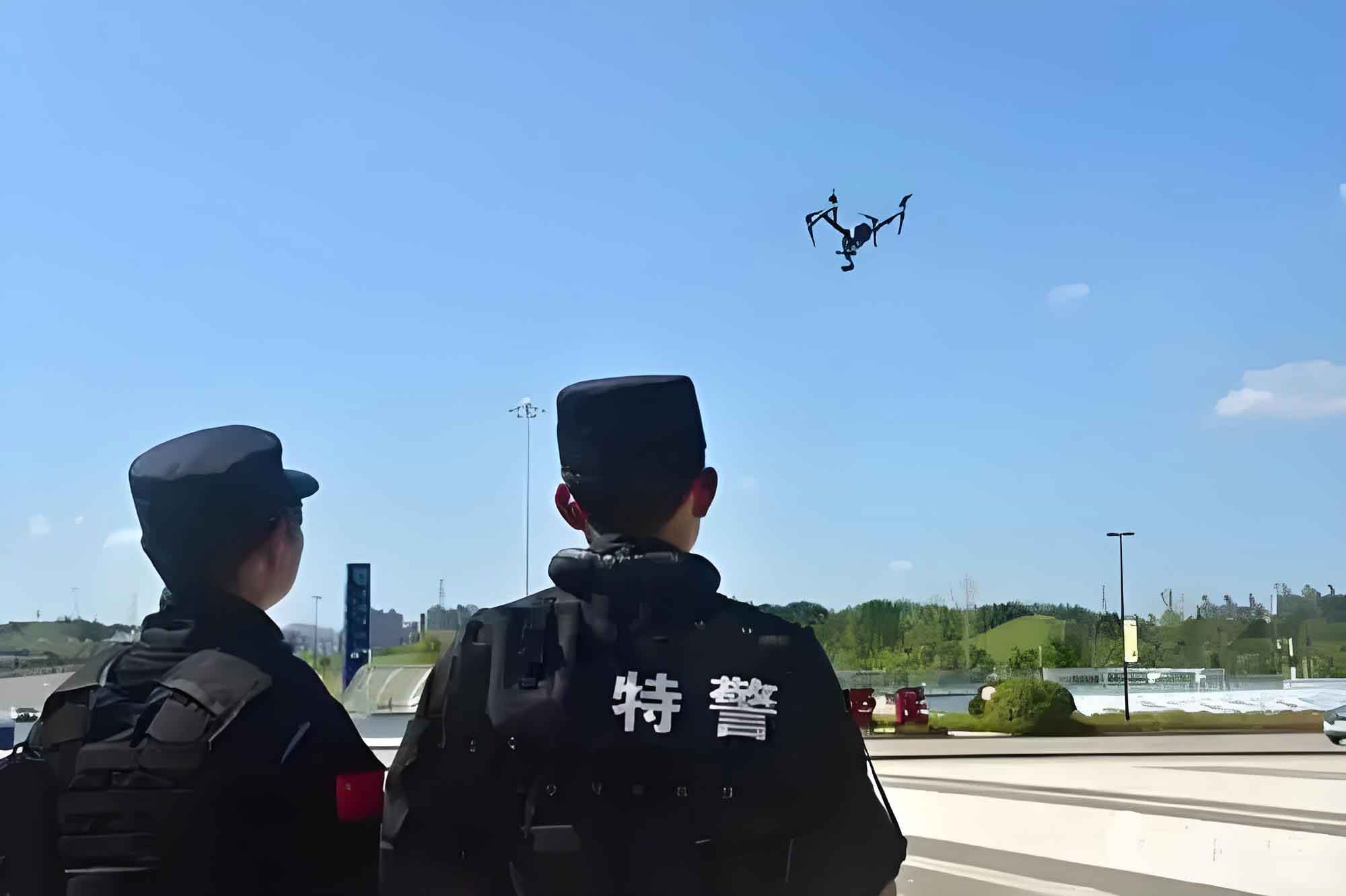
From my perspective, police drones have evolved from early military origins to become essential tools in law enforcement. A police drone refers to an aircraft used by public security agencies for policing activities, without an onboard pilot, including autonomous and遥控 aircraft, but excluding balloons or model planes. As a special equipment in the public security system, police drones have distinct features compared to civilian drones. To ensure support for various police units, police drones possess characteristics such as modularity and compatibility, integration, rapid deployment capability,隐蔽能力, and safety reliability. For example, modularity allows for quick assembly of functional modules based on task needs, while integration avoids redundancy. Rapid deployment is crucial for quick response, and隐蔽能力 enhances stealth in operations like arrests. Safety standards require rigorous testing for durability and secure communication.
Police drones can be categorized into three main types, as summarized in the table below. This classification helps in selecting the appropriate police drone for specific emergencies based on their advantages and disadvantages.
| Type | Advantages | Disadvantages | Applications |
|---|---|---|---|
| Unmanned Helicopter | Strong mobility, long endurance, high payload capacity | High vibration and noise, poor stability | Surveillance, patrol, supply delivery |
| Multi-rotor Drone | Vertical take-off and landing,定点悬停, high flexibility, simple operation, low maintenance cost | Short endurance, small payload | Surveillance, patrol,武力打击, supply delivery, communication relay |
| Fixed-wing Drone | Long endurance, high飞行高度, fast speed, large observation range | Poor rapid deployment, high requirements for take-off and landing sites | Surveillance, patrol, reconnaissance |
Based on these types, police drones play multiple roles in emergency response. I have identified five key functions: reconnaissance and evidence collection,巡逻监视,武力打击, supply delivery, and communication relay. These functions enhance the capabilities of public security agencies. For instance, in reconnaissance, a police drone equipped with cameras can provide real-time全貌 views, reducing risks to personnel. In巡逻监视, police drones with night-vision or infrared devices improve搜索 efficiency. For武力打击, police drones can be armed with non-lethal or lethal weapons to directly engage threats. Supply delivery via police drones is vital in remote areas, and communication relay ensures connectivity in signal-disrupted zones.
To quantify the efficiency gains from using police drones, I propose a simple formula for侦查覆盖率. The coverage area \(C\) achieved by a police drone over time \(t\) can be expressed as:
$$ C = v \times t \times w $$
where \(v\) is the drone’s speed, \(t\) is the operational time, and \(w\) is the effective scanning width. Compared to traditional methods, the efficiency ratio \(E\) can be defined as:
$$ E = \frac{T_{traditional}}{T_{drone}} $$
where \(T_{traditional}\) is the time required for traditional reconnaissance, and \(T_{drone}\) is the time with a police drone. Typically, \(E > 1\), indicating that police drones enhance efficiency. For example, if a police drone reduces reconnaissance time by 50%, then \(E = 2\), meaning it is twice as efficient. This highlights why police drones are increasingly adopted in emergencies.
Now, I will delve into the tactical methods for police drones in different emergencies. These tactics are based on my analysis of real-world scenarios and aim to provide theoretical guidance. The term “police drone” will be frequently used to reinforce its role.
Tactics for Mass Incidents
Mass incidents, often arising from social conflicts, involve large crowds and chaotic environments, posing challenges like information gaps and difficulty in evidence collection. Police drones can address these issues through phased tactics.
In the early stage, the goal is to quickly assess and control the situation. I recommend four tactics for police drones: global reconnaissance and information collection; monitoring and警戒配合封控;人数统计 and danger identification; and宣传喊话 for安抚疏导. For global reconnaissance, a police drone with high-resolution cameras provides comprehensive views, transmitting real-time audio-visual data. This allows警方 to understand the terrain, road conditions, and crowd dynamics. In monitoring, police drones patrol areas hard to access, assisting in setting警戒 lines and guiding机动警力. For人数统计, police drones with facial recognition modules can estimate crowd size and identify leaders, while danger识别 tools assess threats like weapons.宣传喊话 involves using扩音模块 on police drones to broadcast messages, combined with leaflet投放 to安抚群众. This multi-faceted approach prevents escalation.
In the中期 stage,强制措施 may be needed to prevent violence. Here, police drones employ three tactics:监控引导 for辅助抓捕;立体作战 for救援打击; and电磁干扰 for signal屏蔽. For监控引导, police drones track targets and guide抓捕小组, improving accuracy and safety.立体作战 involves police drones with强声 or强光模块 for靶向驱散, or投放模块 for precise催泪弹 delivery or medical supplies.电磁干扰 uses signal干扰模块 on police drones to block communication among agitators, preventing谣言传播. These tactics enhance operational effectiveness while minimizing risks.
In the后期 stage, after平息事态,善后处置 is crucial. Police drones use two tactics:侦查引导 for证据固定; and分片巡防 for警戒救助. For侦查引导, police drones collect evidence throughout the incident, providing proof for legal proceedings and countering谣言.分片巡防 involves dividing areas for police drone patrols to guide疏散 and assist in救援, such as投放急救物品. This ensures order and reduces casualties.
To summarize these tactics, I present a table for quick reference.
| Stage | Tactics | Key Functions | Expected Outcome |
|---|---|---|---|
| Early | Global reconnaissance, monitoring,统计识别,宣传喊话 | Reconnaissance, monitoring, identification, communication | Rapid assessment, crowd control, prevention of escalation |
| Mid | 监控引导,立体作战,电磁干扰 | Surveillance, non-lethal打击, signal jamming | Effective dispersal, arrest assistance, communication阻断 |
| Late | 侦查引导,分片巡防 | Evidence collection, patrol,救援 support | Evidence固定, orderly疏散, injury reduction |
Tactics for Counter-Terrorism Operations
Terrorist attacks are突发性 and highly destructive, requiring precise and efficient responses. Police drones offer advanced tactical methods in three phases:侦查搜索,封控攻心, and攻击捕歼.
In the侦查搜索 phase, the aim is to locate terrorists. I propose two tactics for police drones:划分区域协同搜索 and消音熄灯梯次搜索. For协同搜索, police drones work with ground teams in divided areas. The drone moves in an S-pattern ahead of personnel, ensuring no遗漏. The搜索效率 can be modeled with a formula for area coverage per unit time:
$$ A_{covered} = n \times (v_d \times t_d) + m \times (v_h \times t_h) $$
where \(n\) is the number of police drones, \(v_d\) is drone speed, \(t_d\) is drone time, \(m\) is the number of human searchers, \(v_h\) is human speed, and \(t_h\) is human time. With police drones, \(A_{covered}\) increases significantly. For梯次搜索 in confined spaces like buildings,微型警察 drones with夜视模块 are used, following a由下而上 sequence to minimize risk. This enhances safety and speed.
In the封控攻心 phase, after locating terrorists,封锁 and psychological warfare are key. Police drones use two tactics:巡逻监控悬停警戒 and喊话传书强声震慑. For巡逻监控, police drones continuously patrol封锁区域, providing real-time updates and replacing human patrols in dangerous zones.悬停警戒 involves hovering at choke points for 24/7 monitoring.喊话传书 uses扩音 and投放模块 on police drones to劝降 terrorists, while强声震慑 emits high-intensity noise to disrupt and demoralize them. This reduces the need for exposed personnel and increases psychological pressure.
In the攻击捕歼 phase, if劝降 fails, direct action is taken. Police drones employ two tactics:火力压制直接打击 and跟踪定位辅助打击. For火力压制, police drones equipped with武器模块, such as micro-guns or non-lethal震爆弹, engage terrorists. The effectiveness can be expressed as:
$$ P_{success} = 1 – e^{-k \cdot t} $$
where \(P_{success}\) is the probability of成功压制, \(k\) is a constant based on drone capability, and \(t\) is engagement time. With police drones, \(k\) increases, boosting \(P_{success}\). For辅助打击, police drones with tracking modules mark targets with荧光材料, aiding ground teams. These tactics improve成功率 and safety.
A table summarizes these counter-terrorism tactics.
| Phase | Tactics | Key Functions | Expected Outcome |
|---|---|---|---|
| 侦查搜索 | 区域协同搜索,梯次搜索 | Reconnaissance,搜索 assistance | Rapid location, reduced risk, comprehensive coverage |
| 封控攻心 | 巡逻监控,喊话震慑 | Surveillance, psychological warfare | Effective封锁, morale reduction,劝降 opportunities |
| 攻击捕歼 | 火力压制,跟踪辅助 | Direct打击, target marking | Quick neutralization, enhanced accuracy, minimal casualties |
Tactics for Disaster Accident Response
Disaster accidents, such as geological hazards, water incidents, and fires, are complex and unpredictable. Police drones assist in处置 through specialized tactics.
For geological hazards like landslides, police drones use two tactics:侦查搜索快速救助 and临时基站通信中继. In侦查搜索, police drones with infrared modules survey damaged areas, transmitting data to command centers. This solves access issues and speeds up assessment. The time saved in救援 can be calculated as:
$$ \Delta T = T_{access} – T_{drone} $$
where \(\Delta T\) is the time saved, \(T_{access}\) is the time for traditional access, and \(T_{drone}\) is the drone’s time. Often, \(\Delta T > 0\), enabling faster救助. Police drones also投放应急物品 like food or medicine to victims. For通信中继, police drones with communication modules act as临时基站, ensuring connectivity in信号中断 areas. This improves coordination and response效率.
For水域事故, such as drownings, police drones employ one tactic:高空侦测应急救援. Police drones with cameras quickly scan large water areas, guiding救援 vessels to targets. They can also投放救生圈 to溺水者, extending survival time. The搜索率 \(R\) can be defined as:
$$ R = \frac{A_{scanned}}{A_{total}} \times 100\% $$
where \(A_{scanned}\) is the area scanned by police drones, and \(A_{total}\) is the total search area. With police drones, \(R\) approaches 100% faster, enhancing救援成功率.
For消防灭火, police drones use one tactic:近火侦查灭火救援. Police drones with thermal imaging approach fire scenes to identify火点 and hazards, despite heat and smoke. They can also carry灭火装备 like water bombs or fire-resistant gear for trapped individuals. This reduces risks to firefighters and improves灭火效率.
The table below outlines these disaster response tactics.
| Disaster Type | Tactics | Key Functions | Expected Outcome |
|---|---|---|---|
| Geological Hazards | 侦查搜索,通信中继 | Reconnaissance, supply delivery, communication relay | Rapid assessment, timely救助, restored communication |
| Water Incidents | 高空侦测应急救援 | Surveillance, life-saving投放 | Improved搜索率, extended survival time, efficient救援 |
| Fires | 近火侦查灭火救援 | Fire detection,灭火 support,救援 assistance | Early hazard identification, enhanced灭火, reduced firefighter risk |
In conclusion, from my perspective, police drones are transformative tools in emergency response. Their modular design, diverse capabilities, and tactical adaptability make them invaluable for public security agencies. By employing the tactics discussed—for mass incidents, counter-terrorism, and disaster accidents—police drones enhance efficiency, safety, and success rates. The repeated use of “police drone” in this article underscores its centrality in modern law enforcement. As technology advances, I believe police drones will continue to evolve, offering even more sophisticated solutions for handling emergencies. Future research could explore integration with AI or swarm tactics, but for now, the existing技战法 provide a solid foundation. I hope this analysis contributes to the broader adoption and effective use of police drones worldwide.
To further illustrate the impact, consider the cost-effectiveness of police drones. The overall benefit \(B\) can be expressed as a function of reduced time, saved lives, and economic gains:
$$ B = \alpha \cdot \Delta T + \beta \cdot L + \gamma \cdot E $$
where \(\alpha\), \(\beta\), and \(\gamma\) are weighting factors, \(\Delta T\) is time saved, \(L\) is lives saved, and \(E\) is economic损失 avoided. With police drones, each term increases, justifying their deployment. In summary, police drones are not just gadgets but essential assets in the public security arsenal, and their tactical applications, as I have detailed, are critical for contemporary emergency response strategies.